


























Quick Field Data
- UNESCO Inscription: 1985 · Criterion (iii).
- Scale & Footprint: 45 sites distributed across five areas (Kåfjord alongside Hjemmeluft together with Storsteinen, Amtmannsnes, and Transfarelvdalen) in Alta Municipality, Finnmark, Norway.
- Access & Ticketing: Managed by the Alta Museum at Hjemmeluft; check the official site for seasonal boardwalk access over the carvings.
- Arrival Logistics: Situated at the head of the Alta Fjord far north of the Arctic Circle in Finnmark county, along northern Norwegian coastal routes from Tromsø.
Post-Glacial Land Upheaval and Chronological Terraces
From 1985, the UNESCO World Heritage Atlas in 1985 under Criterion (iii), the Rock Art of Alta preserves the largest concentration of prehistoric hunter-gatherer rock carvings and paintings in northern Europe. Carvings line the uplifted shore. Located in northernmost Norway well above the Arctic Circle around the head of the Alta Fjord in Alta Municipality, Finnmark county (and frequently visited on Arctic Norwegian journeys extending north-east from Tromsø), the World Heritage site comprises thousands of engravings and paintings distributed across 45 individual sites in five distinct fjord-head localities: Kåfjord alongside Hjemmeluft together with Storsteinen, Amtmannsnes, and Transfarelvdalen.
Human settlement around the small bay of Hjemmeluft in the Altafjord dates from around 11,000 years ago, representing one of the earliest documented settlement zones in Finnmark. In 1973, the first prehistoric rock carvings at Hjemmeluft were discovered on the glacially smoothed coastal rocks. Since that initial 1973 discovery, more than 3,000 individual figures have been registered at Hjemmeluft alone, while over 6,000 figures have been registered across Alta Municipality as a whole. Created over thousands of years (described in UNESCO records both as bearing traces of a settlement dating from circa 4200 to 500 BC and as spanning from approximately 5000 BC to about the year 0), this unmatched density of prehistoric rock art indicates that for millennia Alta functioned as an important seasonal meeting place for hunter-gatherer communities far north of the Arctic Circle.
What gives the development of the carvings in Alta its chronological clarity for northern European prehistory is their direct physical link to post-glacial land upheaval. As the coastal landscape rose steadily out of the sea following the retreat of the glacial ice sheets, prehistoric carvers consistently worked on the smooth shore rocks near the water's edge. Because of this continuous post-glacial uplift, the earliest panels occupy the highest elevations of the landscape, whereas progressively younger carvings sit on lower rock terraces stepping down toward the modern fjord. In Alta, the changing prehistoric landscape remains visible on the ground, and the elevation of each rock panel provides a reliable key for dating circumpolar rock art across the Far North.
Across the five designated areas (Kåfjord alongside Hjemmeluft together with Storsteinen, Amtmannsnes, and Transfarelvdalen), both rock carvings pecked into the stone surface and painted figures survive along the head of the fjord. By comparing panels situated at high elevations from around 5000 or 4200 BC with those carved closer to the shoreline toward 500 BC and the year 0, archaeologists can observe how carving techniques alongside boat designs together with hunting methods and ritual motifs evolved step by step as the Alta Fjord shoreline retreated downward over five millennia.
This vertical separation across the coastal terraces means that a walk from the upper hillside down to the modern bay of Hjemmeluft is simultaneously a walk forward through prehistoric time. No later carving phase overwrote the earliest upper panels because the rising land continually shifted the active shoreline zone lower down the slope, preserving each era's artistic style on its own coastal terrace.
Alta contains a greater concentration of hunter-gatherer rock art than any other site in northern Europe. Because the carvings and paintings were executed across 45 distinct sites around the head of the Alta Fjord over a 5,000-year span, the panels record long-term environmental change as the post-glacial fjord landscape rose and prehistoric communities adapted their seasonal hunting and fishing strategies along the Arctic coast.
Hunter-Gatherer Micro-Landscapes and Cosmology
Throughout the 45 sites around the Alta Fjord, these thousands of paintings and engravings expand our understanding of the prehistoric environment and human life on the northernmost fringes of Europe. Unlike many prehistoric art zones where isolated animal outlines predominate, the Rock Art of Alta is distinguished by a high proportion of human figures alongside vivid depictions of prehistoric social life together with communal dancing, processions, and collective rituals.
Across Norway, during this period, the panels provide a vivid testimony to the everyday interaction of hunter-gatherers with the Arctic landscape and sea. Individual rock surfaces depict terrestrial hunting scenes alongside marine fishing and boat journeys across the fjord. Because the prehistoric artists arranged these scenes of hunting alongside fishing together with boat voyages and animal herds across the natural undulations, cracks, and basins of the bedrock, researchers interpret the panels as miniature micro-landscapes that map the real-world geography of the fjord alongside coastal terraces and inland hunting grounds.
Beyond daily subsistence, the Rock Art of Alta gives deep insight into the cosmology and spiritual beliefs of prehistoric northern hunters and gatherers. Many panels illustrate communication linking the world of the living with the spirit worlds, showing human figures engaged in ritual dances and ceremonies that bound the social order of the hunting bands to the seasonal cycles of the Arctic environment.
Together, these narrative compositions show how Arctic communities organised collective hunting drives on land and coordinated multi-paddler boat expeditions on the fjord while gathering at the head of the Alta Fjord for seasonal ceremonies that united dispersed hunter-gatherer bands across northern Norway.
Hjemmeluft Bay and the Alta Museum
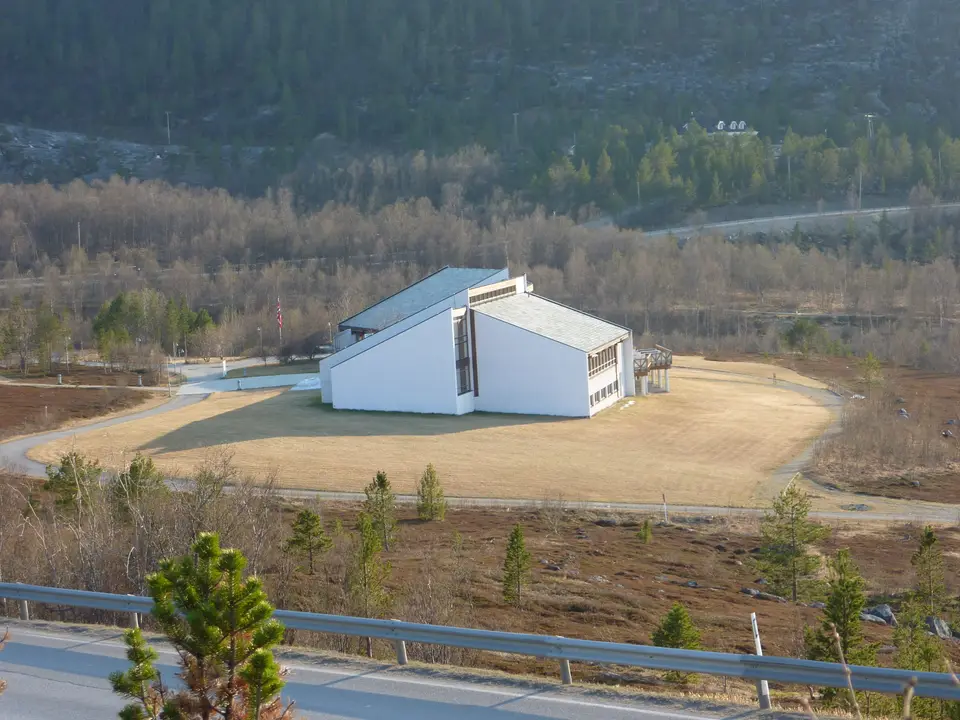
Visitor access alongside conservation research and public interpretation is centred at Hjemmeluft, a small bay in the Altafjord where the Alta Museum (officially the World Heritage Rock Art Centre, or Verdensarvsenter for bergkunst) sits directly beside the open-air carving fields. Opened in June 1991, the Alta Museum received the 1993 European Museum of the Year Award in recognition of its architecture alongside its research and presentation of Arctic heritage.
Today, Alta Museum ranks as northern Norway's most-visited summer museum, welcoming more than 1,000 visitors each day during the summer season, and ranks as Finnmark county's second most visited attraction. Inside, the museum presents exhibitions on local Finnmark culture and historic northern industries alongside full documentation of the prehistoric rock art. Outside the museum building, a network of footpaths and wooden walkways guides visitors across the coastal rock slopes of Hjemmeluft to view the more than 3,000 registered figures in their natural fjord-side setting while preserving the remaining sites at Kåfjord alongside Storsteinen together with Amtmannsnes and Transfarelvdalen.
Walking the wooden pathways at Hjemmeluft allows visitors to examine how prehistoric hunter-gatherers used every ridge and hollow of the shore rock to stage scenes of reindeer hunting alongside boat journeys together with fishing and ritual processions overlooking the waters of the Altafjord. From the earliest carvings pecked along the high post-glacial shorelines around 5000 or 4200 BC down to the youngest panels near the modern bay from around 500 BC to the year 0, the Hjemmeluft trail offers a direct encounter with five millennia of circumpolar hunter-gatherer life and belief far north of the Arctic Circle. Travellers continuing north-east from Tromsø into Finnmark county can walk these boardwalks above the Alta Fjord to see how 6,000 registered figures chronicle the changing Arctic shoreline from 11,000-year-old settlement layers to the start of the first millennium AD. By linking indoor exhibitions at the 1991 World Heritage Rock Art Centre with outdoor trails over the uplifted coastal rock slopes, Hjemmeluft makes northern Europe's richest prehistoric rock art landscape directly accessible to summer visitors.
- 45 Sites in Five Areas: Explore the UNESCO serial landscape encompassing over 6,000 registered figures across Kåfjord alongside Hjemmeluft together with Storsteinen, Amtmannsnes, and Transfarelvdalen at the head of the Alta Fjord.
- Post-Glacial Upheaval Chronology: Follow the elevation of the rock panels from the highest points of the landscape down toward the fjord to trace carvings dating from approximately 5000 or 4200 BC to 500 BC and the year 0.
- 1993 European Museum of the Year: Visit the Alta Museum at Hjemmeluft (opened in June 1991), where exhibitions on local culture and historic industries complement outdoor trails over 3,000 prehistoric figures.
