


























Quick Field Data
- UNESCO Inscription: 1985 (placed on the List of World Heritage in Danger in 2016), inscribed for its concentration of prehistoric Saharan cave paintings and rock carvings documenting twelve millennia of environmental and cultural change.
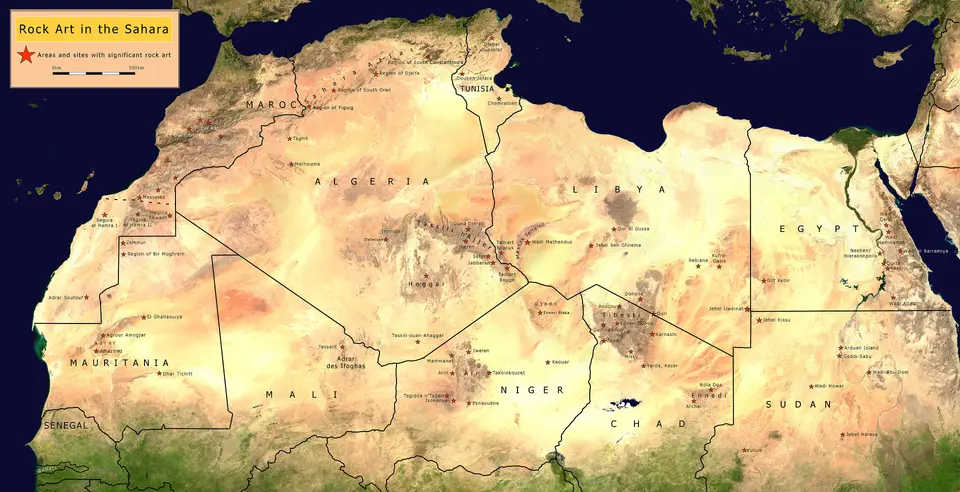
- Scale & Footprint: Stretches for roughly 100 kilometres (62 miles) north from the border with Algeria inside the Ghat District of southwestern Libya, directly east of the oasis city of Ghat.
- Access & Ticketing: Situated in a remote desert mountain range requiring four-wheel-drive vehicles and experienced local desert guides alongside travel permits; check the official site and international travel advisories before planning any expedition.
- Arrival Logistics: Located in the Fezzan region of western Libya adjacent to Algeria's Tassili n'Ajjer massif, historically accessed from the desert gateway town of Ghat.
Rising out of the hyper-arid sand seas and gravel plains of the Ghat District in southwestern Libya, the Rock-Art Sites of Tadrart Acacus (also spelled Tadrart Akakus) form a 100-kilometre sandstone mountain range that shelters one of the richest open-air archives of prehistoric art in the desert. Across Libya, the UNESCO World Heritage Atlas in 1985 and bordering the contiguous protected Tassili n'Ajjer massif across the frontier in Algeria, this desert massif preserves thousands of rock paintings and stone engravings created between roughly 12,000 BC and AD 100. Across natural rock shelters and wind-sculpted sandstone arches alongside deep wadi canyons, these images chronicle the dramatic transformation of the central Sahara from a green savannah teeming with elephants and giraffes into the hyper-arid desert seen today. Wind-carved sandstone arches frame the desert horizon.
Berber Etymology and the African Humid Period in Holocene Adaptation
In the local Berber languages of the indigenous desert peoples who inhabit the southwestern Libyan desert, the word Tadrart is the feminine form of adrar, meaning mountain. Today, the Tadrart Acacus range presents a stark desert topography of multicoloured sand dunes and isolated dark sandstone pillars alongside natural rock arches, including the monumental arches of Afzejare and Tin Khlega, and deep dry ravines (wadis) such as the Wadi Teshuinat, where scattered desert springs and rock wells alongside hardy medicinal shrubs like Calotropis procera survive minimal rainfall.
Archaeological and palaeoenvironmental excavations conducted across cave and rock-shelter sites such as Ti-n-Torha Two Caves and Uan Muhuggiag reveal that the Acacus Mountains were continuously occupied by human communities throughout the Holocene epoch during the African Humid Period. When monsoon rains shifted northward during the early Holocene, the valleys and lowland basins of the Fezzan filled with perennial lakes and streams alongside grasslands. Rather than adopting sedentary crop agriculture, prehistoric inhabitants of the Acacus adapted to fluctuating climatic cycles through specialized foraging and wild grain processing alongside early pastoralism.
Stratigraphic research divides this Holocene human occupation into three primary cultural horizons. During the humid Early Acacus phase (roughly 9810 to 8880 BP), small mobile bands of hunter-gatherers camped along valley floors and lakeside margins. As conditions grew drier during the Late Acacus period (roughly 8870 to 7400 BP), larger and more sedentary communities settled inside sheltered mountain valleys, intensifying the harvesting and storage of wild grasses and making extensive use of stone grinding tools and early ceramic vessels. With the return of moister conditions during the Pastoral Neolithic (beginning around 7000 BP), communities adopted domesticated cattle and flocks, increasing their seasonal mobility across the mountain pastures while reducing their reliance on grinding stones. Radiocarbon analysis of ceramic sherds from Tadrart Acacus has identified the earliest known appearance of processed dairy milk lipids in Africa, dated to 7,500 BP, decisive chemical proof of early Saharan dairying.
Twelve Millennia of Saharan Rock Paintings and Engravings
What makes the Tadrart Acacus globally celebrated is the visual record left by these successive foraging and pastoralist populations on the walls of hundreds of sandstone rock shelters between 12,000 BC and AD 100. Executed in diverse stylistic phases using mineral pigments of red and yellow ochre and white clay and charcoal alongside deeply pecked and polished stone engravings, the rock art mirrors the shifting fauna and flora alongside social rituals of the central Sahara over more than twelve thousand years.
The earliest naturalistic engravings and paintings depict the large wild megafauna of the green Sahara: herds of giraffes and elephants alongside ostriches roaming through watered valleys. During the subsequent Pastoral Neolithic centuries, the rock shelters fill with lively polychrome paintings of domesticated long-horned and dappled cattle alongside herders tending their flocks and intimate scenes of daily camp life, people playing musical instruments, dancing in ritual ceremonies or hunting with bows while gathering around huts. A celebrated fourth-millennium BC composition from around 4000 BC depicts a funerary boat carrying a group of figures (one shown upside down), a motif that later inspired modern Libyan painter Shefa Salem's work Funeral Ritual in the Acacus.
As the African Humid Period ended and progressive desiccation dried up the lakes and savannahs over the final millennia BC, the artistic repertoire shifted once again. Horse-drawn chariots, warriors bearing spears and shields, and finally dromedary camels accompanied by early Berber inscriptions appear across the rock faces, recording the arrival of desert caravan routes and the establishment of the hyper-arid Saharan environment that persists around Ghat today.
Conservation Threats, Vandalism, and Navigating the Wadi Canyons
Along with Libya's four other UNESCO World Heritage properties, Cyrene, Leptis Magna, Sabratha, and the oasis town of Ghadames, the Rock-Art Sites of Tadrart Acacus were placed on the List of World Heritage in Danger in 2016 due to severe conservation challenges and regional instability. Starting in 2005, underground petroleum exploration in the surrounding desert utilized heavy seismic hammers to send shock waves into the bedrock, threatening the fragile sandstone overhangs. Between 2009 and 2014, UNESCO State of Conservation reports and field missions in May 2013 documented deliberate vandalism at multiple rock-art shelters, where individuals carved graffiti names and prehistoric panels or used chemical products and scrub brushes alongside sledgehammers to deface ancient paintings, prompting a joint Libyan and Italian conservation and staff-training initiative based near Ghat and Uweynat.
Walking along the sandy beds of the desert wadis at the base of the sandstone cliffs reveals how closely prehistoric human settlement in the Sahara was tied to shifting water resources. Every sheltered overhang and wind-sculpted rock arch in the Tadrart Acacus functioned as a seasonal gathering place where hunter-gatherers and later cattle pastoralists recorded their surroundings in mineral pigment and incised stone. From the earliest depictions of elephants alongside ostriches and giraffes to the later panels showing herds of domesticated cattle, music, dancing, and horses, the rock shelters preserve an unbroken visual chronicle of human adaptation across twelve millennia of environmental change in the Ghat District of western Libya.
Preserving these open-air galleries amid the extreme heat and wind erosion of the Sahara requires ongoing cooperation between local desert communities and international conservation specialists. As visitors move between the colored dunes, isolated rock pillars, and deep ravines of the 100-kilometre mountain range, observing the paintings from a respectful distance ensures that this fragile prehistoric archive endures for future generations.
Visiting the wadis and rock shelters of the Tadrart Acacus requires careful logistical preparation and strict adherence to desert conservation ethics. Travelling across the sandstone valleys near Ghat with licensed local guides reveals how the engraved wadis and painted rock shelters record thousands of years of ecological change across the Sahara, turning the dry mountain gorges of Fezzan into an extraordinary visual archive of prehistoric North Africa.
- Travel only with experienced local desert guides from Ghat: Because the 100-kilometre mountain massif lacks paved roads or signposts, all travel through wadis such as Wadi Teshuinat and past the arches of Afzejare and Tin Khlega must be arranged with experienced local four-wheel-drive desert guides who know the rock shelters and wells.
- Never touch, wet, or trace prehistoric rock paintings: Skin oils and water permanently accelerate the flaking of mineral ochre pigments and destroy the microscopic surface patina that has preserved the art since 12,000 BC.
- Verify security advisories and permit rules before departure: Given the site's status on the List of World Heritage in Danger and border security restrictions in the Ghat District near Algeria, check current government travel advisories and antiquities department regulations before planning any desert journey.
