


























Quick Field Data
- UNESCO Inscription: 1982 · Criterion (iii) · On the Danger List since 2016.
- Scale & Footprint: Coastal Phoenician, Punic as well as Roman harbour city at 10 metres elevation on the Mediterranean shore of Zawiya District in western Tripolitania
- Access & Ticketing: Encompasses the Roman Forum, three-storey Theatre, seaside and theatre baths alongside an adjacent archaeological museum; coastal erosion and regional security conditions require advance local verification
- Arrival Logistics: Situated on the Mediterranean coast of western Libya in Zawiya District (formerly capital of Sabratha wa Sorman District from 2001 to 2007), approximately 70 km (43 miles) west of modern Tripoli
From the Phoenician Emporium of Tsabratan to the Severan Orthogonal Grid
Set on the Mediterranean shoreline of western Libya in the Zawiya District about 70 kilometres (43 miles) west of modern Tripoli at an elevation of 10 metres around coordinates 32.8053 N and 12.4850 E, the Archaeological Site of Sabratha (known in Arabic as Ṣabrāta and in variants as Sabratah or Siburata, where the modern town recorded 102,038 residents in 2004 with area code 24) formed the western anchor of ancient Tripolis together with Oea and Leptis Magna. Carved theatre columns face the sea here. Since 1982, the UNESCO World Heritage List in 1982 under Criterion (iii) and placed on the List of World Heritage in Danger from 2016 onward, the coastal port owed its rise to a small natural harbour fairly well sheltered from westerly winds that served as a vital Mediterranean outlet for olive oil and exotic goods from the African hinterland.
Archaeological excavations beneath the later Roman levels have uncovered traces of the earliest Phoenician village, established around 500 BCE toward the close of the fifth century BCE as a Phoenician trading post (emporia) named Tsabratan (written in Punic as ṣbrtn or ṣbrtʿn, a name of probable Berber origin studied in Mansour Ghaki's 2015 epigraphic research that points to an earlier native settlement). Founded a century after Leptis Magna as the latest of the three Phoenician trading posts in Tripolitania and known to the Greeks as Sabrata, Sabaratha, or Abrotonon (catalogued in Barclay Head's 1911 Historia Numorum), the early settlement left behind an irregular, organic street network around the harbour alongside a Punic cemetery filled with carved stone votive stelae honouring the goddess Tanit.
As Carthaginian influence grew across Tripolitania, builders erected the earliest stone structures at Sabratha during the late fourth century BCE, followed by substantial urban expansion in the second century BCE when Carthage's wars with Rome fostered greater local economic independence. After the Punic Wars, Sabratha passed briefly into Massinissa's Numidian Kingdom before Rome integrated the city into the province of Africa Nova (New Africa) in 46 BCE.
After a destructive first-century CE earthquake accelerated urban renewal, Roman planners replaced the irregular Phoenician street pattern in the newer quarters with a regular orthonormal grid while preserving parts of the older harbour layout and reinforcing the port with an artificial breakwater pier. When Emperor Septimius Severus, born in nearby Leptis Magna, founded the Severan dynasty, Sabratha entered its monumental golden age across the 2nd and 3rd centuries CE, expanding to nearly twice its previous size.
The Three-Storey Roman Theatre, Imperial Temples as well as Seaward Bath Mosaics
The architectural nucleus of imperial Sabratha clusters around the rectangular Roman Forum near the shore, bordered by the basilica and the Temple of Serapis alongside the Temple of Liber Pater and the coastal Temple of Isis. In 186 AD, Emperor Commodus dedicated a monumental podium temple in Sabratha honouring Hercules and his father, Marcus Aurelius, enclosed by porticoes and southern apsidal chambers whose lower walls were clad in marble and whose painted upper registers depicted Commodus borne to heaven on the wings of an eagle in the western apse and an armed Dea Roma in the eastern apse.
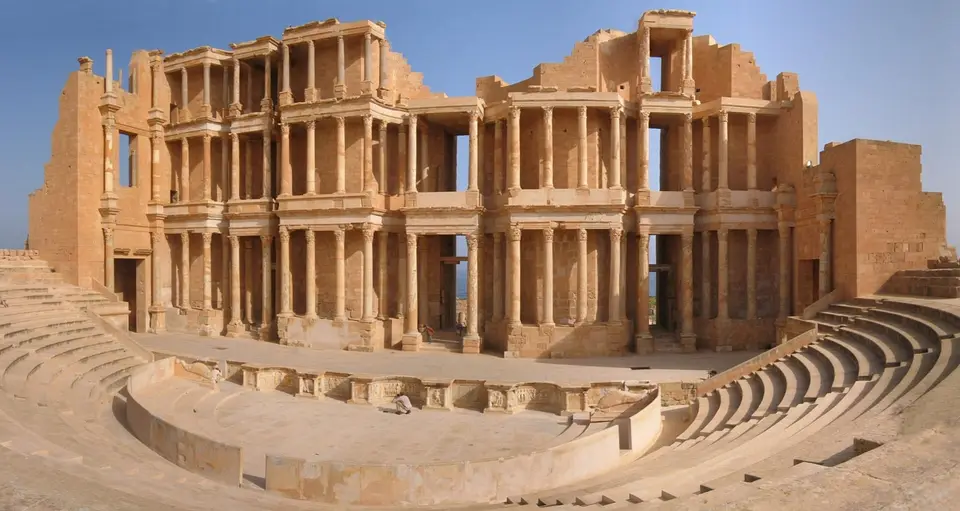
Towering east of the forum is the Ancient Theatre of Sabratha, the monument that defines the city's skyline. Celebrated for its reconstructed three-storey architectural stage backdrop (scaenae frons) of superimposed marble and sandstone columns and sculpted pulpitum relief panels (analysed in María Isabel Rodríguez López's 2017 iconographic study), the theatre was even considered by the Beatles as a possible venue for their final live concert as recounted in Peter Jackson's 2021 documentary The Beatles: Get Back before the band played on their Apple Corps rooftop instead.
Surrounding the public monuments are elite North African residences and bath complexes famous for their mosaic pavements. Polychrome geometric and figurative patterns survive directly above the shoreline in the Seaward (or Forum) Baths, while crisp black-and-white mosaic floors pave the Theatre Baths near the auditorium. Badly damaged by fourth-century earthquakes, above all the catastrophe of 365 CE alongside partially abandoned after falling to the Vandal kingdom in the 5th century, Sabratha experienced a modest Byzantine revival under Byzantine rule when builders erected a smaller defensive wall and multiple churches, including a Christian basilica from the time of Emperor Justinian floored with rich polychrome mosaics, before trade shifted elsewhere within a century of the Muslim conquest of the Maghreb.
Excavated systematically from 1921 onward by Italian archaeologists and between 1948 and 1951 by a British archaeological team directed between 1948 and 1951 by John Ward-Perkins and Dame Kathleen Kenyon (documented in Philip Kenrick's 1986 monograph alongside Joyce M. Reynolds's 1952 and 2009 epigraphic volumes Inscriptions of Roman Tripolitania, Kenneth D. Matthews's 1957 study Cities in the Sand as well as Philip Ward's 1970 guide, while during the Second World War in 1943 archaeologist Max Mallowan, who was married to novelist Agatha Christie, lived in a seaside Italian villa at Sabratha overseeing grain rations for the Western Province of Tripolitania), the ancient ruins have been studied for over a century. However, as an April 2016 conservation report documented, the soft coastal rock, sand, and porous calcarenite building stone face severe marine spray weathering, winter storm waves as well as coastal erosion that have crumbled sections of the harbour, olive press building, and public baths behind inadequate offshore breakwaters.
Walking the Forum Temples, the Seaward Baths, and the Theatre Stage
Located in a hot semi-arid climate zone (Köppen BSh) beside modern Sabratha (home to Sabratha University and the Wefaq Sabratha football club at Sabratha Stadium), the coastal archaeological park can be walked in a logical loop from the older Punic and Forum core by the sea to the eastern Theatre quarter and on-site museum.
- Forum precinct, Temple of Liber Pater, and the Seaward Baths: Enter near the ancient harbour and artificial pier to trace the superimposed Phoenician and Roman layers around the Forum, framed by the podiums of the Temple of Serapis, the Temple of Liber Pater, and the 186 AD temple dedicated by Emperor Commodus to Hercules and Marcus Aurelius. Step north to the edge of the Mediterranean shore to inspect the coloured floor patterns of the Seaward (Forum) Baths and the mosaic floors of the Christian basilica from the time of Justinian, noting how winter storms, marine spray, and coastal erosion documented in April 2016 threaten the soft calcarenite stone of the public baths, the olive press building, and the ancient harbour behind its small breakwaters.
- Three-storey Theatre of Sabratha, Theatre Baths, and the Temple of Isis: Follow the orthogonal grid streets east to the Roman Theatre to walk through the semicircular seating tiers and examine the carved marble reliefs and three-storey columned stage backdrop facing the sea. Beside the auditorium, inspect the black-and-white mosaic pavements of the Theatre Baths before continuing to the coastal promontory where the colonnaded Temple of Isis stands directly above the surf.
- On-site museum treasures and western Tripolitania logistics: Conclude your visit at the adjacent Sabratha Museum, which curates Punic stelae of the goddess Tanit, wall frescoes from the apses of the Commodus temple, statuary, and Byzantine mosaics (with additional finds housed in the national museum in Tripoli 70 km to the east). Because the archaeological site of Sabratha preserves both the irregular Phoenician street network of Tsabratan and the orthonormal Roman grid of the 2nd and 3rd centuries CE within a single coastal landscape 70 km west of Tripoli, check current travel conditions in Libya before planning a trip and consult our UNESCO World Heritage Atlas to connect Sabratha with Leptis Magna.
