


























Quick Field Data
- UNESCO Inscription: 1982 · Criteria (i), (ii), (iii).
- Scale & Footprint: Extensive coastal Roman metropolis and artificial harbour complex where the Wadi Lebda reaches the coast of Tripolitania, buried beneath protective sand dunes after the 7th century AD
- Access & Ticketing: Located within modern Al-Khums and overseen by the Libyan Department of Antiquities with an on-site museum housing the Wadi Lebda villa mosaics; check regional travel advisories before visiting
- Arrival Logistics: Situated on the Mediterranean coast of western Libya inside Al-Khums, 130 km (81 miles) east of Tripoli
Wadi Lebda Hydraulic Engineering and the Severan Imperial Makeover
Situated on the Mediterranean shoreline of Tripolitania where the Wadi Lebda meets the Mediterranean within present-day Al-Khums, 130 kilometres (81 miles) east of Tripoli at coordinates 32.6383 N and 14.2931 E, the Archaeological Site of Leptis Magna (also spelled Lepcis Magna and known in Arabic as Libda al-Kubrā or Labdah, in Italian as Lepti Maggiore as well as in Ancient Greek as Léptis Megálē or Neápolis) preserves one of the best-preserved and most monumental cities of the Roman Empire. Sand dunes protected imperial marble here. Entered onto the UNESCO World Heritage List in 1982 at the 6th session under Criteria (i), (ii) alongside (iii), the city evolved from a Phoenician and Carthaginian trading port into a third-century AD Roman metropolis of roughly 100,000 inhabitants whose public architecture rivalled Rome itself.
Originally founded during the late 7th century BCE as a Phoenician trading port (with earliest Iron Age activity traced to 1000 BC and a 4th- to 3rd-century BC Punic necropolis excavated directly beneath the later Roman theatre), the settlement bore the Punic name lpq or lpqy, linked to the Semitic root lfq meaning to build or piece together. Powerful enough around 515 BC to repel Dorieus when he attempted to plant a Greek colony nearby, Leptis became a key city of the Carthaginian Empire before passing into the Roman sphere after the Punic Wars. During the Jugurthine War in 111 BC, Leptis sent envoys to the Roman Senate for an alliance, receiving four cohorts under consul Quintus Caecilius Metellus Numidicus in 107 BC and retaining autonomy as a civitas foederata and later a civitas libera et immunis that minted silver and bronze coins bearing Punic legends alongside images of Hercules and Dionysus.
Backed by fertile hinterland farmlands dotted with excavated olive presses (which by 46 BC enabled the city to pay Julius Caesar an annual tax of three million pounds of olive oil) alongside trans-Saharan caravan trade in ivory, gold dust, carbuncle, ebony wood, ostrich feathers as well as wild beasts for gladiatorial arenas, Leptis retained its Punic chief magistrates (two suphetes), minor magistrates (mhzm), sacred officials (addir ararim and nequim elim) alongside fifteen-member sacred college under Augustus. Formally incorporated into the Roman province of Africa under Tiberius, the city gained an amphitheatre under Nero, was elevated to a municipium in AD 64 or 65, became a colonia named Ulpia Traiana under Emperor Trajan (reigned 98 to 117) as well as produced its first known Christian bishop, Victor, who became pope in 189.
Leptis Magna reached its zenith after AD 193 when its native son Septimius Severus (reigned 193 to 211), born into a wealthy local family of equestrian rank, ascended the imperial throne. Favoring his hometown above all other provincial cities, Severus expanded the southern frontier defences of the Limes Tripolitanus toward Garama, visited the city with the imperial family in 205 AD, granted the citizens the tax-exempt ius Italicum (styling them Septimiani) alongside funded a vast urban transformation documented in J. B. Ward-Perkins's 1993 architectural survey that made Leptis the third-largest port in the Roman Mediterranean. At the mouth of the Wadi Lebda, Roman engineers created a masterpiece of hydraulic technology: an artificial harbour basin flanked by warehouses, ateliers as well as signal towers, protected from silting by an upstream barrage and diversion canal that redirected the seasonal floods of the Wadi Lebda around the town.
The Severan Forum, Basilica as well as Arch and the 2000 Gladiator Mosaic
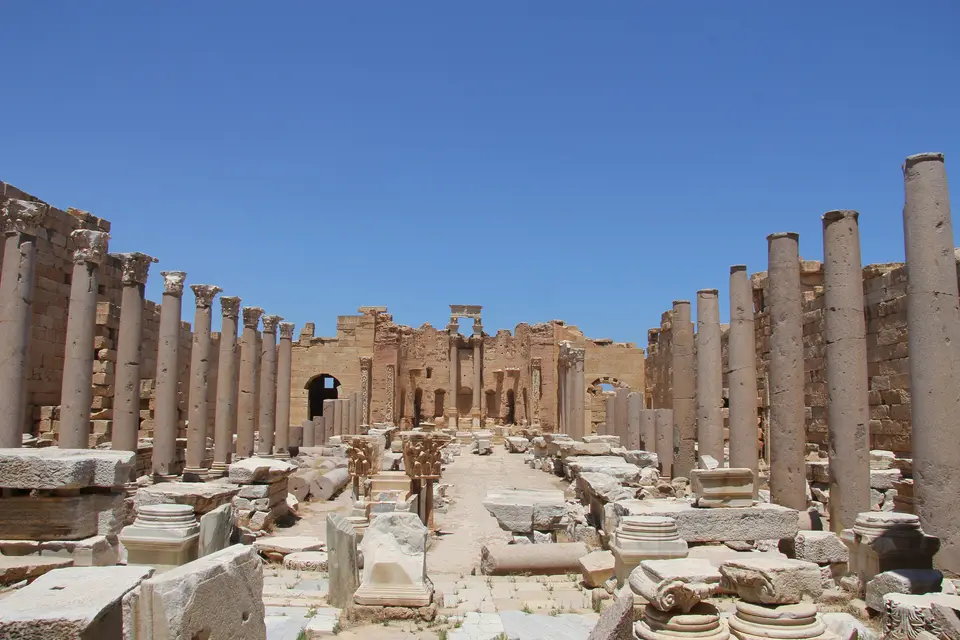
Along the monumental street axis linking the harbour to the interior, Septimius Severus erected three masterpieces of Roman architecture strongly influenced by North African and Eastern Mediterranean artistic traditions. At the major crossroads stands the four-way Arch of Septimius Severus (the Severan Arch), one of the first monuments uncovered during Renato Bartoccini's 1925 to 1926 excavations (published in Africa Italiana 4 in 1931 and studied by Ward-Perkins in 1951), whose relief panels pioneer a crisp, linear as well as angular style of late-antique carving. Nearby spread the vast colonnaded enclosure of the Severan Forum and the towering Severan Basilica, whose double apses and deeply drilled marble pilasters of Hercules and Dionysus rank among the finest sculptural works of the Roman world.
Complementing these imperial showpieces are the structures of everyday civic and commercial life: the early Roman market with its octagonal pavilions, votive arch, and colonnade of shops; the monumental public baths; the seaside Roman Theatre overlooking the Mediterranean; and the coastal Amphitheatre and Circus. In the year 2000 (announced publicly in June 2005 to prevent looting), archaeologists from the University of Hamburg excavating the cold plunge pool of a bathhouse (balneae) inside a Roman villa at Wadi Lebda uncovered a 30-foot length of five polychrome mosaics from the 1st or 2nd century AD, now displayed in the Leptis Magna Museum, depicting four young men wrestling a wild bull alongside a warrior in combat with a deer and an exhausted gladiator staring at his slain opponent in a composition compared by scholars to the Alexander Mosaic in Pompeii.
Following the dissolution of the 3rd Augustan Legion under Gordian III in 238, the Crisis of the 3rd Century, the corrupt governorship of Romanus under Emperor Valentinian (recounted by Ammianus Marcellinus) as well as the devastating tsunami of 365 AD, Leptis declined despite brief revivals under Diocletian and Emperor Theodosius. Captured in 439 by the Vandal king Gaiseric (who demolished its walls, leaving the city exposed to a Berber sack in AD 523), recaptured for Emperor Justinian by general Belisarius in 533 (before prefect Sergius massacred eighty deputies of the Leuathae confederation in 544 and fled to Carthage, though Christian missionaries from Leptis converted the Garamantes in the Fezzan between 565 and 578), the city held fewer than 1,000 inhabitants when Arab forces arrived around 647 and was soon buried under shifting coastal dunes.
Rediscovered by European travellers in the 17th and 18th centuries (when temple columns were shipped to the British Museum in 1816 and erected in 1826 at Fort Belvedere by Virginia Water, Blacknest Road, the A30 London Road alongside Wentworth Drive in England's Windsor Great Park) and systematically excavated by Italian archaeologists in the 1920s and 1930s and 1990s missions from the UCL Institute of Archaeology alongside King's College London, the site escaped visible damage during the 2011 First Libyan Civil War (as verified by archaeologist Hafed Walda) and was protected by local volunteers during the Second Libyan Civil War, though the 2022 IPCC Sixth Assessment Report notes long-term coastal erosion and sea-level rise risks (0.5 to 1 m under RCP 8.5 by 2100 and 2 to 3 m over 2,000 years even at 1.5 °C warming).
Navigating the Severan Axis, the Seaside Theatre, and the Harbour Basin
Set on the coast at Al-Khums 130 kilometres east of Tripoli, the excavated ruins of Leptis Magna spread across a vast pedestrian zone extending from the western Arch of Septimius Severus to the eastern artificial port at the mouth of the Wadi Lebda.
- Arch of Septimius Severus, Public Baths, and the Roman Market: Enter through the western gate to examine the four-way marble reliefs of the Arch of Septimius Severus, then walk north along the colonnaded street past the sprawling vaulted halls and palaestra of the public baths. Continue into the older Roman quarter to inspect the twin octagonal market kiosks, votive arch, and colonnade of shops in the market-place alongside the semicircular auditorium of the Roman Theatre looking straight out over the Mediterranean Sea.
- The Severan Forum, the Severan Basilica, and the Wadi Lebda Port: Follow the monumental colonnaded avenue east toward the Wadi Lebda channel to enter the vast marble-paved enclosure of the Severan Forum and the adjoining Severan Basilica, examining the deeply carved acanthus, Hercules, and Dionysus pilasters. Beyond the basilica, trace the stone quays, mooring blocks, warehouses, and canal barrage of the artificial Roman harbour at the mouth of the Wadi Lebda.
- Eastern Amphitheatre, the Gladiator Mosaic, and coastal preservation: Walk or drive east along the shore to the sunken arena of the Roman Amphitheatre built under Nero and the adjacent seaside Circus, and visit the on-site Leptis Magna Museum to view the 30-foot Wadi Lebda gladiator and bull-wrestling mosaics uncovered in 2000. Always check current Libyan travel advisories and coordinate with accredited local guides in Tripoli and Al-Khums, and explore North Africa's classical cities in our UNESCO World Heritage Atlas.
