


























Quick Field Data
- UNESCO Inscription: 1980 (placed on the List of World Heritage in Danger in 2013 and noted in 2017) · Criteria (i), (iii), (vi).
- Scale & Footprint: 116.2 hectares of fortified urban and archaeological ruins (surrounded by a 200.4-hectare buffer zone, or 287 and 495 acres) in southern Syria
- Access & Ticketing: Historic basalt townscape and fortified Roman theatre-citadel managed by antiquities authorities in Syria; due to ongoing regional security conditions and World Heritage in Danger status, visitors must check official travel advisories prior to any overland travel
- Arrival Logistics: Located on the fertile volcanic basalt plain of southern Syria along the historical caravan highway leading south toward Arabia and Mecca
From the Tell el-Amarna Tablets and Nabataean Capital to Roman Colonian Bostra
Spread across 116.2 hectares (287 acres, framed by a 200.4-hectare or 495-acre buffer zone) on the volcanic plain of southern Syria, the Ancient City of Bosra preserves an extraordinary multi-layered urban landscape carved almost entirely from durable local black basalt. Entered onto the World Heritage List in 1980 under cultural criteria (i), (iii), and (vi), and placed on the List of World Heritage in Danger in 2013 (with status updates in 2017) due to armed conflict in Syria, Bosra documents more than three millennia of continuous urban life across Bronze Age Phoenician and Amorite, Nabataean, Roman, Christian Byzantine, and Islamic civilisations. Black basalt unifies every era here.
Written history records Bosra as early as the fourteenth century BC, when the city's name appears in the royal cuneiform diplomatic archive of the Tell el-Amarna tablets in Egypt, documenting correspondence between the Egyptian Pharaohs and the Phoenician and Amorite kings of the region. During the Hellenistic and early Roman centuries, as caravan trade expanded from Arabia toward the Mediterranean, Bosra rose to become the northern royal capital of the Nabataean Kingdom. Monumental Nabataean arches alongside columns with distinctive horned capitals and eastern urban quarters still anchor the eastern axis of the ancient city.
A transformative urban era began in 106 AD, when the Roman Emperor Trajan annexed the Nabataean Kingdom into the Roman Empire and designated Bosra as the provincial capital of the newly created Roman province of Arabia and the permanent garrison base of a Roman legion. Under subsequent imperial patronage, Emperor Alexander Severus elevated the city to the rank of Colonian Bostra, while Emperor Philip the Arab (born in the surrounding basalt region) minted special provincial civic coinage in its honour. Roman engineers laid out colonnaded east-west and north-south thoroughfares (the decumanus and cardo) lined with monumental four-way arches and public baths alongside a fountain house, triumphal arches, a hippodrome, and two immense open-air masonry water reservoirs that sustained the desert border metropolis.
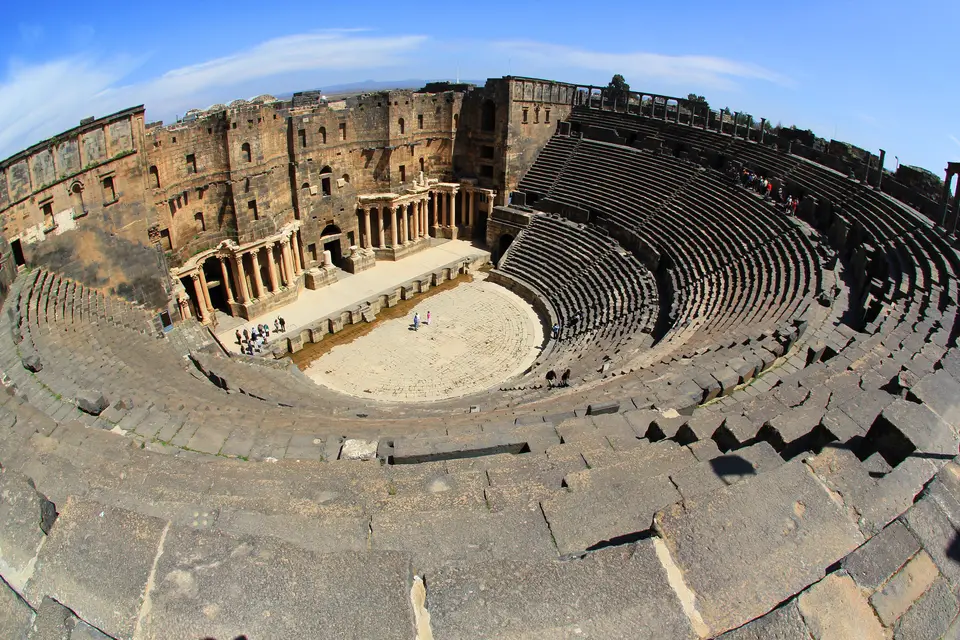
At the southern edge of the Roman street grid, architects most likely working under Emperor Trajan in the early second century AD constructed Bosra's supreme architectural monument: a magnificent freestanding Roman theatre built entirely of dressed black basalt ashlar. Accommodating thousands of spectators across three horizontal tiers of semi-circular stone seating (cavea) divided by vaulted passages and crowned by an upper Doric colonnade gallery, the theatre preserves its multi-storey stage building (scaenae frons) to its full original height, flanked by towering side courtyard wings. Because the builders did not have a natural hillside into which they could carve the auditorium, they raised the entire semicircular seating bowl on a complex vaulted substructure of basalt piers and barrel-vaulted corridors that allowed spectators to enter and exit the tiers rapidly.
Byzantine Frontier Market, Early Islamic Mosques, and the Fortified Theatre Citadel
During the Christian Byzantine era from the fourth to the early seventh century, Bosra flourished as a strategic frontier market where Arabian merchant caravans arrived to provision their camels and trade goods along the desert highway toward Mecca. Ecclesiastical chroniclers record that the archbishops of Bosra participated prominently in the Church Council of Antioch, and Christian architects erected pioneering centrally planned basalt churches across the city. Foremost among them was the early-sixth-century Cathedral of Bosra, whose circular dome-over-octagon interior plan influenced both Byzantine and early Islamic religious architecture, alongside a stone basilica associated with early Christian monasticism in the city.
In 634 AD, during the opening phase of the early Islamic expansion out of Arabia, Bosra became the very first Byzantine city in Syria entered by Arab Muslim armies, and for the next millennium it served as a vital staging post for pilgrims travelling the annual caravan route toward Mecca. Within the ancient Roman street grid stands the Al-Omari Mosque, founded in the early Islamic centuries and enlarged during medieval Islamic periods by reusing tall Roman and Corinthian basalt columns to support a double-arcaded prayer hall around a paved central courtyard and square stone minaret. It stands today as a rare preserved example of early Islamic congregational mosque architecture. Nearby rises the celebrated Madrasah Mabrak al-Naqua, one of the oldest and most revered madrasas in Islam, alongside several other medieval Islamic shrines and schools built from the same dark volcanic stone. Throughout the early and medieval Islamic centuries, caravan merchants and religious scholars travelling between Syria and Arabia paused inside these basalt courtyard mosques and madrasas to draw water from the giant stone reservoirs and study Islamic law along the pilgrimage road to Mecca.
What preserved the second-century Roman theatre of Bosra in an integral, almost undamaged state, complete with its three-tiered stage wall, acoustic galleries, and upper colonnade, was its systematic military fortification between 481 and 1251 AD. Recognising the massive basalt semicircle of the Roman theatre as an impregnable defensive core, medieval Muslim military engineers walled up the external arches, excavated a dry moat around the perimeter spanned by a multi-arch stone bridge, and encased the entire Roman auditorium inside a ring of massive rusticated basalt defensive towers. That fortification converted the classical playhouse into a formidable medieval citadel that guarded the southern caravan approach until twentieth-century archaeologists cleared the interior courtyard installations to reveal the intact Roman auditorium within. Even outside the citadel and civic monuments, the vernacular architecture of old Bosra is prized by architectural historians because hundreds of traditional courtyard houses built of basalt blocks with cantilevered basalt roof slabs preserve ancient domestic layouts. Across the 116.2-hectare core and its 200.4-hectare buffer zone in Daraa, Syria, the integration of Nabataean capitals alongside Roman colonnaded streets, Christian Byzantine churches, and early Muslim mosques within a single black-basalt townscape illustrates how successive ancient and medieval civilisations reshaped the urban fabric of the southern plain.
Tracing the Basalt Colonnades and Theatre-Citadel
Walking through the 116.2-hectare archaeological zone of Bosra reveals an urban palimpsest where village homes alongside early Christian basilicas and medieval mosques share the same dark volcanic stone as Trajan's colonnaded streets and the fortress walls encircling the Roman theatre.
When regional security conditions permit safe access, orient your architectural walk around the fortified theatre, the colonnaded decumanus, and the northern mosques.
- Cross the citadel moat bridge into the second-century Roman Theatre: Enter the medieval fortress over the stone bridge and pass through the vaulted defensive towers (built between 481 and 1251 AD) to emerge inside the second-century AD Roman auditorium. Climb the three tiers of black basalt seating up to the top Doric colonnade to take in the full height of Trajan's scaenae frons stage wall and experience the natural acoustics of the semicircular cavea.
- Follow the Roman decumanus from the western arch to the Nabataean quarter: Step north from the citadel into the colonnaded Roman street grid of Colonian Bostra to walk past the Roman public baths, the tall Corinthian columns of the monumental fountain shrines, and the western triumphal arch. Continue eastward along the ancient axis to inspect the first-century AD Nabataean arch and horned capitals marking the transition from the Roman quarter to the older Nabataean royal sector.
- Inspect the Al-Omari Mosque, Byzantine Cathedral, and Madrasah Mabrak al-Naqua: Explore the northern and eastern quarters of the old town to see the re-used Roman columns and square basalt minaret of the Al-Omari Mosque, the circular-in-square ruins of the sixth-century Byzantine Cathedral, and the historic Madrasah Mabrak al-Naqua beside the vast stone caravan reservoirs, and follow conservation updates across our UNESCO World Heritage Atlas.
