


























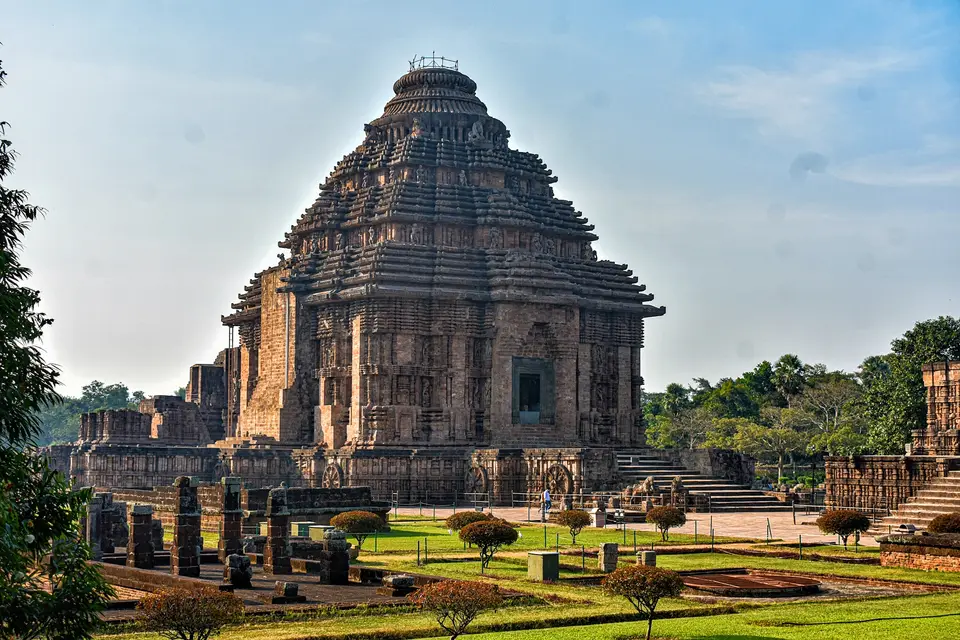
Quick Field Data
- UNESCO Inscription: 1984, recognised as the architectural culmination of the Kalingan temple tradition and a monumental stone personification of the Hindu sun god Surya.
- Scale & Footprint: Occupies a walled sacred courtyard on the eastern shores of the Bay of Bengal, featuring 24 carved stone chariot wheels each measuring approximately 3 metres in diameter.
- Access & Ticketing: Visitor entry passes through the gated eastern approach avenue; check the official site for current admission procedures and conservation rules.
- Arrival Logistics: Situated near the Bay of Bengal shoreline in the eastern state of Orissa (modern Orissa), connected by coastal roads to nearby regional towns.
Rising from the sandy coastal plain along the eastern shoreline of the Bay of Bengal where the morning sun rises directly over the sea, the Sun Temple at Konârak (Konark) is one of the most celebrated Brahman sanctuaries in India. Across India, the UNESCO World Heritage Atlas in 1984, this thirteenth-century sanctuary was conceived not merely as a static house for a deity, but as a monumental stone representation of the sun god Surya's celestial chariot hurtling across the heavens. Resting on a high stone plinth flanked on its north and south sides by 24 carved wheels (twelve pairs) and led toward the eastern horizon by a team of stone horses, the monument represents the culmination of Kalingan temple architecture and sculptural narrative. Morning sunlight illuminates the eastern porch.
Thirteenth-Century Orissa and the Cult of the Sun God Surya
Constructed during the thirteenth century at the height of the medieval kingdom of Orissa, the Sun Temple at Konârak forms a vital link in the history and diffusion of the cult of Surya, the Hindu Sun God. Within the religious traditions of eastern India, the sanctuary is directly and materially linked both to orthodox Brahmanism and to regional tantric belief systems, translating solar cosmology into monumental stone masonry. By personifying divinity through the architectural form of a moving solar chariot, the thirteenth-century master builders created a sanctuary whose scale and proportion alongside sculptural embellishment rank among the finest achievements of Indian art.
Aligned along an east-west axis facing the Bay of Bengal so that the rays of the rising sun strike the eastern entrance and penetrate the inner sanctuary, the temple embodies the Kalingan architectural style in its complete and mature form. Like many classical Indian temples, the Sun Temple at Konârak is organised into distinct, axially aligned spatial units set within a walled rectangular courtyard. Every structural surface was treated by the thirteenth-century sculptors as a canvas for iconographical depictions of contemporary courtly life and religious ritual alongside cosmic time.
At the western end of the main platform once rose the towering vimana (the principal sanctuary housing the presiding solar deity), which was surmounted by a high curvilinear tower crowned with a shikhara cap. Over the centuries following the medieval era, the towering upper spire of the vimana suffered progressive structural instability and collapse, and its remaining unstable upper masonry was razed in the nineteenth century, leaving the monumental eastern porch and the sculpted chariot plinth standing as the primary surviving mass of the sanctuary.
Twenty-Four Solar Wheels, the Chariot Plinth, and Narrative Reliefs
The architectural illusion of a colossal temple-chariot is anchored by the high stone plinth that supports the main sanctuary buildings. Carved into the north and south faces of this plinth are 24 monumental stone wheels, arranged in twelve pairs, with each wheel measuring approximately 3 metres in diameter. Every wheel is sculpted in deep relief with hubs and axles alongside spokes decorated with carved astronomical symbols representing the changing seasons and the twelve months of the solar year, while the eastern stairway of the porch is drawn by stone horses (described in historical and UNESCO accounts as a team of six or seven horses straining in harness).
In the vertical wall spaces between the 24 carved wheels, the stone base is completely covered from base to cornice with detailed horizontal friezes and narrative reliefs. Sculpted with extraordinary vitality, these stone panels depict processions of fantastic lions and mythical beasts, rows of elephants, royal soldiers and hunters, courtly musicians and dancers, and refined erotic groups associated with tantric and auspicious temple iconography. Higher up along the stepped pyramidal roof tiers of the surviving eastern hall stand freestanding stone figures of celestial musicians playing drums and cymbals alongside stringed instruments to welcome the rising sun across the Bay of Bengal.
Within the wider national heritage framework of India, which accepted the World Heritage Convention on 14 November 1977 and counts 45 World Heritage Sites (including 37 cultural sites and seven natural properties and one mixed property alongside 81 tentative properties), the Sun Temple at Konârak was inscribed in 1984 shortly after the initial 1983 cohort of the Ajanta Caves and Ellora Caves alongside Agra Fort and Taj Mahal. Together with other celebrated medieval temple ensembles such as Mahabalipuram and Pattadakal alongside Khajuraho and Hampi, Konârak illustrates the regional mastery of Kalingan stone architecture along the eastern seaboard of the subcontinent.
Coastal Conservation and Walking the Chariot Circuit
Every architectural and sculptural element of the Sun Temple at Konârak works together to sustain the grand visual metaphor of Surya's celestial chariot moving across the sky from east to west. From the eastern stairway where stone horses strain forward in harness to the 24 three-metre wheels carved along the northern and southern faces of the high plinth, the thirteenth-century Kalingan master builders united monumental structural engineering with minute surface ornament. Across the horizontal friezes between the wheels, thousands of sculpted figures, lions, elephants, musicians, dancers, soldiers, and amorous couples, celebrate the generative energy of the sun across all realms of earthly and cosmic life.
Even with the nineteenth-century loss of the towering western vimana spire and its crowning shikhara cap, the surviving tiered assembly hall and the sculpted chariot platform convey the scale and proportion achieved under the thirteenth-century kingdom of Orissa. Standing within the walled courtyard near the Bay of Bengal shoreline, visitors can observe how the shifting coastal light moves across the deep stone reliefs from dawn to late afternoon, animating the spokes of the solar wheels and the freestanding celestial musicians high on the pyramidal roof terraces.
Taken as a whole, the sanctuary at Konârak remains an extraordinary architectural achievement where structural form, astronomical symbolism, and narrative stone carving merge into a single coherent design. By shaping the entire temple platform as a wheeled solar vehicle pulled by straining horses toward the eastern horizon, the sculptors of thirteenth-century Orissa transformed solid stone into an image of perpetual cosmic motion across the heavens. Walking around the perimeter of the courtyard allows visitors to observe how the angle of the sun casts deep shadows across the 24 chariot wheels and the plinth friezes throughout the day, bringing out fine ornamental details carved into every spoke, axle medallion, and recessed wall panel along the base of the monument. Even without its original western spire and crowning shikhara, the harmony between the monumental eastern hall, the sculpted wheel platform, and the surrounding courtyard shrines makes the Sun Temple one of the most memorable sacred monuments on the eastern coast of India.
Because the temple stands close to the saline winds and shifting sands of the Bay of Bengal shoreline, preserving its porous stone reliefs requires ongoing conservation care and structural monitoring. Walking slowly around the perimeter of the courtyard allows visitors to study how the shifting position of the sun casts deep shadows across the 24 chariot wheels and the plinth friezes throughout the day.
- Walk clockwise around the chariot platform: Begin at the eastern horse stairway and follow the stone pathway around the southern and western flanks toward the northern side to compare the lighting across the 24 carved wheels and the ruined base of the western vimana.
- Examine the symbolic motifs inside the three-metre wheels: Pause beside the north and south plinth walls to inspect the small circular medallions carved into the spokes and axles of the 3-metre wheels, which trace the cycle of the months and seasons.
- Study the multi-tiered musician sculptures on the upper roof: Step back into the open courtyard lawn to view the life-sized stone musicians and dancers positioned along the horizontal ledges of the surviving eastern hall's pyramidal roof.
