


























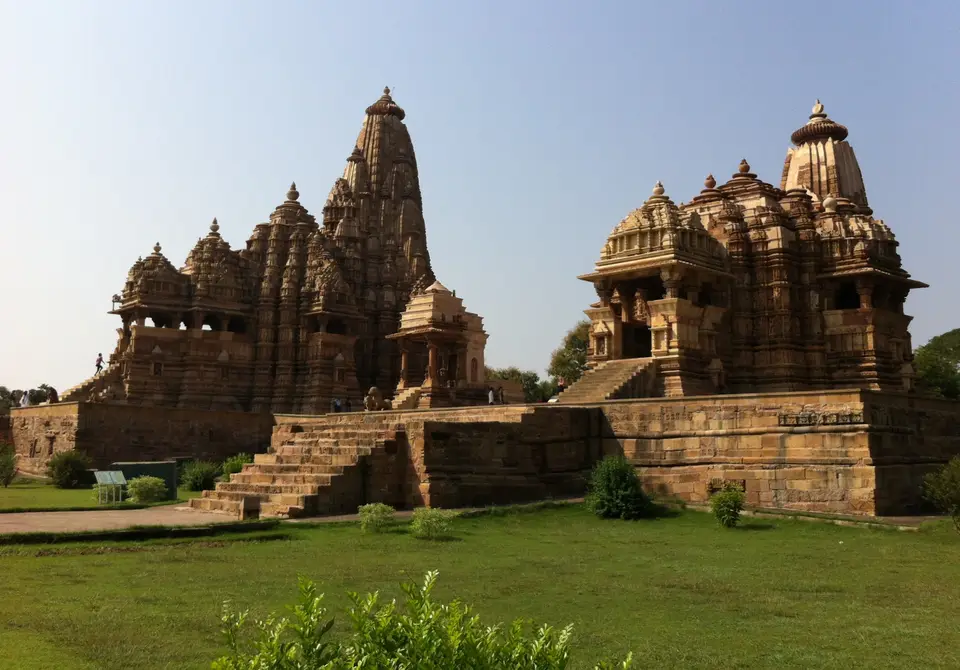
Quick Field Data
- UNESCO Inscription: 1986 (Cultural Criteria i, iii)
- Scale & Footprint: Roughly 20 to 25 surviving Hindu and Digambara Jain temples (23 monuments including one partly excavated temple) spread over 6 square kilometres
- Access & Ticketing: Administered by the Archaeological Survey of India (Bhopal Division); check the official site for Western Group admission, audio guides, and evening light shows
- Arrival Logistics: Located in Chhatarpur district of Madhya Pradesh, 6 kilometres from Khajuraho railway station, served by Civil Aerodrome Khajuraho (HJR), 620 kilometres southeast of New Delhi
Chandela Dynasty Patronage in the Vindhya Hills of Bundelkhand
Set within sight of the Vindhya mountain range beside the waters of Sib Sagar, Khajur Sagar (Ninora Tal), and the Khudar Nadi river in the Chhatarpur district of Madhya Pradesh, central India, the Khajuraho Group of Monuments preserves the architectural and sculptural zenith of the Chandela (Chandella) dynasty, which ruled the medieval kingdom of Jejakabhukti (also called Jijhoti, Jejahoti, or Chih-chi-to, later known as Bundelkhand) from its capital at Mahoba, 35 miles away in the Kalinjar region. Constructed primarily between 885 CE and 1000 CE (reaching their artistic apogee between 950 and 1050 CE, with epigraphic records placing the completion of most surviving sanctuaries between 970 and 1030 CE under the Hindu kings Yashovarman, Dhanga, and Vidyadhara) and inscribed in the UNESCO World Heritage Atlas in 1986 under cultural criteria i and iii (mapped on the Atlas), the site originally counted 85 temples spread across 20 square kilometres (7.7 square miles) by the 12th century, accompanied according to local legend by 64 water bodies (of which archaeologists have physically identified 56). Today, around 20 to 25 temples (specifically 23 monuments, including the partly excavated Beejamandal temple, identified with the Vaidyanath sanctuary cited in the Grahpati Kokalla inscription) survive across 6 square kilometres (2.3 square miles). Sculpted spires rise like mountain peaks.
The Sanskrit name Khajuraho derives from Kharjuravāhaka (combining kharjura, meaning date palm, and vāhaka, meaning bearer, recalling the local legend of two golden date-palm trees forming the temple gate, or signifying the "scorpion bearer" symbolic name of the deity Shiva, who wears snake and scorpion garlands in his fierce form). As early as 641 CE, the Chinese pilgrim Xuanzang described encountering several dozen dormant Buddhist monasteries alongside twelve Hindu sanctuaries served by a thousand worshipping brahmins in the region, and in 1022 CE the Persian historian Abu Rihan-al-Biruni, accompanying Mahmud of Ghazni during his unsuccessful raid on Kalinjar (which ended in a peace ransom), recorded Khajuraho as the capital of Jajahuti. Following the 13th-century seizure of the Chandela kingdom by Delhi Sultanate commander Qutb-ud-din Aibak, the Moroccan traveller Ibn Battuta visited "Kajarra" between 1335 and 1342 CE, noting yellow-skinned ascetic yogis with long matted locks teaching yoga to Muslims beside mutilated idols, before Sikandar Lodi's 1495 campaign caused further temple damage. Protected thereafter by dense forest isolation (and inspiring the 10th-century Bhand Deva "Little Khajuraho" temple in Rajasthan), the overgrown complex was guided by local Hindus in 1838 (in the 1830s) to British surveyor Captain T. S. Burt, who published his findings through the pages of the Asiatic Society of Bengal's journal, followed by F. C. Maisey's earliest drawings in 1852 and Alexander Cunningham's 1850s and 1860s classification into the Western, Eastern, and Southern groups (while noting thousands of Hindu pilgrims still gathering secretly at the active Matangeshvara temple for Shivaratri in February or March).
Nagara Vastu-Purusha-Mandala Geometry and Dry-Masonry Engineering
Built simultaneously across the late 10th and 11th centuries in a grid pattern of major temples surrounded by smaller shrines (comparable to Hindu temple layouts at Angkor Wat, Parambaran, and South India) and divided nearly a third each among the Saivism school of Hinduism (6 surviving temples to Shiva), the Vaishnavism school (8 to Vishnu and his affinities, including Chaturbhuja and Ramachandra, plus 1 to Ganesha and 1 to the Sun god), and Digambara Jainism (3 major temples to Jain Tirthankars), a coexistence cited by historians James Fergusson, James Burgess, R. Phene Spiers, and Will Durant as evidence of deep religious tolerance, every temple at Khajuraho except the westward-facing Chaturbhuja faces east toward the sunrise:
- The 64-pada Vastu-Purusha-Mandala and pentagonal site geometry: Raised atop a concealed granite foundation and a high masonry platform (jagati) without any mortar, using precision mortise-and-tenon joints and gravity to lock superior Kalinjar sandstone megaliths weighing up to 20 tons (where 19th-century brick-and-mortar repairs have aged faster and darkened, and where experiments for the television show Lost Worlds by Alex Evans, taking 60 days to carve a stone sculpture under four feet, and by Roger Hopkins and Mark Lehner, taking 12 quarrymen 22 days to quarry 400 tons, proved that hundreds of highly trained sculptors worked here), most temples deploy the 8-by-8 (64-sub-square padas) Manduka Vastupurushamandala grid. In this sacred geometry, the square symbolises divine perfection circumscribed by the earthly circle of everyday life, while across the wider territory the temples are laid out in three triangles converging to form a pentagon that reflects the Hindu symbolism of three realms (trilokinatha) and five cosmic substances (panchbhuteshvara) governed by Shiva's cosmic dance of time, evolution, and dissolution.
- Axially aligned halls and fractal Shikhara spires: Devotees ascend onto the jagati and progress along an east-west axis through an ornate entrance porch (ardhamandapa), a main waiting hall (mandapa), a grand pillared hall with lateral projecting window transepts, and a vestibule (antarala) into the inner sanctum (garbhagriha or garbhagriya) housing the primary deity or lingam on the central Brahma padas, surrounded in larger temples by an internal clockwise circumambulatory path (pradakshina) and four corner subsidiary shrines. Above the sanctum soars the self-repeating fractal superstructure of the Nagara spire (Shikhara or Vimana), linked in Hindu literature to Mount Kailash or Meru in what scholar Susan Lewandowski termed "an organism of repeating cells".
- The Western Group (Kandariya Mahadeva, Lakshmana, Vishvanatha, and Matangeshvara): Grouped around Lakshmana (built under King Yashovarman) and Vishvanatha (built under King Dhanga, alongside Chitragupta and the 64-cell Chausath Yogini temple), the Western Group is crowned by the Kandariya Mahadeva Temple, built under King Vidyadhara. Measuring 109 feet in length by 60 feet in width across 6,500 square feet and rising 116 feet above the ground (88 feet above its own floor), Kandariya Mahadeva is encircled by three rows of half-life-size (2.5- to 3-foot) figures totalling over 870 statues. Immediately adjacent stands the active square-grid Matangeshvara temple, enshrining a 2.5-metre-high (8.2-foot), 1.1-metre-diameter (3.6-foot) Shiva lingam atop a 7.6-metre (25-foot) platform.
- The Eastern (Jain and Hindu) and Southern Groups: Clustered around the Javeri and Vamana temples in the east-southeast stand four major Digambara Jain sanctuaries: the ruined Ghantai (Ghanti) Temple featuring bells sculpted on its pillars, the Pārśvanātha Temple alongside the Ādinātha Temple (both showing strong architectural evidence of conversion from earlier Hindu temples), and the Śāntinātha Temple, while the Southern Group centres on the Duladeva and Chaturbhuja temples.
Sacred and Secular Sculpture, Symbolism, and Visitor Logistics
Studied by scholars Devangana Desai, Stella Kramrisch, M. R. Anand, Philip Wilkinson, Madan Gopal, Anna Slaczka, Charles-Louis Fábri, Alain Daniélou, Prasenjit Dasgupta, Phani Kant Mishra, L. A. Narain, R. Nath, and James McConnachie, the sandstone walls of Khajuraho integrate thousands of finely carved sculptures (showing strands of hair, manicured nails, and jewellery) depicting everyday medieval potters, farmers, musicians, women applying makeup, heavenly nymphs (apsaras), hybrid lion-bodied Vyalas (including the wolf-lion Vrik Vyala and the elephant-lion Yali), literary motifs from 8th- to 10th-century Sanskrit poems and plays (such as Prabodhacandrodaya, Karpuramanjari, Viddhasalabhanjika, and Kavyamimansa), and double-meaning Sanskrit poem inscriptions. Although famous globally for its erotic maithuna carvings (which helped young bachelor brahmacharyas living in hermitages learn the worldly role of householder and symbolised the four Hindu goals of dharma, kama, artha, and moksha, the reunion of Purusha and Prakriti, alongside the three Āgama stages of Avyakta, Vyaktavyakta, and Vyakta), sexual themes constitute less than 10 percent of the total sculpture, placed on the outer padas in proportional balance with non-sexual spiritual iconography:
- Entry and route: Located near the town of Khajuraho (2011 Census population 24,481) in Chhatarpur district, the monuments lie 9 kilometres (5.6 miles) from Rajnagar, 10 kilometres (6.2 miles) from Khajwa and east-west National Highway 75, 46 kilometres (28.6 miles, or about 50 kilometres) from Chhatarpur city (connected to Bhopal by National Highway 86), 175 kilometres (109 miles) southeast of Jhansi, 283 kilometres (177 miles) from Gwalior, and 620 kilometres (385 miles) southeast of New Delhi, connected by air through Civil Aerodrome Khajuraho (airport code HJR, with flights to Delhi, Agra, Varanasi, and Mumbai) and Khajuraho railway station (6 kilometres from the entrance).
- Tickets and viewpoints: The fenced parkland of the Western Group requires an official ASI admission ticket and provides an ASI audio-guided tour through its seven to eight temples plus an evening English and Hindi sound-and-light (son et lumière) show on the open lawns, whereas the Eastern and Southern groups are entered separately; check the official site for schedules and the annual February Khajuraho Dance Festival held against the backdrop of the Chitragupta or Vishvanatha temples.
- Timing and onward connections: Begin in the Western Group at sunrise when the east-facing entrance porches catch the first morning rays, then hire a bicycle or auto-rickshaw in the afternoon to explore the Eastern Jain enclosure (Pārśvanātha, Ādinātha, Śāntinātha, and Ghantai) and the Southern Duladeva and Chaturbhuja temples.
