


























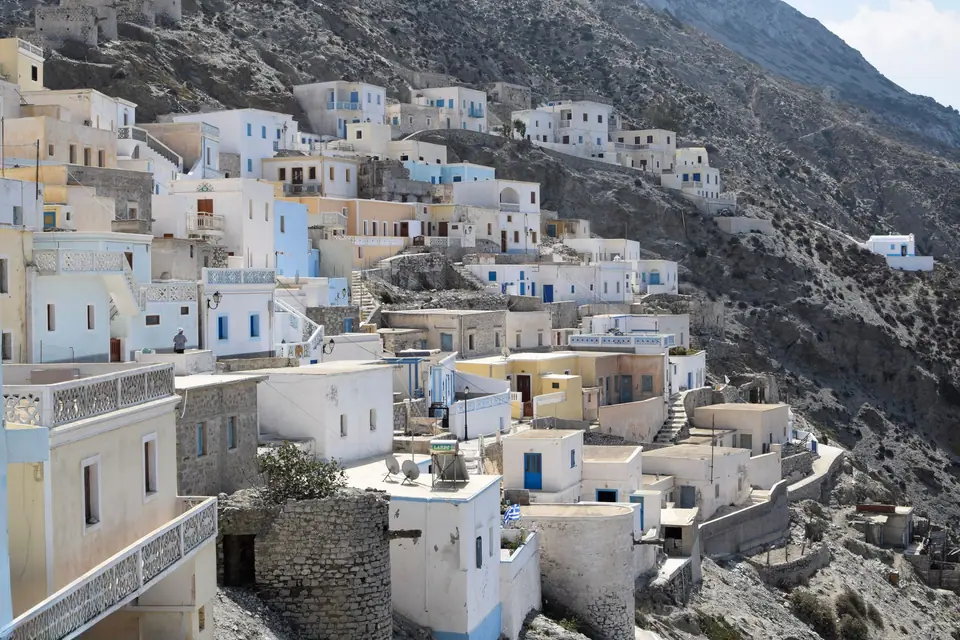
Apeiranthos ('The Marble Village'), Venetian Towers and the Wild East Coast (Moutsouna)
At 600 metres elevation in the eastern mountains: a village paved entirely in white Naxian marble with two Venetian towers.
Twenty-eight kilometres east of Naxos Town (and 10 minutes up the mountain road beyond Filoti, reached by car or KTEL Bus #2), the road crests a 600-metre mountain saddle between two green valleys to reveal Apeiranthos (called "t'Aperathou" by locals), universally known as "The Marble Village of Naxos".
1. Why Apeiranthos Feels Like a Cretan Castle in the Clouds
Unlike any other village in the Cyclades, every single street, staircase, courtyard, archway and house facade in Apeiranthos is built and paved with gleaming blocks of white-and-grey Naxian marble from the surrounding quarries. Settled in the 15th to 17th centuries largely by refugees fleeing Crete (which is why Apeiranthians still speak a distinct Cretan-rooted dialect, play the Cretan lyra and improvise rhyming 15-syllable kotsakia poems at village weddings), the car-free village is anchored by two dramatic 17th-century Venetian fortified tower-houses:
- The Zevgolis Tower (1670s) & Bardani Tower: right at the village entrance rises the crenellated stone Zevgolis Tower, perched on a rocky spur above a Venetian stone arch.
- The 5 Small Museums of Apeiranthos (One Combined standard fare Ticket): despite having fewer than 1,000 residents, Apeiranthos is an intellectual and artistic hub boasting five boutique museums along its main marble lane (the Archaeological Museum displaying rare 2500 BC Early Cycladic stone plaques incised with daily-life scenes from Korfi t'Aroniou, the Geological Museum with 2,000 minerals including Naxos's famous corundum emery stone, the Folklore Museum, Visual Arts Museum and Natural History Museum).
- What to Eat & Buy on the Marble Promenade: sit at Platanos or Lefteris taverna to order Apeiranthos's signature dish, Rosto (pork braised slowly in red wine, coarse garlic and black pepper served with thick pasta), and visit the Apeiranthos Women's Traditional Weaving Cooperative.
2. Driving Down the Emery-Mining Road to Moutsouna & Panermos (East Coast)
If you have a car, drive 20 minutes east from Apeiranthos down the dramatic mountain road, passing the rusty overhead 1926 aerial cableway pylons and iron buckets that once carried tonnes of Naxos emery rock (smyrigli, used worldwide to polish glass and metal before synthetic diamonds) down from the mines of Koronos, to the quiet east-coast port of Moutsouna (where original iron emery cranes still stand above seaside fish tavernas) and the palm-fringed, windless southern cove of Panermos.
Traveller tips
Real advice from people who have been to Apeiranthos ('The Marble Village'), Venetian Towers and the Wild East Coast (Moutsouna). Every tip is read by our team before it goes live.
No tips yet. Been here? Yours could be the first.
Thank you! Your tip will appear here after a quick review.
More in Naxos
Continue exploring Naxos with related neighbourhood, food, and planning guides
Hiking Mount Zas (1,003m, Highest Peak in the Cyclades), Cave of Zeus and Rotonda
Naxos, Greece

What to Eat in Naxos: PGI Potatoes, PDO Graviera, Arseniko Cheese, Rosto and Kitron
Naxos, Greece
Day Trip to Koufonisia & The Small Cyclades (Or Delos & Mykonos Boat Cruise)
Naxos, Greece
Venetian Towers of Naxos: Bazeos Tower, Belonia Tower and Agia Monastery
Naxos, Greece
