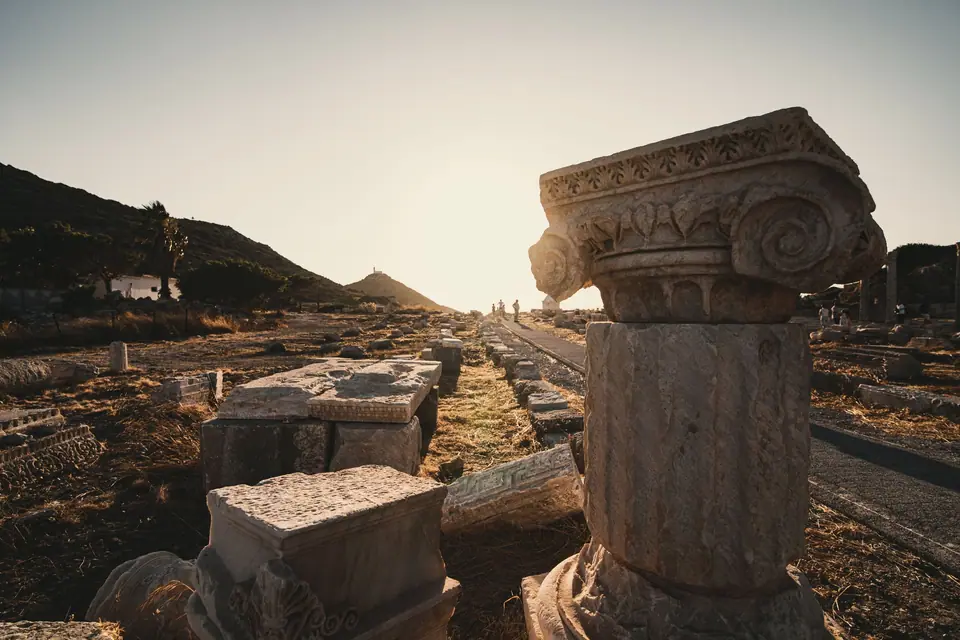
The Portara (530 BC Temple of Apollo), Palatia Islet and Grotta Beach
Standing beneath the 2,500-year-old marble doorway of Apollo on Palatia islet at sunrise and sunset.
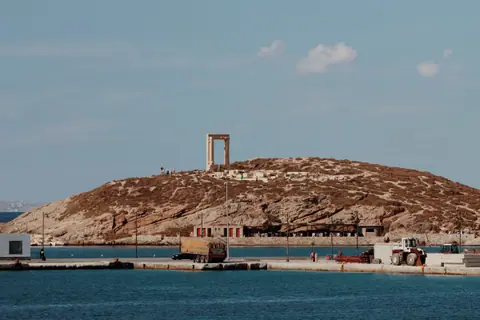
Connected to the northern tip of the Naxos Town harbour promenade by a 100-metre stone causeway rises the low rocky islet of Palatia, crowned by the Portara, the monumental 6-metre-high, 3.65-metre-wide white marble portal of an unfinished archaic temple that has stood against the Aegean winds for 2,550 years.
1. Why Was the Temple Never Finished?
Around 530 BC, the ambitious ruler of Naxos, Lygdamis, ordered the construction of a colossal Ionic marble temple 59 metres long and 28 metres wide that would rival the great sanctuaries of Samos and Athens, and uniquely oriented it facing north-west toward sacred Delos, birthplace of Apollo. Masons quarried the four 20-tonne blocks of the inner sanctuary doorway (opisthodomos) at the inland marble quarries of Flerio, dragged them ten kilometres over wooden rollers to Palatia, and hoisted them into place (notice the surviving protruding marble lifting bosses on the bottom threshold block that were never chiselled smooth because construction stopped abruptly in 524 BC when Sparta overthrew Lygdamis and war broke out with Samos):
- Why only the Doorway Survived: in the 6th century AD, the unfinished temple was converted into a Christian basilica; later, in the 13th to 16th centuries, the Venetians dismantled all the surrounding marble columns and blocks to build the fortifications of the Chora Kastro, leaving only the four 20-tonne blocks of the Portara standing because they were simply too heavy for medieval cranes to lift down.
- The Myth of Theseus, Ariadne & Dionysus: in Greek mythology, this exact rocky islet of Palatia is where the Athenian hero Theseus stopped on his voyage back from Crete after slaying the Minotaur and abandoned sleeping Cretan princess Ariadne, only for the Wine God Dionysus to arrive in a chariot drawn by panthers and marry her.
2. Best Time to Visit & The Sunken Mycenaean City at Grotta
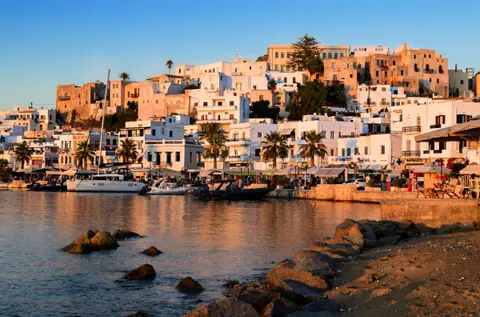
While hundreds of visitors gather on Palatia hill 45 minutes before sunset to watch the orange sun drop into the sea behind Paros, do not miss walking out to the Portara at early in the morning to early in the morning: in the morning you will have the marble doorway completely to yourself, and the morning sun shines from behind the Portara directly onto the whitewashed cube pyramid of Chora.
Traveller tips
Real advice from people who have been to The Portara (530 BC Temple of Apollo), Palatia Islet and Grotta Beach. Every tip is read by our team before it goes live.
No tips yet. Been here? Yours could be the first.
Thank you! Your tip will appear here after a quick review.
More in Naxos
Continue exploring Naxos with related neighbourhood, food, and planning guides