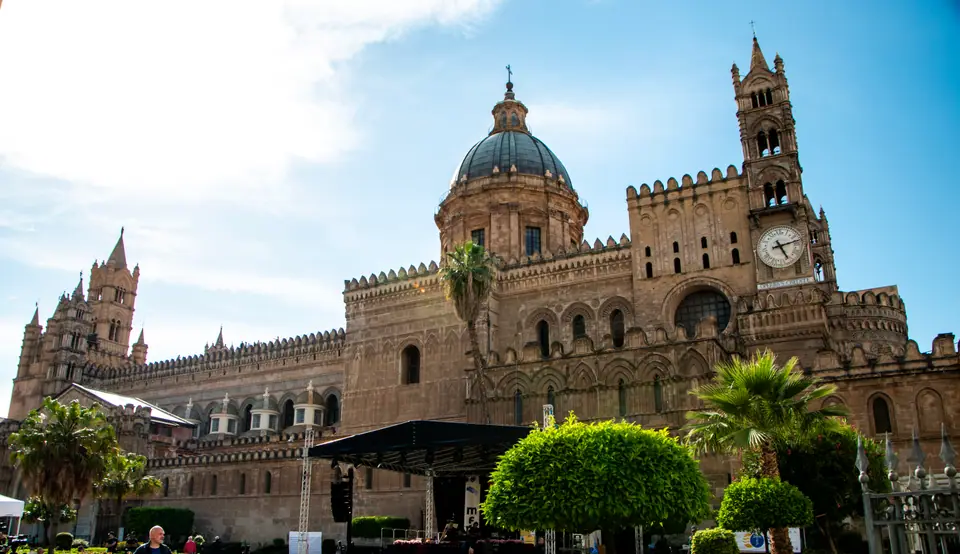
Photo: Julian Lupyan · CC0
Palermo Cathedral, Quattro Canti and Street Markets
Three blocks connect Sicily architectural dynasties at Palermo Cathedral, Baroque urban theatre at Quattro Canti and centuries-old market alleys nearby.
Strolling gently downhill from the Norman palace along Corso Vittorio Emanuele reveals Palermo's widest limestone lawn before the Cathedral of the Assumption. Whereas Cappella Palatina dazzles through intimate gold glitter inside, Palermo Cathedral displays centuries of conquest openly across sun-baked exterior stonework.
Blocks further east, Baroque Quattro Canti links two of southern Italy's liveliest open-air markets, Il Capo and Ballarò. That quick transition moves travellers from silent royal sarcophagi straight into sizzling market alleys within minutes.
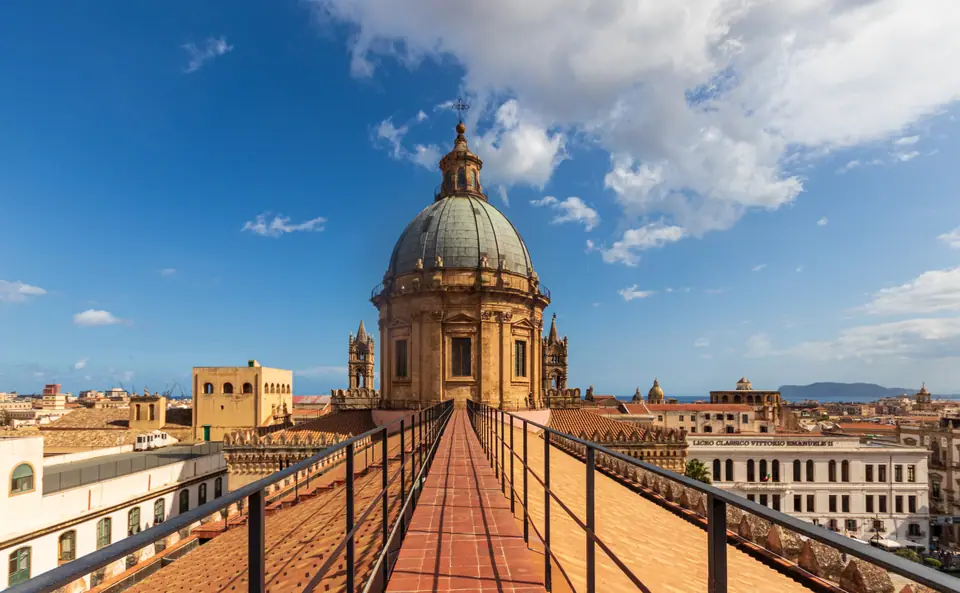
Architectural layers from Norman apses to the Neoclassical dome
Palermo Cathedral's layered outline grew across centuries of regime changes rather than one architect's blueprint. Erected atop a sixth-century Byzantine basilica that later became Palermo's Friday Mosque during Arab rule, the current church began in 1185 under English-born Archbishop Walter Ophamil.
Walk around to the eastern outer apses to inspect geometric black volcanic inlays echoing Islamic ornament. Along the sunny southern flank, a graceful Gothic-Catalan portico added around 1465 rises beside fourteenth-century corner bell towers and fortified stone crenellations. Inside, Florentine architect Ferdinando Fuga and Giuseppe Venanzio Marvuglia reshaped the medieval hall beneath a bright Neoclassical dome between 1781 and 1801. Down the marble nave floor runs astronomer Giuseppe Piazzi's 1801 brass solar meridian line, where midday sunlight crosses inlaid zodiac tiles.
Cathedral rooftop terraces versus royal porphyry sarcophagi
Stepping inside the bright nave and Chapel of Santa Rosalia (holding the patron saint's seventeenth-century silver urn behind a bronze gate) requires zero ticket, though covered shoulders and knees apply. Separate paid passes unlock the royal tombs, silver treasury, underground crypt and panoramic rooftop terraces (Tetti).
- Royal Porphyry Tombs: preserve the heavy purple-stone sarcophagi of King Roger, Emperor Frederick the Second (Stupor Mundi), Empress Constance of Hauteville and Emperor Henry VI under carved stone canopies.
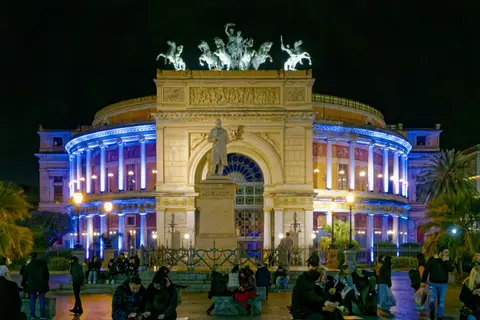
- Rooftop Terraces (Tetti): climb tight spiral tower steps onto elevated walkways hugging ornate Gothic-Catalan battlements, framing clear sights toward Teatro Massimo dome, Palazzo Reale and the gulf.
- Cathedral Treasury: holds historic liturgical silver beside Empress Constance of Aragon's jewel-studded imperial crown (camauro) discovered intact inside her sarcophagus in 1491.
- Underground Crypt: winds through vaulted chambers packed with carved Roman and medieval coffins containing past archbishops of Palermo.
Visitors troubled by narrow spiral climbs or unshaded roof ledges can explore the royal tombs and treasury downstairs comfortably without losing historical context. Leaving the cathedral yard along Corso Vittorio Emanuele leads straight toward Baroque crosses and city hall squares.
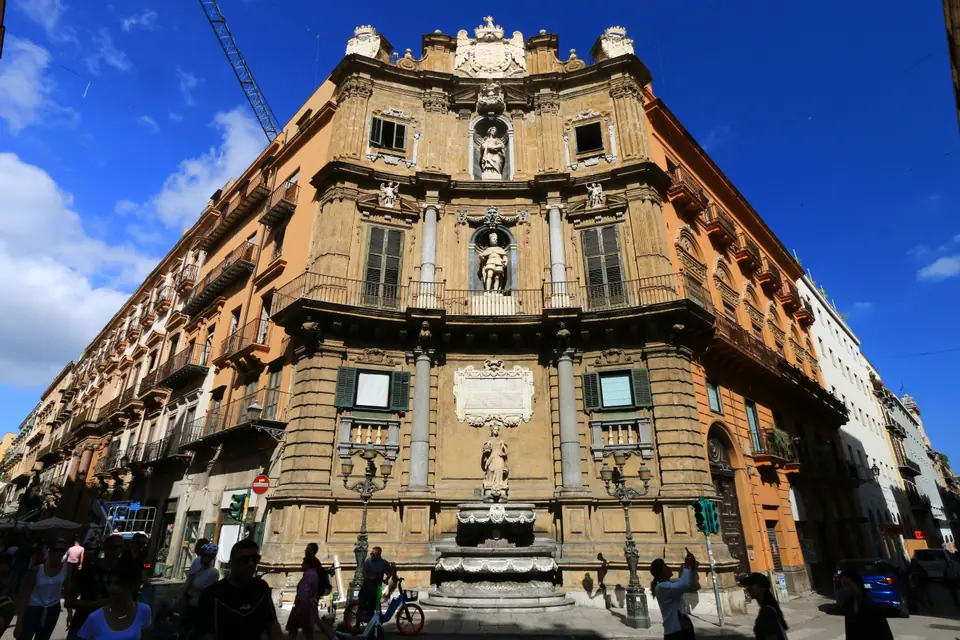
Decoding the four seasons and Spanish kings of Quattro Canti
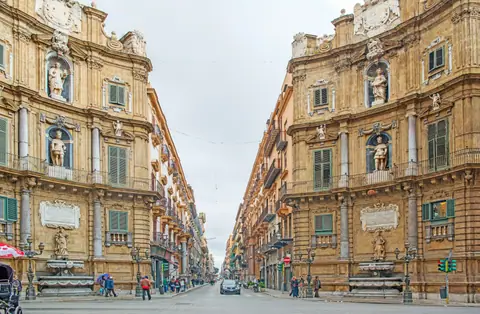
Continuing east down Corso Vittorio Emanuele leads straight into Piazza Vigliena, universally called Quattro Canti ("Four Corners") and nicknamed Theatre of the Sun. Designed between 1608 and 1620 by Florentine architect Giulio Lasso, this octagonal intersection trims all four building corners symmetrically. Sunlight slides smoothly across one curved Baroque facade after another from morning through late afternoon.
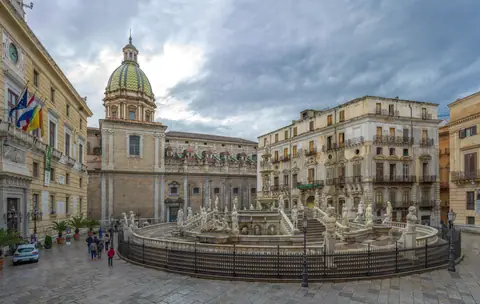
Read each concave wall from street fountain to cornice as a neat civic monument. Ground-level basins show Spring, Summer, Autumn and Winter beside river allegories. Middle niches depict four Spanish Habsburg kings who governed Sicily from afar (Charles V, Philip II, Philip III and Philip IV). Top niches safeguard Palermo's four older female patron saints (Cristina, Ninfa, Olivia and Agata) beneath royal crests. One block south, Fontana Pretoria fills the square beside Palermo's historic town hall, Palazzo delle Aquile.
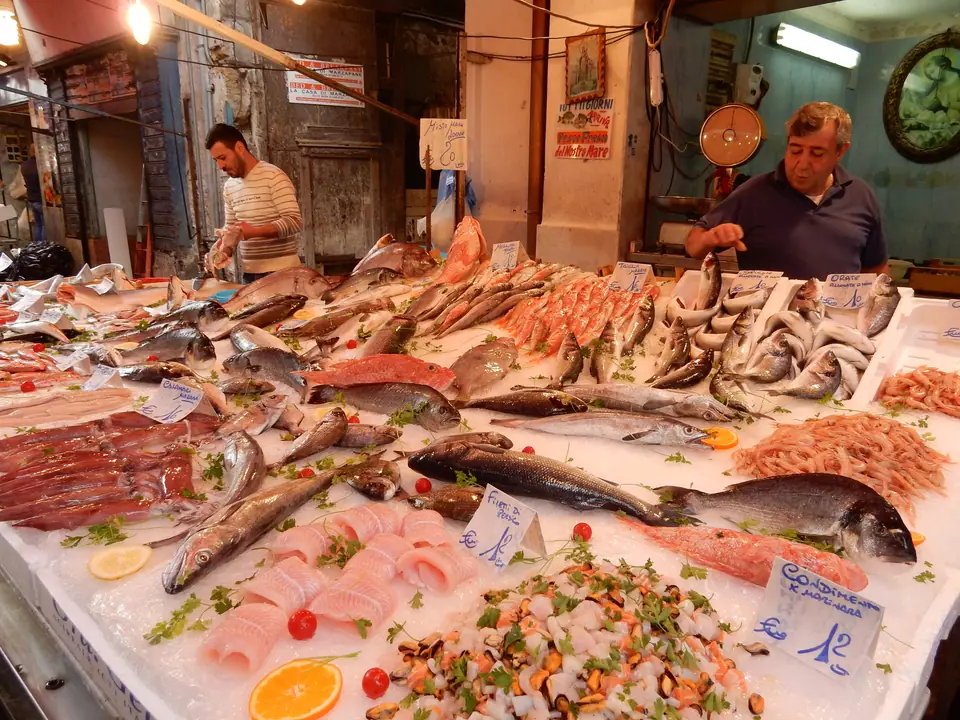
Morning stalls from Mercato del Capo down into Ballarò
Connecting cathedral stonework directly into Palermo's working street markets takes a brief walk from either Piazza della Cattedrale or Quattro Canti. Arrive before midday while colourful awnings still shade glittering fish slabs and mountain herb piles.
- Cross north behind the cathedral through Piazza Beati Paoli onto Via Porta Carini at the top of Mercato del Capo, strolling past fresh tuna steaks, citrus crates and hot chickpea-fritter counters.
- Exit beside Via Sant'Agostino near Teatro Massimo, double south down pedestrian Via Maqueda past Quattro Canti, and turn west behind Piazza Casa Professa.
- Follow Palermo's oldest and loudest open-air street market through Ballarò past Piazza del Carmine, browsing heaps of wild fennel, salted anchovy barrels and ricotta carts stretching toward Palazzo dei Normanni.
Walking both markets inside a single morning reveals clear local contrast. Il Capo keeps tighter covered lanes tailored to neighbourhood fishmongers and bread bakers. Ballarò runs louder through mid-afternoon before traders hose down smooth paving and pack wooden crates away. Keep cross-body bags zipped snugly inside crowded lanes around busy stalls. Return toward Piazza Caracciolo at Vucciria later around sundown, when charcoal grills replace daytime produce awnings and evening crowds spill outside corner taverns.
Between market walks and church steps, pause on stone benches facing Piazza Pretoria or inside cool marble aisles along Corso Vittorio Emanuele. Buying separate rooftop and treasury passes mid-morning lets travellers inspect Constance of Aragon's crown early and watch midday sunshine strike Piazzi's brass meridian line right before lunch. Leaving Via Maqueda markets with warm bakery bread finishes a classic central morning smoothly.
Where it is
- 1Palermo Cathedral, Quattro Canti and Street Markets
- Falcone–Borsellino Airport (PMO) · about 24 km from here in a straight line
- Directions in Google Maps
Stations and taxi ranks: OpenStreetMap. Airports: OurAirports. Distances are in a straight line.
Traveller tips
Real advice from people who have been to Palermo. Every tip is read by our team before it goes live.
No tips yet. Been here? Yours could be the first.
Thank you! Your tip will appear here after a quick review.
More in Palermo
Continue exploring Palermo with related neighbourhood, food, and planning guides