Photo: Aneta Pawska · CC BY-SA 4.0
Cathedral Island, Golden Chapel and Porta Posnania
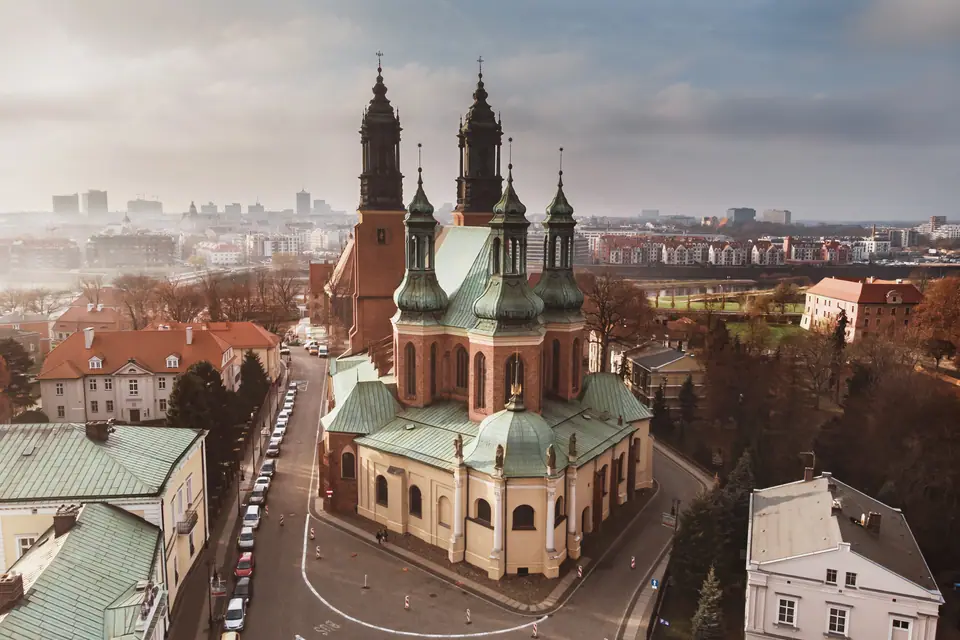
Poland's oldest cathedral on Ostrów Tumski, the Golden Chapel of Mieszko I, 10th-century ramparts at Genius loci and concrete Porta Posnania.
Cross east over the River Warta onto Ostrów Tumski (OS-troof TOOM-skee), Cathedral Island, and busy shopfronts yield abruptly to quiet seminary walls, linden alleys and twin Gothic brick towers. Protected under Poland's 28 November 2008 Historic Monument decree, this forked river island stands as the earliest verified cradle of the Polish state and home to Poland's oldest cathedral. Unlike Stary Rynek across the river, quiet church lanes keep streetcars off the inner island. Footsteps and bicycle bells replace downtown traffic as soon as you step onto tree-shaded episcopal lawns.
Tenth-Century Timber Ramparts and the 968 Episcopal Seat
Long before merchants staked out left-bank house plots in 1253, tenth-century Piast rulers fortified Ostrów Tumski with interlocking wood-and-earth box ramparts. Engineers stacked heavy oak logs filled with compacted clay and sand to resist siege assault and spring flood surges. Following Duke Mieszko I's conversion in 966, missionary Bishop Jordan established Poland's earliest episcopal diocese here in 968. Early masons soon raised a pre-Romanesque stone cathedral dedicated to Saint Peter measuring roughly 48 metres in length. Trams cross Chrobry Bridge along the island's northern fringe today without entering quiet inner cathedral squares, keeping brick churchyards calm underfoot.
Bohemian duke Bretislav I raided and burned the stronghold between 1034 and 1038, roughly 70 years after the 968 foundation. That destruction triggered centuries of ambitious rebuilding atop the exact same sacred ground. Romanesque stone walls rose over ruined piers before fourteenth- and fifteenth-century masons built soaring Gothic brick naves framed by an ambulatory crown of side chapels. Fires in 1622 and 1772 prompted ornate Baroque and Neoclassical facades. Pope Pius VII raised the church to metropolitan archcathedral rank in 1821, and Pope John XXIII granted minor basilica status in 1962.
From 1945 Fire to the Neo-Byzantine Golden Chapel
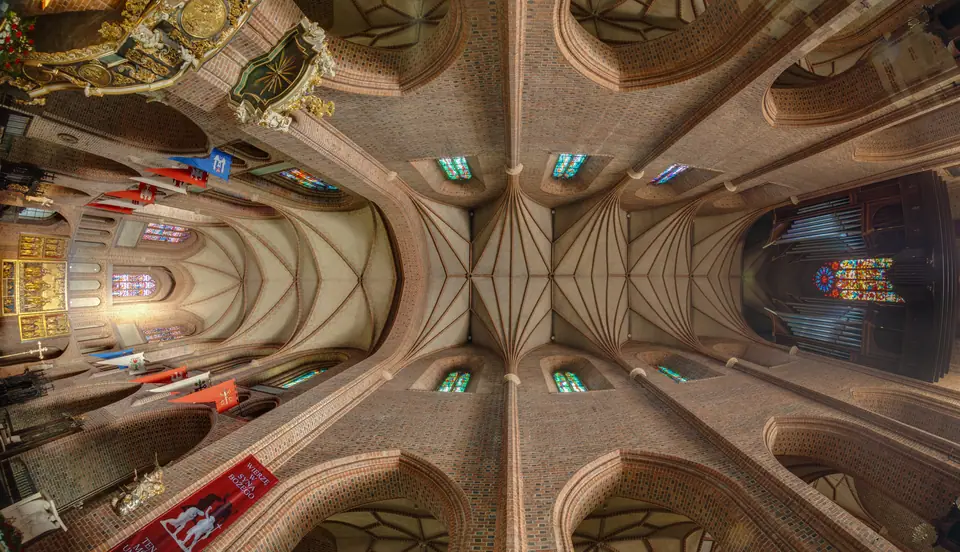
Artillery shelling during the Battle of Poznań set the cathedral roof ablaze on 15 February 1945, collapsing vaults and destroying eighteenth-century woodwork. Rejecting the burnt Neoclassical stucco veneer, post-war restorers pared back soot-blackened piers to recover Gothic pointed brick arcades and stellar nave vaults. After 4,152 days of war scars and rebuilding, the reconsecrated basilica reopened on 29 June 1956. Stepping inside today reveals warm bare brickwork lifting high toward tall lancet stained glass and rescued late-Gothic triptych altars.
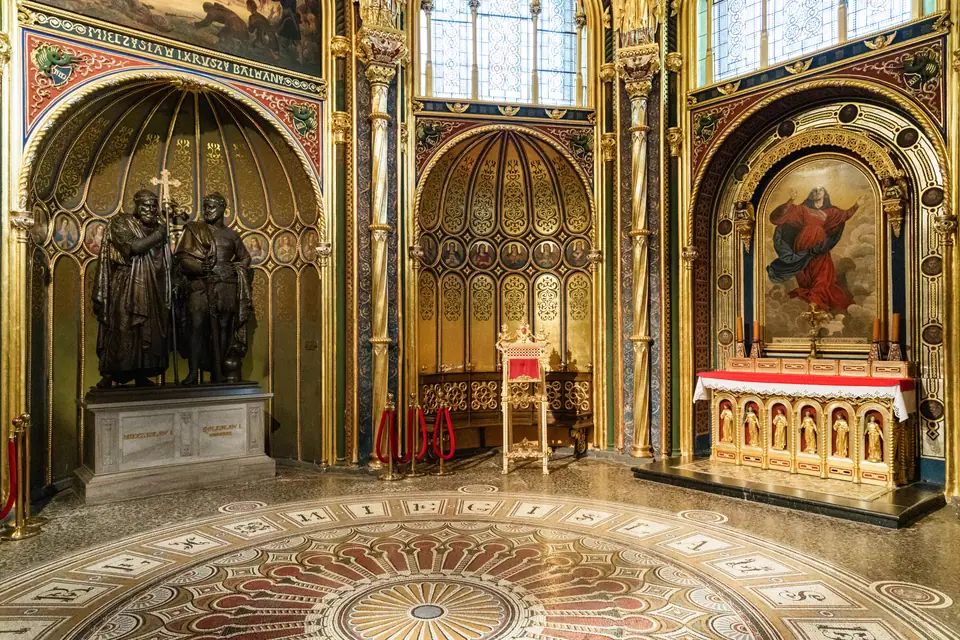
Walk past the choir behind the high altar into the luminous eastern chapel to view the nineteenth-century Golden Chapel (Złota Kaplica). Built between 1835 and 1841 as a Romantic national mausoleum, its gilded mosaic dome and neo-Byzantine marble columns frame Christian Daniel Rauch's bronze statues of Mieszko I (died 992) and King Bolesław I the Brave (died 1025). Symbolic sarcophagi and floor plaques honour eight medieval Piast rulers interred in the sanctuary down to Przemysł II in 1296. Together with the Gothic brick nave, the sanctuary preserves Poland's continuous cathedral site across ten centuries.
Descend concrete stairs inside the nave side aisle into subterranean vaults to inspect tenth- and eleventh-century limestone cathedral footings. Visitors stand feet from pre-Romanesque tomb outlines and a shallow lime-mortar basin linked to early ducal baptisms. Across the cobbled green facing the west towers rises the fifteenth-century Church of the Blessed Virgin Mary (Kościół Najświętszej Marii Panny). Archaeological trenches cut beneath its floor since 1999 revealed the stone footprint of Mieszko I's tenth-century ducal palace and court chapel.
Porta Posnania Glass Footbridge and Bishop Jordan Crossing
Step off the eastern bank across the Cybina channel to see modern museum architecture frame tenth-century statehood without crowding historic brick. Opened in May 2014 in Śródka, minimalist white-concrete Porta Posnania (Brama Poznania ICHOT) serves as Poland's first dedicated heritage interpretation centre. Rather than rows of dusty glass cases, darkened galleries trace Ostrów Tumski's thousand-year story using light projections, tactile scale models and English audio guides. Audio headphones continue cleanly out onto island walkways, allowing self-paced listening beside real church masonry.
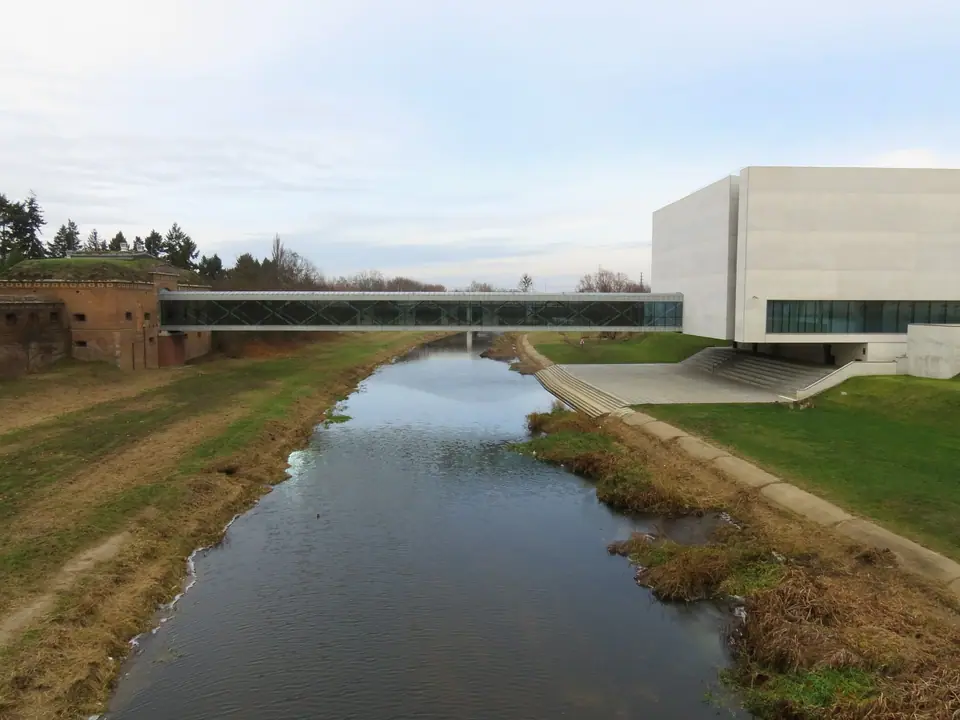
A crisp glazed pedestrian bridge shoots straight from upper exhibition halls across the slow Cybina river toward Prussian brick sluice masonry on Cathedral Island. Immediately south spans the bright red steel-arch Bishop Jordan Bridge (Most Biskupa Jordana, opened in 2007), carrying walkers straight between Śródka wine cafés and Ostrów Tumski linden paths. Because Porta Posnania closes every Monday, plan indoor visits between Tuesday and Sunday before strolling south toward Lake Malta.
Genius Loci Reserve Excavations Beneath Cathedral Island
Steps north of the cathedral porch on ulica ks. Ignacego Posadzego sits the compact Genius loci Archaeological Reserve, opened in June 2012 directly above excavated island defences. Suspended glass walkways inside dimly lit chambers place visitors straight over real tenth-century Piast wood-and-earth rampart cross-sections. Thick oak beams bound with interlocking wooden hooks demonstrate physically how early Polish builders anchored sand and clay embankments above river silt.
Interactive screens beside the trench show how river branches surrounded the fortified settlement long before modern bridges linked it to town. Stepping back outside onto quiet cathedral paths, visitors can loop past the red-brick seminary facades before riding west across the Warta on trams or continuing east on foot. Remember that Genius loci, Porta Posnania and the nearby Archdiocesan Museum all close every Monday. Scheduling Cathedral Island between Tuesday and Sunday lets you inspect the underground ramparts, walk the glazed Cybina footbridge into Porta Posnania and linger inside the Golden Chapel on one calm half-day circuit.
Where it is
- 1Cathedral Island, Golden Chapel and Porta Posnania
- Poznań-Ławica Airport (POZ) · about 9 km from here in a straight line
- Directions in Google Maps
Stations and taxi ranks: OpenStreetMap. Airports: OurAirports. Distances are in a straight line.
Traveller tips
Real advice from people who have been to Poznań. Every tip is read by our team before it goes live.
No tips yet. Been here? Yours could be the first.
Thank you! Your tip will appear here after a quick review.
More in Poznań
Continue exploring Poznań with related neighbourhood, food, and planning guides