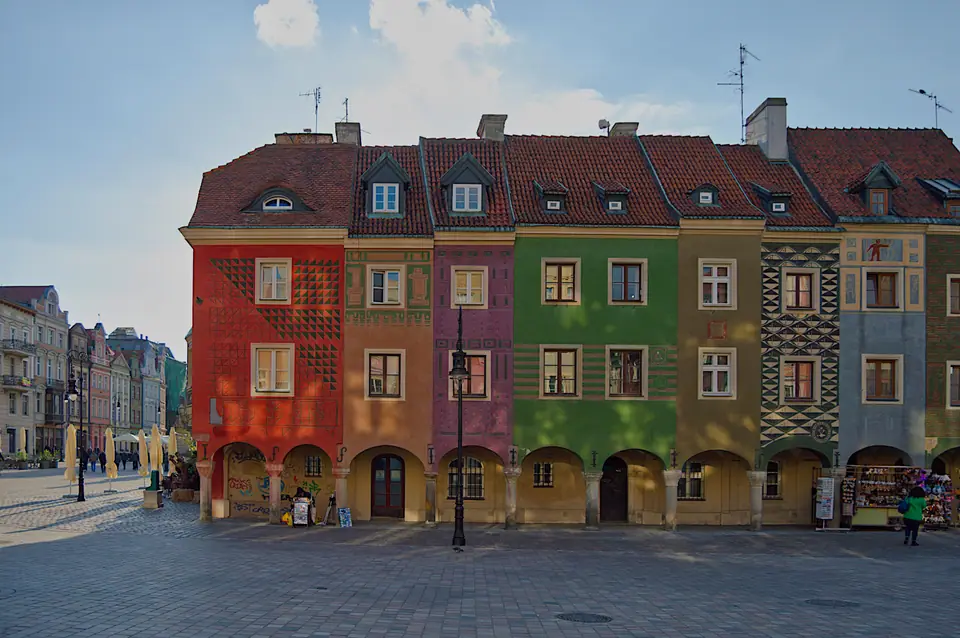
Photo: DamianButrym · CC BY-SA 4.0
Granite Square, Di Quadro's Loggia and Goats
Inside Stary Rynek's post-renovation granite paving, Giovanni Battista di Quadro's 1560 Town Hall, the 2026 to 2028 museum closure and live midday goats.
Stepping onto Stary Rynek today feels far calmer underfoot than it did even a few years ago. Comprehensive civic works carried out between 2021 and 2024 lifted decades of uneven, ankle-twisting cobbles across the historic plaza. Engineers exposed medieval fieldstones beneath old layers while setting smooth structured granite suited to everyday walking. Framed by more than ninety restored merchant townhouses, the square works cleanly as both open-air architectural museum and Poznań's civic living room.
The 1253 Square Plan and Post-Renovation Granite Paving
When Duke Przemysł I granted Poznań its Magdeburg Law town charter in 1253, town surveyors gridded Stary Rynek on a remarkably regular square. Each flank measures roughly 140 to 141 metres long, covering 19,600 to 20,000 square metres in total. That makes Stary Rynek Poland's third-largest historic market square behind Kraków and Wrocław. Each side originally held sixteen equal burgher house plots, making 64 lots around one central trading block.
During the 2021 to 2024 plaza overhaul, engineers renewed deep underground pipes before paving the outer square (płyta rynku). Masons set precision-cut granite blocks in five tonal shades into rigid mortar for flat, step-free crossing. Inside the central market block (blok śródrynkowy), crews sorted and relaid salvaged 1960s granite setts next to level granite pavement slabs bordered by Trident porphyry. Look along historic plinth bases to spot older erratic fieldstones uncovered during trenching, left exposed as quiet markers of medieval ground heights.
Corner stone fountains frame the open plaza, led by the Baroque Proserpina Fountain facing the Town Hall loggia. Wide level pavements keep café tables separated neatly from main walking lanes along all four flanks. Wheelchair users and visitors pulling wheeled suitcases roll straight from corner side streets to central monuments without catching heels between loose cobbles.
Giovanni Battista di Quadro's Loggia, Ratusz Closure and Midday Goats
Rising above the central market island stands the pale Renaissance Town Hall (Ratusz), Poznań's defining civic facade. Begun around 1300 under King Wenceslaus II of Bohemia as a one-storey Gothic council building (Domus Consulum), the hall was documented in 1310, 47 years after the 1253 charter. Builders expanded the hall during the fifteenth century and added a corner tower around 1500. After a severe 1536 fire, Italian architect Giovanni Battista di Quadro rebuilt the monument between 1550 and 1560.
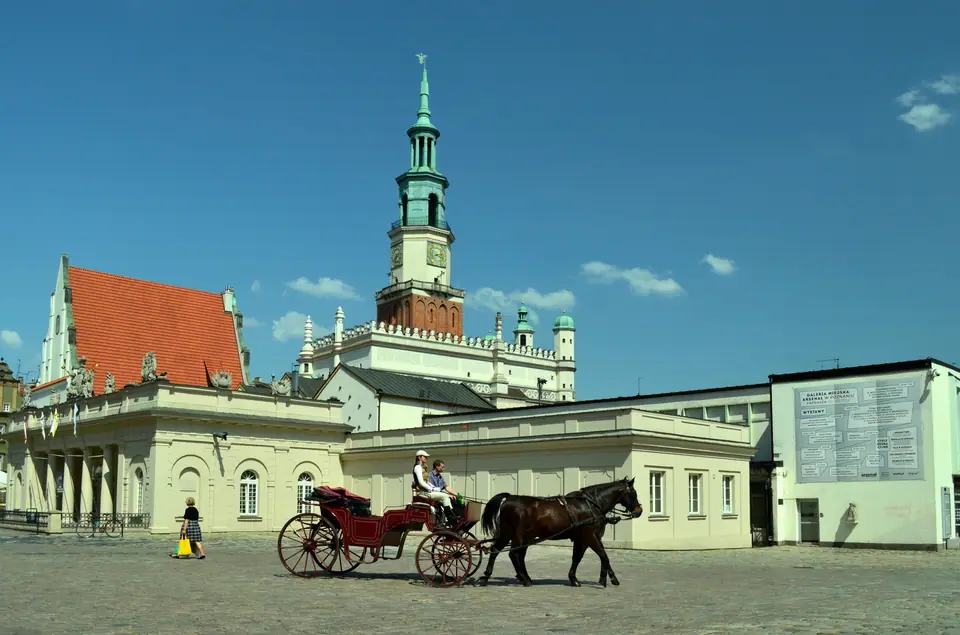
Di Quadro added an upper storey, ornate stepped attic walls and a three-storey arcaded eastern loggia backing onto the Great Renaissance Hall, whose ceiling dates to 1555. High above the central attic gable sits Poznań's famous clock, originally fitted with mechanical goats (Koziołki, kozh-YOHW-kee) in 1551. Lightning shattered both spire and goats in 1675. Carpenters later raised a 90-metre tower in 1690, before a 1725 hurricane tore down its upper spire. Bonawentura Solari crowned the brickwork between 1781 and 1784 with a Classical helmet and two-metre white eagle.
German craftsmen restored the mechanical goats in 1913 during a 1910 to 1913 conservation campaign. Heavy 1945 artillery shelling then demanded painstaking post-war rebuilding from 1945 to 1954. A modern carillon installed in 2003 revived the traditional hourly bugle call (hejnał). Every day at midday and again in mid-afternoon, twin metal goats emerge between open iron shutters above the clock face. Spectators gather on the granite paving below as the goats butt horns twelve times in crisp unison.
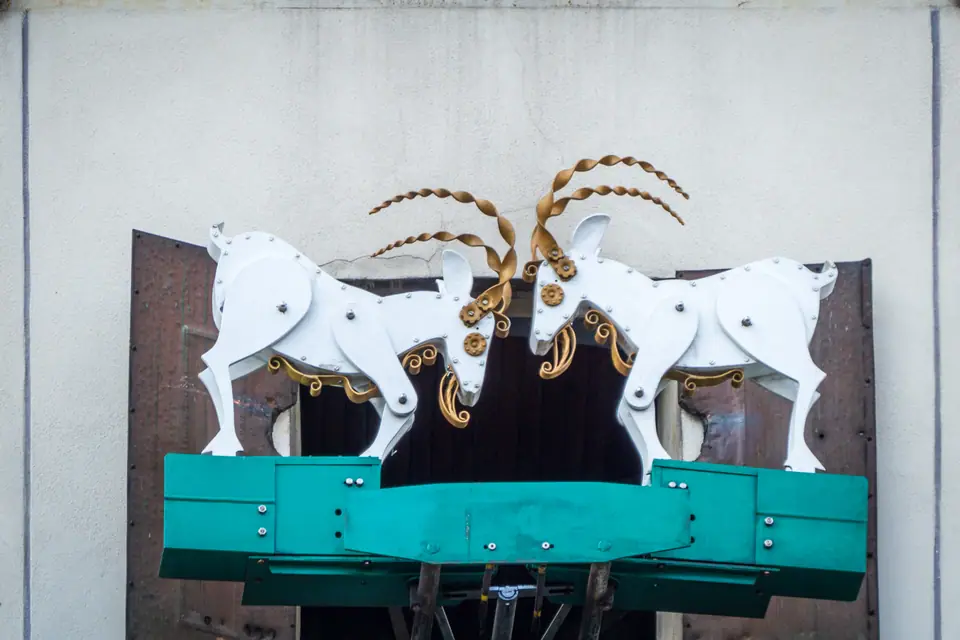
Verify current interior status before scheduling museum visits inside the Town Hall building itself. Ratusz - Muzeum Poznania (a National Museum in Poznań branch) closed completely to visitors on 1 July 2026. Multi-year structural conservation, tower facade repairs and new permanent gallery installations keep interior rooms shut; verify reopening news at mnp.art.pl. Crucially, the exterior mechanical goats continue operating daily at midday and mid-afternoon, staying free to watch from Stary Rynek.
Domki Budnicze Herring Stalls, Waga Miejska, Odwach and Fara
Walking one tight circuit around the central market island joins four civic landmarks facing the Town Hall loggia. Tucked beneath the south-eastern facade stand the slender, brightly painted Domki Budnicze (Merchant Houses). These sixteenth-century Renaissance homes evolved from medieval budy śledziowe stalls where traders sold pickled herring, salt and tallow candles under wooden arcades. Inspect the post-1945 sgraffito facade figures before browsing printmakers' work under the ground arches.
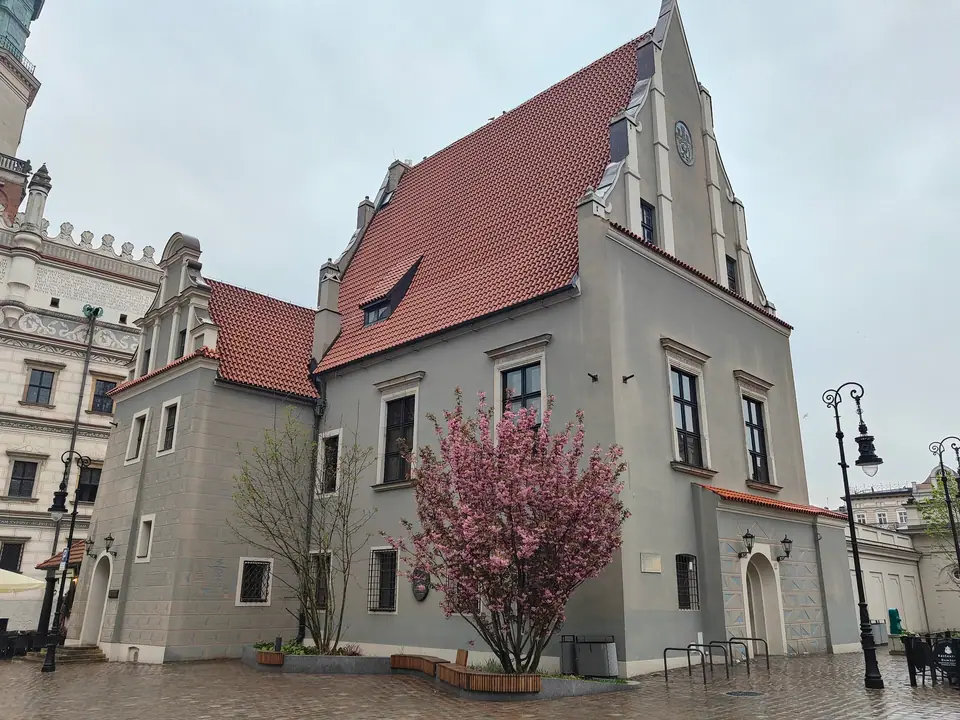
Behind the Town Hall stands the reconstructed Renaissance City Weigh House (Waga Miejska), where civic clerks weighed imported bales for customs tolls. Directly opposite rises the Classical colonnade of the eighteenth-century Odwach (City Guardhouse). Today Odwach continues to display the Museum of the Greater Poland Uprising 1918 to 1919 while a new museum headquarters remains under construction beneath St. Wojciech Hill. Outside the northern corner stands the bronze Bamberka statue, honouring eighteenth-century Franconian settlers invited from Bamberg to farm villages around Poznań.
Whenever plaza cafés turn lively, slip out the southern corner off Świętosławska onto quiet ulica Gołębia. One block down rises the pink stuccoed Baroque facade of Fara Poznańska (1651 to 1705, holding the 2,579-pipe Ladegast organ of 1875 to 1876) beside former Jesuit cloisters. A short walk northwest climbs Góra Przemysła to the thirteenth-century Royal Castle, rebuilt between 2010 and 2016 and now housing the Museum of Applied Arts (closed Mondays). Turning back east along the old square edge stops neatly outside Rogalowe Muzeum at Stary Rynek 41.
Where it is
- 1Granite Square, Di Quadro's Loggia and Goats
- Poznań-Ławica Airport (POZ) · about 8 km from here in a straight line
- Directions in Google Maps
Stations and taxi ranks: OpenStreetMap. Airports: OurAirports. Distances are in a straight line.
Traveller tips
Real advice from people who have been to Poznań. Every tip is read by our team before it goes live.
No tips yet. Been here? Yours could be the first.
Thank you! Your tip will appear here after a quick review.
More in Poznań
Continue exploring Poznań with related neighbourhood, food, and planning guides