Photo: Historia3012 · CC BY-SA 4.0
Imperial Castle, Enigma Centre and Fort Winiary
Wilhelm II's 1910 sandstone palace, CK Zamek's Monday-open interiors, the 2021 Enigma Cipher Centre, 1956 crosses and Park Cytadela sculptures.
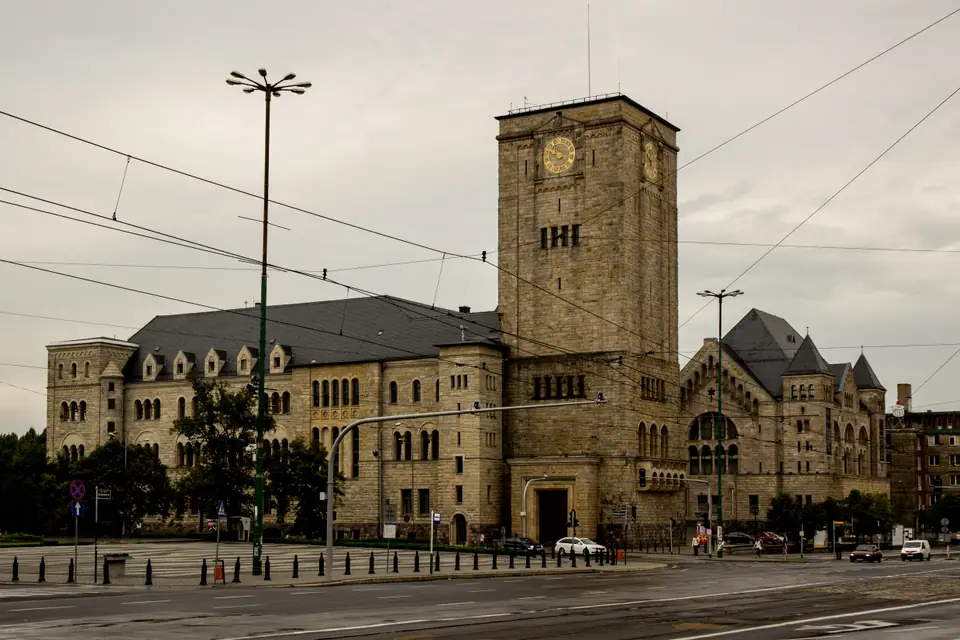
West across Aleja Niepodległości from medieval town walls rises the monumental grey sandstone bulk of Poznań's Imperial Quarter. Directly north up the Warta ridge stretch the wooded embankments of former Fort Winiary. Taken together, the 1910 Imperial Castle, the nearby Enigma Cipher Centre and Park Cytadela trace one clear twentieth-century arc from Prussian rule and Nazi occupation to Polish codebreaking and public remembrance.
Franz Schwechten's 1910 Imperial Palace and Nazi Rebuilding
After Prussian engineers pulled down Poznań's inner brick defences around 1900, imperial architect Franz Schwechten designed a vast Neo-Romanesque palace for Emperor Wilhelm II on the cleared ring boulevard. Drawings took shape in 1904, masonry rose between 1905 and 1910 at a cost of five million German marks, and Wilhelm II inaugurated the residence on 21 August 1910. West wings held private imperial suites beside grand reception halls and a mosaic Byzantine chapel decorated by August Oetken inside the clock tower.
Following Polish independence in 1918, the building housed Polish presidents and Adam Mickiewicz University classrooms before dark wartime rebuilding began in 1939. German occupation architects led by Franz Böhmer under Albert Speer's planning office stripped royal ornament to adapt the palace for Adolf Hitler and Wartheland Gauleiter Arthur Greiser. Builders converted the chapel into a marble office study and reshaped the throne hall into an audience chamber. Crews also excavated an air-raid bunker for 375 people beneath the wings before Eastern Front reversals halted work in 1943.
Rose Courtyard, Throne-Hall Cinema and Daily CK Zamek Access
Battered by 1945 artillery fire, the palace lost the tall spire of its 75-metre tower, leaving today's distinctive truncated stone crown. Listed as a protected monument on 6 June 1979, the complex now houses Centrum Kultury ZAMEK (CK Zamek). Exhibitions, live concerts and Kino Pałacowe arthouse cinema screenings fill the former state rooms. Crucially for itinerary planning, CK Zamek corridors, exhibitions and audio-guided tours operate seven days a week including Mondays, offering dependable indoor shelter when other Poznań museums lock up.
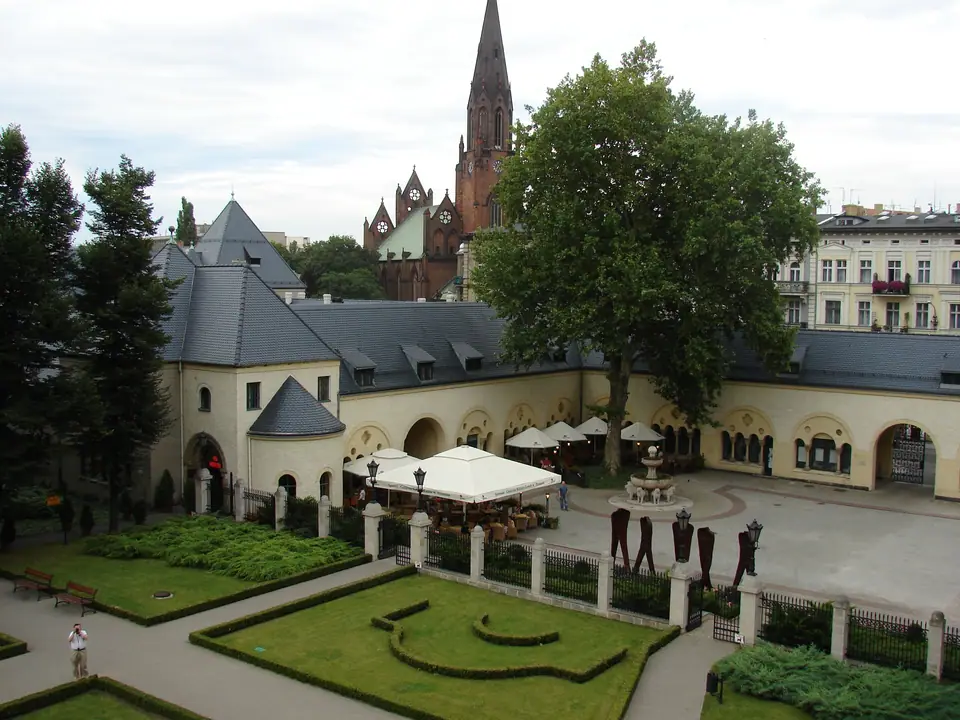
Walk out the western arcade into the sheltered Rose Courtyard, centred on a carved Lion Fountain modelled on Granada's Alhambra and guarded by Magdalena Abakanowicz's weathered iron figures. Every 11 November, festive crowds fill Święty Marcin directly outside the castle walls for Poznań's St Martin's Day parade.
Enigma Cipher Centre: Rejewski, Zygalski and Różycki
Walk two minutes east along ulica Święty Marcin 78 to historic Collegium Martineum, standing over the site where pre-war Polish General Staff cryptologists worked. Opened in September 2021 behind the engraved steel Enigma Cryptologists Monument, the interactive Enigma Cipher Centre (Centrum Szyfrów Enigma) tells the story of Poznań University mathematicians Marian Rejewski, Henryk Zygalski and Jerzy Różycki. Using mathematical group theory rather than guesswork, the trio cracked German military Enigma encryption in 1932 and shared blueprints with Allied intelligence in July 1939.
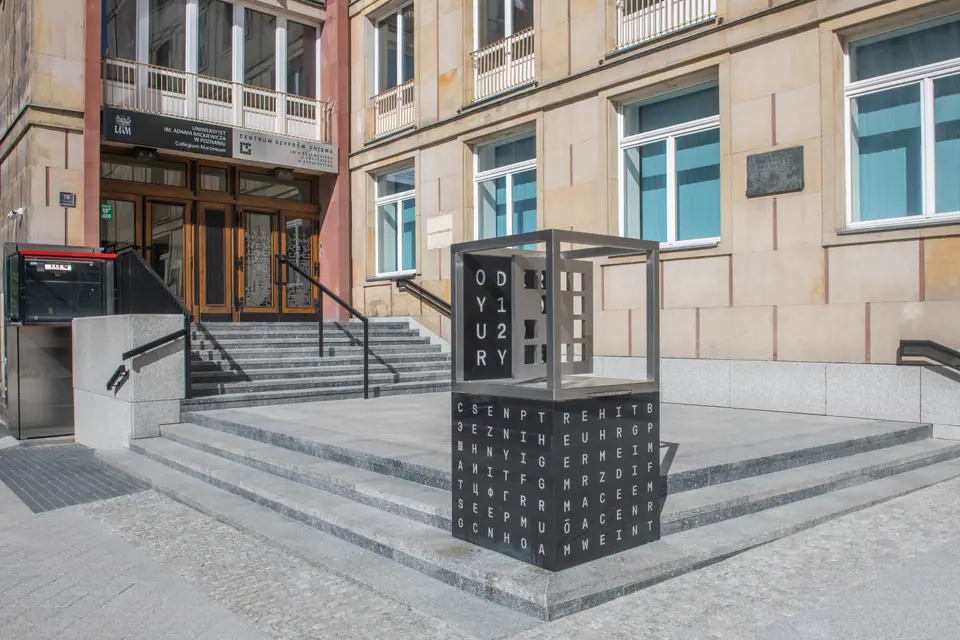
Hands-on cipher displays guide visitors through mechanical substitution rotors step by step before moving into modern digital encryption. Unlike neighbouring CK Zamek, Enigma Cipher Centre closes every Monday with other municipal museums across Poznań.
Twin 21-Metre Crosses at Plac Adama Mickiewicza
Across the wide traffic junction south-east of CK Zamek opens Plac Adama Mickiewicza, framed by Neo-Classical Adam Mickiewicz University assembly halls and Grand Theatre colonnades. Towering above clipped park lawns rise the twin 21-metre linked steel crosses of the Poznań June 1956 Monument. Unveiled on 28 June 1981 by Cegielski factory workers on the 25th anniversary of the uprising, the memorial honours an event where 67 deaths were officially recorded. Engraved dates 1956, 1968, 1970, 1976, 1980 and 1981 commemorate successive Polish protest waves.
Fort Winiary's Prussian Bastions and the February 1945 Fall
Two kilometres north along Aleja Niepodległości rises the hilltop of former Fort Winiary, central anchor of nineteenth-century Festung Posen. Approved on 21 February 1829 under Prussian fortress chief Johann Leopold Ludwig Brese (whose forenames later named bastions Johann, Leopold and Ludwig in 1856), building works displaced Winiary villagers in 1830 before outer ravelins finished around 1838 and 1839. In February 1945, Fort Winiary fought on as the last German strongpoint in Poznań until Soviet units stormed its casemates on 23 February 1945. Post-war courts later held Arthur Greiser's public execution on its slopes.
| Landmark Site | Historical Origin | Monday Access | Core Highlight |
|---|---|---|---|
| Imperial Castle (CK Zamek) | 1905 to 1910 for Wilhelm II; 1939 to 1943 Nazi remodel | Open daily (audio tours) | Rose Courtyard Lion Fountain, throne cinema & galleries |
| Enigma Cipher Centre | Opened Sept 2021 at Collegium Martineum | Closed Mondays | 1932 Polish mathematical breaking of Enigma machine |
| June 1956 Monument | Unveiled 28 June 1981 at Plac Mickiewicza | Open-air (always open) | 21-metre linked crosses marking 1956 workers' revolt |
| Park Cytadela & Nierozpoznani | Fort Winiary 1829 to 1945; park built 1963 to 1970 | Park open (museums closed Mon) | 100-hectare rampart woods & 112 Abakanowicz sculptures |
Park Cytadela, Abakanowicz's Nierozpoznani and Military Museums
Between 1963 and 1970, city planners cleared damaged brick ramparts across roughly 100 hectares to create Park Cytadela, Poznań's largest urban park. Woodland paths pass terraced lawns of the sunken Rosarium, war cemeteries and brick gunpowder magazines. Two military collections closed on Mondays occupy historic fortress wings here: the Museum of Armaments (displaying wartime tanks and aircraft beside brick casemates) and the "Poznań" Army Museum.
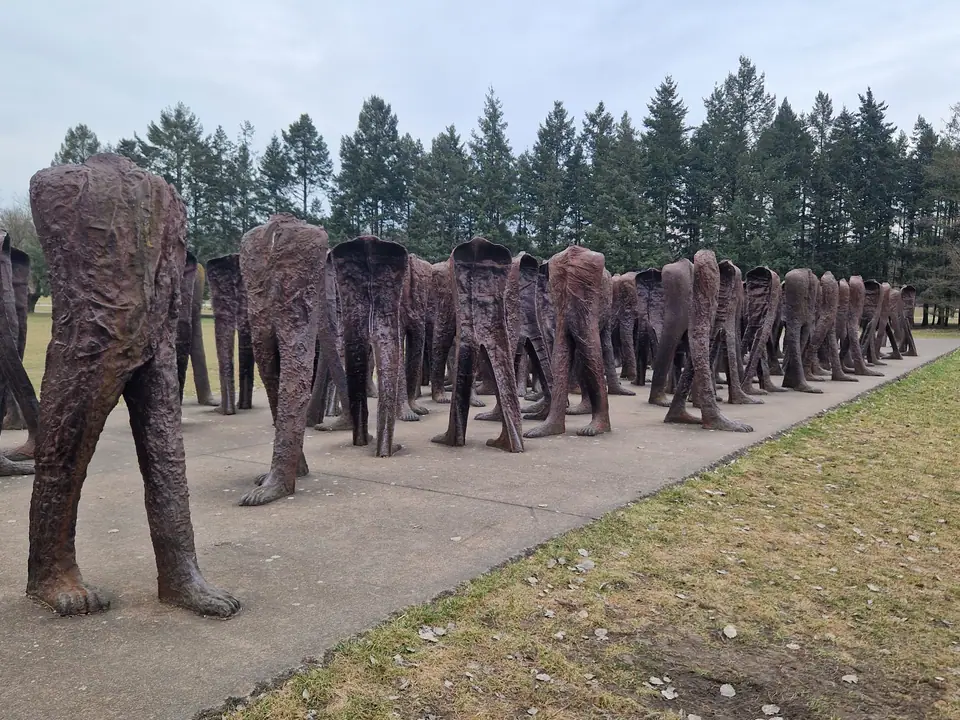
High on the sunlit western ridge stands Magdalena Abakanowicz's Nierozpoznani ("The Unrecognised"), cast from iron in 2002 to mark the 750th anniversary of Poznań's 1253 charter. Walking quietly between those 112 headless striding figures before riding Pestka fast trams back into town brings Poznań's modern history into sharp focus.
Where it is
- 1Imperial Castle, Enigma Centre and Fort Winiary
- Poznań-Ławica Airport (POZ) · about 7 km from here in a straight line
- Directions in Google Maps
Stations and taxi ranks: OpenStreetMap. Airports: OurAirports. Distances are in a straight line.
Traveller tips
Real advice from people who have been to Poznań. Every tip is read by our team before it goes live.
No tips yet. Been here? Yours could be the first.
Thank you! Your tip will appear here after a quick review.
More in Poznań
Continue exploring Poznań with related neighbourhood, food, and planning guides