


























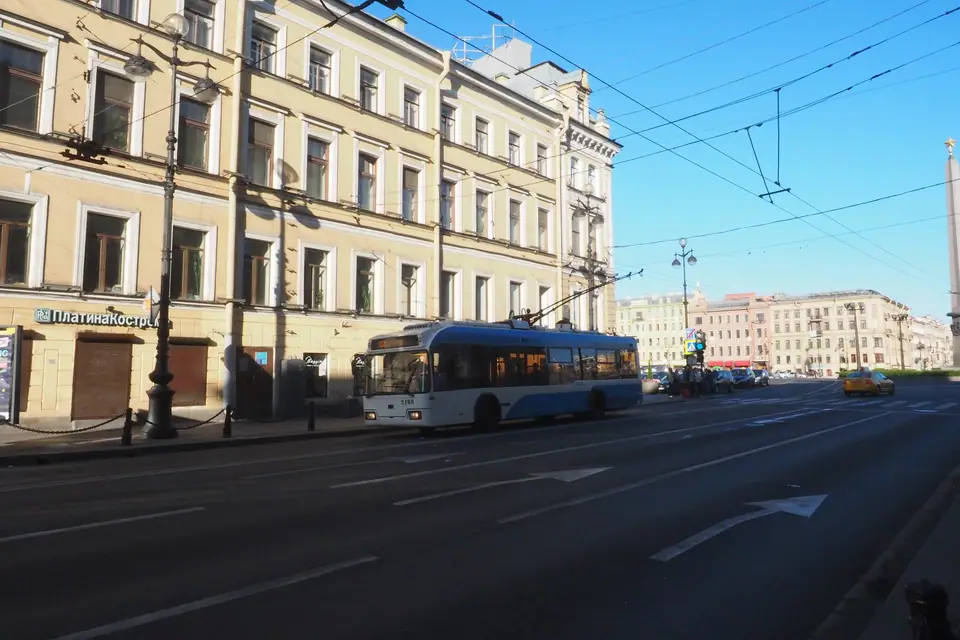
Nevsky Prospekt and the Canals: Singer House, Bridges and Palaces
Walk Saint Petersburg's 4.5-kilometre main avenue from the Admiralty to Fontanka, exploring Singer House, Eliseyev Emporium, and historic canal bridges.
Cut through coastal forest shortly after 1710 to link the Admiralty shipyard with the Alexander Nevsky Monastery at the eastern bend of the Neva River, Nevsky Prospekt has been the commercial, literary, and social spine of Saint Petersburg for three centuries. Stretching 4.5 kilometres across the Moika River, the Griboyedov Canal, and the Fontanka River, the boulevard runs from Palace Square to Vosstaniya Square, where it bends towards the Alexander Nevsky Lavra.
From the Admiralty to the Moika River
Starting at the western end of the avenue between the gilded spire of the Admiralty and Palace Square, walkers pass the former banking palaces of nineteenth-century imperial Russia before reaching the Green Bridge (Zelyony Most) over the Moika River. On the south-eastern corner at Nevsky Prospekt 17 stands the pink-and-white Stroganov Palace, built between 1753 and 1754 by Bartolomeo Rastrelli for Baron Sergei Stroganov, while on the opposite bank at Moika 12 sits the apartment where poet Alexander Pushkin died in January 1837 following his duel with Georges d'Anthès.
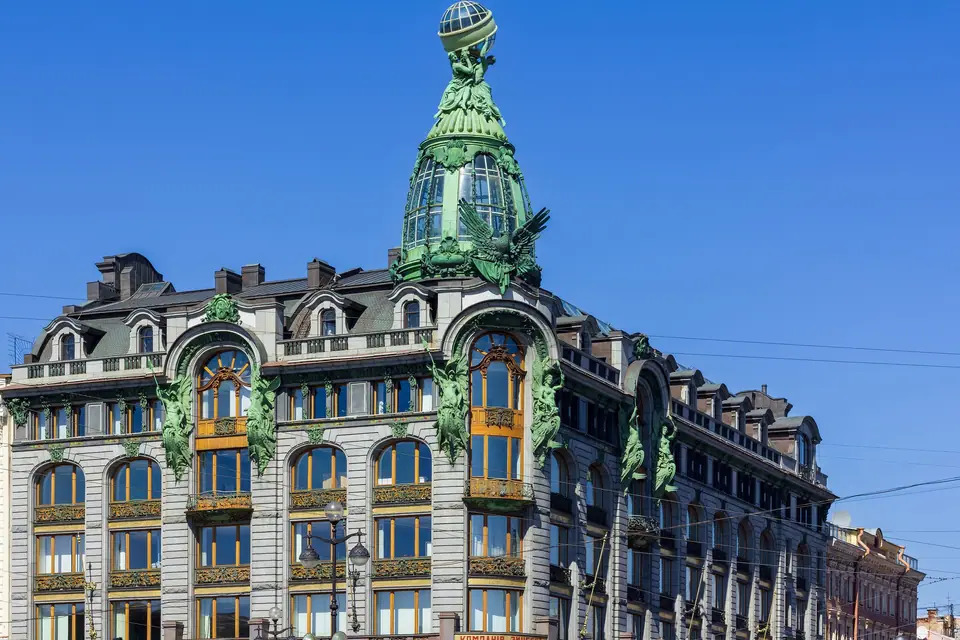
Singer House and the Griboyedov Canal
At the intersection of Nevsky Prospekt and the Griboyedov Canal directly opposite Kazan Cathedral stands the Singer House (Nevsky Prospekt 28), built between 1902 and 1904 by architect Pavel Suzor as the Russian headquarters of the Singer Sewing Machine Company. Because imperial building regulations forbade any secular building in central Saint Petersburg from rising higher than the 23.5-metre cornice of the Winter Palace, Suzor respected the roofline limit for the six-storey granite facade and crowned the corner with a glass tower topped by a globe, while the facade sculpture is the work of Estonian sculptor Amandus Adamson. Since 1938 the building has housed the Dom Knigi (House of Books) bookstore and an upstairs café overlooking Kazan Square.
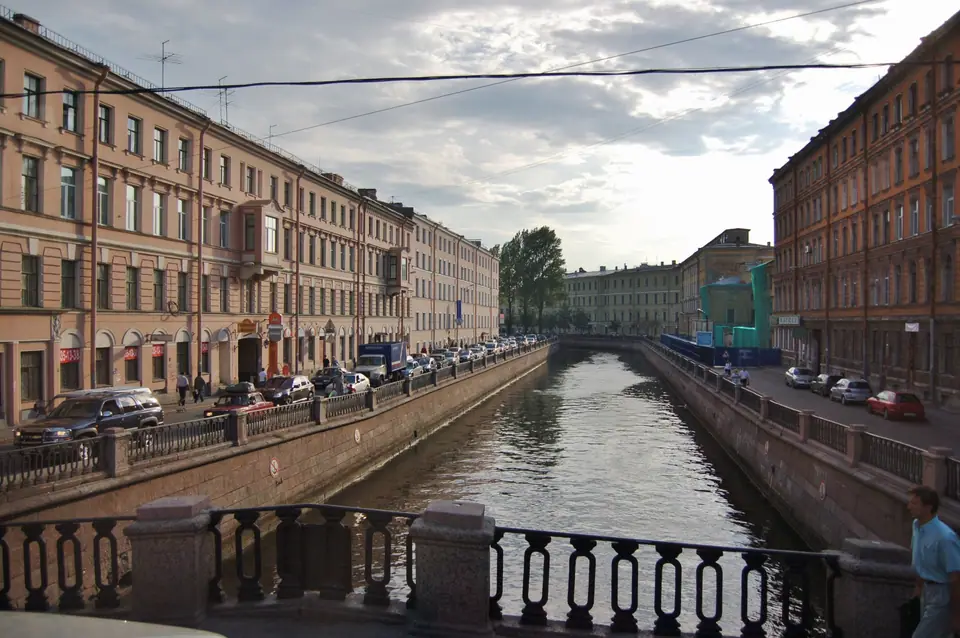
Bank Bridge and the Winged Griffins
Two hundred metres south along the Griboyedov Canal behind Kazan Cathedral, the narrow pedestrian Bank Bridge (1826) spans the water in front of the former Assignation Bank (now the Saint Petersburg State University of Economics). Designed by German-born engineer Wilhelm von Traitteur, its suspension cables are concealed inside the mouths of four cast-iron winged griffins sculpted by Pavel Sokolov, whose gilded copper wings were mythological guardians of gold.
Gostiny Dvor, Eliseyev Emporium and Ostrovsky Square
East of the Griboyedov Canal, the southern side of the boulevard is occupied by Great Gostiny Dvor, an immense two-storey yellow-and-white neoclassical shopping arcade begun in 1761 to a design by Jean-Baptiste Vallin de la Mothe with a perimeter exceeding one kilometre. Across the street at Nevsky Prospekt 56 stands the 1903 Art Nouveau Eliseyev Emporium, facing Ostrovsky Square and the 1873 monument to Catherine the Great in front of Carlo Rossi's Alexandrinsky Theatre (1832).
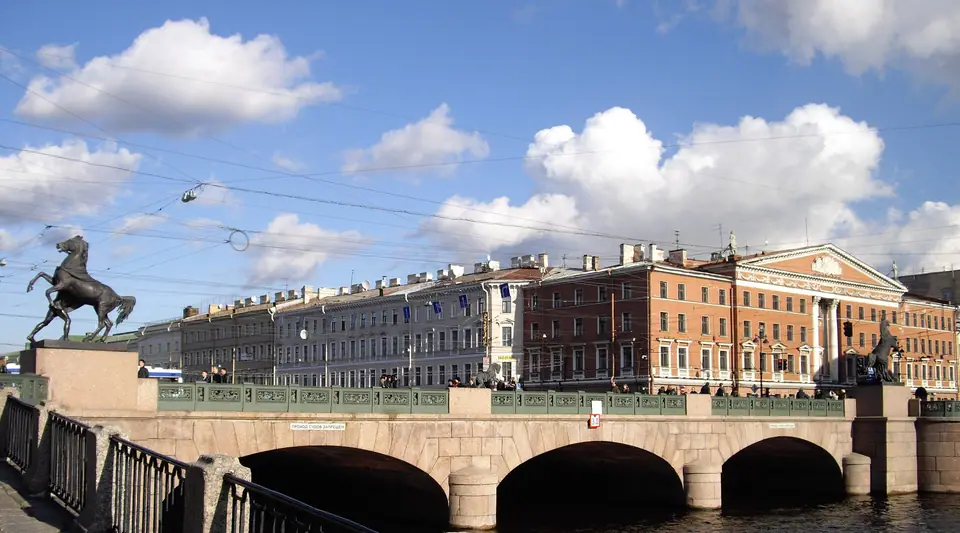
Anichkov Bridge and the Fontanka River
Where Nevsky Prospekt crosses the Fontanka River, Anichkov Bridge marks the eighteenth-century boundary of the city. Rebuilt in stone in 1841, its four corners are anchored by bronze sculptures of The Horse Tamers by Baron Peter Clodt von Jürgensburg (installed in their final sequence in 1850), depicting four stages of a youth subduing a rearing stallion. Beside the bridge stand the neoclassical Anichkov Palace (begun in 1741) and the raspberry-red Beloselsky-Belozersky Palace (1848) by Andrei Stackenschneider.
Boat Cruises Along the Moika and Fontanka
Sightseeing launches depart regularly from piers beside Anichkov Bridge, Green Bridge, and the Griboyedov Canal near the Church of the Savior on Spilled Blood. A one-hour loop passes under low bridges past the Summer Garden and Fabergé Museum before entering the Neva River.
Traveller tips
Real advice from people who have been to Nevsky Prospekt and the Canals: Singer House, Bridges and Palaces. Every tip is read by our team before it goes live.
No tips yet. Been here? Yours could be the first.
Thank you! Your tip will appear here after a quick review.
More in Saint Petersburg
Continue exploring Saint Petersburg with related neighbourhood, food, and planning guides
How to Get to Saint Petersburg: Pulkovo Airport, Trains and Metro
Saint Petersburg, Russia
Where to Stay in Saint Petersburg: Best Districts and Canal Quarters
Saint Petersburg, Russia
Best Time to Visit Saint Petersburg: White Nights, Weather and Seasons
Saint Petersburg, Russia
Saint Petersburg 3-Day Itinerary: Palaces, Islands and Imperial Estates
Saint Petersburg, Russia
