


























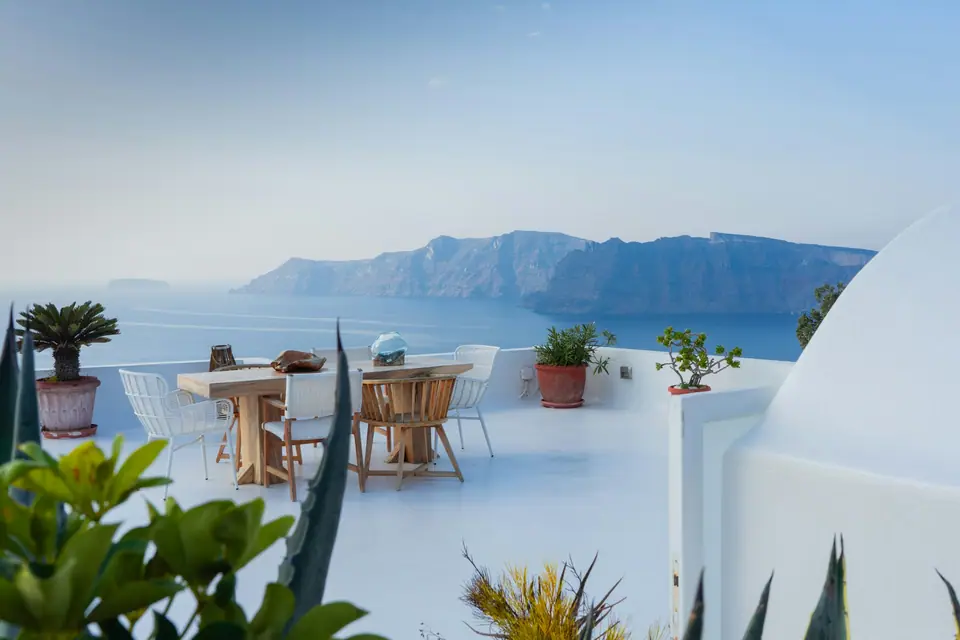
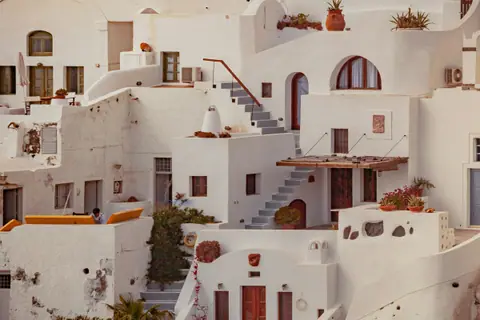
Photo by Philip Jahn on Unsplash
Best Time to Visit Santorini: Weather, Meltemi Winds & Crowds
Why late May, June, September, and early October are the sweet spot for Santorini, how the summer meltemi wind affects boat trips, and what closes in winter.
Short answer. late May through June and mid-September through mid-October are the best times to visit Santorini. During these two shoulder windows, daytime highs sit between 23°C and 27°C, and rainfall is virtually zero. The caldera path from Fira to Oia is comfortable for walking. Cliffside hotel rates also sit 20 to 40 percent below peak August levels. If swimming in warm Aegean water is your top priority, pick September and early October, when the sea has absorbed all summer's sun. If wildflowers, green vineyards, and 14 hours of bright daylight matter more, choose May and early June.
Late Spring (May to June) vs Early Autumn (September to October)
Santorini has one of the driest, sunniest island climates in the Mediterranean, averaging fewer than 50 rainy days across the entire year.
- Late Spring (May & June, 22.8°C to 27.0°C) / Long Daylight & Calm Seas. Rain practically disappears by May, averaging just 11 mm across 2.7 wet days in May and 6 mm in June. The volcanic hillsides around Akrotiri and Ancient Thera bloom with wild red poppies and yellow daisies. Every winery, beach club, and catamaran operator is open for the season before European school-holiday crowds peak. The only catch in May is sea temperature. At 19°C to 21°C, the Aegean off Kamari and Perissa feels brisk until mid-June, though heated hotel plunge pools solve that.
- Early Autumn (September & October, 26.8°C to 23.1°C) / Warmest Sea & Harvest. September is our single favourite month on the island. Air temperatures average a balmy 26.8°C by day and 22.6°C at night with only 6 mm of rain. Sea temperatures off the black-sand beaches peak at 24°C to 25°C. Late August and September bring the traditional vendema (grape harvest) and pressing of sun-dried Vinsanto grapes at the island wineries. By mid-October (average high 23.1°C, low 19.3°C), cruise-ship calls begin tapering off and Oia's lanes feel relaxed again.
Peak Summer (July & August): Crowds, Prices & the Meltemi Wind
July and August bring guaranteed blue skies. Rainfall averages just 1 mm in July and 2 mm in August, with daytime highs of 29.2°C and 29.1°C. Because Santorini is a narrow island surrounded by deep sea, it rarely hits the 40°C extremes of mainland Athens. Instead, high summer is defined by two factors: peak visitor density and the northern Aegean wind known as the meltemi (mel-TEH-mee).
Blowing from the north-northeast across the Cyclades between late June and August, the meltemi is a blessing on the sheltered south-facing caldera rim of Fira and Imerovigli. There it keeps afternoon temperatures fresh and clear of haze. When it reaches Force 6 to 8 on the Beaufort scale for two or three days at a time, however, it whips up whitecaps on the exposed northeastern coast around Kamari and Oia. Strong gusts can delay smaller inter-island high-speed catamarans, while conventional Blue Star ferries almost always sail on schedule. If you visit in July or August, book every hotel, catamaran, and sunset table months ahead. Hike the caldera path at 07:00, and check the municipal cruise ship schedule so you visit Oia on days with fewer ships anchored in the lagoon.
Spring Orthodox Easter (Good Friday in Pyrgos) & the Ifaisteia Festival
Two annual cultural dates stand out on the Santorini calendar and reward planning ahead.
- Greek Orthodox Good Friday (Megali Paraskevi) in Pyrgos (April or Early May). If your spring trip coincides with Greek Orthodox Easter, head up to the medieval hilltop village of Pyrgos on Good Friday afternoon. As dusk falls, local youths light thousands of small tin-can paraffin lanterns lining every rooftop, parapet, church dome, and castle wall on the hill. Viewed from below as the candlelit Epitaphios procession winds through the alleys, the entire mountain glows like a flickering volcano in the night sky. Easter Sunday follows with open-air lamb roasts and local wine across every village square.
- The Ifaisteia (Volcano) Festival in Mid-September. Each September, the municipality stages a spectacular nighttime sound-and-light fireworks reenactment of the Minoan volcanic eruption from barges anchored off the lava island of Nea Kameni. You can watch it free of charge from the entire caldera rim of Fira, Firostefani, Imerovigli, and Oia.
Winter & Low Season (November to March): What Stays Open
Between early November and late March, Santorini enters quiet hibernation. Daytime temperatures stay mild by northern European standards, averaging 14.5°C to 19.8°C by day and 11.0°C to 16.1°C at night. Wet days increase to between 7 and 11 days per month from December to March. Roughly 80 percent of cliffside cave hotels in Oia and Imerovigli, beach bars in Perissa, and seasonal catamaran operators close for winter maintenance. Year-round life centres on Fira (where local shops, tavernas, pharmacies, and KTEL buses keep running) and inland Pyrgos and Emporio. Crucially, the archaeological site of Akrotiri, the Museum of Prehistoric Thera, and leading year-round wineries such as Santo Wines, Estate Argyros, and Domaine Sigalas remain open. Winter is not for beach swimming. Still, if you pack a windproof rain jacket from our what to wear guide, you can walk the entire 10-kilometre Fira-to-Oia trail without seeing another tourist and pay a third of summer hotel rates. Late October also marks St Averkiou Day (22 October), the traditional patron saint feast of wine when village cellars bless and open the new vintage. When comparing ferry schedules across the calendar, note that high-speed catamarans from Heraklion (Crete), Mykonos, Naxos, and Paros run daily from mid-April through late October, whereas winter sailings between November and March rely on the larger conventional Blue Star Ferries vessels out of Piraeus. Choosing a daytime ferry arrival lets you stand on the open sun deck as the ship enters the flooded caldera lagoon beneath the 300-metre red and black volcanic cliffs. Before locking in your travel dates, review our Santorini packing guide for seasonal wind, grippy footwear, and sun-protection layers tailored to the Cyclades, and pair your dates with our 3-day Santorini itinerary.
Where it is
- 1Santorini
- Santorini International Airport (JTR) · about 2 km from Santorini in a straight line
- Heraklion International Nikos Kazantzakis Airport (HER) · about 120 km from Santorini in a straight line
- Directions in Google Maps
Stations and taxi ranks: OpenStreetMap. Airports: OurAirports. Distances are in a straight line.
Traveller tips
Real advice from people who have been to Santorini. Every tip is read by our team before it goes live.
No tips yet. Been here? Yours could be the first.
Thank you! Your tip will appear here after a quick review.
More in Santorini
Continue exploring Santorini with related neighbourhood, food, and planning guides
Santorini: Island Layout, 2025/2026 Rules & Tips
Santorini, Greece
12 Best Things to Do in Santorini: Caldera Hike, Akrotiri & Wine
Santorini, Greece
How to Get to Santorini: Airport (JTR), Athinios Port & KTEL Buses
Santorini, Greece
What to Wear in Santorini: Cliff Steps, Wind, Hot Black Sand & List
Santorini, Greece
