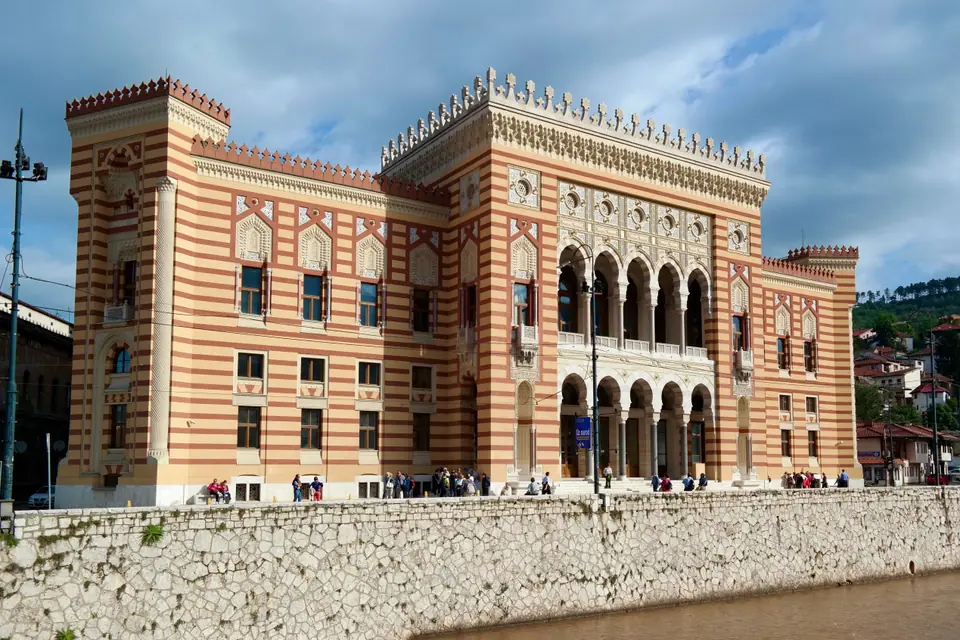
Photo: Choinowski · CC BY-SA 4.0
The Latin Bridge, Vijećnica and June 1914
Crossing the four stone arches where 20th-century war began, then stepping inside Sarajevo's restored Moorish-Revival library hall.
Walk three hundred metres along the north embankment of the Miljacka River (Obala Kulina bana) and two landmarks frame major turning points in European history. At the western end sits the weathered stone arch of the Latin Bridge (Latinska cuprija). That crossing stays tied forever to the morning of 28 June 1914, when gunshots ignited World War One. Three minutes upstream rises Sarajevo City Hall (Vijecnica), whose Moorish-Revival walls burned during the 1992-1996 siege before multi-year restoration brought light back to its stained-glass octagon.
Four stone arches linking Latinluk and Bistrik
Early Ottoman census records already logged a crossing on this site in 1541. A 1565 court register credits builder Ali Ajni-Beg with completing the durable stone bridge connecting Sarajevo's Catholic quarter (Latinluk) on the north bank with Bistrik opposite. Supported by three stout masonry piers, its four semi-circular arches include small weight-relief apertures cut between spandrels to handle spring torrents. Fierce flooding on 15 November 1791 heavily damaged the span, prompting careful stonework reconstruction around 1798 to 1799.
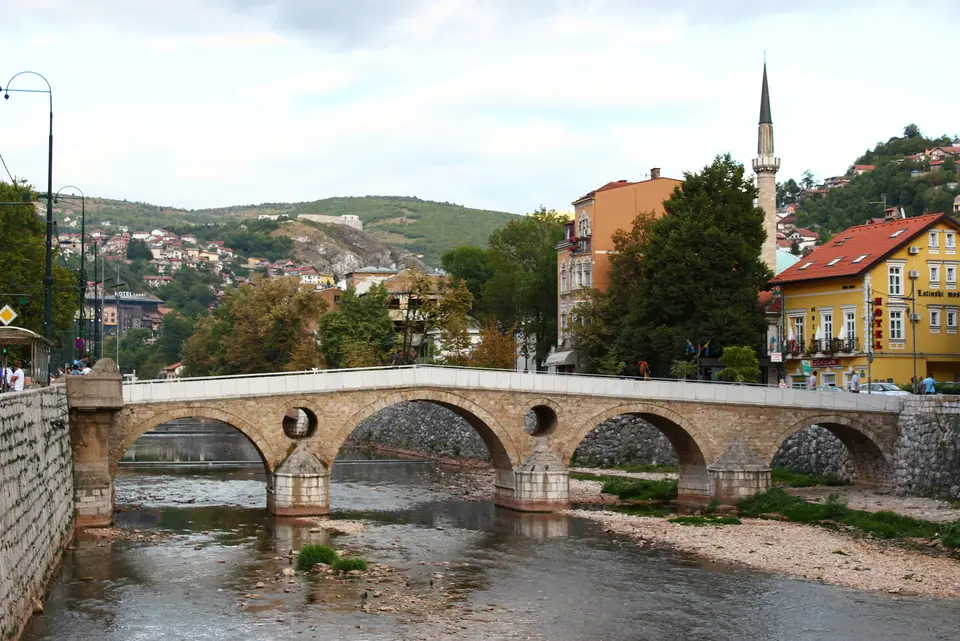
Between 1918 and 1992 Yugoslav authorities renamed the crossing Principov most. Sarajevo later restored its older historical name of Latin Bridge, reflecting the medieval merchant enclave north of the piers. Stand halfway across the cobbled deck today and notice how tightly riverbank hillsides frame both town banks. From the low stone parapet, the street corner outside the northern arch sits just paces away.
The 28 June 1914 corner outside Moritz Schiller's shop
On the morning of 28 June 1914, Austro-Hungarian heir Archduke Franz Ferdinand and his wife Sophie visited Sarajevo for a municipal reception. Earlier along Appel Quay (today Obala Kulina bana), Nedeljko Cabrinovic tossed a grenade that bounced off their open touring car, injuring attendants behind them. After their brief reception at City Hall, the royal motorcade returned down the quay against updated security advice. The lead car turned north off the embankment beside Moritz Schiller's delicatessen at the foot of the Latin Bridge.
As the chauffeur stopped to reverse out of the narrow side street, nineteen-year-old Young Bosnia (Mlada Bosna) member Gavrilo Princip stepped off the kerb. He fired two fatal pistol shots at point-blank range, triggering the July diplomatic crisis across Europe.
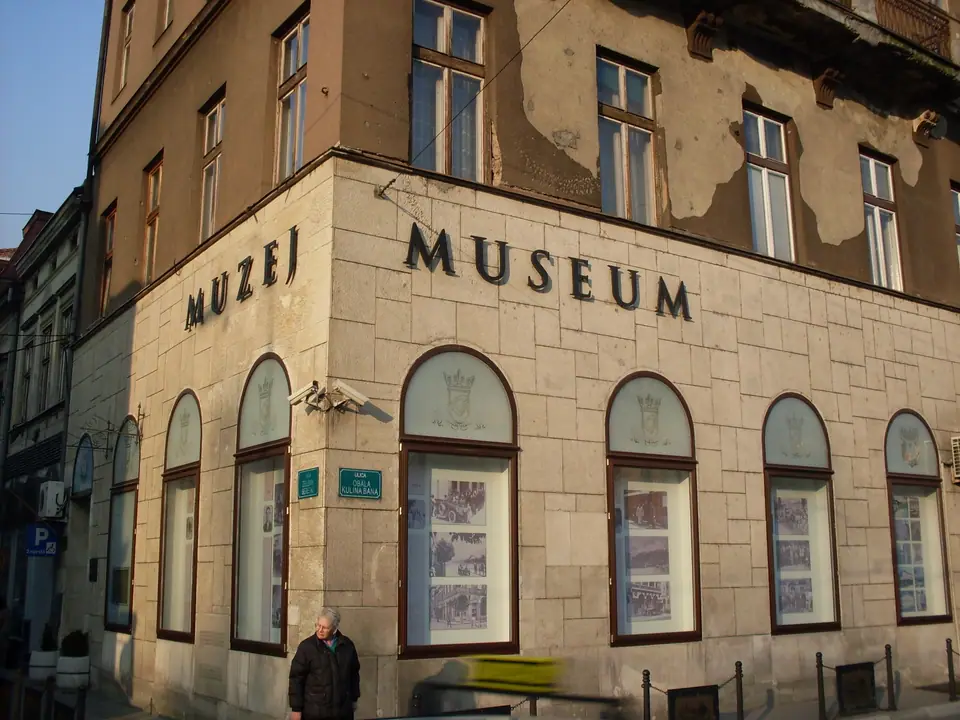
Today the former delicatessen building houses the compact Museum of Sarajevo 1878-1918 (Muzej Sarajeva 1878-1918). Inside one ground-floor room, photographs, civic maps and modest exhibits document Habsburg municipal rule before the war. Step outside onto the pavement corner to read simple street plaques marking the junction cleanly without melodramatic staging.
From 1896 town hall to burned library and restored octagon
Three hundred steps upstream beside Mustaj-pasa's Square, golden-ochre and terracotta stripes lift Vijecnica clearly above the riverbank. Drafted initially in 1891 by Czech architect Karel Parik, the plans shifted into ornate Pseudo-Moorish geometry under Austrian architect Alexander Wittek. Wittek travelled to Cairo to inspect Mamluk arches before his death in 1894, leaving Croatian architect Ciril Metod Ivekovic to finish construction between 1892 and 1894. Documented civic spending reached 984,000 crowns for building works plus 32,000 crowns for fittings (1,016,000 crowns total), celebrating the official opening on 20 April 1896.
From 1949 onward, authorities entrusted the monument to the National and University Library of Bosnia and Herzegovina. Stacks eventually safeguarded roughly 1.5 million volumes, including 155,000 rare books and manuscripts. On the night of 25 to 26 August 1992, Bosnian Serb Army incendiary shelling struck the roof during the 1992-1996 siege. Fires burned relentlessly for days, destroying nearly 90 percent of collections and roughly 700 irreplaceable manuscripts.
Multi-stage restoration followed over nearly two decades. Reconstruction phases three and four alone accounted for KM 4.6 million and KM 14 million toward an estimated KM 25 million effort. Vijecnica hosted its symbolic Europe Day ceremony on 9 May 2014 and opened fully to citizens and travellers on 17 July 2014.
Planning your riverfront walk and Inat Kuca pause
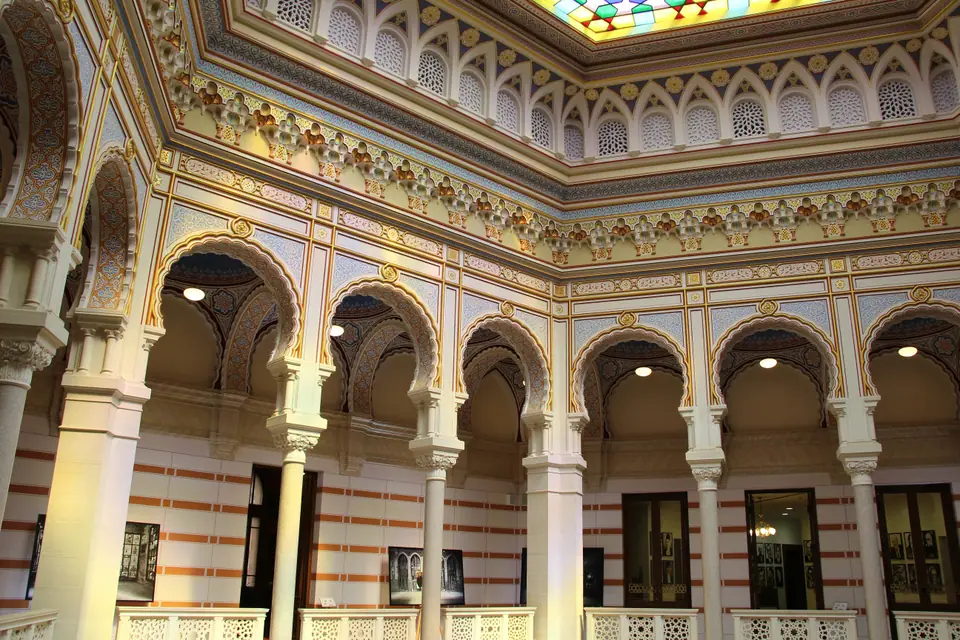
Buy entrance tickets inside Vijecnica's vestibule and climb twin stone staircases to circle the painted arcade beneath the hexagonal skylight. Allow unhurried time inside the vaulted hall to read basement displays covering late nineteenth-century masonry craft and post-1992 structural restoration. Check official visiting notices on vijecnica.ba before setting out, as civic ceremonies and municipal receptions occasionally close the main hall for a morning.
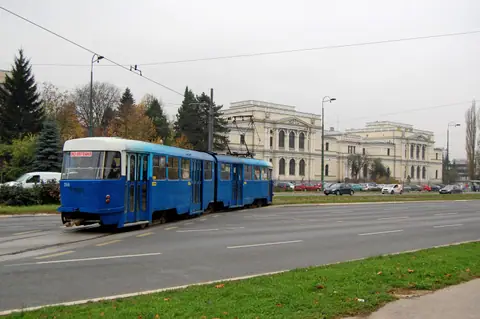
After stepping back into daylight, cross the pedestrian bridge directly opposite to frame Vijecnica mirrored above the Miljacka beside Inat kuca (House of Spite). When Habsburg planners cleared the north embankment for City Hall, the stubborn householder refused cash buyouts unless builders moved his home brick-by-brick across the river in 1895. Today the timber-framed house runs as a traditional restaurant overlooking the triangular riverfront bend where trams swing past Old Town. From that south-bank corner, walk two minutes north back into Bascarsija crafts or west along the embankment toward Ferhadija cafés.
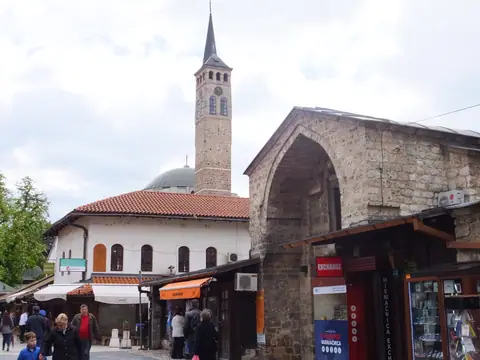
Combine both banks smoothly on foot rather than waiting for taxis between short blocks. River bridges sit a few hundred paces apart, letting you link the 1914 assassination corner, covered stone bazaars and Habsburg riverfront facades within one flat riverside loop.
Where it is
- 1The Latin Bridge, Vijećnica and June 1914
- Sarajevo International Airport (SJJ) · about 9 km from here in a straight line
- Directions in Google Maps
Stations and taxi ranks: OpenStreetMap. Airports: OurAirports. Distances are in a straight line.
Traveller tips
Real advice from people who have been to Sarajevo. Every tip is read by our team before it goes live.
No tips yet. Been here? Yours could be the first.
Thank you! Your tip will appear here after a quick review.
More in Sarajevo
Continue exploring Sarajevo with related neighbourhood, food, and planning guides