






















Castle of the Moors (Castelo dos Mouros): Walls, Hike & Views
Complete 2026 visitor guide to Sintra's 8th-century Castle of the Moors (Castelo dos Mouros): walking the 450 m battlements, Royal Tower climb, Vila.
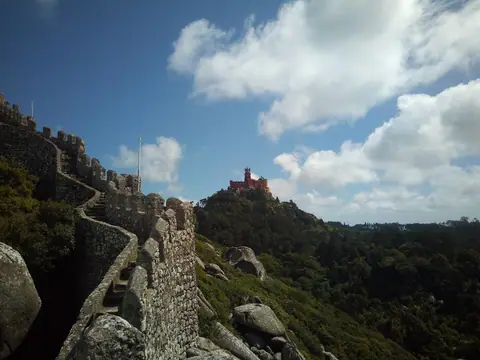
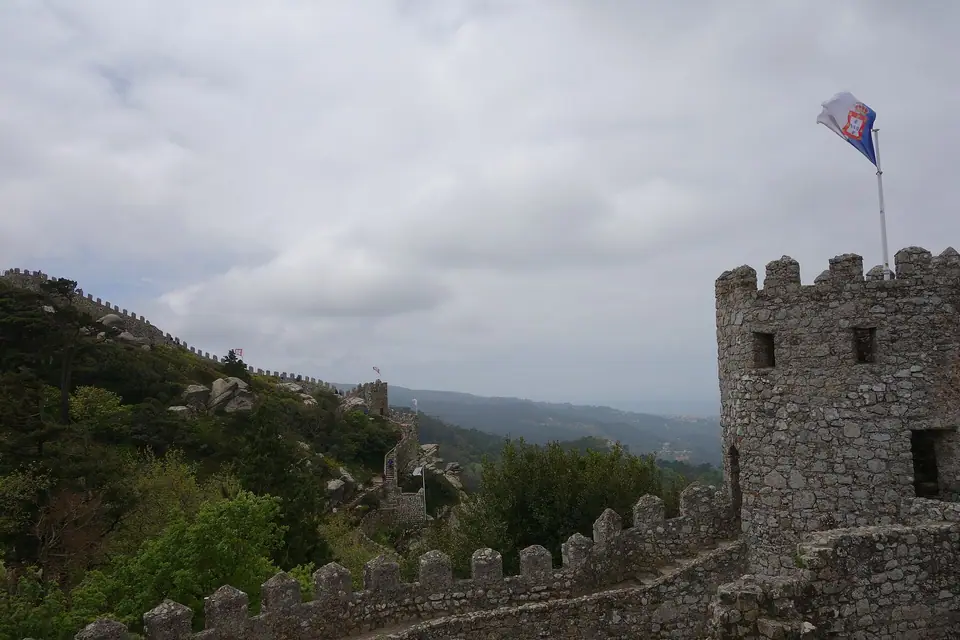
Draped like a stone dragon across two jagged granite peaks at 412 metres elevation directly above the roofs of Sintra-Vila. The Castle of the Moors (Castelo dos Mouros) is the oldest monument on the Serra de Sintra and commands the most dramatic panoramas in the entire region. North African Muslim Umayyad and Berber forces built this cliffside fortress during the 8th and 9th centuries after the 711 AD conquest. From the ridge, the garrison controlled the plains north of Lisbon and the Atlantic shipping lanes. Unlike the ornate staterooms of Pena Palace just 300 metres uphill, the Moorish Castle is an open-air mountain fortress. Here visitors walk directly along 450 metres of crenellated granite battlements suspended between mossy boulders and the sky.
| Castelo dos Mouros Detail / Route | Distance / Steps | Time Needed | 2026 Price / Access (as of Nov 2026) |
|---|---|---|---|
| Adult Castle Admission Ticket. | 450 m rampart perimeter + 5 towers. | 1.5 to 2 hours. | €12.00 adult / €10.00 youth (6 to 17) & senior (65+). |
| Walk from Pena Park Lower Gate. | 300 metres downhill along cobbled road. | 4 to 5 minutes flat/downhill. | Free public forestry walkway. |
| Vila Sassetti Hiking Trail (from Town). | 1.8 km one-way (+215 m vertical ascent). | 40 to 50 min uphill / 30 min downhill. | Free scenic garden & forest trail (open 09:00 to 18:00). |
| Royal Tower (Torre Real) Climb. | ~500 steep stone steps along eastern wall. | 25 to 35 min round-trip on wall. | Included in €12.00 castle ticket. |
From 1147 Christian Reconquest to Ferdinand II's Romantic Restoration
For four centuries, the Muslim garrison of Xintara defended the ridge against Christian raids. Highlights include a brief capture in 1093 by King Alfonso VI of León and Castile and a Viking-style siege in 1108 by Norwegian Crusader King Sigurd I Magnusson. Finally, after the fall of Lisbon in October 1147 during the Second Crusade, the Moorish garrison surrendered the fortress without bloodshed to Portugal's first king, Dom Afonso Henriques. He granted a royal charter (Foral) to thirty Christian settlers and erected the Romanesque Church of São Pedro de Canaferrim inside the outer castle walls.
As maritime trade shifted down to the valley and Lisbon, the wind-lashed mountain fortress was gradually abandoned by the 1500s. Shattered by lightning and the 1755 earthquake until King Consort Ferdinand II leased the ruins in 1839. Rather than rebuilding roofed halls, Ferdinand II and Baron von Eschwege consolidated the double ring of crenellated granite curtain walls as a giant romantic landscape feature visible. From the terraces of Pena Palace, planting native ferns and cedar trees across the rocky interior.
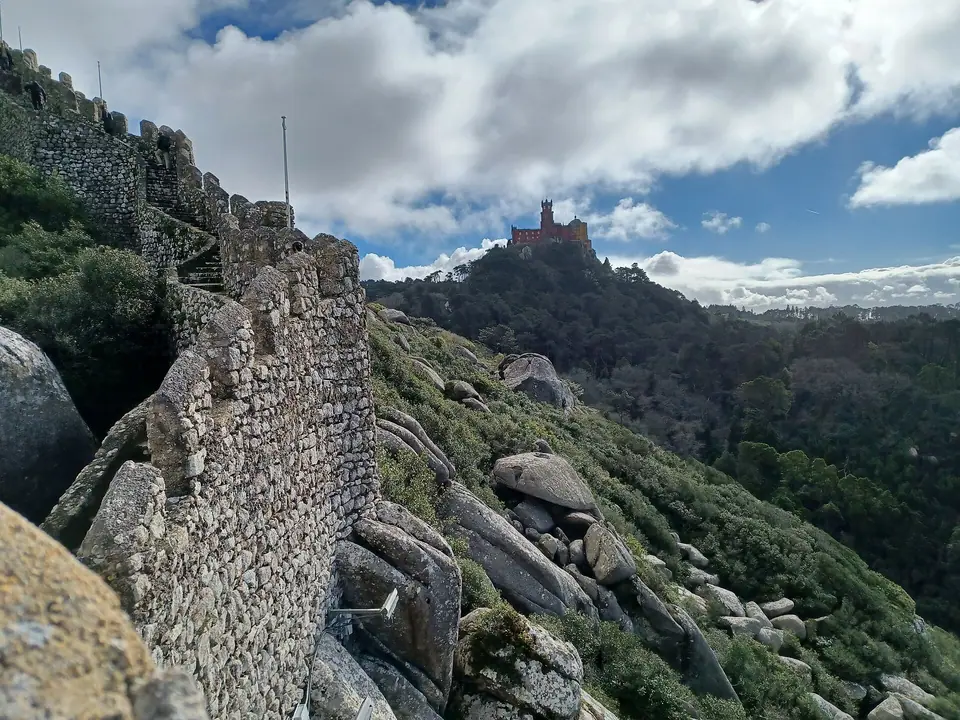
Walking the Double Curtain Walls: The Five Towers & The Royal Tower
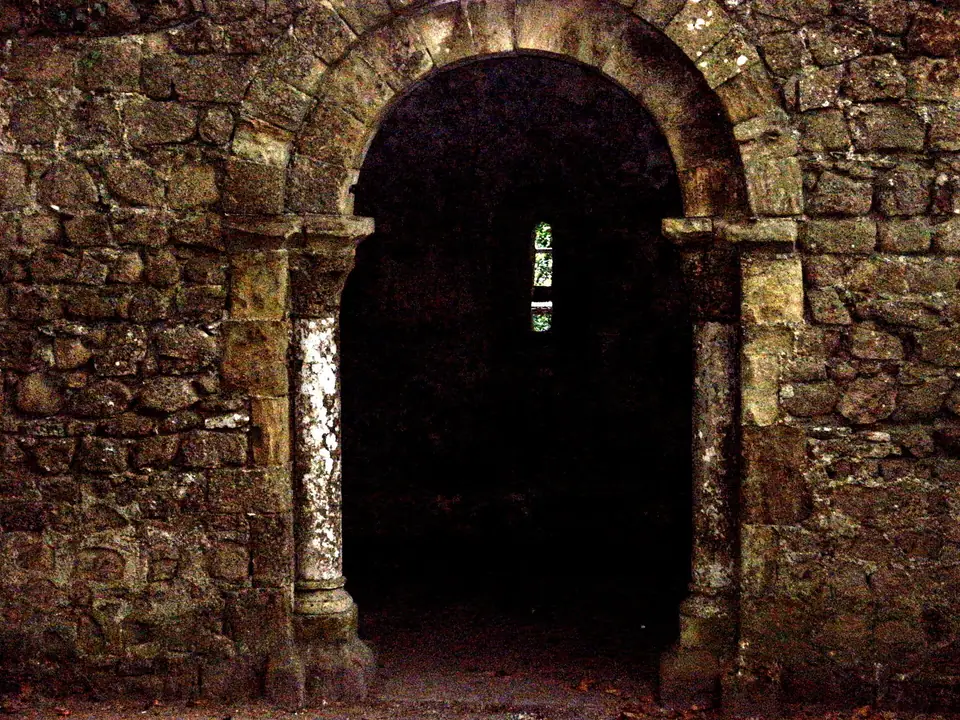
From the outer forest gate, a shaded 500-metre woodland path passes archaeological excavations of the Medieval Islamic Quarter. Here silos dug into the granite rock once stored grain, millet, and fava beans. Archaeologists uncovered medieval Christian burials here near the 12th-century Church of São Pedro de Canaferrim, which now displays Moorish ceramics and arrowheads. Just beyond the church stands the horseshoe-arched portal of the inner citadel (Alcáçova).
Once inside the inner fortress, the rampart walk splits into two distinct loops:
- The Lower Northwestern Wall (Overlooking Sintra-Vila). Easy stone steps lead out to the lower watchtowers directly above the sheer cliff face, looking straight down 200 vertical metres onto the twin white chimneys of the Sintra National Palace. From here you can also spot the octagonal tower of Quinta da Regaleira and the checkerboard fields of the Colares plain stretching to the Atlantic Ocean.
- The Upper Southeastern Climb to the Royal Tower (Torre Real). Climbing nearly 500 irregular granite steps up the spine of the ridge brings you to the highest watchtower of the castle, the Torre Real, where King Ferdinand II loved to sit and paint watercolours. From this high bastion, you get the single most famous wide-angle framing in Sintra: the red and yellow domes of Pena Palace rising out of the forest canopy directly across the valley.
Before leaving the central courtyard, peer inside the vaulted 12th-Century Underground Cistern (Cisterna Árabe)., an 18-metre-long stone reservoir fed by a natural mountain spring inside the rock that supplied fresh water to both the castle garrison and the town palace down in the valley.
How to Hike the Scenic Vila Sassetti Trail (Instead of Taking Bus 434)
To skip the €8.50 Bus 434 queue, take the Percurso Pedestre da Vila Sassetti (PR10), restored in 2015 and free to enter (open daily 09:00 to 18:00). Starting 350 metres south of the Sintra National Palace on Estrada da Pena (opposite the Olga Cadaval Cultural Centre tunnel), you step through an iron gate into the 1890s terraced gardens of Quinta da Amizade (Vila Sassetti). Luigi Manini (the architect of Quinta da Regaleira) designed this estate with a circular Lombard-brick castle villa, terracotta gargoyles, and rushing artificial streams.
Above the Vila Sassetti garden gate, the granite staircase trail climbs past climbing boulders (Penedo da Amizade) and ancient cork oaks. It emerges between the gates of the Moorish Castle and Pena Park in 40 to 50 minutes uphill (or 25 minutes downhill).
Archaeological Treasures: The Islamic Silos & Christian Necropolis
Between 2009 and 2013, comprehensive archaeological excavations led by Parques de Sintra prior to the castle's bicentennial restoration uncovered over a thousand years of daily life on the mountain. Along the outer hillside outside the 12th-century Church of São Pedro de Canaferrim, archaeologists excavated dozens of bell-shaped underground grain silos carved directly into the weathered granite bedrock during the 10th and 11th centuries, lined with clay to keep wheat and barley dry through foggy Sintra winters.
Surrounding the Romanesque church apse, which preserves fragments of 12th-century geometric frescoes on its vaulted stone sanctuary, lies the Medieval Christian Necropolis, used from the 1147 Reconquest until the 15th century. Inside the glass-floored church museum, visitors can inspect Islamic glazed oil lamps, green-and-manganese bowls imported from Córdoba, bone weaving combs, and silver coins minted by Portugal's early kings.
Safety on the Battlements, Wind Warnings & Physical Effort
Walking the full perimeter of the Castle of the Moors is one of the most exhilarating experiences in Portugal, but it requires sensible mountain awareness. While the outer side of the granite battlements has high stone merlons, the inner side of several wall sections drops two to three metres onto rocky terraces. With minimal modern handrails, and the steps climbing up to the Royal Tower are steep and uneven. Hold onto the fixed iron cable handrails installed along the steepest sections, wear grippy closed-toe sneakers, and keep young children closely by the hand. Note that the only restrooms and coffee/water vending kiosks are located near the outer entrance gate and the Church of São Pedro de Canaferrim. There are no toilets once you climb up onto the high eastern ramparts.
Where it is
- 1Castle of the Moors (Castelo dos Mouros)
- Lisbon Humberto Delgado Airport (LIS) · about 22 km from here in a straight line
- Directions in Google Maps
Traveller tips
Real advice from people who have been to Sintra. Every tip is read by our team before it goes live.
No tips yet. Been here? Yours could be the first.
Thank you! Your tip will appear here after a quick review.
More in Sintra
Continue exploring Sintra with related neighbourhood, food, and planning guides
Pena Palace & Park Guide: Timed Tickets, Terraces & Bus 434
Sintra, Portugal
Quinta da Regaleira Guide: Initiation Well, Tunnels & Tickets
Sintra, Portugal
Sintra National Palace (Town Palace): Swan Room & Azulejos
Sintra, Portugal
Monserrate Palace & Convent of the Capuchos: Complete Guide
Sintra, Portugal
