





















Palace of Queluz & Chalet of the Countess of Edla: Complete Guide
Complete 2026 guide to the 18th-century Rococo National Palace of Queluz (€10) on the Lisbon-Sintra train line and the alpine Chalet of the Countess of Edla.
Two remarkable monuments bookend the 19th-century fairy-tale palaces on the mountain. Halfway between Lisbon Rossio and Sintra on the CP railway line stands the 18th-century Rococo National Palace and Gardens of Queluz (Palácio Nacional de Queluz). High inside the western woods of Pena Park sits the cork-trimmed alpine Chalet of the Countess of Edla (Chalet da Condessa d'Edla), where King Ferdinand II spent his final years with his second wife.
| Royal Monument | Location & Access | Visit Duration | 2026 Ticket Price (as of Nov 2026) |
|---|---|---|---|
| National Palace & Gardens of Queluz. | Queluz-Belas CP Station (12-min walk) or €10 Uber from Lisbon. | 1.5 to 2 hours. | €10.00 Palace+Gardens (or €5.00 Gardens only). |
| Chalet of the Countess of Edla. | Western edge of Pena Park (25-min walk from Pena Palace). | 45 to 60 minutes. | Included FREE in both €20 Pena Palace & €10 Pena Park tickets! |
| Portuguese School of Equestrian Art. | Queluz Palace Gardens (Henrique Calado Riding Arena nearby). | 45 to 60 min training/gala. | Check schedule on parquesdesintra.pt (€10 to €25). |
National Palace of Queluz: The 18th-Century "Portuguese Versailles"
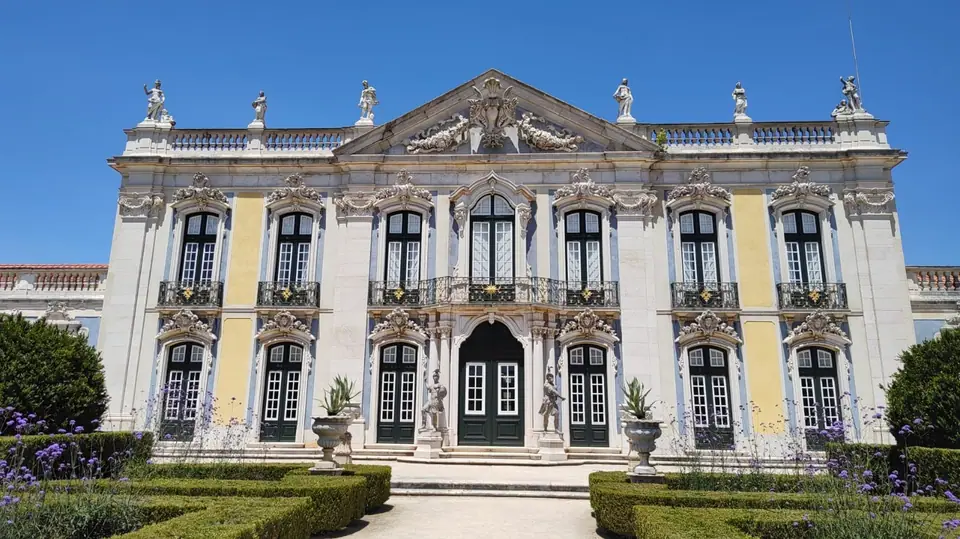
Located 14 kilometres northwest of Lisbon, the National Palace of Queluz was transformed from 1747 onward by Prince Dom Pedro of Braganza. He expanded a 17th-century hunting lodge into a summer palace inspired by Versailles and Marly. It was designed in two phases, first by Portuguese Rococo master Mateus Vicente de Oliveira (who created the Throne Room and Ceremonial Facade) and second by French architect Jean-Baptiste Robillion (who added the Robillion Pavilion and Lion Staircase). Queluz became the permanent residence of the royal family after the 1755 earthquake, where Queen Maria I slipped into mental illness before the court fled to Brazil in November 1807.
Walking through the single-storey enfilade of state rooms (€10.00 adult entry for Palace and Gardens as of November 2026, open daily 09:00 to 18:00) reveals four essential interiors:
- The Throne Room (Sala do Trono, 1768). Mateus Vicente de Oliveira designed this grand hall for royal banquets and masquerade balls. Gilded caryatids support its vaulted ceiling, while mirrored French doors multiply the sparkle of crystal chandeliers.
- The Music Room (Sala da Música, 1759). The oldest surviving room in the palace, where Italian castrato singers and chamber orchestras performed works by Domenico Scarlatti beside a priceless 18th-century French Empire grand piano beneath an ornate red-and-gold cartouche ceiling.
- The Ambassadors' Room & The Don Quixote Chamber. In the Ambassadors' Room, a ceiling fresco by Francisco de Melo depicts King José I and Queen Mariana Vitória attending a concert. Next door in the polygonal Don Quixote Room, painted with scenes from Cervantes, King Pedro IV (Emperor Pedro I of Brazil) was both born in 1798 and died in 1834.
The Queluz Formal Gardens & The 115-Metre Tiled Azulejo Canal
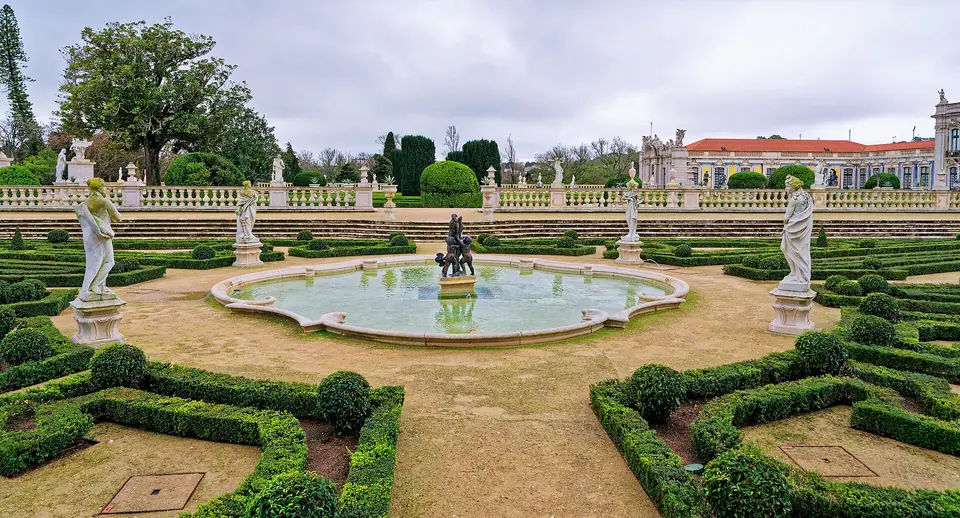
Stepping out onto the terraced parterres behind the palace reveals five hectares of French-Italian formal gardens populated by lead statues of classical mythology cast in the London workshop of British sculptor John Cheere (including the central Fountain of Neptune and the Fountain of Nereids) and the monumental Lion Staircase (Escadaria dos Leões) connecting the lower bamboo grove to the Robillion Pavilion.
The most original feature in the entire garden sits along the western stream: the Tiled Canal (Canal dos Azulejos). Spanning 115 metres in length, its three-metre-high walls are faced in more than 50,000 blue-and-white and polychrome 18th-century glazed tiles depicting harbour scenes, sailing ships, and allegories of the four seasons. In summer, the canal was dammed with wooden sluice gates so the royal family could float up and down in Venetian gondolas while musicians played from the Chinoiserie bridge. To visit Queluz on your way to or from Sintra, hop off the CP train at Queluz-Belas Station (18 minutes from Rossio, 22 minutes from Sintra). Follow the signposted avenue 900 metres south to the palace forecourt.
The Chalet of the Countess of Edla (1869): Cork Architecture & Royal Romance
Sixteen years after the death of Queen Maria II in childbirth, the widowed King Ferdinand II fell deeply in love with Elise Hensler (1836 to 1929)., a Boston-born Swiss-American operatic soprano whom he heard sing in Verdi's Un ballo in maschera at Lisbon's Teatro Nacional de São Carlos in 1860. Portuguese court protocol forbade a royal widower from marrying a commoner without a title. Ferdinand's cousin Duke Ernest II of Saxe-Coburg and Gotha created Hensler Countess of Edla (Condessa d'Edla) days before their wedding in June 1869.
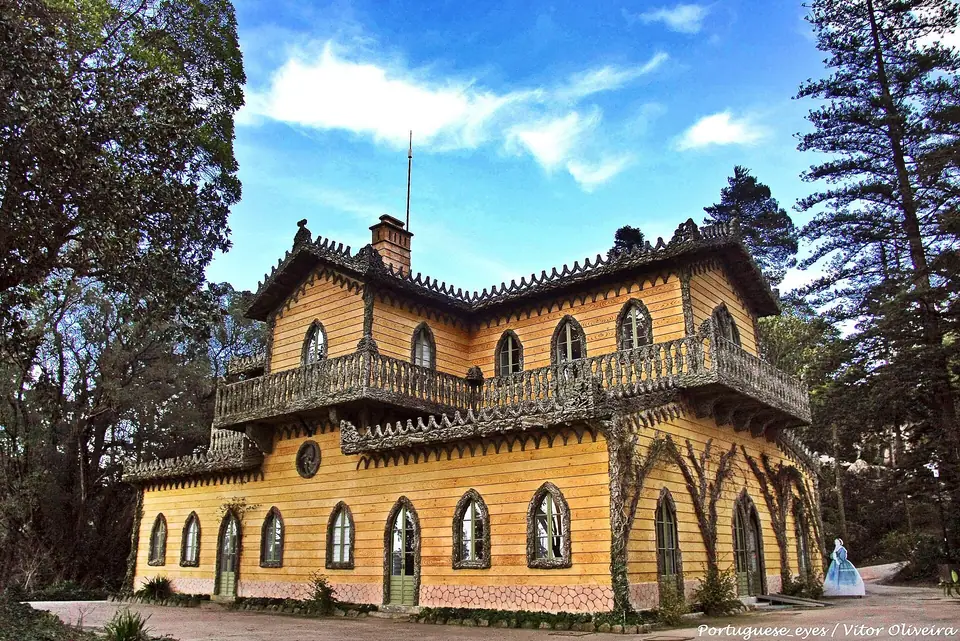
Between 1864 and 1869, the couple designed their own private two-storey refuge on the western edge of Pena Park, modelled on a traditional Swiss alpine chalet. What makes the Chalet of the Countess of Edla architecturally unique in Europe is its trompe-l'œil exterior and interior craftsmanship. All the corner quoins, window frames, balcony balustrades, and climbing ivy vines are carved from raw local cork bark. Meanwhile, the interior walls are painted in faux-wood mural patterns and inlaid with cork mosaics. After a catastrophic arson fire gutted the abandoned building in 1999, Parques de Sintra completed an award-winning brick-by-brick and cork-by-cork reconstruction in 2011 (honoured with the Europa Nostra Award). Remember that admission to the Chalet and its surrounding Feteira da Condessa botanical garden is 100% included in both the €20.00 Pena Palace ticket. The €10.00 Pena Park ticket, either walk 25 minutes west from Pena Palace through the Valley of the Lakes or enter directly via the western Portão dos Lagos gate.
Watching the Portuguese School of Equestrian Art & Visiting Logistics
The Palace of Queluz is also the historic home base of the Portuguese School of Equestrian Art (Escola Portuguesa de Arte Equestre). It ranks among the world's "Big Four" classical riding academies together with Vienna, Saumur, and Jerez. Mounted on purebred chocolate-bay Lusitano stallions from the royal Alter Real stud (founded in 1748) and dressed in 18th-century velvet coats and tricorn hats, the riders perform courtly haute école airs to Baroque chamber music. Check the official parquesdesintra.pt calendar before your visit to see whether morning training sessions or Friday/weekend gala performances are taking place at the palace gardens or the nearby Henrique Calado Riding Arena in Belém.
To visit Queluz by rail between Lisbon and Sintra, step off the CP train after 18 minutes at Queluz-Belas Station. Follow the brown pedestrian signs 900 metres south along Avenida António Enes to the semicircular palace forecourt. After spending two hours in the state rooms and the tiled Azulejo Canal, walk back to the station and hop on the next train 22 minutes up the line to Sintra.
Inside the west wing of Queluz Palace, visit the Music Room (Sala da Música) to see its 18th-century Italian harpsichord and court portrait medallions. Next door stands the Royal Chapel, consecrated in 1752 with a polychrome marble altar and Rato glazed tiles. When walking between Pena Palace and the Chalet of the Countess of Edla, follow the shaded path past the Queen's Fern Valley (Feteira da Rainha). The route passes the five tiered duck ponds of the Valley of the Lakes.
Where it is
- 1Palace of Queluz & Chalet of the Countess of Edla
- Lisbon Humberto Delgado Airport (LIS) · about 11 km from here in a straight line
- Directions in Google Maps
Traveller tips
Real advice from people who have been to Sintra. Every tip is read by our team before it goes live.
No tips yet. Been here? Yours could be the first.
Thank you! Your tip will appear here after a quick review.
More in Sintra
Continue exploring Sintra with related neighbourhood, food, and planning guides
What to Wear in Sintra: Wet Cobble Grip, Wind Layers & Tunnels
Sintra, Portugal
Where to Stay in Sintra: Sintra-Vila, Estefânia, Seteais & Coast
Sintra, Portugal
Sintra 3-Day Itinerary: Pena, Regaleira, Monserrate & Coast
Sintra, Portugal
Pena Palace & Park Guide: Timed Tickets, Terraces & Bus 434
Sintra, Portugal
