






















Sintra National Palace (Town Palace): Swan Room & Azulejos
Complete 2026 guide to Sintra National Palace (Palácio Nacional de Sintra): twin 33 m kitchen chimneys, 15th-century Mudéjar azulejos, Swan Room and Blazon.
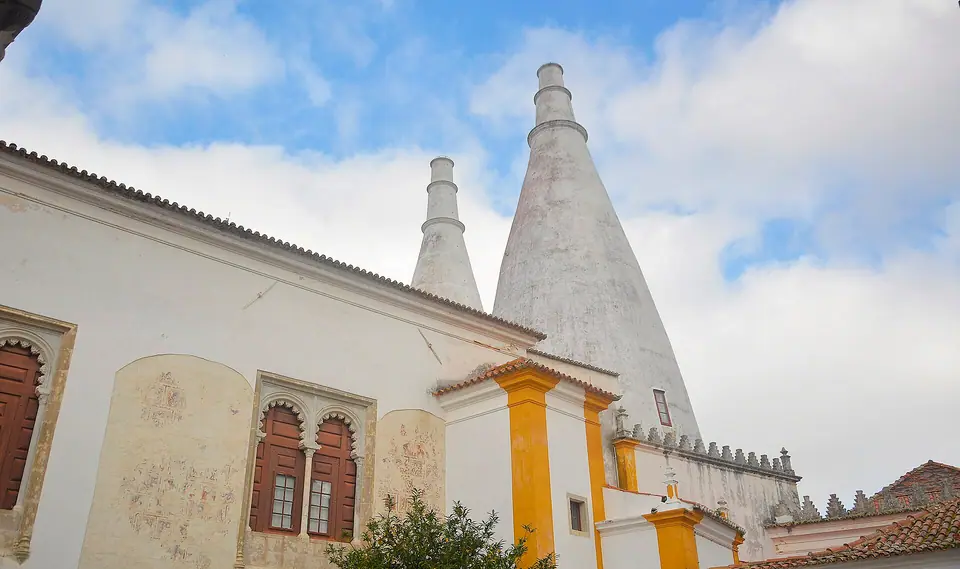
Standing at the centre of Sintra-Vila on Praça da República, the National Palace of Sintra (Palácio Nacional de Sintra / Palácio da Vila) is the only medieval royal palace in Portugal that has survived virtually intact. Recognisable by the pair of 33-metre-tall conical white chimneys above its kitchen, the residence evolved from a 10th-century Moorish castle (Alcáçova) into the summer retreat of the Portuguese court until 1910. Together with Seville and Granada's Alhambra, the Town Palace preserves an extraordinary treasury of 15th- and 16th-century Mudéjar glazed tiles (azulejos).
| Sintra National Palace Info | Details & Location | Recommended Time | 2026 Price (as of November 2026) |
|---|---|---|---|
| Adult Admission Ticket. | Praça da República (12-min walk from Sintra Station). | 1 hr 15 min to 1 hr 45 min. | €13.00 adult / €10.00 youth (6 to 17) & senior (65+). |
| Opening Hours. | Open daily year-round (no timed slot required). | Best visited 13:30 to 16:30. | 09:30 to 18:30 (last admission 18:00). |
| Must-See Royal Halls. | Swan Room, Magpie Room, Blazon Room, Arab Room & Kitchen. | Self-guided one-way route. | Free smartphone web audio guide included. |
The Swan Room (Sala dos Cisnes) & The Magpie Room (Sala das Pegas)
Climbing the Gothic arcade built by King João I (1385 to 1433) brings you into the oldest ceremonial wing, anchored by two rooms named after their painted ceilings:
- The Swan Room (Sala dos Cisnes). Serving as the grand banqueting and reception hall of the palace, its octagonal wooden ceiling is divided into 27 painted panels depicting white swans wearing golden crowns around their necks. According to royal chronicles, King João I commissioned the swan motif in 1428 to honour his daughter Princess Isabel of Portugal. Before she sailed to Flanders to marry Philip the Good, Duke of Burgundy (whose court emblem in Bruges was the white swan).
- The Magpie Room (Sala das Pegas). In the adjacent audience chamber, the ceiling is covered with 136 painted magpies. Each holding a red rose of the English House of Lancaster in its claw and a scroll in its beak reading "Por bem" ("For good / No harm meant"). Legend holds that King João I was caught by his English-born queen, Philippa of Lancaster, kissing a lady-in-waiting. When the court ladies gossiped like chattering magpies, the King had 136 magpies painted overhead repeating his excuse, "Por bem!", to silence the court.
The Blazon Room (Sala dos Brasões): 72 Noble Coats of Arms
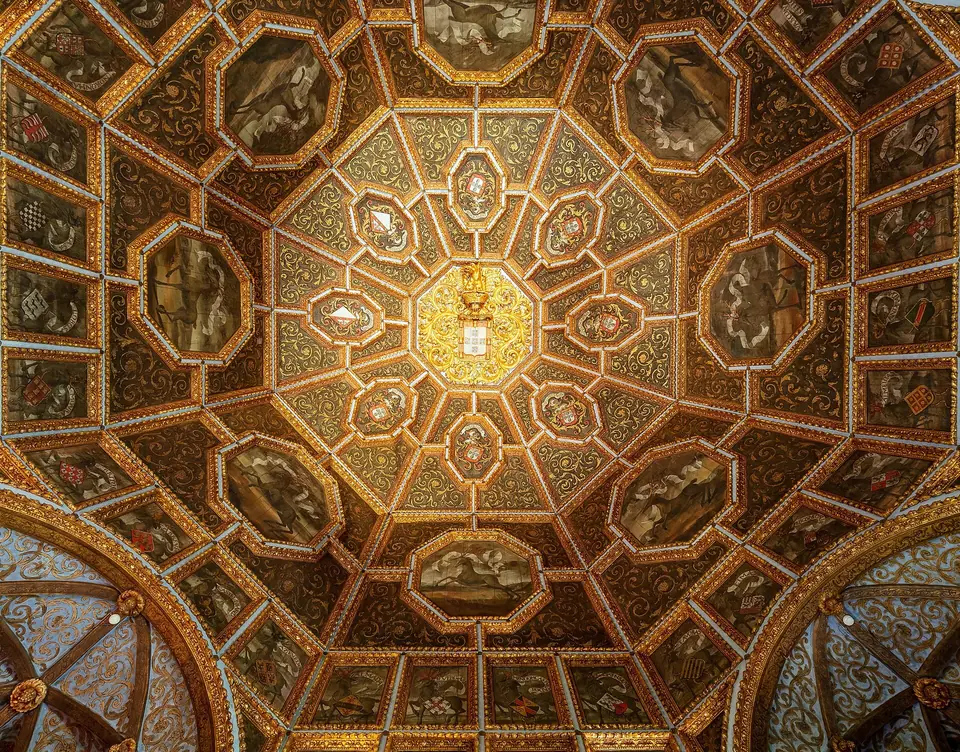
This room sits at the highest point of the medieval palace atop the former Mecca Tower. The Blazon Room (Sala dos Brasões) was commissioned between 1515 and 1518 by King Manuel I ("The Fortunate") at the height of the Portuguese spice trade with India. Its magnificent coffered octagonal wooden dome, gilded and painted in deep ultramarine blue, functions as a heraldic roll of honour of the kingdom:
- The Royal Crown & 8 Royal Children. At the very apex of the dome sits the shield of King Manuel I, surrounded by the coats of arms of his eight sons and daughters.
- 72 Coats of Arms Held by Stags. Around the lower frieze stand 72 painted stags, each bearing between its antlers the heraldic shield of one of Portugal's 72 principal noble families. Only one panel sits completely blank: the coat of arms of the Coelho family, which was chiselled out by royal decree after Dom João Coelho conspired against King João II. Around the cornice runs a Latin inscription reminding the nobility that their titles are won and kept only through loyalty to the Crown.
- 18th-Century Blue-and-White Hunting Tiles. Lining the lower walls beneath the gilded dome are monumental 18th-century Delft-style blue-and-white azulejo panels painted in Lisbon workshops, depicting courtly deer hunts, wild boar chases, and country balls.
World-Class Mudéjar Azulejos, the Arab Room & the 33-Metre Kitchens
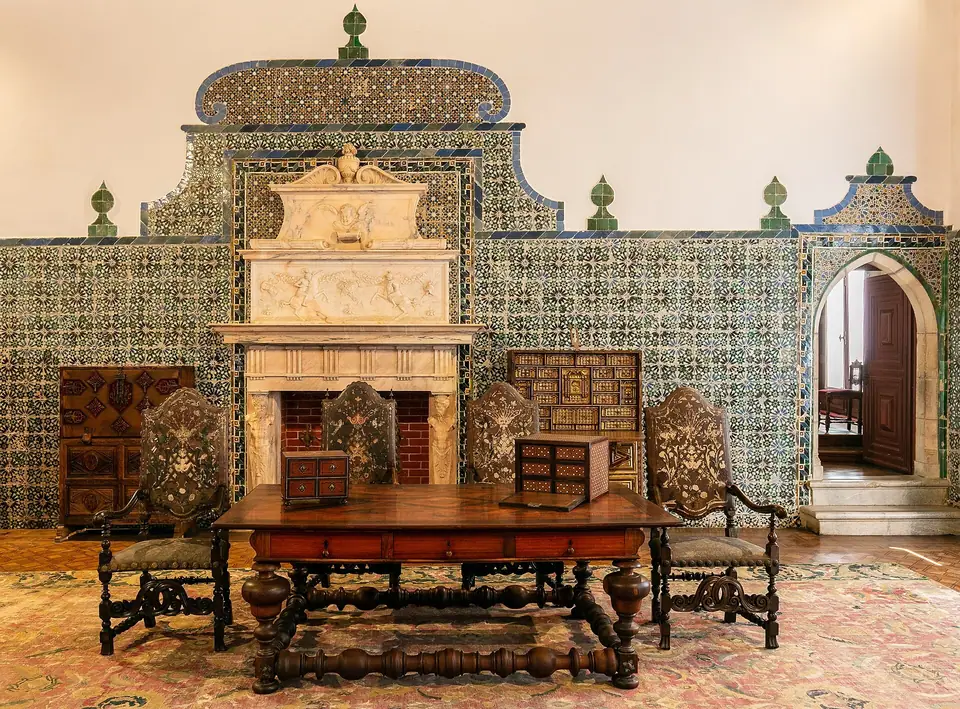
For lovers of ceramic art, Sintra National Palace is the birthplace of the Portuguese azulejo tradition. After King Manuel I visited Seville and the Alhambra in 1498, he imported thousands of cuerda seca (dry-cord) and arista (raised-edge) geometric polychrome tiles from Seville to transform Sintra into a Christian Alhambra. You will walk through the Central Patio with its trickling Moorish marble fountain, the Palatine Chapel (featuring a rare 15th-century wooden latticework ceiling and tile carpet). The Arab Room (Sala dos Árabes), where a gilt bronze fountain basin once cooled the royal bedroom during August heatwaves.
Your tour concludes inside the cavernous 15th-Century Royal Kitchen, filled with iron roasting spits, copper cauldrons, and wood-fired ovens. Overhead rise the two whitewashed brick funnels (33 metres tall), which drew smoke and heat out of the palace during banquets.
Royal History Inside the Walls: From King João I to Prisoner King Afonso VI
Every wing of the Sintra National Palace echoes with pivotal moments in Portuguese history. Here in 1415, King João I and his sons. Highlights include Prince Henry the Navigator, planned the naval expedition to Ceuta that launched the European Age of Discovery. Here King Afonso V was born in 1432 and died in 1481 in the exact same bedroom. Here King Manuel I sat inside the Water Courtyard watching fountains play while receiving news of Vasco da Gama's voyage to India and Pedro Álvares Cabral's landing in Brazil.
One of the most poignant rooms in the older medieval wing is the small Prison Chamber of King Afonso VI (Quarto-Prisão de Dom Afonso VI). Deposed in a 1667 palace coup led by his younger brother Prince Pedro, the king was locked inside this brick-floored room for the final nine years of his life (1674 to 1683). Here he paced back and forth across the worn 15th-century Mudéjar tile floor until he died, listening to Mass through a small spyhole into the adjacent chapel.
Practical Visitor Guide: Best Time to Visit, Tickets & Café
The Sintra National Palace stands right on the main square of Sintra-Vila, a flat 12-minute walk from Sintra Train Station. It requires zero mountain buses and has no restrictive 30-minute timed entry slots. Tour buses tend to visit the palace first thing between 09:30 and 11:30. If you visit between 13:30 and 16:30 after descending from Pena Palace or the Moorish Castle, the Swan Room and Blazon Room are wonderfully uncrowded. Scan the QR codes at the entrance to launch the free smartphone audio guide (bring headphones). Finish in the sheltered garden café before walking two minutes up Rua das Padarias for warm pastries.
Before leaving the main square of Praça da República outside the palace, pause at the base of the wide front staircase. Admire the Gothic-Manueline marble arcades and twisted stone columns carved by royal master mason Pero Anes in the early 1500s. Looking straight up from the forecourt gives you the clearest perspective of how the two 33-metre conical brick kitchen chimneys dominate the skyline beneath the high battlements of the Moorish Castle.
Where it is
- 1Sintra National Palace (Town Palace)
- Lisbon Humberto Delgado Airport (LIS) · about 22 km from here in a straight line
- Directions in Google Maps
Traveller tips
Real advice from people who have been to Sintra. Every tip is read by our team before it goes live.
No tips yet. Been here? Yours could be the first.
Thank you! Your tip will appear here after a quick review.
More in Sintra
Continue exploring Sintra with related neighbourhood, food, and planning guides
Palace of Queluz & Chalet of the Countess of Edla: Complete Guide
Sintra, Portugal
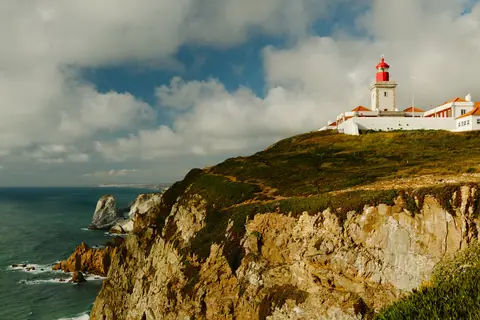
Cabo da Roca, Praia da Ursa & Azenhas do Mar: Sintra Coast Guide
Sintra, Portugal

What to Eat in Sintra: Travesseiros, Queijadas & Colares Wine
Sintra, Portugal
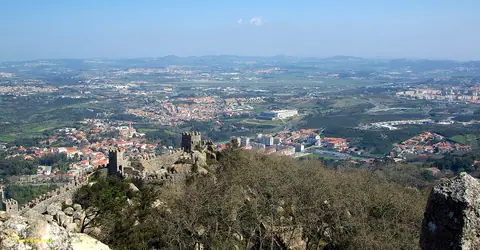
Sintra: avoiding the Day-Trip Trap, Palace Zones & Car Ban
Sintra, Portugal
