Photo: Zairon · CC BY-SA 4.0
Piazza Castello, Palazzo Madama and the Savoy Capital
Savoy heritage across Piazza Castello: Palazzo Madama strata, Musei Reali apartments and armoury, Guarini Shroud Chapel, Porte Palatine and Palazzo Carignano.
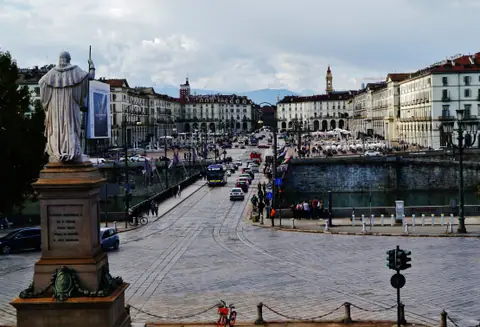
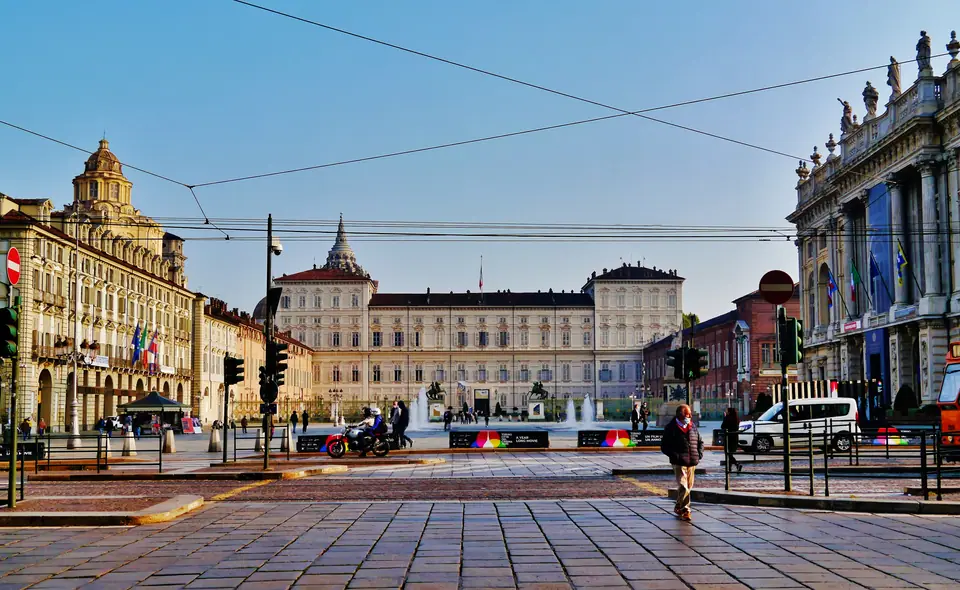
Stand near the flagstones of Piazza Castello and two millennia of power surround you at arm's reach. Roman legionary masonry, medieval feudal towers, undulating Baroque brickwork and crisp nineteenth-century arcades frame a single civic rectangle. Together they anchor UNESCO's Residences of the Royal House of Savoy and reveal how a border garrison became Italy's unification cradle.
Ascanio Vitozzi and the 1583 royal command plan
In 1563, Duke Emmanuel Philibert shifted the House of Savoy capital across the Alps to Turin. His court inherited cramped medieval lanes boxed inside Roman walls. In 1583, court architect Ascanio Vitozzi cleared the castle perimeter to frame Piazza Castello as an ordered ducal theatre. His master layout drove straight sightlines outward towards palace avenues and the River Po.
That urban design forms Turin's historic Zone of Command, inscribed by UNESCO in 1997 and extended in 2010 across 22 royal sites. The UNESCO group links downtown headquarters straight out to suburban hunting estates profiled in our Venaria and Stupinigi guide. Every street walk charted in our Turin orientation guide still radiates cleanly from these central flagstones.
Palazzo Madama across Roman, medieval and Baroque strata
No monument shows Turin's stacked chronology more clearly than Palazzo Madama rising free in the square centre. Walk around all four exterior walls before entering to inspect every historical stratum at street level. Its eastern brick wall preserves fourteenth-century fortress towers known as the Casaforte degli Acaja. Medieval builders raised those brick bastions directly onto twin decagonal piers of the first century BC Roman eastern gate, the Porta Decumana.
Walk back towards Via Garibaldi where Filippo Juvarra's 1716 to 1721 white limestone facade dresses the fort in airy Baroque grandeur. Tall arched portals flood Juvarra's ceremonial double staircase in natural morning daylight inside the Museo Civico d'Arte Antica. Opened here in 1934, the museum welcomed roughly 210,000 visitors in 2024. Rooms display medieval woodcarvings, painted glass, ceramics and Antonello da Messina's Portrait of a Man, crowned by an upper rooftop tower panorama. Palazzo Madama carries its own municipal ticket separate from Musei Reali, making it sensible to tour both palaces on distinct mornings.
State apartments, armoury and library inside Musei Reali
Across Piazzetta Reale behind bronze Victory gateposts, a unified Musei Reali ticket joins royal wings behind Palazzo Reale's sober seventeenth-century frontage.
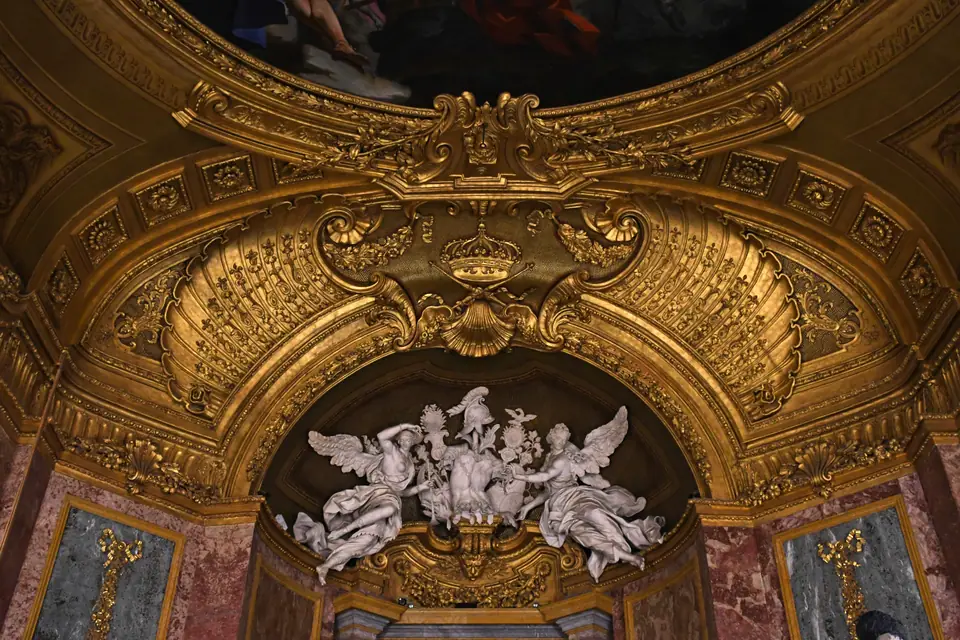
The unified pass connects five royal institutions: Palazzo Reale state apartments, Armeria Reale, Archaeological Museum, Galleria Sabauda old masters and Biblioteca Reale. Tours step through gilded reception salons and velvet Throne Chambers before entering the mirrored Armoury. Mounted sixteenth-century cavalry suites here display celebrated court armour and parade weapons. Next come Galleria Sabauda canvases and the Biblioteca Reale, caretaker of delicate Leonardo da Vinci sheets rotated selectively for conservation. Covering all sections thoroughly fills nearly half a day. Rest legs mid-visit inside the free Giardini Reali behind the east palace wing before resuming gallery walks.
The Renaissance Duomo and Guarini Shroud Chapel
Directly west off Piazzetta Reale stands the white marble frontage of the Cathedral of Saint John the Baptist. Built from 1491 to 1498 by Tuscan architect Meo del Caprino, it remains Turin's sole major Renaissance church. Visitors enter the main nave without a ticket outside liturgical services, then look behind dark glass arches to glimpse an extraordinary black-marble cupola above.
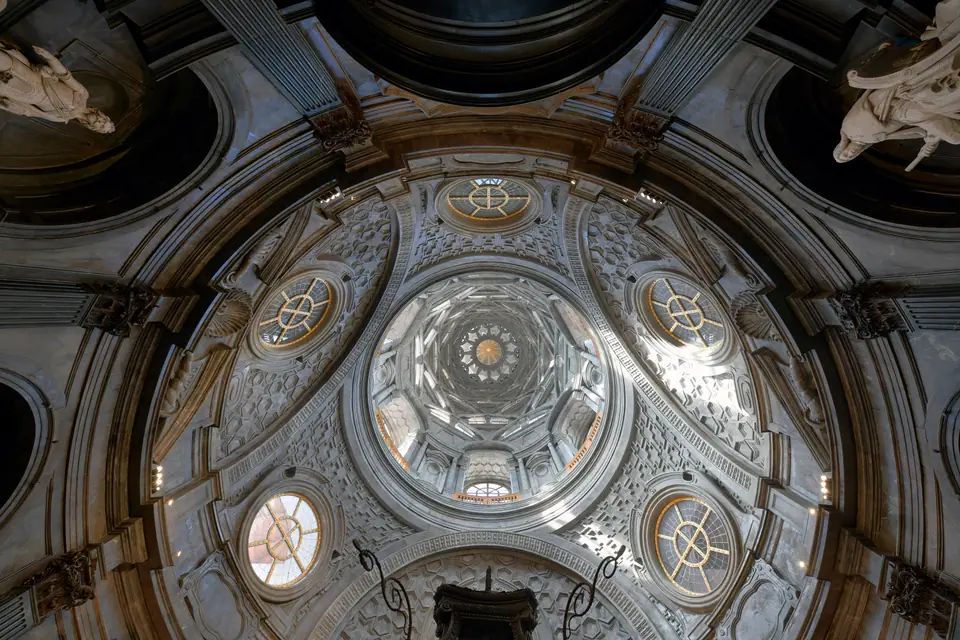
From 1668 to 1694, Theatine architect and mathematician Guarino Guarini engineered the Chapel of the Holy Shroud atop the royal apse. Six interlocking tiers of arched stone ribs soar upwards into a twelve-pointed starburst lantern overhead. Badly damaged during a 1997 fire, delicate masonry restoration concluded in September 2018 when the chapel reopened inside the Musei Reali circuit. The Shroud casket below stays veiled outside rare public expositions.
Roman brick towers at the Porte Palatine
Walk three minutes north behind the Duomo precinct and imperial Roman engineering emerges in weathered terracotta brick. Surviving from the first century BC founding of Julia Augusta Taurinorum, the twin sixteen-sided towers and double arched portals of the Porte Palatine once guarded Turin's northern approach. Roman records knew this entrance as Porta Principalis Dextera.
Quiet archaeological lawns and bronze replicas of Augustus and Julius Caesar surround the excavated stone foundations. Those quiet gardens offer a shady pause barely three minutes south of lively Porta Palazzo market canopies.
Undulating brick at Palazzo Carignano and the Risorgimento
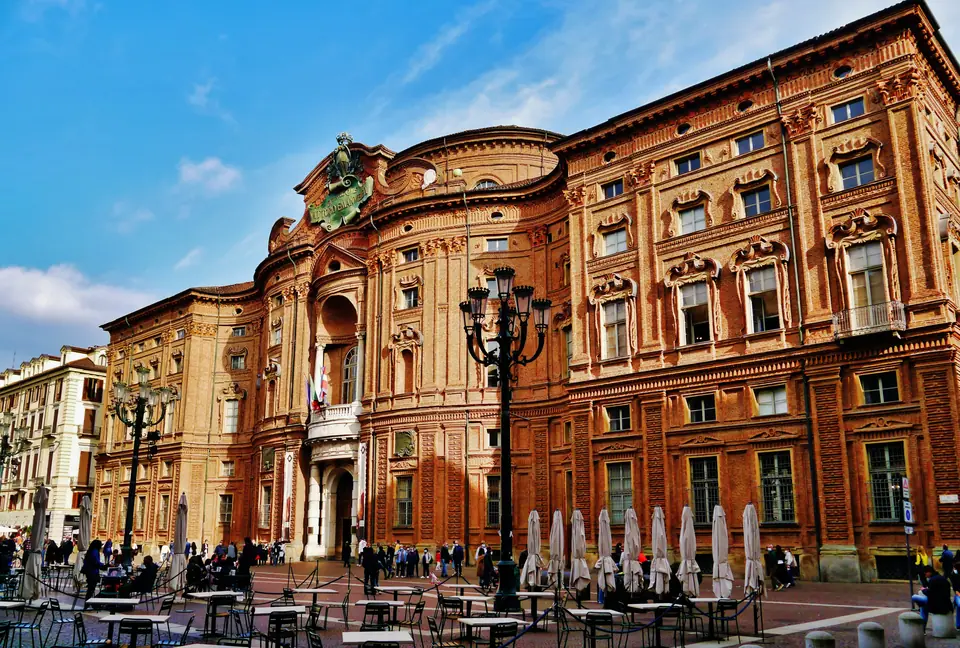
Two blocks south of Piazza Castello along Via Accademia delle Scienze, Guarino Guarini sculpted terracotta brick into fluid motion at Palazzo Carignano in 1679. Concave and convex curves ripple smoothly across the street frontage without needing pale travertine columns. Stepping inside reveals a historic courtyard and nineteenth-century elliptical chamber where unified Italy's first Parliament met in 1861. Today those richly preserved rooms form the heart of the Museo Nazionale del Risorgimento Italiano directly across the cobbles from the Museo Egizio.
Twin churches and coffee tables in Piazza San Carlo
Step out past Palazzo Carignano onto Via Roma to finish this royal loop inside Carlo di Castellamonte's 1638 Piazza San Carlo. Even arcaded palaces and twin Baroque churches dedicated to San Carlo and Santa Cristina enclose the spacious rectangle cleanly. Duke Emmanuel Philibert sheaths his sword atop Carlo Marochetti's 1838 bronze charger at centre square. Covered colonnades frame wood-panelled coffee rooms around the perimeter, giving walkers an easy afternoon base near Galleria Subalpina before heading back to Piazza Castello.
Where it is
- 1Piazza Castello, Palazzo Madama and the Savoy Capital
- Turin Airport (TRN) · about 15 km from here in a straight line
- Directions in Google Maps
Stations and taxi ranks: OpenStreetMap. Airports: OurAirports. Distances are in a straight line.
Traveller tips
Real advice from people who have been to Turin. Every tip is read by our team before it goes live.
No tips yet. Been here? Yours could be the first.
Thank you! Your tip will appear here after a quick review.
More in Turin
Continue exploring Turin with related neighbourhood, food, and planning guides