Photo: Abbrey82 · CC BY-SA 4.0
The Mole Antonelliana and the Egyptian Museum
Deep guide to Turin top museums: Museo Egizio collections and Tomb of Kha, plus Antonelli towering Mole Antonelliana Cinema Museum and glass lift.
Two standout museums separated by a ten-minute stroll past Piazza Castello define almost every opening visit to Turin. One houses ancient stone kings and three-millennia-old household linen inside a seventeenth-century Jesuit college. The other stacks cinema history inside a towering nineteenth-century brick cupola originally begun as a synagogue. Giving each landmark an unhurried half-day slot keeps Turin's richest indoor visits enjoyable rather than exhausting.
From Drovetti to the Collegio dei Nobili galleries
King Charles Felix founded Turin's Museo Egizio in 1824 by purchasing 5,268 Egyptian antiquities assembled by Piedmontese diplomat Bernardino Drovetti. Installed inside Guarino Guarini's 1679 Palazzo dell'Accademia delle Scienze, it stands as the world's oldest museum devoted wholly to ancient Egyptian civilisation. Visiting Egyptologists arrived from across Europe decades before formal archaeological collections opened along the Nile.
Holdings today surpass 37,000 artefacts, with reserve study items pushing total inventory above 40,000 objects across four spacious floors. Museo Egizio welcomed 1,036,689 visitors in 2024. Recent bicentenary renovations added the bright glass-roofed Piazza Egizia courtyard and a dramatically lit Galleria dei Re statuary hall. Stepping out of sunlit Baroque colonnades into shadowy galleries lined with colossal granodiorite pharaohs sets a hushed, focused mood immediately. Early morning entry slots bring calmer viewing conditions across the ground-floor statuary rooms before late-morning visitors crowd the aisles.
Champollion, Schiaparelli and the intact Tomb of Kha
Rigorous fieldwork turned a royal cabinet into a vivid window onto everyday New Kingdom life. French linguist Jean-François Champollion travelled to Turin in 1824 shortly after deciphering hieroglyphs to examine royal king-list papyri. He famously wrote that the road to Memphis and Thebes passed straight through Piedmont.
From 1900 to 1920, museum director Ernesto Schiaparelli led disciplined Italian excavations across Egypt. His team uncovered an extraordinary prize at Deir el-Medina in 1906 by entering the intact Tomb of Kha and Merit, catalogued as TT8. Unlike robbed royal burials, royal architect Kha's tomb survived completely undisturbed. Folded linen tunics, cosmetic chests, wooden chairs, measuring cubits, dried bread loaves and painted coffins preserve daily craftsman life in crisp detail. Lingering over wooden combs, woven sandals and workmen's jars reveals everyday household skill far more clearly than hurrying past stone sarcophagi.
Navigational strategy inside Museo Egizio
Because exhibits climb chronologically across four deep levels, a clear route prevents gallery fatigue mid-afternoon:
- Lock in an early online slot: Timed ticketing governs entry smoothly, though weekend lines form by mid-morning if arriving without pre-booked passes. Store heavy coats and bulky backpacks inside ground-floor lockers before climbing up the escalators.
- Prioritise two signature wings: Spend fresh concentration inside the Deir el-Medina village rooms and intact Tomb of Kha before pausing for coffee or entering the dimly lit Statuary Hall below.
- Use official audio commentary selectively: Guided highlights decode funerary papyri and carved stone reliefs far more clearly than attempting to read every display vitrine in order.
Divide the two landmarks across a full day if schedules permit. Pair morning Egyptian rooms with neighbouring Palazzo Carignano and a relaxed lunch break around Via Po or Galleria Subalpina covered in our Turin dining guide, then stroll east along sheltered arcades in late afternoon.
Antonelli masonry tower and its 1961 spire
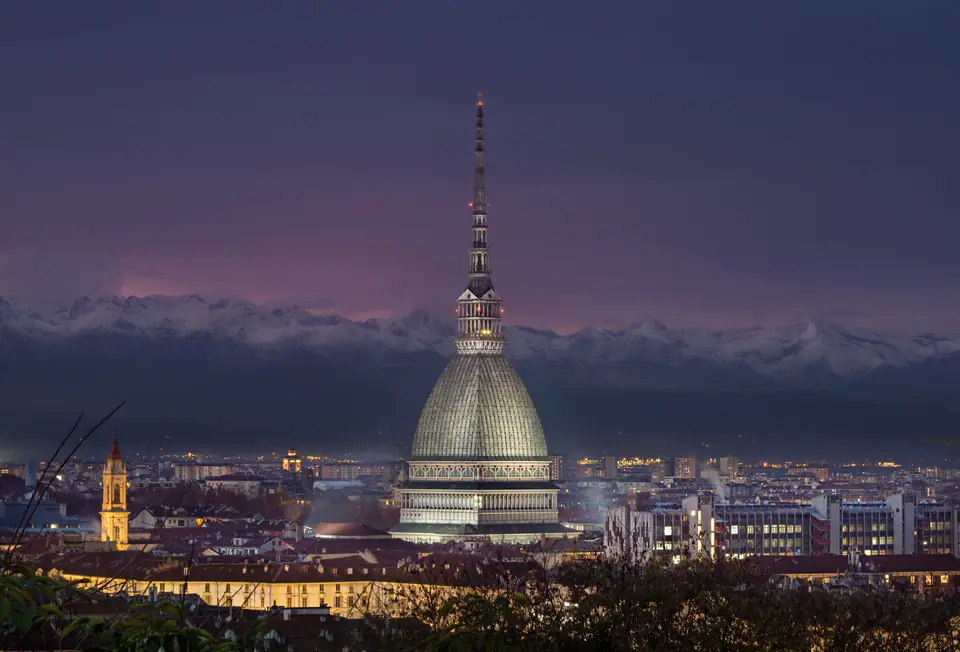
Walk north-east from Via Po's covered colonnades onto quiet Via Montebello. Suddenly Piedmontese brickwork leaps skyward in Alessandro Antonelli's daring Mole Antonelliana. Commissioned in 1863 as an ambitious synagogue for Turin's newly emancipated Jewish community, escalating height sparked fierce budget disputes. The Municipality of Turin bought the half-built vault in the 1870s and completed it as a civic monument in 1889.
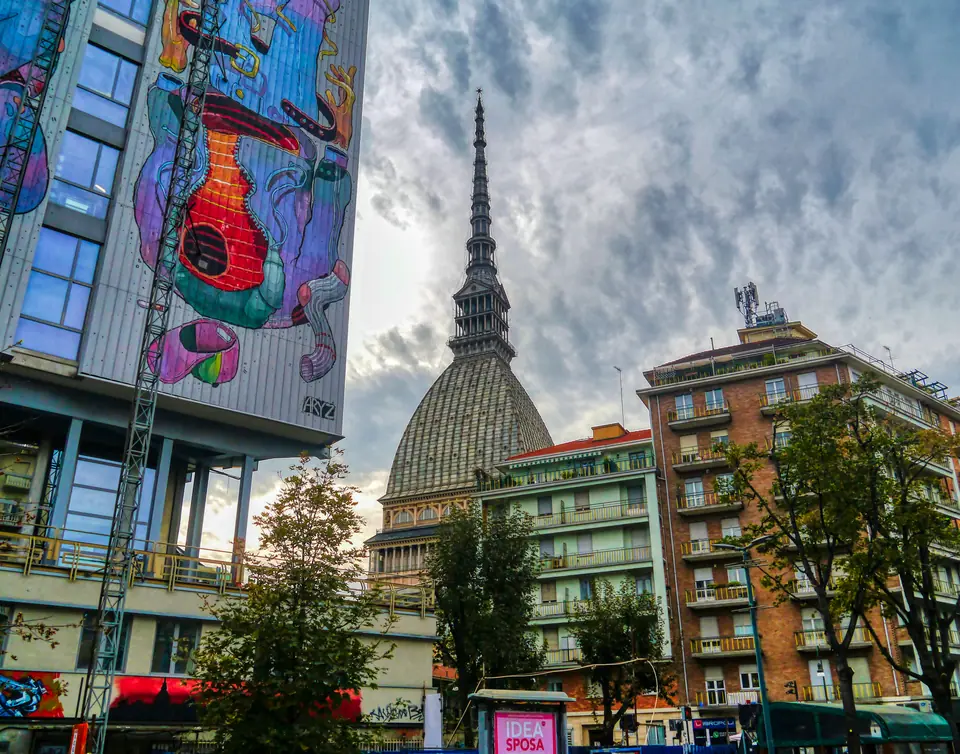
Reaching 167.5 metres in height using pure brick masonry below its upper pinnacle, it stood as Europe's tallest brick building on completion. On 23 May 1953, a violent whirlwind snapped away the upper 47 metres of stonework. Engineers rebuilt the slender spire in reinforced steel and stone by 1961. Today that star-crowned silhouette guides walkers back across town from Po bridges and the Superga ridge.
Silent cinema treasures inside the Temple Hall
Since 2000, the cavernous interior has housed Italy's National Museum of Cinema, drawing over 818,000 visitors in 2024 up a continuous spiral ramp. Opening rooms trace magic lanterns, nineteenth-century optical boxes and silent features filmed inside pioneering Turin studios. Rainy afternoons turn these darkened rooms into an absorbing indoor refuge for hours. Vintage hand-cranked cameras and painted placards explain how northern Italy built an international film industry decades before Rome's Cinecittà.
Every exhibition ramp spirals gently around the dramatic Aula del Tempio. Intimate side chapels dedicated to horror, science fiction, westerns and musicals encircle scarlet reclining loungers facing twin colossal screens. Pausing midway up the spiral deck lets visitors watch silent-era clips beneath the vast brick dome before continuing past optical pre-cinema instruments, vintage costumes and illustrated film posters.
Taking the glass lift above Turin rooftops
Independent steel cables suspend an all-glass panoramic cabin vertically straight through the open centre of the Temple Hall. Rising smoothly 85 metres upward in 59 seconds, the lift opens onto a narrow railed balcony below the spire base. Check clear-sky visibility outlined in our seasonal weather guide before picking a lift hour. Crisp dry fronts reveal the Roman street grid directly below snow-covered Western Alps, while spring afternoons turn hazy. Combined museum-plus-lift tickets routinely sell out early, so book timed access online well before arriving in Turin.
Where it is
- 1The Mole Antonelliana and the Egyptian Museum
- Turin Airport (TRN) · about 15 km from here in a straight line
- Directions in Google Maps
Stations and taxi ranks: OpenStreetMap. Airports: OurAirports. Distances are in a straight line.
Traveller tips
Real advice from people who have been to Turin. Every tip is read by our team before it goes live.
No tips yet. Been here? Yours could be the first.
Thank you! Your tip will appear here after a quick review.
More in Turin
Continue exploring Turin with related neighbourhood, food, and planning guides