


























Constructivist Architecture in Yekaterinburg: White Tower & Chekist Town
Trace Yekaterinburg's 1920s and 1930s Soviet avant-garde heritage, from the reinforced-concrete White Tower in Uralmash to Gorodok Chekistov on Lenin Avenue.
Between 1924 and the mid-1930s, when Yekaterinburg (then renamed Sverdlovsk) became the administrative capital of the vast Ural Region during rapid Soviet industrialisation, young graduates of Moscow's VKhUTEMAS and Leningrad's Institute of Civil Engineers turned the city into an open-air laboratory of Soviet Constructivism. More than 140 avant-garde buildings were erected in a single decade, giving Yekaterinburg a remarkable concentration of Constructivist architecture across its central boulevards and residential districts.
The White Tower in Uralmash (1929 to 1931)
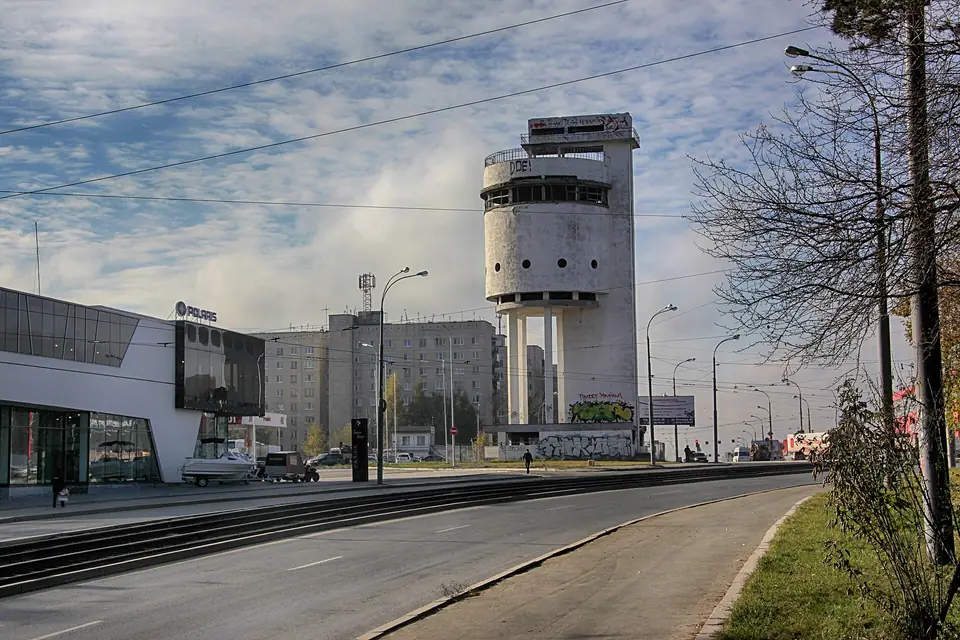
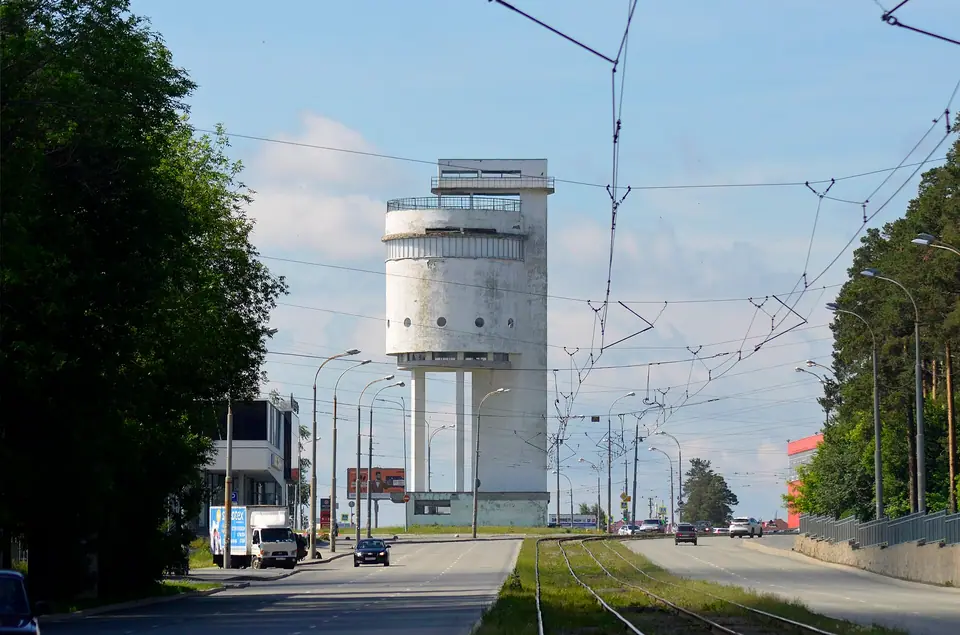
The flagship monument of Ural Constructivism stands in the northern industrial garden district of Uralmash, founded around the Ural Heavy Machinery Plant on 15 July 1928. To supply water to the new socialist city without building a costly pumping station, 26-year-old architect Moisei Reisher designed a 29-metre reinforced-concrete water tower erected between 1929 and 1931 on the elevated ground of Kultura Boulevard.
Resting on four slender concrete legs and a recessed stair cylinder, the elevated 700-cubic-metre cylindrical tank (then among the largest monolithic reinforced-concrete tanks in the world) was painted bright white with lime wash, earning the name White Tower (Belaya Bashnya). Decommissioned in the 1960s and designated a federal architectural monument in 1974, the tower has been conserved since September 2012 by the independent Podelniki architectural group, who run guided tours inside the tank dome with multimedia projections.
Gorodok Chekistov and Hotel Iset (69 Lenin Avenue)
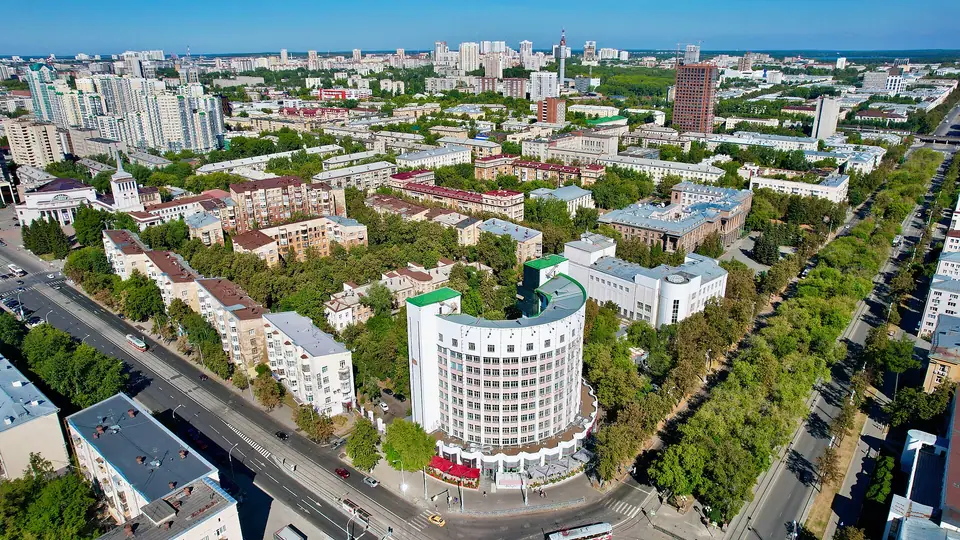
Back in the city centre at the junction of Lenin Avenue and Lunacharsky Street stands Gorodok Chekistov ("Chekists' Town"), a 14-building residential commune built between 1929 and 1936 for officers of the NKVD by architects Ivan Antonov, Veniamin Sokolov, Arseny Tumbasov, and Alexei Stelmashchuk. Designed as an autonomous commune with a factory-kitchen, nursery, clinic, and bathhouse, its 444 apartments were originally built without private kitchens to encourage collective dining and rotated 10 degrees to the street grid for optimal sunlight.
Two buildings anchor the perimeter:
- Hotel Iset (Building 1, completed 1933 to 1934): An 11-storey semicircular dormitory tower for single officers (originally 97 rooms), whose curved facade gives rise to the urban legend that the complex resembles a hammer and sickle from the air.
- Dzerzhinsky Club (Building 10, completed 1934): Known for its cantilevered marble spiral staircase that winds counter-clockwise in the foyer; since 2003 the building has housed the Museum of History and Archaeology of the Urals, where the 12,000-year-old wooden Shigir Idol (discovered in 1890 near Kirovgrad) is exhibited.
Walking the Lenin Avenue Constructivist Spine
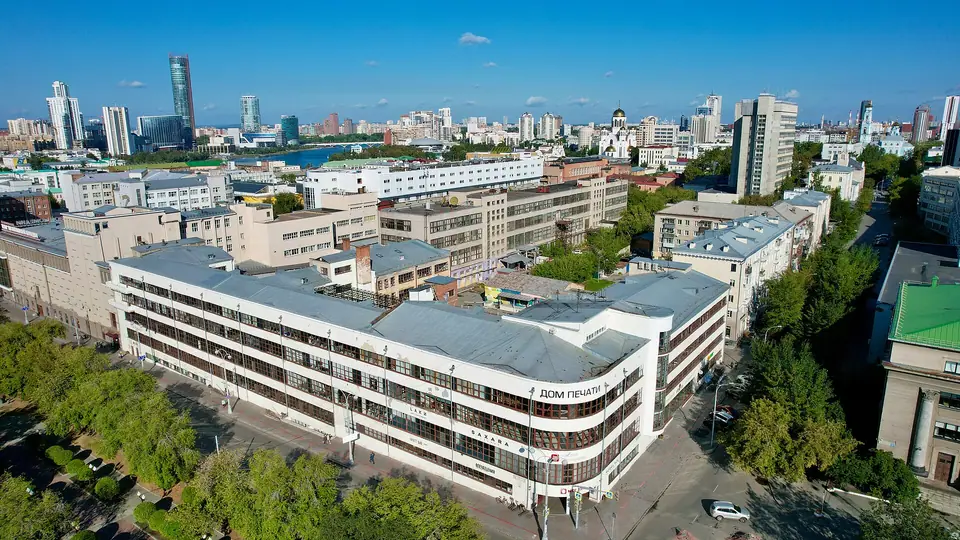
West along Lenin Avenue stand two more landmarks: the 1930 House of the Press (Dom Pechati, 49 Lenin Avenue, designed by Vladimir Sigov with ribbon windows and a rounded corner) and the 1934 Main Post Office / House of Communications (39 Lenin Avenue, by Kasyan Solomonov and Veniamin Sokolov) opposite Plotinka.
Traveller tips
Real advice from people who have been to Constructivist Architecture in Yekaterinburg: White Tower & Chekist Town. Every tip is read by our team before it goes live.
No tips yet. Been here? Yours could be the first.
Thank you! Your tip will appear here after a quick review.
More in Yekaterinburg
Continue exploring Yekaterinburg with related neighbourhood, food, and planning guides
3 Days in Yekaterinburg: Plotinka, Constructivism & Ural Day Trips
Yekaterinburg, Russia
Yekaterinburg: Everything You Need to Know
Yekaterinburg, Russia
Best Things to Do in Yekaterinburg: Landmarks, Museums & Views
Yekaterinburg, Russia
Plotinka, Historic Square & the Iset Embankment in Yekaterinburg
Yekaterinburg, Russia
