


























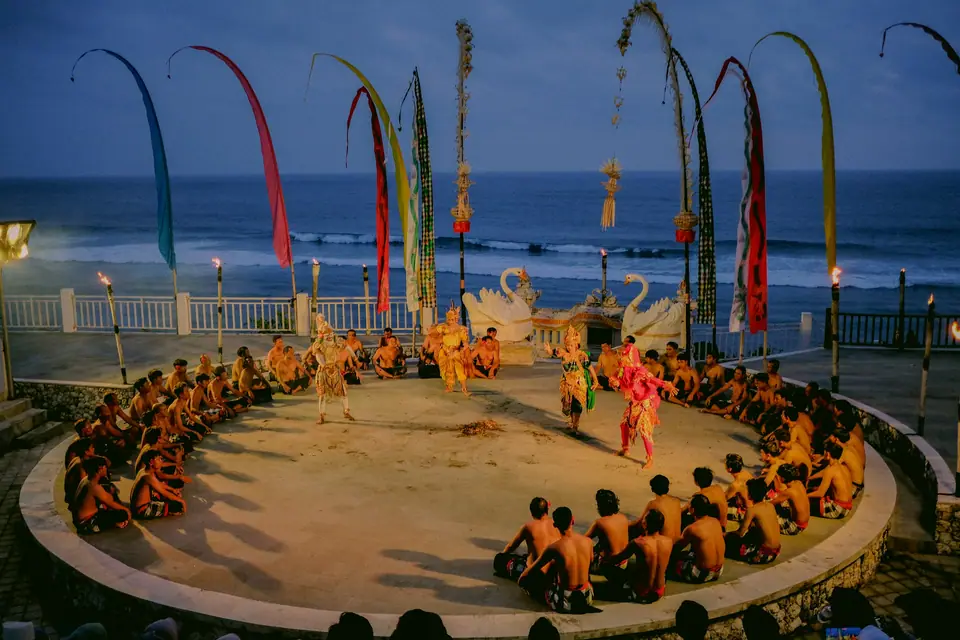
Photo by Gede Yoga on Unsplash
Kecak Fire Dance at Uluwatu Temple
A circle of chanting men tells the Ramayana on a clifftop above the Indian Ocean while the sun goes down behind them.
Overview
Pura Luhur Uluwatu sits on the edge of a limestone cliff at the southern tip of Bali, with the Indian Ocean breaking far below. Every evening, in an open-air amphitheatre on the headland next to the temple, a troupe of men performs the Kecak while the sun sinks into the sea behind them. It is the most popular evening out on the island, and for once the popularity is deserved.
The temple itself is only half the visit. The inner sanctuary is closed to visitors, so you walk the clifftop paths, look down at the surf and back along the cliffs to the shrine. Our temples guide covers how Uluwatu fits among the island's other great temples.
What you actually watch
There are no instruments. Around fifty men, bare-chested and in black and white checked cloth, sit in tight concentric circles and chant "cak-cak-cak" in overlapping rhythms, swaying, raising their arms, falling back. That sound is the orchestra, and when the whole circle drops to a whisper and then surges back, the hair on your arms stands up.
Inside the circle, costumed dancers act out an episode of the Ramayana, the Hindu epic: Prince Rama, his wife Sita, her abduction by the demon king Rahwana, and the white monkey Hanuman, who comes to rescue her. Hanuman is the crowd favourite. He clowns, climbs into the audience and pulls faces at children. Near the end he is trapped in a ring of fire, and the performers kick burning coconut husks across the stage floor. That finale is where the "fire dance" name comes from.
The Kecak you see today took shape in the 1930s, when Balinese dancers adapted the chorus of an older trance ritual into a staged story, with encouragement from the German painter Walter Spies. It was made partly for visitors from the start. That doesn't make it fake. It makes it a piece of theatre with a long history, performed nightly by villagers rather than hired professionals.
Is it overrated?
The setting carries it. The story is hard to follow without reading the leaflet handed out at the entrance, the seating is concrete, and the last half hour happens in the dark after the sun has gone. If you only care about sunset, the clifftop paths give you that without the crowd. But the chanting at dusk, with a thousand people falling silent at once, is the part people still talk about long after most of Bali's other shows have blurred together.
Who it suits
First-time visitors, couples, and families with children old enough to sit for an hour (Hanuman keeps most of them happy). It suits people staying on the Bukit peninsula best, since they are close. It suits people with a bad back, a fear of monkeys or a low tolerance for crowds much less. In Ubud, smaller Kecak performances run in village halls most evenings, and they are calmer if not as dramatic.
How to Book
You need two things: a temple entry ticket, paid at the gate, and a separate ticket for the Kecak. Show tickets are sold at a counter inside the temple area and online through the official channel and various resellers. Seats are not numbered. Your ticket gets you in; where you sit depends on when you arrive.
In high season (July, August and the Christmas to New Year weeks) the sunset performance sells out. Buy a day or more ahead in those months. In busy periods a second, later performance runs after dark. It's easier to get into, but you lose the sunset.
Most people come as part of a half-day tour or with a private driver. When comparing, look for:
- Whether the temple entry and show ticket are included, or only the transport.
- Time at the temple before the show. Less than an hour is too rushed.
- A pickup time that gets you there by mid-afternoon in high season.
- A clear plan for meeting the driver afterwards.
Uluwatu is about an hour from the airport and further from Seminyak or Canggu in traffic. See our where to stay guide for the Bukit bases that make this an easy evening. Also, keep your Bali tourist levy voucher on your phone. The provincial tourism office has run spot checks at Uluwatu, and our travel guide explains how to pay it online.
Tips
- Arrive early. The first people in take the top rows facing the sea, which have the sunset behind the dancers. Aim to be seated well before the show starts.
- Put glasses away. The long-tailed macaques around the temple grab sunglasses, hats, earrings, flip-flops and phones, then trade them back for fruit. Keep everything zipped inside a bag and don't try to wrestle an item back yourself.
- Sarongs are handed out at the gate for bare legs, but bringing your own is quicker. Our what to wear guide has the temple rules.
- Take water and insect repellent. The late sun is hot on the stone seats, then the mosquitoes arrive.
- Plan the exit. Everyone leaves at once down one narrow road, and the car parks jam. Agree an exact spot with your driver, or have dinner nearby in Jimbaran and let the traffic clear.
Reviews
Log in to write a review.
No reviews yet.
You might also like

Nusa Penida Snorkelling Trip from Bali
A full day from Bali including the crossing, or half a day if you stay on Nusa Penida or Nusa Lembongan · Bali

Ubud Cycling Tour
Usually a half day to a full day including hotel pickup, with around 2 to 3 hours on the bike · Bali

Mount Batur Sunrise Trek
About 1.5 to 2 hours up and 3 to 4 hours on the trail in total; a long night and morning with transfers from Ubud or the south · Bali
