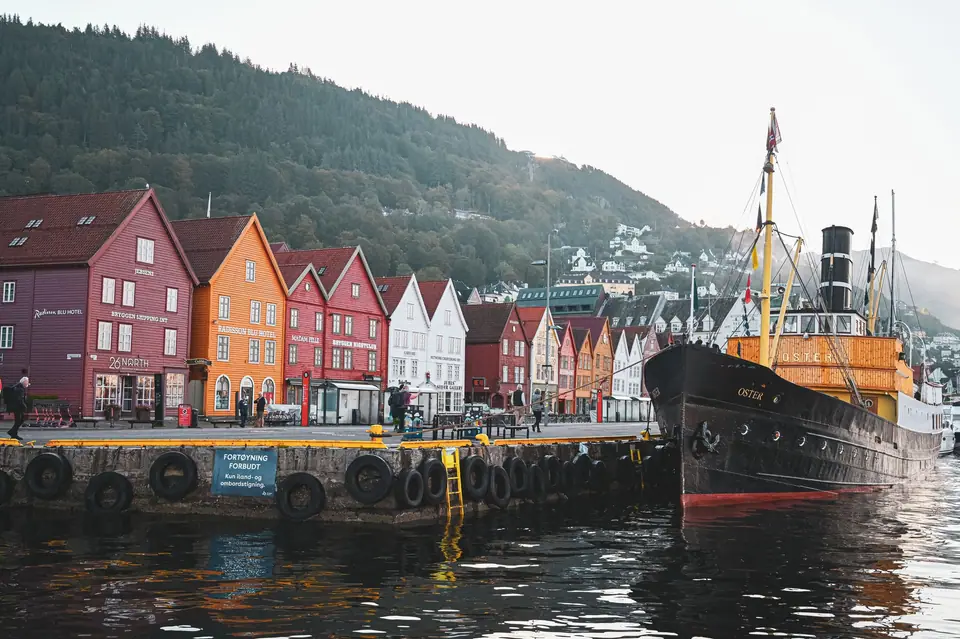
A detailed walking and mountain route through the City Between the Seven Mountains: Hanseatic timber tenements at Bryggen, cobblestoned Nordnes, KODE art galleries, and Mount Ulriken.
Royal Bergenhus and Four Centuries of the Hanseatic Stockfish Kontor
Founded in 1070 by King Olav Kyrre as Bjørgvin (The Green Meadow Among the Mountains) around the sheltered harbour bay of Vågen, Bergen served as the royal capital of medieval Norway until 1299, with kings crowned and buried at Bergenhus Fortress. In 1360 the German Hanseatic League established one of its four great overseas Kontors on the eastern wharf of Bryggen, trading dried Lofoten stockfish for Baltic grain across four centuries.
Although swept by periodic fires, the wooden merchant rows, overhanging galleries, and narrow stone-paved passages of Bryggen were systematically rebuilt on their twelfth-century foundations according to original medieval methods, earning UNESCO World Heritage status alongside the musical legacy of Edvard Grieg at Troldhaugen.
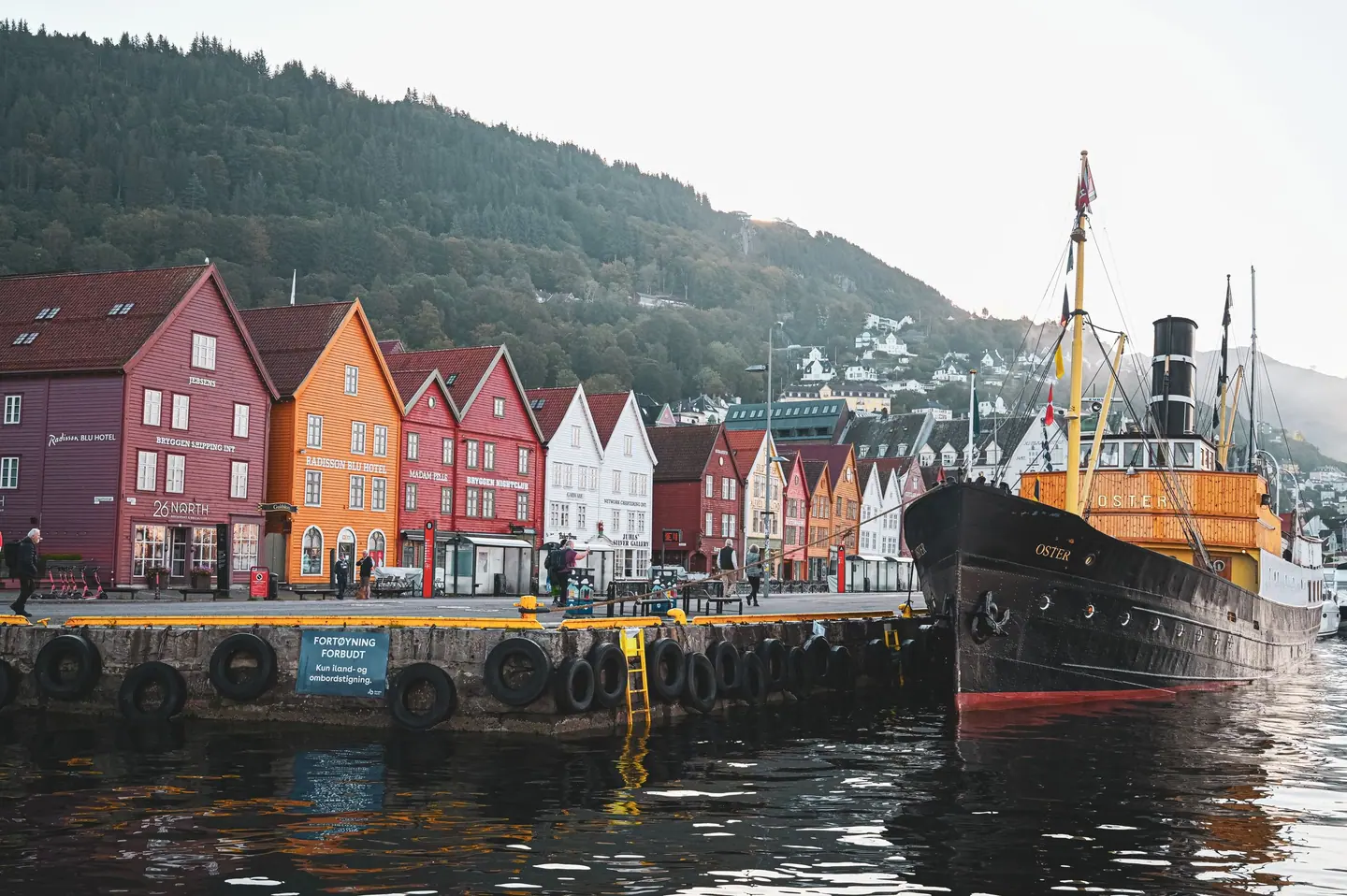
Bryggen Hanseatic Wharf & Bergenhus Royal Fortress
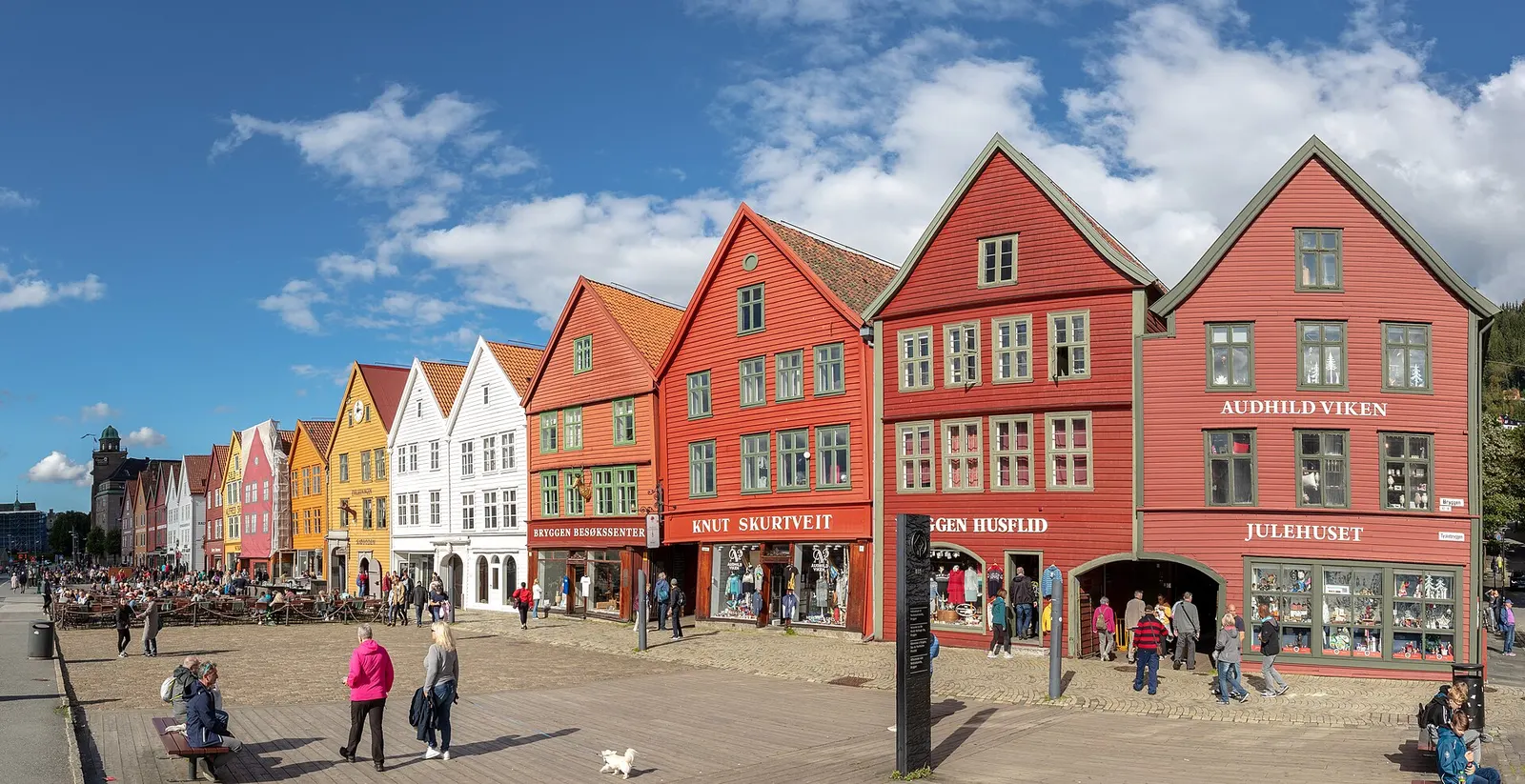
Bryggen UNESCO Wooden Tenements, Bellgården, Jacobsfjorden & Svensgården Passages, Hanseatic Museum Schøtstuene Assembly Halls, Bryggens Museum Medieval Foundations, St Mary’s Church Mariakirken (12th century), Rosenkrantz Tower, and Håkon’s Hall at Bergenhus Fortress
Bryggen Wharf
Constructed along the eastern shore of Vågen harbour, these colourful timber tenements served as the commercial hub of the Hanseatic League from the fourteenth to eighteenth centuries. Visitors can trace repeated reconstructions after historical city fires, observing distinctive gabled facades and cantilevered upper galleries that face the waterfront.
Bellgården Passage
Named after a long-lost bell emblem, Bellgården provides a direct route into the dense interior alleyways of the Hanseatic wharf. The surviving wooden walkways, external staircases, and raised storage lofts demonstrate how merchant clerks lived and organised stock in compact, fire-prone conditions.
Jacobsfjorden and Svensgården
This passage preserves the structural layout of twin Hanseatic yards sharing a central wooden corridor. Travellers walking between the leaning timber walls can inspect the original external tackle hoists, stone fireproof cellars, and timber beam foundations resting directly upon earlier medieval occupation layers.
Schøtstuene
Located behind the main wharf tenements, these communal halls provided the only heated living spaces permitted for the Hanseatic merchants, who were forbidden from lighting fires in their living quarters. The complex features an authentic cookhouse, timber assembly rooms, and historical artefacts illustrating strict guild discipline.
Bryggens Museum
Erected directly above the remains uncovered after a devastating fire in 1955, this museum displays substantial twelfth-century building foundations. The collection includes Runic inscriptions carved on wooden sticks, ceramic trade goods, and everyday maritime tools that illuminate life in early commercial Bergen.
St Mary's Church
Dating from around 1130, this twin-towered stone basilica stands as the oldest surviving building in Bergen. It served as the official church of the Hanseatic merchants between 1408 and 1766, retaining an ornate baroque pulpit, medieval altar panels, and carved stone portals.
Rosenkrantz Tower
Constructed in the 1560s by Governor Erik Rosenkrantz, this stone bastion encased an earlier thirteenth-century royal keep built for King Magnus Lagabøte. Visitors can ascend narrow spiral staircases to view the dungeon, royal residential chambers, and open gun platforms overlooking the harbour approaches.
Håkon's Hall
Erected by King Håkon Håkonsson between 1247 and 1261, this Gothic stone hall was the largest secular building in medieval Norway. It held royal feasts, coronations, and legal assemblies, featuring steep gables, tall arched windows, and reconstructed timber ceiling beams restored after wartime damage.
Bergenhus Fortress Grounds
Guarding the entrance to Vågen harbour, this strategic complex served as the royal seat of Norwegian monarchs before moving into defensive military use. The grassy ramparts enclose stone bastions, eighteenth-century military barracks, and ceremonial pathways that trace medieval and early modern military architecture.
Bergenhus Fortress Museum
Housed within an eighteenth-century heavy stone storehouse, this museum charts Norway's armed forces from the resistance movement in the Second World War through modern peacekeeping missions. Exhibits detail the 1944 harbour munitions explosion, local underground printing presses, and the regional coastal defence corps.
Koengen
Originally used as grazing pasture for the royal livestock and later as an open military drill field, Koengen extends along the fortress ramparts. Today it offers expansive views of historic masonry walls and functions as an outdoor civic space between the garrison and the Sandviken district.
Bradbenken Quay
Bradbenken marks the historic site where medieval and early modern ships were careened and caulked alongside the fortress walls. The contemporary quay serves passenger vessels and heritage sailing tall ships, offering uninterrupted perspectives across the water toward the Nordnes peninsula.
Dreggsalmenningen
Created following early municipal fires to prevent flames spreading between the timber merchant yards and the neighbouring royal estates, this open stone square acts as an entry plaza. It links Bryggens Museum and St Mary's Church, flanked by preserved nineteenth-century commercial stone buildings.
Hanseatic Museum at Finnegården
Standing at the southern edge of Bryggen, Finnegården is one of the most complete original wooden tenements on the wharf. It contains preserved trading offices, sleeping berths, and stock rooms that exhibit the daily routines, commercial tools, and living standards of German merchants.
Fish Market
Operating at the inner harbour basin of Vågen, this public trading place has supplied the city with fresh coastal catches for centuries. Today, market stalls sell local salmon, stockfish, and shellfish alongside regional produce, connecting the town centre to the maritime trades of Bryggen.
Zachariasbryggen
Positioned at the tip of the inner harbour, this historic commercial pier has accommodated coastal passenger boats since the nineteenth century. It provides clear sightlines across the water toward both the wooden facades of Bryggen and the stone battlements of Bergenhus Fortress.
Bergen Cathedral
Dedicated to Saint Olav, this stone cathedral dates back to the late twelfth century and was rebuilt following severe urban fires. Embedded in the exterior tower wall is a cannonball from the 1665 Battle of Vågen between English and Dutch naval fleets.
Fløibanen Funicular Lower Station
Constructed in 1918, this neo-classical station marks the starting point of the electric funicular ascending Mount Fløyen. Located just behind Bryggen, the stone portal and terminal platform have carried generations of residents and visitors from the historic centre up the steep mountainside.
Skuteviken
Lying just north of Bergenhus Fortress, Skuteviken developed as an important seafaring and barrel-making community. Its shoreline features white wooden maritime homes, narrow cobbled streets, and timber sea wharves that demonstrate domestic harbour life away from the Hanseatic merchants.
Sandviken Waterfront and Stoltzekleiven Base
Sandviken developed as a northern extension of Bergen's maritime economy, noted for dried-cod storehouses, sailcloth factories, and water mills. Walking along the shore reveals sea-facing timber structures and steep cobbled stairways that lead up toward the mountain trails behind the fortress.
Torget Fish Market, Torgallmenningen & Nordnes Timber Lanes
Bergen Fish Market Fisketorget, Zachariasbryggen, Torgallmenningen Sailors’ Monument, Den Nationale Scene Theatre, Knøsesmauet & Strangehagen Cobblestone Alleys, Nykirken, Fredriksberg Fortress, and Nordnes Park & Bergen Aquarium
Bergen Fish Market
Dating back to the 1200s, this waterfront marketplace has long anchored maritime trade at the head of Vågen. Fishermen historically moored along the stone quays to sell their fresh morning catch directly from wooden skiffs. Today, travellers find indoor and outdoor fishmonger stalls alongside local fruit, berry, and traditional craft displays.
Zachariasbryggen
Occupying a prominent position on the western edge of the inner harbour, this modern complex stands on ground once defined by historic timber piers. It houses several restaurants and outdoor terraces that command wide views across the water towards Bryggen. Stone and glass elements now blend with maritime references along the quayside.
Torgallmenningen
Created following the devastating city fire of 1702, this wide boulevard served as a strategic firebreak to prevent flames jumping between timber districts. Reconstruction after another major blaze in 1916 introduced cohesive Neoclassical facades designed by architect Finn Berner. Today it functions as the central pedestrian thoroughfare of the city.
Sailors' Monument
Erected in 1950, this imposing monument sculpted by Dyre Vaa occupies the centre of Torgallmenningen. Twelve bronze human figures and accompanying bas-reliefs depict Norwegian seafarers spanning the Viking Age to modern twentieth-century merchant shipping. The square granite pool reflects the surrounding stone architecture and gathers local crowds daily.
Sundt Department Store
Designed by Per Grieg and completed in 1938, this department store stands as one of the finest Functionalist buildings in Norway. Its clean lines and expansive glass windows brought modern retail architecture to the southern end of Torgallmenningen. A bronze statue of the Roman trade god Mercury crowns the building roofline.
Blue Stone
Crafted by sculptor Asbjørn Andresen and installed in 1993, this nine-metre-long tilted slab consists of Brazilian blue sodalite. Set at the intersection of Torggaten and Ole Bulls plass, the distinctive blue stone serves as the city's most common rendezvous point. Its smooth, polished surface reflects northern light amidst historic civic buildings.
Ole Bulls Plass
This landscaped civic square forms an open corridor connecting Torgallmenningen with the national theatre. At its centre stands Stephan Sinding's bronze sculpture of Ole Bull, the nineteenth-century composer and violin virtuoso, standing atop a waterfall where a water sprite plays the harp. The square is lined with restaurants, hotels, and leafy walkways.
Den Nationale Scene
Founded in 1876 with early ties to Henrik Ibsen and Bjørnstjerne Bjørnson, this national theatre moved into its present Art Nouveau building in 1909. Designed by Einar Oscar Schou, the granite structure features decorative animal motifs and an ornate pediment. Statues of famous Norwegian playwrights flank the grand entrance steps on the terrace.
Holbergsallmenningen
Engineered as an essential urban firebreak across the Nordnes peninsula, this broad avenue slopes directly down towards the harbour quays. It commemorates Ludvig Holberg, the celebrated Dano-Norwegian writer born in Bergen in 1684. The street separates distinct clusters of whitewashed wooden houses and offers open sightlines towards the northern harbour entrance.
Nykirken
Constructed originally in 1621 to serve the growing merchant community of Nordnes, this cruciform parish church earned its name as the New Church. Repeatedly rebuilt following urban fires and wartime bomb damage, it retains a distinct spire and eighteenth-century Rococo interior furnishings. The church features a dedicated children's chapel that welcomes neighbourhood families.
Tollboden
Built between 1759 and 1761 after a predecessor burned down, this handsome Baroque stone customs house watched over shipping entering Vågen. Designed by Johan Joachim Reichborn, its symmetry and classical proportions project administrative authority over regional maritime commerce. The building now serves educational institutions while preserving its original harbourfront masonry.
Knøsesmauet
This picturesque alleyway showcases the classic domestic architecture of the Nordnes peninsula. Paved with uneven cobblestones and flanked by small nineteenth-century clapboard homes, the passage exhibits colourful potted plants, traditional wooden doorways, and hanging gas-style lanterns. It provides a peaceful glimpse into the historic living conditions of artisans and mariners.
Strangehagen
This narrow residential street takes its name from Strange Jørgenssøn, who established a charitable almshouse for destitute widows here in 1609. The quiet cobblestone corridor is edged by tidy, pastel-painted wooden dwellings, small private gardens, and stone retaining walls. It remains one of the best-preserved timber ensembles in the inner city.
Strange Stiftelse
Rebuilt in 1751 following fire, this protected wooden building represents one of the oldest continuing social welfare institutions in Norway. The structure exhibits classic vernacular timber styling with white horizontal cladding, a steep tiled roof, and a serene inner courtyard. It supplied housing for impoverished elderly women for centuries.
Klosteret
Perched on the crest of the Nordnes ridge, this charming public open space marks the former grounds of Munkeliv Abbey, a major Benedictine monastery founded around 1110. While little monastic stonework remains visible above ground, the cobblestone square features historical gas lamps and modest timber residences. It offers a tranquil village atmosphere.
Fredriksberg Fortress
Constructed on the highest point of Nordnes between 1666 and 1667 under royal Danish direction, this fortress guarded the harbour and controlled local civilian unrest. Its stone bastions, ramparts, and central courtyard provide panoramic vistas over Byfjorden, Askøy, and the working docklands. Today it serves as the headquarters for the Nordnæs Bataillon crossbow troupe.
Nordnes Park
Established in the late 1880s, this public park spans the tip of the Nordnes peninsula with winding paths, mature deciduous trees, and open lawns. Benches along the perimeter overlook the waters of Byfjorden and incoming coastal express vessels. A towering totem pole, gifted by Seattle in 1970, stands prominently near the seaside path.
Nordnes Sjøbad
Operating since 1910, this outdoor bathing facility features a heated seawater pool alongside platforms providing direct swimming access into the chilly waters of Byfjorden. The modernist bathhouse pavilion sits historic against the rocky shoreline of Nordnes Park. Swimmers frequent the site year-round to experience open-air swimming and saunas against views of Mount Fløyen.
Bergen Aquarium
Opened in 1960 at the northern tip of Nordnes, this public aquarium is dedicated to North Sea fish, native invertebrates, and Atlantic marine fauna. Outdoor saltwater tanks accommodate seals, penguins, and otters alongside deep-water indoor exhibits displaying Norwegian coastal ecosystems. The complex has educated generations of travellers about northern maritime habitats.
C. Sundts Gate
Named after merchant and politician Christian Sundt, this street traces the commercial wharves along the western shore of Vågen. Stone and brick warehouses, built during the nineteenth century to replace fire-prone timber, line the eastern side facing the docks. The boulevard reflects the industrial and shipping expansion that transformed Bergen during late Victorian times.
Skostredet, Domkirke, KODE Museums & Lille Lungegårdsvann
Bergen Cathedral Domkirke Cannonball in the Wall, Korskirken, Skostredet Artisan Lane, Leprosy Museum St Jørgen’s Hospital, Lille Lungegårdsvann Octagonal Lake, Festplassen, and KODE 1, 4 Art Museums (Edvard Munch & Nikolai Astrup Collections)
Bergen Cathedral
Originally constructed in the late twelfth century, this long stone basilica survived multiple city conflagrations and underwent several major Gothic reconstructions. Visitors can inspect the exterior masonry to discover an embedded Dutch cannonball dating from the 1665 Battle of Vågen. Inside, the quiet nave displays detailed rood work and centuries of civic religious history.
Cannonball in Bergen Cathedral Wall
High up on the western tower facade sits a black iron projectile fired during the 1665 Anglo-Dutch naval engagement in the city harbour. The English fleet attacked Dutch merchant ships sheltering in Bergen, inadvertently striking the medieval cathedral tower. Preserved in place during subsequent restorations, it remains one of the most curious military remnants in central Bergen.
Korskirken
Dedicated to the Holy Cross, this historic church stands at a traditional junction near the old harbour quarter. The building features an unusual mix of Romanesque foundations, later Renaissance additions, and an eighteenth-century clock tower. Its whitewashed interior now functions both as a spiritual sanctuary and an inclusive community drop-in centre for urban residents.
Skostredet
Dating back to the Middle Ages, this narrow cobblestone passage served as the primary gathering quarter for the city shoemakers guild. Today, the street preserves traditional timber fronts painted in cheerful ochre and crimson hues, alongside curious street art murals on flanking alley walls. The lane offers a pedestrian-friendly environment showcasing independent design boutiques, artisan craft workshops, and lively local cafes.
Leprosy Museum (St Jørgen's Hospital)
This remarkably preserved timber hospital compound served leprosy patients for centuries and provided the base for Dr Gerhard Armauer Hansen's 1873 discovery of the leprosy bacillus. The wooden complex features an intact eighteenth-century church, patient dormitories, and original apothecary rooms. The exhibition documents scientific breakthroughs alongside the daily lives and medical treatments of past residents.
St Jørgen's Church
Standing directly within the Leprosy Museum courtyard, this dark green wooden church was rebuilt in 1706 following a citywide blaze. Its interior remains unaltered, featuring enclosed wooden box pews, an ornate Baroque pulpit, and historic altarpieces designed specifically for the hospital community. It stands as a rare surviving example of post-Reformation hospital architecture in Scandinavia.
Lille Lungegårdsvann
Once connected directly to the nearby fjord via a narrow strait, this natural basin was modified into a formal octagonal lake in the nineteenth century. The surrounding pathways offer wide views of Mount Fløyen and Mount Ulriken reflected in the surface waters. A central fountain operates throughout the warmer months, anchoring the city central park network.
Festplassen
Bordering the western shore of Lille Lungegårdsvann, this open public esplanade hosts the city official Constitution Day ceremonies, circuses, and the annual winter market. Redesigned with expansive natural stone paving, the plaza features a prominent lakeside pavilion and direct sightlines to the surrounding museum quarter. It remains the principal staging ground for major cultural gatherings in downtown Bergen.
KODE 1 (Permanenten)
Housed in an imposing 1896 stone building designed by architect Henry Bucher, this wing houses extensive collections of decorative art and design. Highlights include the remarkable silver and gold treasures produced by Bergen goldsmiths over five centuries, as well as the unique Chinese art collection. The ground floor houses temporary craft displays and welcoming public gathering rooms.
KODE 2 (Stenersen)
Constructed in 1978 to accommodate the generous bequest of collector Rolf Stenersen, this functionalist building hosts large temporary exhibitions by contemporary international and Norwegian artists. The interior includes adaptable exhibition halls and a dedicated art bookstore. The institution regularly mounts thought-provoking displays spanning painting, conceptual sculpture, and interactive multimedia installations.
KODE 3 (Rasmus Meyer Collection)
Erected in 1924 to display the private collection of industrialist Rasmus Meyer, this elegant neoclassical building features an internationally acclaimed assembly of Edvard Munch paintings. Visitors can admire key works such as Jealousy and Melancholy alongside treasures from the golden age of Norwegian landscape painting. The building also retains original ceiling murals executed by celebrated painter Gerhard Munthe.
KODE 4 (Lysverket)
Occupying the former headquarters of the municipal electrical utility built in 1938, this monumental neoclassical building contains a premier survey of Nikolai Astrup paintings. Astrup's luminous, evocative depictions of Western Norwegian landscapes and rural festivals hang alongside extensive modern art displays. A creative children art laboratory operates on the lower floors of the venue.
Bergen Public Library
Designed by architect Olaf Nordhagen in the national romantic style, this grand stone edifice stands near the southeastern corner of Lille Lungegårdsvann. The exterior displays rough-hewn soapstone carvings depicting classical scholarly symbols alongside traditional Norwegian motifs. Inside, soaring arched ceilings and quiet reading alcoves create a serene space for public research and cultural lectures.
Bergen Railway Station
Serving as the western terminus of the famed Bergensbanen railway across the Hardangervidda plateau, this monumental station was designed by architect Jens Zetlitz Kielland. The facade is constructed from native grey gneiss stone, complete with battlements and decorative animal carvings. The grand passenger concourse features high timber ceilings and retains an evocative early twentieth-century transport atmosphere.
Nonneseter Abbey Remains
Surviving from a once-sprawling Benedictine nunnery founded in the twelfth century, these two small stone buildings stand surrounded by modern transit lines. The base of the tower and the former choir chapel demonstrate refined late-Romanesque stone masonry and vaulted ceilings. They constitute some of the oldest preserved ecclesiastical structures anywhere in the central district.
Grieg Hall
Completed in 1978 and named after composer Edvard Grieg, this modernist concert hall serves as the home base for the Bergen Philharmonic Orchestra. The Danish architect Knud Munk designed the structure with a dramatic glass facade and angular concrete contours evoking a grand piano. The main auditorium provides exceptional acoustics for symphony performances, opera, and international congresses.
Edvard Grieg Monument in Byparken
Sculpted by Ingebrigt Vik and unveiled in 1917, this life-sized bronze statue honours Bergen's most celebrated native composer in the city municipal park. Grieg is portrayed standing in a contemplative pose wearing a long overcoat, gazing toward the central lake and surrounding hills. It remains a focal point for classical music lovers who visit the central green.
Byparken Music Pavilion
Crafted in dynamic Moorish style by architect Richard Perez, this octagonal wrought-iron pavilion was presented to the city as a civic gift in 1888. The decorative roofline features delicate filigree metalwork, slender pillars, and colourful paintwork reflecting Victorian outdoor leisure aesthetics. The bandstand continues to host brass ensemble performances, choral recitals, and public speeches during summer weekends.
Ole Bull Monument
Dominating Ole Bulls Plass, this dynamic bronze monument by Stephan Sinding depicts the virtuoso violinist performing atop a rugged natural boulder. Below his feet, a water-nøkk, a mythical Norwegian water spirit, plays a harp crafted from cascading streams of water. Unveiled in 1901, the sculptural ensemble celebrates the musician who helped ignite Norway's nineteenth-century national romantic movement.
Bergen City Hall (Gamle Rådhus)
Originally constructed in the 1550s by governor Christoffer Valkendorf, this robust stone hall served for centuries as the focal point of municipal governance and city council debates. The building survived several catastrophic fires, maintaining its distinctive Renaissance-era proportions and sturdy cellar vaulting. It remains in ceremonial municipal use today, neighbouring the historic police headquarters and regional courts.
Fløibanen Funicular, Mount Fløyen, Sandviken & Mount Ulriken
Fløibanen Lower Station, Mount Fløyen Panorama Viewpoint (320m), Skomakerdiket Forest Lake, Fjellveien Hillside Promenade, Sandviken Rosegrenda Timber Houses, Norwegian Fisheries Museum, Stoltzekleiven Stone Steps, and Ulriksbanen Cable Car to Mount Ulriken (643m)
Fløibanen Lower Station
Engineered by Waldemar Stoud Platou, the station opened to the public in 1918 after years of planning. The stepped brick entrance sits a short walk from the harbour market, welcoming passengers onto the funicular tracks. Inside, original mechanical photographs and period details illustrate the line's century of municipal transport service.
Mount Fløyen Viewpoint
Rising 320 metres above sea level, this broad stone terrace opened alongside the funicular terminus in the early twentieth century. Visitors look directly down upon the medieval harbour, Vågen, and the peninsula of Nordnes. The surrounding grounds feature historic weather instruments, carved wooden trolls, and access to an extensive web of hillside paths.
Skomakerdiket Lake
This scenic body of water was established as a mill pond and water reservoir during the nineteenth century. Surrounded by mature spruce and pine trees, it offers calm waters that reflect the changing Nordic light. A traditional wooden warming hut on the western bank provides shelter for walkers following the well-graded gravel trails.
Fjellveien Hillside Promenade
Constructed in stages between 1879 and 1906, this wide mountain road served as a civic beautification and employment project. It skirts the steep western slopes of Mount Fløyen, connecting the central districts to Sandviken. The route is famous for its cast-iron benches, drystone retaining walls, and sweeping views across the urban core.
Tippetue Path
Built during the late nineteenth century as an aristocratic carriage road, Tippetue features tightly engineered switchbacks carved into the bedrock. It winds gently from Fjellveien to the summit of Fløyen through stands of European beech and native birch. Walkers frequently stop at stone vantage points built to showcase passing steamships entering the fjord.
Skansedammen
Originally constructed as a water reservoir for municipal firefighting, Skansedammen stands beside the earthen fortifications of the historic Skansen redoubt. The site guarded the city against landward attacks during the seventeenth and eighteenth centuries. Today, a sleek reflecting basin sits above an underground car park, flanked by historic wooden fire stations.
Sandviken Rosegrenda
This quiet residential district escaped the major fires that repeatedly cleared central Bergen over the centuries. The narrow cobblestone alleys feature whitewashed wooden cottages adorned with climbing roses and small kitchen gardens. Architectural details include classical timber pediments, exterior wooden stairs, and traditional slate roofs dating from the late 1700s.
Norwegian Fisheries Museum
Housed within genuine eighteenth-century timber sea-warehouses standing on pilings over Sandviksbukten, this museum documents Norway's coastal history. The massive pine structures retain authentic salt-cured timbers, iron hoist systems, and internal canals once used by transport rowboats. Exhibits explore the historic stockfish trade, seal hunting expeditions, and modern coastal aquaculture.
Sandvikskirken
Designed by architect Ernst Norgrenn, this commanding stone church rises prominently against the steep cliffs of Sandviken. The structure features rugged granite ashlar walls, pointed-arch windows, and an asymmetrical corner bell tower. Inside, the timber hammerbeam roof and stained glass windows reflect Victorian-era religious craftsmanship tailored to coastal worshippers.
Stoltzekleiven Stone Steps
Named after merchant Gerhard Stoltz, this sheer mountain path originally provided access to upland grazing pastures. In recent years, Sherpas from Nepal rebuilt the roughly eight hundred steep steps using local stone blocks to prevent erosion. It is the site of a celebrated annual vertical running competition that tests regional athletes.
Sandviksfjellet Summit
Rising 417 metres over Sandviken, this barren plateau crowns the northern end of the city amphitheatre. The landscape transitions quickly from coastal forest to subalpine scrub and exposed bedrock scarred by ancient glaciers. Hikers find historic boundary markers and stone cairns that have marked traditional parish boundaries since the nineteenth century.
Munkebotn Valley
Munkebotn cuts deeply between Sandviksfjellet and neighbouring hills, historically supplying water power to coastal flour mills and textile factories. A well-maintained gravel carriage track climbs through dense pine groves beside tumbling mountain streams. The trail connects Sandviken directly to the extensive mountain plateau trails of the Seven Mountains.
Storetveit Lake Dam
This secluded lake sits historic in the mountain plateau behind Mount Fløyen, engineered in the early 1900s to regulate urban water supplies. The solid granite ashlar dam exemplifies municipal masonry of the late Industrial era. Today, the surrounding wetland vegetation provides a protected sanctuary for migrating waterfowl and native amphibians.
Ulriksbanen Lower Station
The cable car system opened in 1961, providing swift mechanical access to the highest of the Seven Mountains. The lower station sits above Haukeland University Hospital, anchoring the steel cables that suspend the aerial tramway. Recently modernised cabins transport passengers upward along a steep gradient over native deciduous woods.
Mount Ulriken Summit
Standing 643 metres above sea level, Ulriken forms the dramatic eastern backdrop to the city landscape. The summit features a towering telecommunications mast, expansive timber walkways, and panoramic vistas stretching out to the North Sea. The windswept plateau serves as the starting point for the demanding cross-mountain traverse toward Fløyen.
Skredderdalen Valley
Skredderdalen follows a rushing stream that carves a dramatic valley down the slopes toward the Sandviken district. A stone staircase and reinforced dirt path run beneath a canopy of ancient deciduous trees and mossy banks. The route was traditionally used by tailor apprentices and washerwomen commuting to mountain water sources.
Koppen Viewpoint
Located near the upper terminus of the Stoltzekleiven stairs, this prominent rock shelf provides a sheltered resting place for descending hikers. The clearing offers an unhindered vantage over the coastal ship lanes and historic salt storehouses of the outer harbour. Interpretive plaques describe the wartime observation posts that formerly monitored coastal shipping.
Skansemyren Athletics Arena
Constructed in the 1930s on a drained peat bog, this athletic venue occupies a plateau halfway up the slope of Mount Fløyen. Surrounding fir trees protect the red running circuit, which preserves a traditional timber pavilion and stone terraces. It remains an active training ground for local track athletes and cross-country running clubs.
Skuteviken Wooden Waterfront
Skuteviken is one of the oldest surviving maritime communities in the region, established along a sheltered cove south of Sandviken. The district consists of timber boathouses, barrel-making workshops, and merchants' residences facing narrow saltwater canals. Preserved flagstone paths and cast-iron bollards highlight the area's rich history as a historic cooperage centre.
Vidden Mountain Trailhead
Marked by stone cairns that have guided mountain travellers for centuries, this rugged alpine trail traverses the exposed crest between Bergen's two major summits. The open terrain showcases glacial tarns, peat bogs, and stark granite ridges with clear views across neighbouring fjords. It represents the quintessential upland wilderness experience situated right beside the metropolitan boundary.
Nygårdshøyden, Troldhaugen Grieg Villa, Fantoft Stave Church & Gamlehaugen
St John’s Church Johanneskirken, University Museum of Bergen Natural History & Cultural History, Nygårdsparken, Gamlehaugen Royal Residence on Nordåsvannet, Fantoft Stave Church, Edvard Grieg Museum Troldhaugen & Composer’s Hut, and Lysøen Ole Bull Villa View
St John's Church
Architect Herman Backer designed this monumental cruciform church, completed in 1894 with the tallest steeple in Bergen at sixty-one metres. Constructed from red brick on stone foundations, the building dominates the skyline above Nygårdshøyden. Visitors can inspect the wood-carved altarpiece depicting Christ in prayer, created by sculptor Marcus Grønvold.
Johanneskirken Steps
Ascending steeply from Vestre Torggate towards the western facade of St John's Church, these wide granite stairs form a striking ceremonial axis. The flight was built alongside the church in the late nineteenth century to establish a formal link from the urban grid below. The landing at the top provides open vistas across central Bergen rooftops.
University Museum of Bergen Natural History
Founded in 1825 by former parliament president Wilhelm Frimann Koren Christie, the museum occupies a monumental Renaissance Revival building designed by Johan Henrik Nebelong. Restored in 2019, the galleries present historic whale skeletons suspended from ceilings alongside extensive mineral displays. The preserved Victorian interior retains carved display cases and grand marble staircases.
University Museum of Bergen Cultural History
Positioned north of the university quadrangle, this wing contains Norway's largest collection of medieval church art outside Oslo. Displays showcase intricate painted altarpieces, Viking Age silver hoards, and traditional folk textiles from western fjords. Researchers and visitors can examine carved stave church portals that illustrate regional carpentry traditions spanning several centuries.
Muséhagen Botanical Garden
Laid out between 1897 and 1899 by botanist Jørgen Brunchorst, this protected garden surrounds the Natural History Museum with approximately three thousand plant species. The grounds feature a historic glasshouse from 1901, formal perennial borders, and cold-climate rhododendrons suited to Bergen's maritime climate. Winding gravel paths offer sheltered walking circuits across the hillside.
Christie Statue at Muséplassen
Sculpted by Christopher Borch and unveiled on Norway's Constitution Day in 1868, this statue depicts Wilhelm Frimann Koren Christie standing proudly with state documents. The monument honours his stewardship during the 1814 Eidsvoll assembly and his role establishing the Bergen Museum. It marks the central entrance plaza leading into the university campus.
Nygårdsparken
Designed by Danish landscape gardener Sophus Tandberg in 1880, this forty-acre retreat constitutes Bergen's premier urban park. Features include sweeping lawns, tranquil water basins, mature beech avenues, and decorative wrought-iron street lanterns. The upper section contains a restored music pavilion that hosts summer orchestral recitals for university scholars and local families.
The Academic Quarter
Housed within a cluster of renovated nineteenth-century timber townhouses, this community institution opened in 1995 to support debate, literature, and performing arts. Crown Prince Haakon attended its inauguration, highlighting the building's place in Norwegian civic education. Today the complex contains debate halls, galleries, and meeting rooms used by regional student organisations.
Gamlehaugen
Constructed in 1900 for Prime Minister Christian Michelsen by architect Jens Hetland, this estate combines elements of a French chateau and Scottish castle. The property became an official royal residence after Michelsen's death, surrounded by open parkland running down to the fjord. Preserved state rooms display art collections reflecting Norway's peaceful independence in 1905.
Gamlehaugen Park and Boathouse
Surrounding the royal residence, this publicly accessible park features gravel walking trails, specimen conifers, and formal rose beds overlooking the bay. The grounds descend towards an ornamental wooden boathouse where small watercraft historically moored for Michelsen's guests. It remains a popular summer spot for swimming, picnics, and quiet coastal reflection.
Fantoft Stave Church
Originally constructed in Fortun around 1150 and relocated to Fantoft in 1883 by consul Fredrik Horn, this landmark was destroyed by arson in 1992. Master carpenters completed an exacting reconstruction in 1997 using traditional timber-framing techniques and heavy pine logs. The exterior displays distinctive layered tarred shingles, carved dragon heads, and an exterior ambulatory.
Troldhaugen
Built in 1885 by architect Schak Bull for composer Edvard Grieg and his wife Nina, this pastel-hued wooden villa incorporates classical Norwegian details with Victorian woodwork. A commanding tower provides expansive views over Lake Nordås, where Grieg drew artistic inspiration for late compositions. The preserved drawing room retains Grieg's 1892 Steinway grand piano, still used for seasonal concerts.
Grieg's Composer's Hut
Perched directly above the water at the base of the Troldhaugen slope, this modest red painted cabin served as Grieg's private workspace. The composer worked here daily to escape domestic noise, keeping only a desk, sofa, and upright piano inside. Visitors can look through the window to see his original score sheets and inkstand on display.
Troldsalen Concert Hall
Constructed in 1985 to celebrate the centenary of the main house, this modern two-hundred-seat auditorium sits submerged beneath a turf roof to blend with the landscape. The glass rear wall behind the stage directly frames Grieg's lakeshore composing cabin below. The hall hosts international classical musicians throughout the annual Bergen International Festival programme.
Edvard and Nina Grieg Tomb
Carved directly into the rock face along a steep lakeside path, this crypt serves as the final resting place of Edvard Grieg and Nina Hagerup Grieg. The composer chose the location himself to ensure an eternal view across the sheltered fjord waters. A simple inscribed stone tablet marks the entrance, surrounded by native ferns and mossy crags.
Troldhaugen Museum Exhibition Building
Completed in 1995, this purpose-built pavilion introduces the artistic legacy of Edvard Grieg through audio stations, archival photographs, and interactive musicology archives. The collection contains original scores, concert attire, and letters documenting the composer's international touring career across Europe. It orientates travellers prior to visiting the historic villa grounds and concert venues.
Paradis Manor
Set within a secluded wooded fold south of the city, this historic country manor showcases classical coastal wooden building traditions from the late eighteenth century. Originally developed as a rural retreat for wealthy Bergen merchants, the estate lent its name to the surrounding suburban district. The preserved grounds retain stone boundary walls and ancient deciduous trees.
Storetveit Church
Erected in 1930 following designs by architect Ole Landmark, this monumental church was constructed using heavy blocks of local soapstone and granite. The building blends national romanticism with early twentieth-century modernism, presenting steep roofs reminiscent of traditional regional barns. The atmospheric interior displays crafted wooden rafters, copper furnishings, and narrow stained-glass window apertures.
Hop Railway Station
Constructed in 1883 to serve suburban passengers on the narrow-gauge Voss Line, this Swiss-chalet-style station was once Grieg's primary transport terminal. The building features carved bargeboards, decorative eaves, and the original station sign from the nineteenth century. While passenger trains no longer stop here, the converted line forms part of a scenic regional cycling path.
Lysøen Ole Bull Villa
Designed in 1873 by Conrad Fredrik von der Lippe for violin virtuoso Ole Bull, this eccentric summer home features an ornate onion dome and delicate gingerbread fretwork. Bull sculpted the surrounding island with thirteen kilometres of shell-covered walking avenues and exotic pine plantings. The music hall inside boasts fifty-foot ceilings crafted from pierced Norwegian pine.
Funicular Trails and Timber Smau Alleys in Bergen
For neighbourhood accommodation notes, seasonal weather tables and airport transfer details, consult our Bergen destination guide, or browse other city and regional walking routes across the atlas.