All 100 essential sights across Habsburg Madrid (El Madrid de los Austrias), the Royal Palace, Barrio de las Letras, Paseo del Prado, Retiro and Malasaña mapped in walking order.
Moorish Mayrit, Habsburg Courts and the Landscape of Light
Madrid began in the late ninth century when Emir Muhammad I of Córdoba built a hillside citadel called Mayrit above the Manzanares River to guard the northern approaches to Toledo. Captured by King Alfonso VI of Castile in 1085, the medieval town remained a modest royal hunting seat until 1561, when King Philip II transferred the permanent court of the Spanish Empire to the geographic centre of the Iberian Peninsula. Under the Habsburg kings (los Austrias), red-brick and granite plazas such as the arcaded Plaza Mayor and Royal convents like Las Descalzas Reales shaped the old quarter.
When a Christmas Eve fire destroyed the old Alcázar in 1734, the new Bourbon dynasty erected the vast white-granite Royal Palace (Palacio Real) and, under the enlightened reign of Charles III, laid out the tree-lined Paseo del Prado with Neoclassical fountains, the Royal Botanical Garden and the edifice that became the Museo del Prado, home to the royal collections of Velázquez, Goya, El Greco, Titian and Bosch.
Puerta del Sol, Plaza Mayor & Habsburg Madrid (El Madrid de los Austrias)
Start at Kilometre Zero in Puerta del Sol and walk through the arcades of Plaza Mayor, Mercado de San Miguel and the medieval Plaza de la Villa.
Kilometre Zero
Set into the pavement outside the Casa de Correos, this modest stone slab marks the geographic origin for Spain's national radial road network. First placed here in 1950 and renewed in 2009, it represents the symbolic heart of Spanish civic cartography. Travellers gather here to photograph their shoes against the compass rose design.
Real Casa de Correos
French architect Jaime Marquet constructed this landmark between 1766 and 1768 under King Charles III. It features a distinctive clock tower added in 1866 whose chimes traditionally regulate the nationwide New Year grape-eating custom. Today the grand stone and brick edifice serves as the headquarters of the Community of Madrid presidency.
Statue of the Bear and the Strawberry Tree
Sculptor Antonio Navarro Santafe cast this monumental bronze work in 1967 to represent the municipal coat of arms. The composition depicts a bear leaning against a madroño tree, a symbol dating back to thirteenth-century council settlements over local land and timber rights. It remains a principal landmark at the eastern corner of the square.
Equestrian Statue of Charles III
Standing prominently in the centre of Puerta del Sol, this bronze monument honours the king credited with modernising eighteenth-century Madrid. Sculptors Miguel Angel Rodriguez and Eduardo Zancada unveiled the piece in 1994, modelling it on an earlier cast by Juan Pascual de Mena. The limestone pedestal displays an extensive inscription detailing his extensive urban works.
Plaza Mayor
Designed by Juan de Herrera and completed under Juan Gomez de Mora in 1619, this grand rectangular plaza hosted royal coronations, bullfights and inquisitorial trials. Following three devastating fires, architect Juan de Villanueva reconstructed the uniform facades with nine arched entrance gateways. Its continuous ground-floor porticoes shelter century-old traditional stamp and coin merchants.
Casa de la Panadería
Erected in 1590, this municipal building originally regulated Madrid's bread supply and provided state rooms for the royal family during grand celebrations. The current structure displays two corner spires and colourful allegorical frescoes completed by Carlos Franco in 1992. It currently houses the city's principal municipal tourist information centre and institutional reception rooms.
Statue of Philip III
Italian master Giambologna began this imposing bronze portrait in Florence, and Pietro Tacca completed it before its arrival in Spain in 1616. Originally stationed in the Casa de Campo royal hunting grounds, Queen Isabella II ordered its relocation to the Plaza Mayor centre in 1848. The detailed marble base depicts classical Habsburg triumphs.
Arco de Cuchilleros
Juan de Villanueva engineered this massive arched portal to bridge the drastic elevation change between the Plaza Mayor and neighbouring streets below. Its name originates from the guild of cutlers who supplied knives to the butcher shops of the old meat market. Massive inclined stone buttresses support the tall residential blocks rising overhead.
Mercado de San Miguel
Inaugurated in 1916, this building represents Madrid's sole surviving iron-frame food market from the early industrial era. Alfonso Dube y Diez designed the airy hall with decorative iron pillars and expansive glass walls that replaced an open-air parish market. Today visitors encounter specialist purveyors serving Iberico ham, regional cheeses and traditional seafood tapas.
Plaza de la Villa
This quiet triangular space served as Madrid's primary civic square throughout the Middle Ages and Renaissance. Bordered by three historic municipal edifices representing Mudéjar, Plateresque and Baroque styles, it preserves the town layout prior to Habsburg expansion. A central bronze statue by Mariano Benlliure commemorates naval commander Don Alvaro de Bazan.
Casa y Torre de los Lujanes
Constructed in the fifteenth century for the wealthy Lujan family, this is among the oldest surviving civil complexes in central Madrid. Built in the Mudéjar style with exposed brickwork and horseshoe-shaped arches, legend suggests French King Francis I was imprisoned here following the 1525 Battle of Pavia. It now hosts the Royal Academy of Moral Sciences.
Casa de Cisneros
Benito Jimenez de Cisneros, nephew of Cardinal Cisneros, commissioned this grand townhouse in 1537 as a family residence. The building demonstrates the Spanish Plateresque style with detailed stone relief carvings around its main entrance and inner courtyard. Architect Luis Bellido extensively restored the exterior in the early twentieth century to connect it to City Hall.
Casa de la Villa
Architect Juan Gomez de Mora designed this imposing structure in 1644 to serve simultaneously as the municipal council chamber and city jail. Featuring classic Herrerian corner spires and symmetric stone balconies, its construction finished under Teodoro Ardemans. Inside, ornate halls preserve historical council furniture and murals by Antonio Palomino before administrative offices moved to Cibeles.
Iglesia del Santísimo Sacramento
Founded in 1615 by the Duke of Lerma for the Bernardine order, this grand Baroque church was designed by Francisco Bautista and Manuel del Olmo. The granite facade features classical pilasters and relief carvings depicting Saint Bernard and Saint Benedict. It now functions as the Military Cathedral of Spain, housing significant royal funerary memorials.
Plaza de la Paja
During the Middle Ages, this sloping square formed the commercial centre of Madrid, hosting the city's main straw and grain market. Farmers provided straw to the canonic horses of neighbouring San Andres church, giving the site its historical name. Shaded by acacia trees, the plaza retains an unhurried atmosphere bounded by aristocratic mansions.
Capilla del Obispo
Constructed between 1520 and 1535 by the Bishop of Plasencia, this chapel originally housed the mortal remains of Madrid's patron, Saint Isidore the Labourer. It exhibits a transitional Gothic structural plan crowned by elaborate Renaissance alabaster tombs sculpted by Francisco Giralte. The magnificent carved wood retable inside is widely regarded as a pinnacle of Castilian Renaissance art.
Iglesia de San Andrés
Dating back to the twelfth century, this parish was frequently visited by King Alfonso VI and the city patron Isidore, who was originally buried here. The present building showcases a magnificent Baroque dome and chapel added by Pedro de la Ribera and Juan de Villanueva. Subterranean excavations have revealed ancient Christian foundations beneath its vaulted chambers.
Basílica Pontificia de San Miguel
Begun in 1739 by Italian architect Giacomo Bonavia, this church introduces dramatic Roman Baroque forms into Madrid's austere Habsburg district. The unusual convex stone facade curves outwards toward Calle de San Justo, flanked by twin bell towers and allegorical statues. Interior vaulted ceilings display intricate illusionistic frescoes by painter Bartolome Rusca.
Plaza del Cordón
This intimate square takes its name from the carved Franciscan cordon adorning the portal of the historic Casa del Cordon that once stood here. Bounded by traditional brick facades and seventeenth-century townhouses, it reveals the intricate street pattern of the Austrias quarter. Granite steps and iron lanterns enhance its historic residential charm.
Iglesia de San Pedro el Viejo
Believed to stand on the site of an earlier Moorish mosque, this church preserves one of Madrid's rarest Mudéjar bell towers, dating to the fourteenth century. The slender brick tower features horseshoe arches and intricate geometric brickwork patterns typical of Islamic craftsman techniques under Christian rule. Inside, the church venerates the popular statue of Jesus the Nazarene.
Royal Palace, Almudena Cathedral, Sabatini Gardens & Temple of Debod
Explore Plaza de Oriente, the Royal Palace of Madrid, Almudena Cathedral, Campo del Moro and the Egyptian Temple of Debod overlooking Casa de Campo.
Plaza de Oriente
Commissioned during the reign of Joseph Bonaparte, this formal esplanade connects the Royal Palace with the Teatro Real. We find twenty limestone statues of Spanish monarchs flanking the central parterres. Pietro Tacca's pioneering bronze equestrian monument of King Philip IV anchors the garden centre.
Monument to Philip IV
Unveiled in 1640, this bronze masterpiece represents the first equestrian statue successfully cast with the horse rearing on its hind legs. Florentine sculptor Pietro Tacca achieved the structural balance using calculations provided by Galileo Galilei. Reliefs on the pedestal depict the monarch conferring honours upon Diego Velázquez.
Teatro Real
Founded in 1818 by King Ferdinand VII, Madrid's primary opera venue blends neoclassical exteriors with lavishly restored auditorium interiors. Structural instability caused by subterranean water channels forced several closures before its comprehensive reopening in 1997. Travellers admire the vaulted foyer ceilings and historic stage machinery.
Royal Palace of Madrid
Erected on the site of the medieval Alcázar, this Bourbon residence was designed by Filippo Juvarra and Juan Bautista Sachetti. The colossal granite and limestone complex features over three thousand rooms, including the opulent Throne Room and Hall of Halberdiers. Elaborate ceiling frescoes by Giambattista Tiepolo adorn the state apartments.
Plaza de la Armería
This expansive parade ground provides the ceremonial approach to the Royal Palace. Enclosed by classical colonnades designed in the nineteenth century, the space hosts the solemn Changing of the Guard ceremonies. It provides an uninterrupted architectural transition between the royal state rooms and the cathedral entrance.
Royal Armoury of Madrid
Located within the western wing of the Plaza de la Armería, this institution houses the personal military collections of Emperor Charles V and Philip II. The vaulted gallery displays complete tournament suits, ornate parade shields, and bespoke horse armour. Many pieces bear intricate damascene gold inlays crafted by Renaissance armourers.
Royal Pharmacy
Operating since the reign of Philip II, this specialised royal department preserves original mahogany cabinetry and hand-painted Talavera ceramic apothecary jars. Distillation apparatus, antique prescription books, and medicinal herb drawers reflect the scientific advancements of the Enlightenment. The rooms illustrate centuries of court medical treatments.
Royal Chapel of Madrid
Designed by Giovanni Battista Sacchetti and completed under Ventura Rodríguez, this palace chapel features striking black marble columns quarried in Biscay. Corrado Giaquinto painted the crowning frescoes, which depict the coronation of the Virgin. The altar holds relics of Saint Isidore the Labourer, the patron saint of Madrid.
Royal Library of Madrid
Established under the Bourbon dynasty, this scholarly sanctuary preserves rare incunabula, medieval illuminated manuscripts, and historic maps. Finely carved bookcases and stuccoed ceilings frame thousands of royal volumes, including personal book collections of successive Spanish monarchs. Several preserved Stradivarius instruments form an integral part of the royal legacy.
Almudena Cathedral
Commenced in 1883 by the Marquess of Cubas, this cathedral was altered during construction to present a neoclassical exterior harmonising with the palace. Francisco de Cubas initially planned a neo-Gothic structure, but twentieth-century architects opted for a modern, pop-art interior colour scheme. Pope John Paul II consecrated the building in 1993.
Almudena Cathedral Crypt
Entered from Calle Mayor, this vast underground crypt represents the earliest completed portion of the cathedral. Architect Francisco de Cubas designed the forest of over four hundred limestone pillars, each crowned with unique hand-carved capitals. Ornate private chapels along the ambulatories feature nineteenth-century stained glass and marble sarcophagi.
Cuesta de la Vega
Following the natural contours of the Manzanares river valley, this descending avenue historically ran beneath the Moorish city walls. The route connected the upper fortress with the riverbank orchards below. Modern stone parapets along the curve offer clear views across the Campo del Moro towards western Madrid.
Muslim Walls of Madrid
Erected during the reign of Emir Muhammad I of Córdoba, these flint and limestone ramparts represent the oldest standing architectural remains in Madrid. The surviving curtain wall originally protected the Muslim citadel of Mayrit against northern Christian incursions. Archaeological information panels explain the horseshoe-tower fortifications and early urban settlement.
Royal Collections Gallery
Designed by Mansilla and Tuñón, this museum descends down the steep hillside below the Almudena Cathedral esplanade. The concrete and granite structure displays Spanish royal patrimony spanning five centuries, including masterworks by Caravaggio, Velázquez, and Goya. Travellers also inspect preserved sections of Madrid's Moorish wall inside the lower gallery.
Campo del Moro
Occupying the river valley below the palace, these historic gardens take their name from the 1109 encampment of Almoravid leader Ali ibn Yusuf. Philip II originally laid out royal hunting grounds here, but Queen Maria Christina transformed them into romantic landscaped gardens. Two monumental fountains, the Tritons and the Shells, punctuate the central avenue.
Fountain of the Tritons
Carved in Italy in 1656, this fountain was originally placed in the royal gardens of Aranjuez before its relocation to Campo del Moro in 1846. The central column features three mythical tritons supporting a wide marble basin with classical drapery. It terminates the grand westward vista originating at the Royal Palace facade.
Sabatini Gardens
Occupying the former site of the palace stables designed by Francesco Sabatini, these geometric gardens opened to the public in 1978. Boxwood parterres, marble statues of Spanish kings, and a central rectangular pond reflect the northern facade of the palace. We discover quiet, shaded pathways lined with tall cypresses and magnolias.
Mirador de la Cornisa
Situated between the cathedral facade and the palace gates, this open-air terrace commands long views across western Madrid. Looking outwards, visitors see the extensive tree canopy of Casa de Campo and the peaks of the Guadarrama mountains beyond. The paved balcony provides a popular vantage point for afternoon photography.
Parque del Oeste
Conceived by city landscape architect Celedonio Rodrigañez, this green expanse sweeps northward along the former military front line of the Spanish Civil War. The grounds encompass sweeping lawns, shaded pine groves, and preserved concrete bunkers. Broad promenades lead seamlessly into the elevated platform supporting the relocated Temple of Debod.
Temple of Debod
Dating to the second century BC, this ancient Egyptian temple was donated to Spain in 1968 for assistance with the UNESCO Nubian monuments rescue. Dedicated to Amun and Isis, the sandstone shrine features carved relief inscriptions and ceremonial chapels. Surrounded by a shallow reflecting pool, the complex looks across the western plains.
La Latina, Cava Baja, El Rastro, Lavapiés & Barrio de las Letras
Follow the tapas lanes of La Latina and Cava Baja across to the Golden Age literary streets of Barrio de las Letras and the Lope de Vega House-Museum.
Church of San Andrés
Dating back to the twelfth century, this red-brick parish church was substantially rebuilt after sustaining severe fire damage during the Spanish Civil War. Visitors can admire its reconstructed baroque dome and the attached Chapel of San Isidro, which sheltered Madrid's patron saint before his translation to the royal collegiate church.
Plaza de la Paja
During the Middle Ages, this gently sloping square served as Madrid's primary commercial centre and the location of its main grain market. Bordered by the Chapel of the Bishop and Renaissance townhouses, the square offers shaded stone benches and outdoor dining terraces away from heavy traffic.
Chapel of the Bishop
Commissioned in the early sixteenth century by the Vargas family, this walled chapel represents a rare survival of transition from Flamboyant Gothic to Plateresque design. Inside, the sanctuary features a polychrome wooden altarpiece carved by Francisco Giralte and intricate alabaster funerary monuments dedicated to Bishop Gutierre de Vargas.
Museum of San Isidro
Occupying the former palace of the counts of Paredes, this municipal museum exhibits palaeolithic tools, Roman mosaics and Islamic defensive artefacts excavated across the capital. A central renaissance courtyard leads to the legendary Miraculous Well, where Saint Isidore is reputed to have raised his infant son from the water.
Plaza de la Cebada
Originally utilised as a public threshing ground and later as a site for public executions in the nineteenth century, this square anchors La Latina. The modern covered market hall on its western perimeter features colourful vaulted domes and provides fresh regional food alongside independent neighbourhood community projects.
Calle de la Cava Baja
Following the path of the defensive ditch that once protected Madrid's medieval town walls, this curved thoroughfare evolved into an avenue of post-houses and traditional coaching inns. Today, centuries-old taverns, zinc bars and original brick arches line the cobblestones, welcoming visitors seeking local wines and classic fried tapas.
Church of San Pedro el Viejo
Recognised by its fourteenth-century Mudéjar bell tower, this is one of Madrid's oldest surviving religious sanctuaries. The austere brick exterior gives way to a restored Gothic ribbed vault interior that houses the revered seventeenth-century statue of Jesús el Pobre, carried through local streets during Holy Week.
Plaza de Cascorro
This triangular clearing marks the northern threshold to the historic El Rastro open-air market. At its centre stands a bronze memorial statue cast in 1897 commemorating Eloy Gonzalo, a soldier who fought with remarkable valour during the siege of Cascorro in the Cuban War.
El Rastro
Running downhill along Calle de Ribera de Curtidores, this Sunday market originated around the city tanneries and municipal slaughterhouse in the sixteenth century. Permanent antique arcades and street stalls sell second-hand books, vintage furniture, brass fixtures and curios, attracting collectors across Sunday mornings.
Teatro Pavón
Constructed in 1925 by architect Teodoro de Anasagasti, this venue stands as one of Madrid's earliest public examples of pure Art Deco design. Its illuminated corner clock tower and geometric auditorium have hosted classic zarzuelas, variety revues, and contemporary theatrical productions throughout its history.
Church of San Cayetano
Designed by architect Pedro de Ribera and completed in 1761, this baroque church serves as an architectural anchor for Calle de Embajadores. Despite interior devastation in 1936, the dramatic stone facade remains intact, decorated with composite columns, high cornices and elaborate relief sculptures.
Plaza de Lavapiés
Occupying a steep natural slope, this crossroads served as Madrid's historic Jewish quarter prior to 1492 and later as the heart of traditional working-class culture. Surrounding lanes display multi-tiered corralas, eighteenth-century communal tenement buildings featuring shared wooden balconies overlooking open interior courtyards.
La Tabacalera de Lavapiés
Constructed between 1780 and 1792 by order of King Charles III, this neoclassical complex initially operated as a royal distillery before producing tobacco. Its cavernous brick galleries, stone stairwells and perimeter walls have evolved into creative spaces dedicated to street art, photography and contemporary performance.
Cine Doré
Inaugurated in 1923, this eye-catching cinema features a stucco modernist facade painted in pastel tones with intricate plaster cartouches. Now functioning as the permanent public screening venue for the Filmoteca Española, it presents international art-house cycles, historic retrospectives, and restored silent reels inside its original tiered auditorium.
Church of San Sebastián
Rebuilt in the mid-twentieth century following wartime destruction, this parish church preserves centuries of Spanish literary associations. Plaque inscriptions record the burial of playwright Lope de Vega, the baptism of Jacinto Benavente, and the marriage ceremonies of Gustavo Adolfo Bécquer and José de Espronceda.
Plaza de Santa Ana
Laid out in 1810 during the Napoleonic reign following the demolition of a Carmelite convent, this pedestrian square sits at the core of the literary quarter. Stone statues of playwright Pedro Calderón de la Barca and poet Federico García Lorca face the neoclassical facade of the Teatro Español.
Teatro Español
Occupying the site of the Corral del Príncipe, this historic municipal theatre has presented dramatic works continuously since the late sixteenth century. The current neoclassical building, restored after an 1802 fire, displays stone plaques carved with the names of Spain's most influential Golden Age playwrights.
Lope de Vega House-Museum
Playwright Lope de Vega purchased this narrow townhouse in 1610, spending the final twenty-five years of his life writing here. Restored with period seventeenth-century furnishings, visitors can tour his private study, the domestic oratory, and the walled rear garden planted with fruit trees mentioned in his poetry.
Convent of the Trinitarians
Founded in 1612, this secluded convent of bare-brick masonry is renowned as the final resting place of Miguel de Cervantes, who requested burial here in gratitude to the Trinitarian friars who ransomed him from Algiers. A dignified wall monument honours the writer in the convent church interior.
Ateneo de Madrid
Established in 1835, this private cultural society occupied its purpose-built headquarters on Calle del Prado in 1884. Inside, the institution houses a magnificent wood-panelled reading room, a portrait gallery of Spanish intellectuals, and an ornate neo-Greek auditorium that fostered seminal political and intellectual debates.
Landscape of Light: Museo del Prado, Reina Sofía, Thyssen & Retiro Park
Walk the UNESCO Paseo del Prado art triangle (Prado, Thyssen-Bornemisza, Reina Sofía) and enter Buen Retiro Park for the Crystal Palace and Great Pond.
Museo del Prado
Commissioned by King Charles III as a natural history cabinet, the neoclassical Villanueva building opened in 1819 as the royal painting gallery. The collection holds essential masterpieces by Diego Velázquez, Francisco Goya, and Hieronymus Bosch. We recommend admiring the colossal Doric portico facing the Paseo del Prado before inspecting Velázquez's Las Meninas within.
Thyssen-Bornemisza Museum
Occupying the late eighteenth-century Villahermosa Palace, this gallery completes the golden art triangle alongside the Prado and Reina Sofía. The extensive collection traces Western painting from early Italian Trecento masters through Impressionism to twentieth-century pop art. Spanish architect Rafael Moneo redesigned the interior spaces, creating sunlit galleries that showcase works by Hans Holbein and Caravaggio.
Museo Nacional Centro de Arte Reina Sofía
Housed inside an eighteenth-century hospital designed by Francisco Sabatini, the museum acquired distinctive glass exterior lift towers during its twentieth-century modernisation. The collection centres on modern and contemporary masterpieces, most notably Pablo Picasso's monumental anti-war painting Guernica alongside major works by Salvador Dalí. French architect Jean Nouvel later added a red-roofed auditorium expansion.
Real Jardín Botánico de Madrid
King Charles III relocated these royal botanical grounds to the Paseo del Prado in 1781 to support scientific research. Arranged over tiered terraces, the garden preserves thousands of living plant species, historic greenhouses, and herbarium specimens collected during Spanish expeditions across the Americas. Wrought-iron gates designed by Juan de Villanueva grant access to serene, tree-lined promenades.
CaixaForum Madrid
Swiss architects Herzog & de Meuron transformed the derelict Mediodía electrical power plant into this striking cultural centre. The brick structure appears to hover above a public plaza, supported on hidden subterranean pillars and crowned by oxidized cast-iron levels. Patrick Blanc designed the adjacent four-storey vertical wall garden, which incorporates thousands of diverse botanical specimens.
Church of San Jerónimo el Real
Originally constructed in the early sixteenth century for the Order of Saint Jerome, this church long served as a royal monastery adjoining the historic Buen Retiro Palace. Spanish monarchs historically took their official oaths here, including King Juan Carlos I in 1975. Restorations during the nineteenth century rebuilt its Gothic spires, while its cloisters were integrated into the Prado Museum.
Casón del Buen Retiro
This elegant structure is one of the few surviving buildings from the sprawling seventeenth-century Buen Retiro palace complex built for King Philip IV. Inside, the ceiling boasts Luca Giordano's vault fresco depicting the Allegory of the Golden Fleece. The building now houses the Prado Museum's study centre and research library, presenting an austere neoclassical façade reconstructed after storm damage.
Neptune Fountain
Sculptor Juan Pascual de Mena carved this white marble monument in the late eighteenth century as part of the Paseo del Prado urban design scheme. The sculpture depicts Neptune holding a trident aboard a conch shell chariot pulled by sea horses and dolphins. The surrounding plaza serves as the traditional celebration ground for supporters of Atlético Madrid football club.
Fuente de Apolo
Designed by royal architect Ventura Rodríguez, this monumental fountain was completed in 1803 to embellish the central promenade of the Paseo del Prado. The structure features a classical statue of Apollo holding a lyre, elevated above stone representations of Spring, Summer, Autumn, and Winter. Water cascades from carved grotesque masks into semicircular stone basins below.
Plaza de la Platería de Martínez
This leafy public square marks the location where King Charles III founded the Royal Silversmith School in 1778 under the direction of Antonio Martínez. While the original neoclassical workshop was demolished in the early twentieth century, the space remains an atmospheric link between the Huertas literary quarter and Paseo del Prado. Mature plane trees shade benches facing stone fountains.
Puerta de Murillo
Opening onto the Plaza de Murillo opposite the Botanical Garden, this portal provides southern access to the Villanueva building. Bronze statue work by Sabino de Medina honours Sevillian painter Bartolomé Esteban Murillo, mounted prominently before the classical stone entrance. The surrounding esplanade offers calm views of historic museum masonry framed by tall cypress and horse chestnut trees.
Puerta de Goya
This grand entrance greets visitors approaching the Prado from the Plaza de Cánovas del Castillo. A fine bronze statue of Francisco Goya by sculptor Mariano Benlliure sits upon a pedestal carved with motifs from the painter's famous Caprichos etchings. Ascending the stone flight of steps leads to neoclassical portals and the museum's upper exhibition galleries.
Puerta de Velázquez
Forming the central focal point of the Villanueva building, this entrance opens directly from the tree-lined pedestrian avenue of the Paseo del Prado. An imposing seated bronze figure of court painter Diego Velázquez, sculpted by Aniceto Marinas in 1899, commands the front terrace. The grand Doric portico behind him reflects the enlightened architectural vision of Charles III.
Crystal Palace
Architect Ricardo Velázquez Bosco completed this glass and cast-iron structure in 1887 to house exotic flora during the Philippines Exposition. Modelled directly on London's Crystal Palace, the pavilion sits upon a brick base decorated with ceramic friezes by Daniel Zuloaga. It now hosts temporary contemporary art installations managed by the Reina Sofía museum, illuminated by changing natural light.
Palacio de Velázquez
Also designed by Ricardo Velázquez Bosco, this grand exhibition pavilion was erected in 1883 for the National Mining Exhibition. The exterior combines warm red brick, white stone accents, and coloured tiles produced by ceramicist Daniel Zuloaga. Vaulted iron-and-glass ceilings provide abundant daylight to the central halls, which serve as an ancillary exhibition venue for modern art.
Great Pond of El Retiro
Constructed in the 1630s under the direction of the Count-Duke of Olivares, this large artificial reservoir once hosted mock naval battles and royal barges for Philip IV. Today it serves as the recreational centrepiece of Retiro Park, where visitors hire rowboats on calm waters. Stone balustrades edge the perimeter, offering open vistas across the park toward surrounding tree canopies.
Monument to Alfonso XII
Designed by architect José Grases Riera and inaugurated in 1922, this monument dominates the eastern bank of the Great Pond. A towering equestrian bronze of King Alfonso XII by Mariano Benlliure surmounts a central pedestal, flanked by a sweeping semicircular colonnade of ionic columns. The stone plinth features carved reliefs depicting peace, liberty, and progress alongside stone lions and mermaids.
Fontana del Ángel Caído
Sculpted by Ricardo Bellver in 1877 and set upon an octagonal pedestal by Francisco Jareño, this fountain is celebrated for its dramatic subject matter. The bronze sculpture captures the fallen angel Lucifer twisting in agony as he tumbles from heaven. The monument sits at precisely 666 metres above sea level, adding an intriguing topographical quirk to its gothic design.
La Rosaleda de Madrid
Created in 1915 following the style of prominent Parisian rose gardens such as the Roseraie de L'Haÿ-les-Roses, this symmetrical garden contains thousands of rose bushes. Circular gravel pathways navigate around wrought-iron climbing pergolas and central fountains. The blooms peak during late spring, displaying a vast array of heritage and modern hybrid varieties from across Europe.
Parterre del Retiro
King Philip V, the first Bourbon monarch of Spain, commissioned this formal garden in the early eighteenth century to mirror French landscape tastes. Symmetrical box-hedges and manicured lawns line the central path, which leads toward the park's western gates. The grounds contain the historic Ahuehuete, a Montezuma cypress planted around 1630 that survived the Napoleonic invasion.
Cibeles, Gran Vía, Malasaña, Chueca, Chamberí & Salamanca
Climb Gran Vía from Cibeles Palace and Círculo de Bellas Artes into Malasaña, the Sorolla and Romanticism museums in Chamberí, and the National Archaeological Museum.
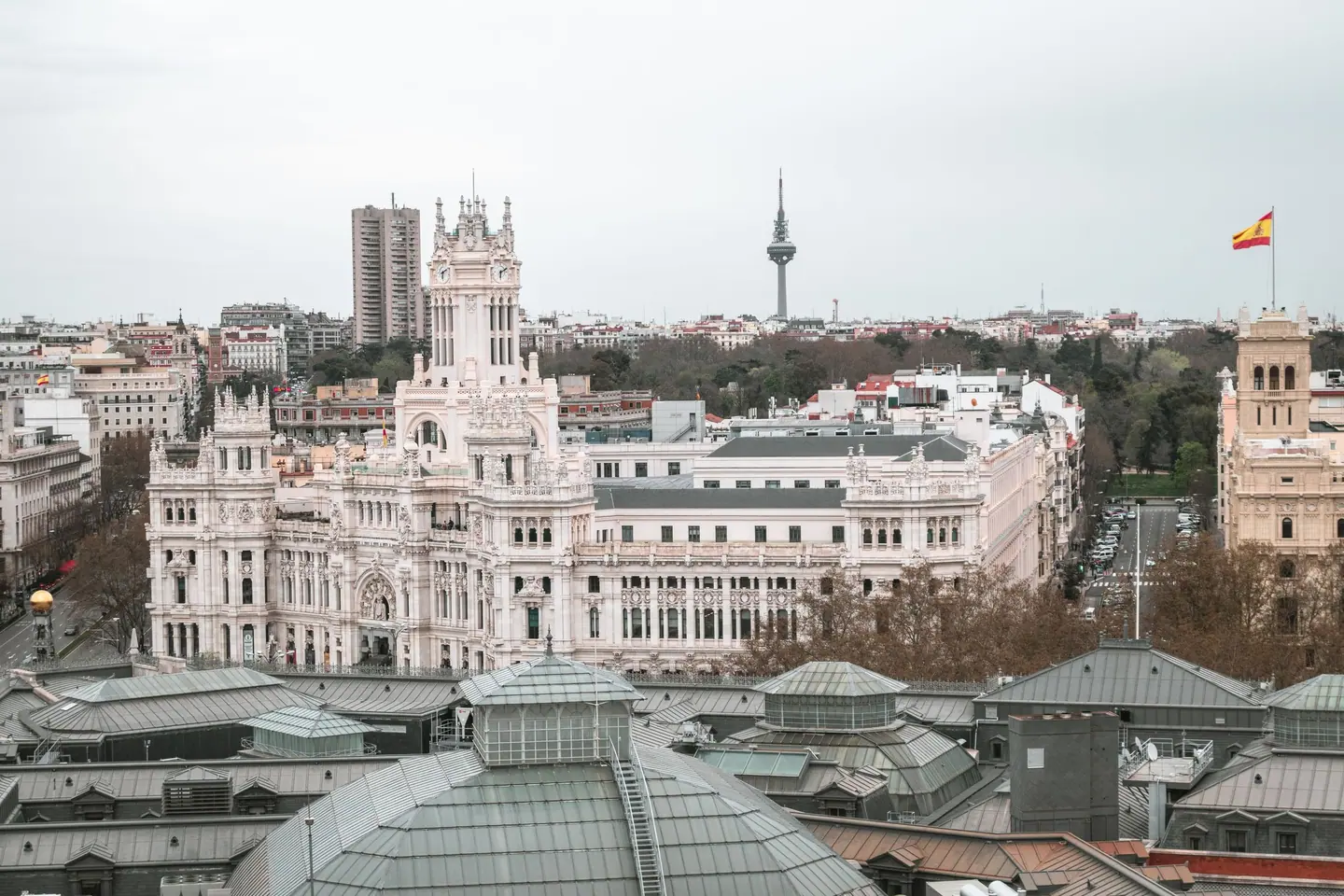
Cybele Palace
Designed by Antonio Palacios and Joaquín Otamendi, this colossal early twentieth-century edifice originally served as the central post office. Today it functions as Madrid City Hall and a cultural venue, crowned by a tall central tower and an observation platform offering sweeping perspectives across the neighbouring plaza.
Fountain of Cybele
Sculpted in 1782 by Francisco Gutiérrez and Roberto Michel under King Charles III, the fountain depicts Cybele riding a chariot drawn by two lions. Positioned at the intersection of Paseo del Prado and Calle de Alcalá, it remains an enduring emblem of civic celebrations and municipal pride.
Bank of Spain
Completed in 1891, the imposing headquarters blends Eclectic and Classical Revival architecture with ornate stained glass by the Maumejean workshop. The interior houses an extraordinary library and a legendary gold vault located deep beneath the street level, engineered to flood in the event of an intrusion.
Círculo de Bellas Artes
Founded in 1880 and housed in an Antonio Palacios building from 1926, this cultural institution champions fine arts, literature, and cinema. Visitors admire the bronze statue of Minerva presiding over the roof terrace, while the grand exhibition halls display contemporary artwork and host public lectures throughout the year.
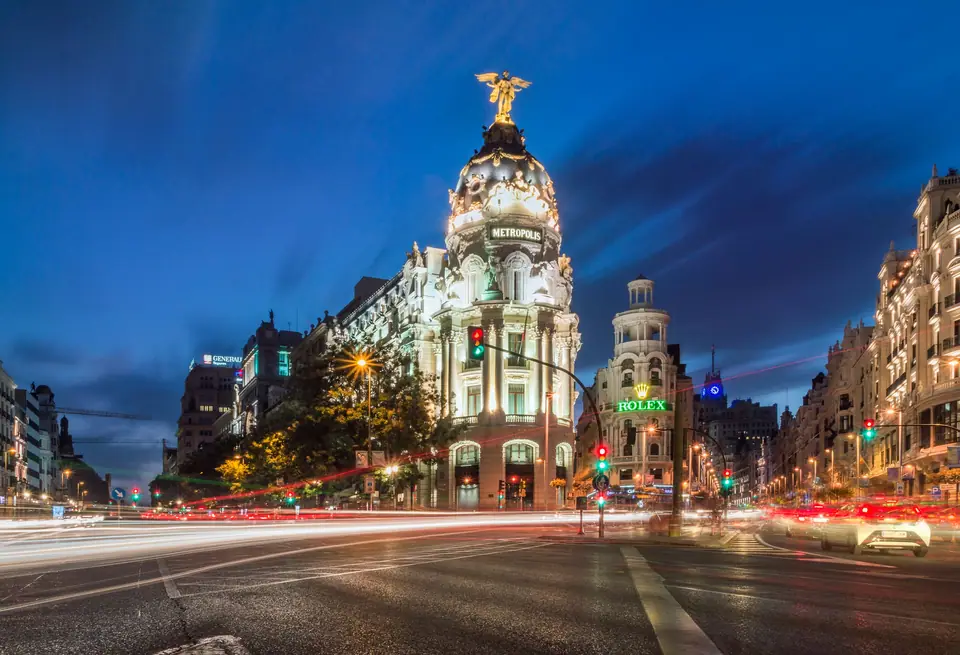
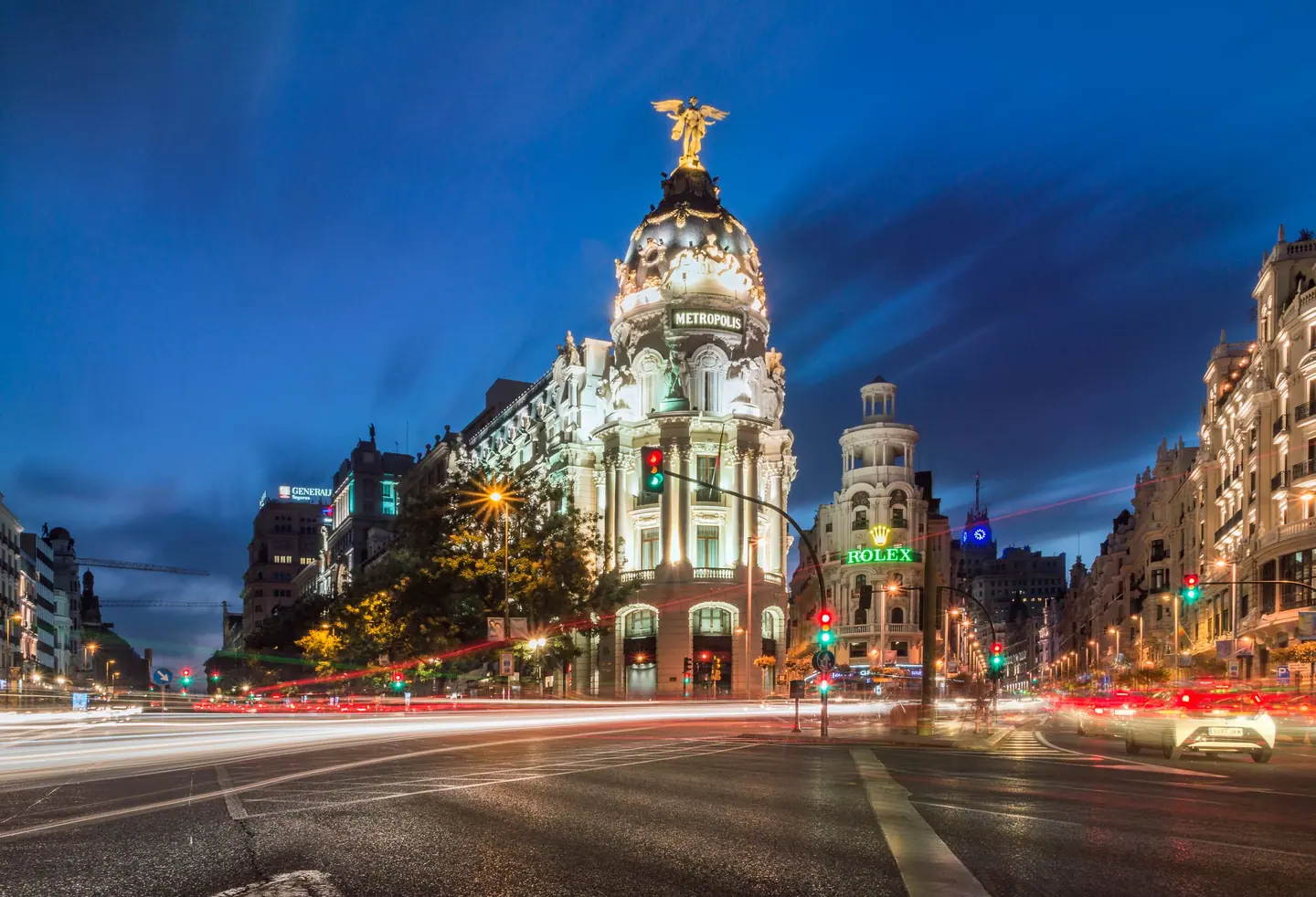
Metrópolis Building
Erected between 1907 and 1911 by French architects Jules and Raymond Février, this corner landmark stands where Calle de Alcalá meets Gran Vía. Its black slate dome is adorned with twenty-four-carat gold leaf detailing and topped by a winged statue of Victoria, showcasing French neoclassical elegance.
Edificio Grassy
Constructed between 1916 and 1917, this triangular building was designed by Eladio Laredo to punctuate the first segment of Gran Vía. Characterised by its stacked open-air rotundas and classical balustrades, it has long accommodated luxury jewellers alongside an antique clock museum on its ground floor.
Telefónica Building
Rising eighty-nine metres into the skyline, this 1929 skyscraper by Ignacio de Cárdenas drew direct inspiration from American high-rises. It served as a vital communications hub during the Spanish Civil War, and its lower levels currently host rotating exhibitions dedicated to the history of telecommunications and technology.
Plaza del Dos de Mayo
This open square serves as the social heart of the Malasaña quarter, named after the 1808 rebellion against Napoleonic troops. At its centre stands the preserved granite arch of the former Monteleón artillery barracks, framing a classical sculpture of officers Luis Daoíz and Pedro Velarde.
Museum of Romanticism
Occupying a late eighteenth-century neoclassical palace, this museum re-creates the daily atmosphere, fashions, and interior decors of the Spanish Romantic era. Visitors inspect elaborate drawing rooms containing period furniture, musical instruments, personal belongings of writer Mariano José de Larra, and paintings by Francisco de Goya.
Church of San Antonio de los Alemanes
Founded in the early seventeenth century by King Philip III, this modest exterior conceals an oval sanctuary covered in continuous trompe-l'œil murals. Master painters Luca Giordano and Francisco Carreño de Miranda decorated the curving dome and walls with scenes depicting the life of Saint Anthony of Padua.
Museum of History of Madrid
Housed in the former Royal Hospice of San Fernando, the museum boasts a lavish Churrigueresque portal sculpted by Pedro de Ribera in 1726. The permanent collection documents Madrid from its selection as royal capital in 1561, featuring porcelain, cartography, scale models, and paintings by Francisco de Goya.
Sorolla Museum
Set in the artist's former Chamberí residence, this intimate museum preserves original furnishings, ceramics, and hundreds of paintings filled with Mediterranean light. Outside, quiet courtyard gardens influenced by Andalusian architecture feature tiled fountains and shaded pergolas designed by Sorolla himself to provide artistic inspiration.
Andén 0 - Estación de Chamberí
Closed in 1966 when train lengths were extended, this underground station has been restored to its 1919 appearance. Visitors walk along the curved platform to examine bevelled white tiles, original turnstiles, and colourful advertisements made of glazed ceramic that reflect early twentieth-century consumer culture.
National Archaeological Museum
Founded by Queen Isabella II, the museum occupies a monumental neoclassical palace shared with the National Library. Its extensive galleries trace human settlement across the Iberian peninsula, showcasing foundational masterworks such as the fourth-century BC Lady of Elche, Visigothic votive crowns, and intricate Roman floor mosaics.
National Library of Spain
Completed in 1892, this imposing structure features a broad staircase flanked by statues of Saint Isidore and Alfonso X of Castile. Inside, it preserves millions of rare manuscripts, incunabula, and prints, with a public museum showcasing illuminated books and explaining the evolution of written language.
Puerta de Alcalá
Erected in 1778 by Italian architect Francesco Sabatini, this royal gateway once marked the eastern boundary of the walled city. Built from Segovian granite and Colmenar limestone, it features five arches and decorative military trophies, predating similar triumphal arches in Paris and Berlin.
Plaza de Colón
Named after Christopher Columbus, this vast open junction separates the Salamanca district from central Madrid. The plaza features a high neo-Gothic pinnacle topped by a statue of the explorer, the underground Fernán Gómez cultural centre, and colossal concrete sculptures commemorating maritime expeditions.
Mercado de San Antón
Originally an open-air market established during the nineteenth century, the site was entirely rebuilt into a modern gastronomic centre. Its three floors house traditional produce vendors, artisan tapas counters, and a rooftop dining terrace that overlooks the surrounding rooftops of the Chueca quarter.
Palacio de Longoria
Built between 1902 and 1904 by José Grases Riera, this private mansion represents a rare example of Catalan modernisme in Madrid. The exterior features undulating stone balconies and vegetal motifs, while the interior is centred on an iron staircase beneath a stained-glass dome created by the Maumejean workshop.
Church of San Manuel y San Benito
Erected between 1902 and 1910 by architect Fernando Arbós y Tremanti, this striking temple was built as a memorial for an affluent Catalan businessman and his wife. It features a central Greek cross plan, an Italian-style campanile, and a white marble dome decorated with luminous interior mosaics.
Structuring Your Days in Central Madrid
Before setting out, check local transit connections, museum booking notes and monthly weather data in our Madrid city guide, and compare other walking itineraries.