


























Quick Field Data
- UNESCO Inscription: 1989 (Cultural heritage property in Raisen District, Madhya Pradesh, India)
- Scale & Footprint: 50 numbered monuments including three main stupas, monolithic pillars, chaitya halls, and monastic viharas atop a sandstone sandstone hill overlooking the Betwa River plain
- Access & Ticketing: Protected and managed by the Archaeological Survey of India (ASI); check the official site for hilltop monument entry tickets and admission to the Sanchi Archaeological Museum at the base of the hill
- Arrival Logistics: Located 46 kilometres northeast of Bhopal and 10 kilometres north of the ancient city of Vidisha in central Madhya Pradesh
Emperor Ashoka, Vidisha Merchants, and Fifteen Centuries of Monastic Patronage
Rising roughly nearly 100 metres above the fertile Malwa plateau on a flat-topped sandstone hill overlooking the confluence of the Betwa and Bes rivers in Madhya Pradesh, the Buddhist Monuments at Sanchi constitute the oldest surviving stone sanctuary of Buddhism in India. Since 1989, the UNESCO World Heritage Atlas in 1989, the hilltop complex sits 46 kilometres northeast of Bhopal and just 10 kilometres from the ancient mercantile metropolis of Vidisha, also written as Vidisa, which stood at the crossroads of the ancient northern and southern trade arteries linking Pataliputra, Ujjain, and Bharhut. Known in ancient texts as Cetiyagiri and Chetiyagiri, Sanchi was never directly visited by the Buddha during his lifetime, yet its proximity to prosperous Vidisha and personal imperial ties transformed the quiet hill into a premier monastic centre from the 3rd century BC until the 12th century AD.
The architectural history of the sanctuary began during the reign of the Mauryan Emperor Ashoka between roughly 267 and 247 BC. Before ascending the imperial throne at Pataliputra, Ashoka had functioned as viceroy at Ujjain and married Devi, the devout Buddhist daughter of a wealthy merchant from nearby Vidisha, where their children Mahindra, or Mahendra, and Sanghamitta were born before departing on their historic mission to introduce Buddhism to Sri Lanka. When Ashoka redistributed the cremated relics of the Buddha across the subcontinent into 84,000 stupas, he constructed the original hemispherical brick core of the Great Stupa, Stupa 1, atop Sanchi Hill alongside a polished Chunar sandstone pillar bearing his schism edict warning monks and nuns against dividing the Sangha.
Following the fall of the Mauryan dynasty and a period of damage in the 2nd century BC often linked in Buddhist texts to Pushyamitra Shunga, artisans and monastic communities under the Shunga Empire rebuilt and doubled the size of Stupa 1, encasing Ashoka's brick mound in dressed stone slabs and adding a stone circumambulatory balustrade, harmonic crowning umbrellas, and two additional reliquary stupas on the hill. During the 1st century BC and 1st century AD under the Satavahana rulers of the Satavahana territory, guilds of ivory carvers from Vidisha and hundreds of lay patrons sculpted the four monumental stone gateways, or toranas, around Stupa 1 and the single gateway of Stupa 3. Patronage continued through the Western Satraps, or Kshatrapa rulers, the imperial Gupta dynasty of the 4th to 6th centuries AD under Chandragupta II, who left an inscription here in AD 412, and the post-Gupta rulers of Malwa up to the 12th century, after which the hilltop monasteries fell into abandonment and became overgrown by jungle until British cavalry officer General Henry Taylor came upon the intact ruins in 1818. After early 19th-century treasure hunting by amateur excavators damaged parts of the mounds, Major Alexander Cunningham and Frederick Charles Maisey recovered the inscribed sandstone and steatite reliquary caskets of the Buddha's chief disciples Sariputta and Mahamoggallana inside Stupa 3 and those of ten early Buddhist teachers inside Stupa 2 in 1851, before Sir John Marshall, heading the Archaeological Survey of India as Director-General, oversaw a meticulous restoration and conservation of the monuments between 1912 and 1919. Carved sandstone gateways frame the dome.
The Great Stupa, Narrative Torana Reliefs, and Gupta Temple Architecture
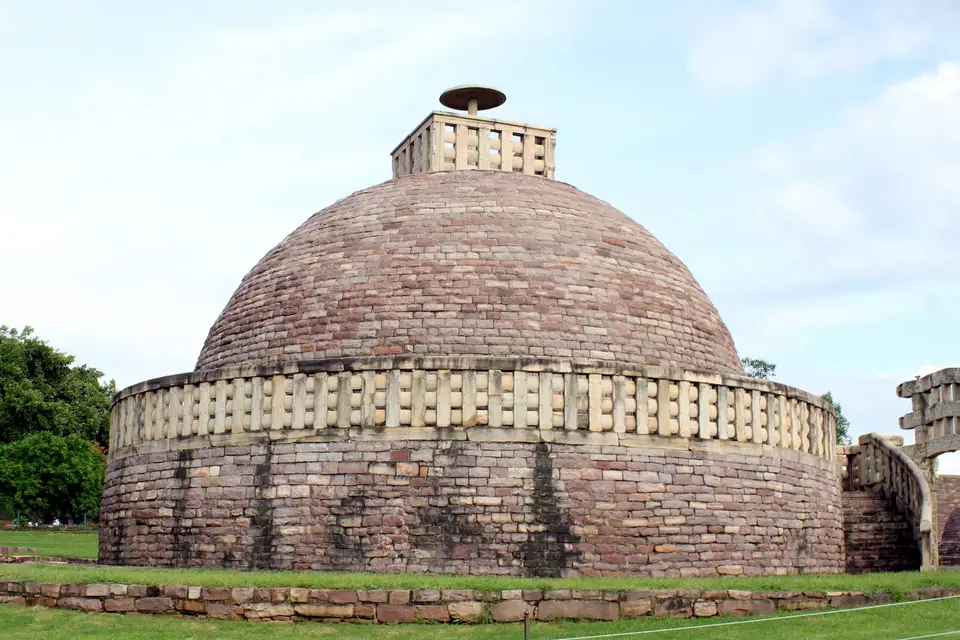
Dominating the central plateau of the hill is Stupa 1, the Great Stupa, whose flattened hemispherical dome, or anda, measures 36.6 metres in diameter and rises 16.46 metres high, crowned by its stone railing and triple parasol. Symbolising the cosmic mountain and the dome of heaven, the masonry hemisphere rests on a circular basal terrace, the medhi, reached by a double flight of stairs on the south side that allowed monks to perform clockwise circumambulation, pradakshina, alongside a ground-level stone paved processional path enclosed by a massive plain stone balustrade, the vedika, donated piece by piece by hundreds of individual monks, nuns, merchants, and artisans whose names are engraved in Brahmi script on the crossbars and uprights. At the apex of the dome stands a square stone railing, the harmika, surrounding a triple-tiered stone parasol, the chhatra, representing the Three sacred pillars of Buddhist teaching: the Buddha, the Dharma, and the Sangha.
At the four cardinal points of the Great Stupa rise the 1st-century BC to 1st-century AD toranas, each standing approximately 10 metres tall and consisting of two square vertical pillars spanned by three slightly curved horizontal architraves with spiralling volute ends that translate wooden architectural joinery into creamy sandstone. Covered from base to summit in dense narrative bas-reliefs, these gateways belong to the aniconic phase of early Buddhist art: the Buddha is never depicted in human form, appearing instead through sacred symbols such as the Bodhi tree of enlightenment, the Dharma wheel of the law, the stupa of the Decease, the riderless horse at the Great Departure, the royal parasol, footprints, or an empty throne. Across the architraves and pillars unfold lively scenes from the Jataka tales of the Buddha's previous incarnations, including the Vessantara Jataka, Syama Jataka, and Mahakapi Jataka, alongside historical episodes such as Emperor Ashoka's pilgrimage to the Ramagrama stupa and the Bodhi tree, the War of the Relics at Kushinagar, the Miracle at the Nairanjana River, the Temptation of Mara, Bimbisara departing Rajagriha, and Suddhodana's procession at Kapilavastu, framed by graceful tree goddesses, salabhanjikas or yakshis, swinging from mango branches as structural brackets.
Surrounding Stupa 1 across the hillside and down the western slope stand forty-nine other numbered structures tracing the entire evolution of Indian sacred architecture. Halfway down the western ledge sits Stupa 2, built in the 2nd century BC without gateways to house the bone relics of ten Buddhist masters from three generations who presided after the Third Buddhist Council, its ground balustrade carved with early medallions of lotus rosettes, elephants, centaurs, and winged lions. Immediately northeast of the Great Stupa stands Stupa 3, housing the relics of Sariputta and Mahamoggallana beneath a single hemispherical dome and one richly carved southern torana. South of Stupa 1 lie the broken lustrous shaft of Ashoka's Pillar 10, whose four-lion capital closely mirrors the Sarnath national emblem, the apsidal Mauryan and Shunga foundations of Temple 18 with its tall 7th-century stone pillars, and Temple 40, one of India's earliest free-standing apsidal stone structures. Just beside Temple 18 stands Temple 17, a small early 5th-century AD Gupta sanctuary consisting of a flat-roofed square sanctum and a four-pillared portico whose harmonious proportions, restraint, and symmetry mark the birth of classical Hindu and Buddhist stone temple design, while the eastern plateau ends at the multi-storeyed late medieval complex of Monastery 45 and the eastern monastic courtyards.
Walking the Hilltop Sanctuary Circuit and Archaeological Museum
Travellers visiting Sanchi from Bhopal or Vidisha climb the gentle curving road or stone steps up the sandstone hill into a tranquil lawn-covered enclosure managed by the Archaeological Survey of India. Because the low relief carvings on the four gateways of Stupa 1 catch the sunlight differently through the day, walking the hilltop circuit in the morning or late afternoon reveals the finest sculptural detail.
- Clockwise circumambulation of Stupa 1 and the four toranas: Begin at the Southern Gateway, the oldest of the four toranas erected right beside the broken shaft of Ashoka's Mauryan pillar and the double stairway, where an inscription on the top architrave records the gift of Ananda, foreman of the artisans of King Satakarni. Proceed clockwise past the Western, Northern, and Eastern Gateways, pausing at the intact Northern Gateway crowned by wheels and triratna emblems and at the Eastern Gateway where the famous cantilevered bracket of the salabhanjika yakshi hangs beneath the architraves.
- Stupa 3, Gupta Temple 17, and the eastern monastic quarter: Step northeast of the Great Stupa to inspect the single carved gateway of Stupa 3 and the modern Vihara built in 1952 to enshrine the returned relics of Sariputta and Mahamoggallana. South of the main mound, compare the tall rectangular colonnade of apsidal Temple 18 with the compact classical portico of 5th-century Gupta Temple 17, where four medieval seated Buddha sculptures placed against the inner walls of the Great Stupa's outer ambulatory also illustrate how figural human depictions of the Buddha emerged under Kushan and Gupta workshops, before walking east to the high carved tower of Temple 45.
- Western slope trail to Stupa 2 and the Sanchi Archaeological Museum: Descend the stone-paved path down the western escarpment past the monolithic monolithic stone begging bowl cut from a single boulder and the courtyard cells of the western monastic cells to reach the 2nd-century BC balustrade of Stupa 2. Finish at the base of the hill inside the Sanchi Archaeological Museum, established by Sir John Marshall in 1919, which exhibits the original four-lion capital of Ashoka's Pillar 10 with its pecking geese abacus, reliquary caskets, a red sandstone Mathura Bodhisattva, and Iron Age and monastic metalwork unearthed on the hill.
