


























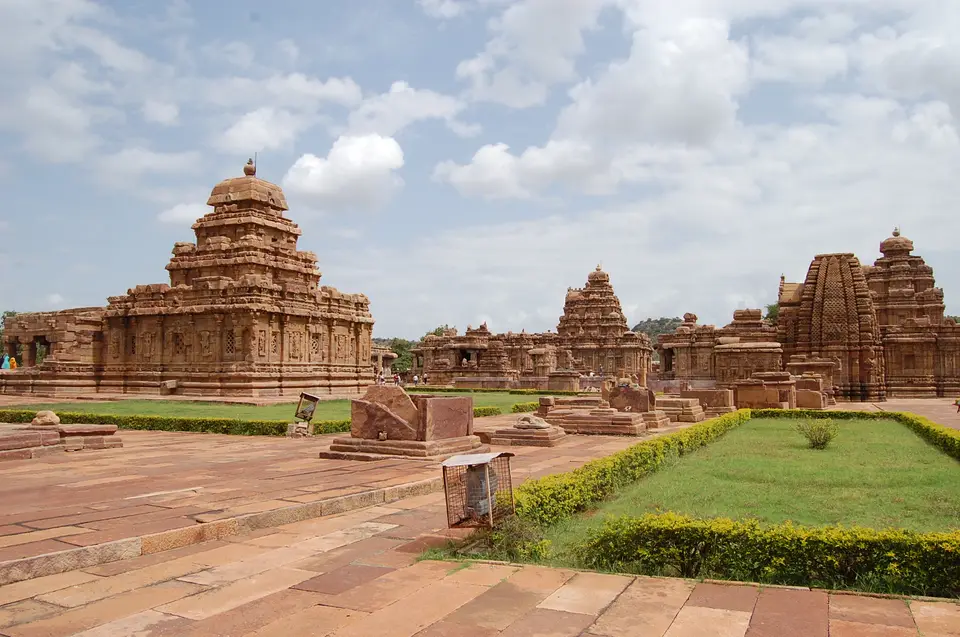
Quick Field Data
- UNESCO Inscription: 1987
- Scale & Footprint: Ten principal sandstone temples set along the western shore of the Malaprabha River within Bagalkot district, Karnataka, India
- Access & Ticketing: Managed by the Archaeological Survey of India as a fenced riverside reserve with pedestrian walkways linking the main Hindu complex and road access to the western Jain sanctuary; check the official site before travel
- Arrival Logistics: Reached by road via Karnataka state highway SH 14, lying 23 kilometres from the railhead at Badami and 9.7 kilometres from Aihole, with regional flights through Hubballi and Sambra Belgaum airports
Coronation Grounds on the Northbound Bend of the Malaprabha River
Set along the western shore of the Malaprabha River within Bagalkot district in northern Karnataka, the Group of Monuments at Pattadakal preserves the ceremonial and architectural heart of the Early Chalukya dynasty. The river originates at Kanakumbi in the Belagavi district of the Western Ghats and flows eastwards across the sandstone plains before turning sharply from south to north just 1 kilometre before the temple compound. In Hindu sacred geography, a northward-flowing river course is revered as an auspicious Uttarvahini Ganga directed towards the Himalayas and Mount Kailasha. Because of this sacred hydrography and the red sandstone terrain of the valley, historical inscriptions and literary texts knew the settlement as Pattadakallu, Kisuvolal, Raktapura, and Pattada-Kisuvolal, signifying the red-soil valley of the coronation stone. The Greek geographer Ptolemy recorded the settlement as Petirgal, while early medieval texts by Srivijaya also noted its prominence. During the 7th and 8th centuries CE, Chalukya monarchs including Vinayaditya gathered along this riverbank for royal coronation rites, transforming the valley into a dynastic ritual stage alongside the neighbouring temple centres of Badami, 23 kilometres away, and Aihole, 9.7 kilometres away.
The broader Malaprabha valley had witnessed monument building long before the rise of the Chalukya court. Archaeological surveys led by Prof Ravi Korisettar for the National Institute of Advanced Studies documented prehistoric iron-age megalithic dolmens at Bachinnagudda, two kilometres west of Pattadakallu near the Badami road, dating between roughly 1200 BCE and 500 BCE. Excavations conducted in 1969 and 1971 beneath the ruined hall of the Sangameshwara Temple, together with Archaeological Survey of India trenching at the Jain sanctuary that revealed a brick complex and a standing Tirthankara sculpture, confirm that earlier brick shrines stood along the river by the 3rd or 4th century CE. Across the wider Pattadakal-Badami-Aihole cultural zone, more than 150 Hindu, Jain, and Buddhist monuments survive from the 4th to the 10th centuries. While the earliest Chalukya rulers of the 5th and 6th centuries were devotees of Lord Vishnu, later monarchs embraced Shaivism, dedicating the riverside sandstone sanctuaries of Pattadakal to Lord Shiva while integrating Vaishnavism and Shaktism iconography across the carved walls.
After the eclipse of the Early Chalukya empire, the Rashtrakutas governed the valley into the 10th century and added the Jain Narayana Temple under King Krishna II. Between the 11th and 12th centuries, the Late Chalukyas of Kalyani continued patronising temples and monasteries across the district. In the 14th century, raids by armies of the Delhi Sultanate damaged the Malaprabha sanctuaries before the Vijayanagara Empire fortified nearby Badami to defend the frontier. After the fall of Vijayanagara in 1565, control passed successively to the Adil Shahi dynasty of the Bijapur Sultanate, the Mughal Empire under Aurangzeb in the late 17th century, the Maratha Empire, and the late-18th-century rulers Haider Ali and Tipu Sultan, before British annexation placed the ruins under colonial antiquarian administration.
Northern Curvilinear Spires, Southern Stepped Towers, and Narrative Friezes
The architectural distinction of Pattadakal lies in its deliberate synthesis of two major Indian building traditions within a single enclosure: the northern Rekha-Nagara-Prasada style with curvilinear towers and the southern Dravida-Vimana style with stepped pyramidal storeys. Of the 10 major sanctuaries at the complex, 8 stand clustered within the riverside lawn enclosure, a 9th Hindu temple stands half a kilometre south of the main compound, and the 10th monument, a Jain sanctuary, lies about 1 kilometre to the west. Four of the temples follow the Chalukya Dravida canon, four employ the northern Nagara profile, and the Papanatha Temple blends both idioms across its elongated plan. Artisans quarried warm pink-red sandstone from hills located 5 kilometres away, where archaeologist Venkateshaiah identified guild sketches of Shiva, Nandi, Durga, Ganesh, peacocks, and tridents in 2008, while selecting polished black granite for specific interior sculptures.
Among the smaller northern-style shrines inside the main lawn, the east-facing Kadasiddheshwara Temple and Jambulingeshwara Temple date from the late 7th or early 8th century. Both rise above square sanctums housing a Shiva linga and project an eastern sukanasa arch carved with a dancing Nataraja alongside Parvati, while their exterior niches hold Ardhanarishvara, Harihara, Vishnu, Surya, and Lakulisha above doorways bordered by statues of the river goddesses Ganga and Yamuna. Immediately east of Jambulingeshwara, the Galaganatha Temple preserves a towering curvilinear Rekha-Nagara spire modelled closely on the 689 CE Svarga Brahma shrine at Alampur in Andhra Pradesh. Its covered circumambulatory path, or pradakshina patha, encloses the sanctum, while its southern slab depicts an 8-armed Shiva slaying the demon Andhaka and its basement mouldings carry miniature reliefs from the Panchatantra fables, including the mischievous monkey and the 2-headed bird. Nearby, the compact towerless Chandrashekhara Temple occupies a platform measuring 33.33 feet by 17.33 feet, and the Kashi Vishwanatha Temple raises a 5-stage northern spire above a hall whose pillars and ceiling panels portray Ravana lifting Mount Kailasha, the marriage of Shiva and Parvati, and the playful youth of Krishna.
The southern Dravida-Vimana tradition reaches monumental scale in the 3 largest riverside temples. Sangameshwara Temple, also called Vijayeshvara, was commissioned by King Vijayaditya Satyashraya between 720 and 733 CE and left slightly unfinished at his death in 734 CE; its 2-tiered square vimana and hall of 16 massive pillars set in groups of 4 display unfinished deity niches and struggling dwarf ganas beneath the eaves. Immediately south stand the twin royal foundations of the sisters Queen Lokamahadevi and Queen Trailokyamahadevi, consorts of King Vikramaditya II, erected to celebrate his 3 victories over the Pallavas of Kanchipuram. The Trailokeshwara or Mallikarjuna Temple crowns its Dravida tower with a hemispherical roof, while the adjacent Virupaksha Temple, built between 740 and 745 CE as the Shri Lokeshvara Mahasila Prasada by chief architect Gunda Anivaritacharya, rises 17.5 metres to a square kuta roof and kalasha finial. Modelled after the Kailasanatha sanctuary at Kanchipuram and later inspiring the rock-cut Kailasha monument at the Ellora Caves, the Virupaksha compound encloses an 18-column sabha-mantapa, an eastern Nandi pavilion, and footprints of 32 subsidiary shrines. Its walls, porch, and pillars carry signed sculptural panels depicting narrative scenes from the Ramayana, episodes from the Mahabharata, legends of the Bhagavata Purana, the Harivamsa, and the Kiratarjuniya, alongside a monolithic Shaiva pillar erected by Jnana Shivacharya from Mrigathanikahara on the Ganges and an 8th-century column inscribed in both northern Siddhamatrika and southern Kannada scripts. Half a kilometre south, the Papanatha Temple joins 2 interconnected halls of 16 and 4 pillars under a northern spire and Dravida parapet, while 1 kilometre west, the 9th-century Jain Narayana Temple features lathe-turned sandstone columns, life-sized elephant riders, and 7-bay walls carved with seated Jinas.
Walking the Malaprabha Sanctuary Lawns and Sandstone Corridors
Travellers consulting the UNESCO World Heritage Atlas find that Pattadakal is best explored on foot during the early morning hours, when low eastern sunlight illuminates the east-facing sanctum doorways, sukanasa arches, and deep sandstone pilasters across the Malaprabha lawns. A paved pedestrian circuit links the 8 clustered Hindu monuments inside the Archaeological Survey of India garden enclosure, allowing visitors to compare northern curvilinear spires and southern stepped towers within a few paces of one another. Because the Virupaksha Temple remains an active house of Hindu worship while the surrounding 7 shrines function as conserved archaeological monuments, footwear must be removed before stepping onto the stone porches and interior columned halls. After completing the main riverside enclosure, visitors should walk half a kilometre south through the village lanes to examine the elongated twin halls and ceiling medallions of the Papanatha Temple, then follow the western road 1 kilometre out to the quiet courtyard of the Jain Narayana Temple.
Most independent itineraries pair Pattadakal with the rock-cut cave sanctuaries and cliff fort of Badami, 23 kilometres southwest along state highway SH 14, and the early experimental temple laboratories of Aihole, 9.7 kilometres further east along the Malaprabha valley. Indian Railways services on the Hubballi-Solapur line stop at Badami station, from which local taxis and buses cover the short valley road to the monument gates. Travellers arriving by air can use either Hubballi Airport or Sambra Belgaum Airport (IATA code IXG), each roughly a 3-hour drive away with regular domestic flights connecting to Bengaluru, Mumbai, Chennai, Kochi, and Delhi. The stone pavements hold intense heat by midday.
- Best time to walk the complex: Arrive shortly after the gates open in the morning so the rising eastern sun lights the carved sanctum lintels, sukanasa reliefs, and Nandi pavilions before the sandstone courtyards heat up.
- Footwear and active worship etiquette: Bring slip-on sandals and socks for crossing the warm stone flagstones, as shoes must be left at the threshold of the active Virupaksha Temple and interior mandapa halls.
- Completing the three-part layout: Budget enough time beyond the main fenced lawn to visit both the southern Papanatha Temple and the western Jain Narayana sanctuary, which lies 1 kilometre away along the road towards Badami.
