


























Quick Field Data
- UNESCO Inscription: 1986 (Cultural Criteria ii, iv, vi)
- Scale & Footprint: Serial ensemble of seven religious monuments in Goa Velha (Old Goa) on the banks of the Mandovi River
- Access & Ticketing: Protected by the Archaeological Survey of India (ASI) in partnership with the Catholic diocese of Goa; check the official site for museum and church access
- Arrival Logistics: Situated on the west coast of India in the state of Goa, roughly 10 kilometres east of the state capital Panjim (Nova Goa)
The "Rome of the East" on the Banks of the Mandovi River
Set amid palm groves on the southern bank of the Mandovi River in Goa Velha (present-day Old Goa), roughly 10 kilometres east of the state capital Panjim on the west coast of India, the Churches and Convents of Goa preserve the monumental religious core of the former capital of the Portuguese Indies. Within India, the UNESCO World Heritage Atlas in 1986 under cultural criteria ii, iv, and vi and mapped on the Atlas, this serial ensemble of seven surviving churches, chapels, and convents illustrates both the Catholic evangelisation of Asia from the 16th century onwards and the dissemination of Manueline, Mannerist, and Baroque architectural and decorative forms across Asian mission territories. Comparable in historical wealth to the Latin American colonial ensembles of Ouro Preto (inscribed in 1980), Olinda (1982), Cuzco (1983), and Salvador de Bahia (1985), the monuments of Old Goa gave birth to an original Indo-Portuguese style shaped across 450 years (451 years in total) of Portuguese administration until 1961. Red laterite stone defines the facades.
Originally developed in the fifteenth century out of an earlier village called Ella (or Ela) under the rule of the Muslim Sultanate of Bijapur as a river port on the banks of the Mandovi, the city of Goa was captured in 1510 by the Portuguese commander Afonso de Albuquerque with the assistance of the Goan Hindu privateer Timoja. Following the 1510 conquest, the earliest converts to Christianity were local Goan women who wed Portuguese soldiers and settlers arriving with Albuquerque's fleet. Elevated to the seat of a Catholic bishopric by Pope Paul III in 1534 and enjoying administrative privileges similar to those of Lisbon, the city grew during its sixteenth- and seventeenth-century Golden Age into an international trading metropolis recorded as having over 200,000 inhabitants, celebrated by travellers as the "Rome of the East" for its concentration of sumptuous cathedrals, convents, and colleges founded by the Franciscans, Jesuits, Dominicans, Augustinians, Carmelites, and Theatines.
While the ground plans and facades of these sanctuaries followed contemporary European Renaissance, Mannerist, and Baroque canons, their construction relied on local materials and on the skilled labour of native Goan sculptors, painters, woodcarvers, and silversmiths, which made it unnecessary for the Portuguese to bring in European craftsmen or rely on African slave labour as they did in colonial Brazil. From the late seventeenth century onwards, however, maritime trade competition with the Dutch and the British, recurring tropical epidemics, and the inadequacy of the Mandovi River channel for larger modern ships triggered an urban decline: although designated capital for Portuguese occupied territories in Asia in 1730, the Viceroy moved his residence downstream to Pangim (Nova Goa) in 1759, Velha Goa officially lost its capital status in 1843, and the Republic of India annexed Goa in 1961.
The Seven Inscribed Monuments: Manueline Portals to Baroque Gilt Altars
Walking across the landscaped greens of Old Goa allows visitors to inspect all seven protected religious monuments that compose the World Heritage serial ensemble:
- Chapel of Santa Catarina (1510 and 1534): Erected in 1510 directly over the door of the Muslim wall of Ela where Afonso de Albuquerque entered the city (about 100 metres west of St. Francis of Assisi Church, near the former Royal Hospital and Arsenal), this rectangular single-nave chapel with a stone cylindrical-vaulted chancel and tripartite pilastered facade flanked by two square-section bell towers briefly held cathedral status under Pope Paul III in 1534.
- Church of St. Francis of Assisi (1517, 1521, and 1661): Founded by the Franciscan Order after obtaining permission from King Manuel of Portugal in 1517 and first completed in 1521, the church was completely rebuilt in the Mannerist style from 1661 while preserving its dark-stone 16th-century Manueline doorway carved with a lobed profile and King Manuel's armillary spheres between two octagonal-section towers and a large granite forecourt cross. Inside, the stuccoed and painted single vaulted nave with side chapels and inscription-paved floor graves leads to a gilded 1670 high altarpiece depicting Jesus on the cross extending one arm to embrace Francis Xavier above an ornate tabernacle resting upon sculpted figures of the Four Evangelists.
- Church of Our Lady of the Rosary (Igreja de Nossa Senhora do Rosário, 1543): Built in 1543 as the earliest surviving church in Old Goa, its fortress-like exterior porch framed by rounded turrets topped with cupolas recalls late-Gothic and Manueline churches of the Alentejo region in Portugal, while its Manueline vaulted chancel preserves a wall-mounted sculpted alabaster cenotaph blending Persian and Indian decorative motifs and inscribed in Portuguese to commemorate Dona Catarina above the floor grave of her husband Garcia de Sá (who died in 1549 as Governor of India succeeding João de Castro).
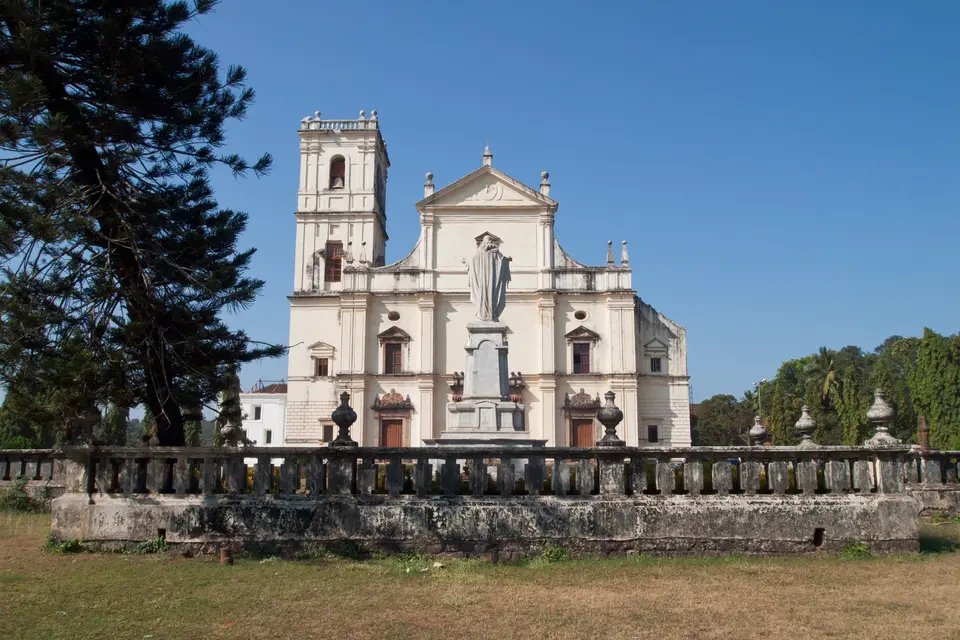
- Sé Catedral of Goa (1562 to 1631): Rebuilt from 1562 under Viceroy Dom Francisco Coutinho to replace the earlier 1534 cathedral dedicated to Catherine of Alexandria (with the main body completed in 1619 and the missing facade finished in 1631), the 91-metre-long cathedral is the largest church ever erected by the Portuguese in Asia. Modelled as a three-nave hall-church of equal height like the Portuguese cathedrals of Miranda do Douro (from 1552), Portalegre (1556), and Leiria (1559), its severe three-portal facade retains a single bell tower (after the right tower was destroyed during a storm in 1766) and houses a magnificent gilded chancel altarpiece and the revered miraculous cross.
- Basilica of Bom Jesus (1594 to 1605): After Jesuit missionaries reached Goa in 1542 under Francisco Xavier ("Apostle of the East") and created St. Paul's College (also called São Roque College, demolished in 1830), Goan engineer Julius Simon and Portuguese Jesuit Domingos Fernandes built the Basilica of Bom Jesus between 1594 and 1605. Following the model of the Jesuit churches of the Holy Spirit of Évora and St. Roque in Lisbon, its three-storey Mannerist facade with three portals and a scrolled pediment cartouche bearing the arms of the Society of Jesus opens into a timber-roofed single nave housing a golden 1699 high altarpiece to the Infant Jesus and Ignatius of Loyola, while the transept chapel enshrines the remains of Francisco Xavier (placed here in 1655) inside a richly worked silver reliquary casket crafted by Goan silversmiths atop a 1697 Italian marble mausoleum executed by Florentine sculptor Giovanni Battista Foggini, offered by Grand Duke Cosimo III of Medici of Tuscany, and set in place in 1698 by artist Placido Francesco Ramponi.
- Ruins of the Church of St. Augustine (1597) and Church of Divine Providence / São Caetano (1665): Built by the Augustinians from 1597 with two five-floor towers before its vault collapsed in 1842 and its facades fell in 1936, the Church of St. Augustine survives as a striking solitary tower fragment. Nearby stands the Church of Divine Providence, widely known as São Caetano or St. Cajetan, built by the Theatines between 1639 and 1665 on the plan of a Greek cross designed by Italian architects Carlo Ferrarini alongside Francesco Maria Milazzo, whose Corinthian facade, two quadrangular towers, and huge hemispherical dome imitate Carlo Maderno's St. Peter's Basilica in Rome, adorned with four carved basalt figures representing St. Peter, St. Paul, St. Matthew, and St. John the Evangelist above the portal inscription "Domus mea, domus orationis" ("My House is a House of Prayer").
Urban Conservation and Practical Visitor Logistics in Old Goa
Following a January 1999 UNESCO mission that launched urban conservation cooperation under the European Union Asia Urbs Programme linking Old Goa with Guimaraes in Portugal and Brighton and Hove in the UK, alongside consultations involving the central government of India, the State of Goa, the Catholic diocese, the Goa circle of the Archaeological Survey of India, the Fundação Orient, and Portugal's national monuments directorate (DGEMN), heritage managers have worked to inventory the site and protect the historic port town setting beyond the enclosed garden squares:
- Entry and route: Old Goa lies roughly 10 kilometres east of Panjim along the road beside the Mandovi River; regular buses, taxis, and river ferries connect Panjim directly to the central green between the Basilica of Bom Jesus and the Sé Cathedral.
- Tickets and viewpoints: Entry to the active worship spaces of the Basilica of Bom Jesus, Sé Cathedral, and St. Cajetan Church is open to visitors, while the museum wing adjacent to the Church of St. Francis of Assisi is managed by the ASI; check the official site before visiting for schedules and walk up to the hilltop Church of Our Lady of the Rosary and the ruined tower of St. Augustine for views over the Mandovi palms.
- Timing and onward connections: Visit in the early morning before tour groups arrive from the coast, and dress modestly with shoulders and knees covered when entering the Basilica of Bom Jesus and the Sé Cathedral.
