


























Quick Field Data
- UNESCO Inscription: 1980 · Criterion (iii)
- Scale & Footprint: 500 m2 underground complex spanning three superimposed levels cut down to 10.60 metres below ground level into soft globigerina limestone in Paola, Malta
- Access & Ticketing: Managed by Heritage Malta with a strict conservation cap of 80 visitors per day; tickets must be booked online months in advance (or via the twenty daily Last-Minute tickets sold at Fort St. Elmo in Valletta or the Gozo Museum of Archaeology)
- Arrival Logistics: Located on a hill in the town of Paola rising above the inner basin of the Grand Harbour of Valletta, easily reached by public bus from Valletta
Three Subterranean Limestone Tiers and Imitation Megalithic Architecture
Beneath a residential street on a hill in the town of Paola overlooking the innermost basin of the Grand Harbour of Valletta, the Ħal Saflieni Hypogeum (known officially in Maltese as Ipoġew ta' Ħal Saflieni) is the world's only known prehistoric subterranean temple and necropolis complex of its scale. Stone becomes underground architecture here. Spanning roughly 500 square metres across three superimposed underground levels reaching 10.60 metres below the present street surface, this Neolithic monument was excavated between approximately 4000 BC and 2500 BC across the Żebbuġ, Ġgantija, Saflieni (3300 to 3000 BC) as well as Tarxien phases of Maltese prehistory. Included on the UNESCO World Heritage List in 1980 under Criterion (iii) and depicted on the obverse of a commemorative coin in the Maltese Prehistoric Sites series struck in 2022, it represents a subterranean counterpart to Malta's above-ground Megalithic Temples and the Xagħra Stone Circle on Gozo.
The word hypogeum derives from Hellenic roots meaning under the earth, while the locality name Ħal Saflieni combines two words of Berber origin meaning low village, contrasting with the nearby high village of Ħal Fuqani between Tarxien and Luqa. Originally, Neolithic worshippers entered the underground complex through a monumental surface shrine built on the brow of the hill; although only a few stone blocks of that ground-level entrance survived, its collapse thousands of years ago sealed and protected the chambers below until modern times.
Working without metal tools, prehistoric miners and masons hollowed out the soft globigerina limestone using only hand tools fashioned from flint, chert, obsidian, and deer antlers, hoisting huge blocks of coralline and globigerina rock to the surface with cyclopean rigging. The uppermost level, lying just one metre below the surface, began as natural limestone caves that were artificially enlarged and cut with side burial cavities during the earliest phases around 4000 BC. As the community expanded, builders carved downward to create the spacious middle level and finally the lowest level at 10.60 metres depth, connecting all three tiers through a labyrinthine sequence of rock-cut steps, lintels as well as porthole doorways.
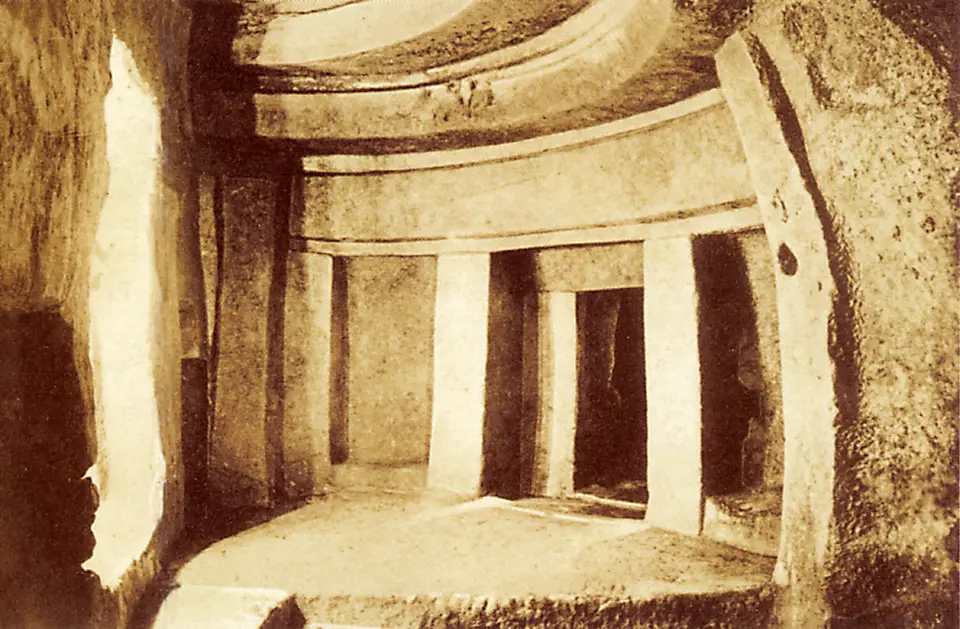
What makes the middle level architecturally extraordinary is that its subterranean halls were carved in direct imitation of Malta's contemporary above-ground megalithic temples. In the circular Main Chamber, masons sculpted free-standing and engaged trilithon doorways, some opening into side chambers and others blind, washed in red ochre pigment. Nearby, the central sanctuary known as the Holy of Holies features a porthole entrance framed within three nested trilithons of vertical stone jambs and horizontal lintels beneath a corbelled rock-cut ceiling, providing vital architectural evidence for how Malta's now-roofless surface temples were originally vaulted. In addition, the Holy of Holies was oriented so that natural daylight entering through the original upper surface opening illuminated its facade during the winter solstice, whereas navigating the deeper middle chambers and the dark lower level (which contained no bones or offerings) required artificial oil lamps.
Red Ochre Spirals, Acoustic Resonance and 7,000 Prehistoric Burials
Adjacent to the circular Main Chamber and the inward-slanting Decorated Room, which bears geometrical spiral patterns and a rock-carved human hand (petrosomatoglyph) on its right entrance wall, lies the roughly rectangular Oracle Room. Measuring as one of the smallest side chambers on the middle level, the Oracle Room features an elaborately painted ceiling of red ochre spirals, circular spots, and honeycomb motifs. Cut into its wall is a hemispherical acoustic resonance niche designed so that deep male vocalizations, chanting, or drumming inside the niche reverberate powerfully throughout the entire subterranean complex, a phenomenon investigated by an international team of acoustics scientists in 2014.
Across the centuries from around 4000 BC to 2500 BC as a sanctuary and collective necropolis, the Hypogeum received the skeletal remains of an estimated 7,000 individuals alongside rich funerary offerings. Excavations in the Main Chamber and adjoining halls yielded finely decorated pottery vessels, including a famous bowl combining realistic bovines, pigs, and goats on one side with stylized animals hidden inside geometric hatching on the other, alongside stone and clay beads, shell buttons, amulets, stone axe-heads, and sculpted human and animal figurines. The masterpiece recovered from the Main Chamber is the Sleeping Lady, a small terracotta figurine reclining on a couch that is widely interpreted as a mother goddess or symbol of ritual sleep and spiritual transformation.
The monument was rediscovered by accident in 1902 when construction workers cutting water cisterns for four new town houses broke through the limestone roof of the upper level and initially tried to conceal the discovery while disturbing early deposits. In November 1903, scholar Manuel Magri began the first systematic archaeological excavation on behalf of the Museums Committee, though his sudden death in Tunisia in 1907 and the loss of his field notebooks, compounded by the early discarding of uncatalogued bones, left gaps in the initial record. Sir Themistocles Zammit took over excavations until 1911, publishing foundational reports starting in 1910, opening the site to the public in 1908 (visited by Queen Mary and Sir Leslie Rundle in 1912), and depositing the surviving skulls (including several exhibiting cranial elongation) and the Sleeping Lady within Valletta at the National Museum of Archaeology.
To safeguard the fragile red-ochre ceiling paintings against humidity and algae triggered by visitor breath, archaeologists Anthony Pace, Nathaniel Cutajar, and Reuben Grima conducted targeted excavations between 1990 and 1993 after the four surface houses were demolished, closing the monument from 1991 to 2000 to install an environmental buffer zone. Following intensive decay monitoring launched in 2011, the site closed again in September 2016 for a major conservation renovation partly financed by grants from Iceland, Norway, and Liechtenstein, reopening on 15 May 2017 with an advanced microclimate control system and visitor centre.
Securing One of the 80 Daily Tickets and Pairing Paola with Valletta
Because Heritage Malta strictly caps admission at 80 visitors per day (grouped into small hourly guided cohorts starting in the morning during the winter and summer seasons) to keep subterranean temperature and humidity stable, visiting the Ħal Saflieni Hypogeum requires planning months before you arrive in Malta.
- Advance online booking or the twenty Last-Minute tickets: Reserve your timed entry slot on the official Heritage Malta portal several months ahead of your travel dates. If online allocations are sold out, queue before noon the day prior to your intended visit at Fort St. Elmo in Valletta or the Gozo Museum of Archaeology (or after noon within Valletta at the National Museum of Archaeology, the Domus Romana, or the Hypogeum desk) to purchase one of the twenty daily Last-Minute tickets.
- Descending the three levels from the upper caves to the Holy of Holies: Arrive in Paola 15 minutes before your timed slot to watch the introductory audiovisual briefing in the 2017 visitor centre, then descend along the suspended walkways through the microclimate airlocks. Follow the audio-guided route past the upper-level burial caves into the middle level to view the red-ochre spiral and honeycomb ceilings of the Oracle Room and Decorated Room, the Main Chamber where the Sleeping Lady was found, the nested trilithons of the Holy of Holies, and the steep steps dropping to the lowest level at 10.60 metres depth.
- Viewing the Sleeping Lady in Valletta and nearby Tarxien Temples: Because no photography is permitted inside the Hypogeum and all excavated artefacts were removed for preservation, walk 10 minutes east from Paola to the above-ground Megalithic Temples of Tarxien, then ride the bus back into Valletta to see the original terracotta Sleeping Lady, pottery bowls, amulets, and skulls at the National Museum of Archaeology. Explore our UNESCO World Heritage Atlas to connect Paola with Valletta and Malta's Megalithic Temples.
