


























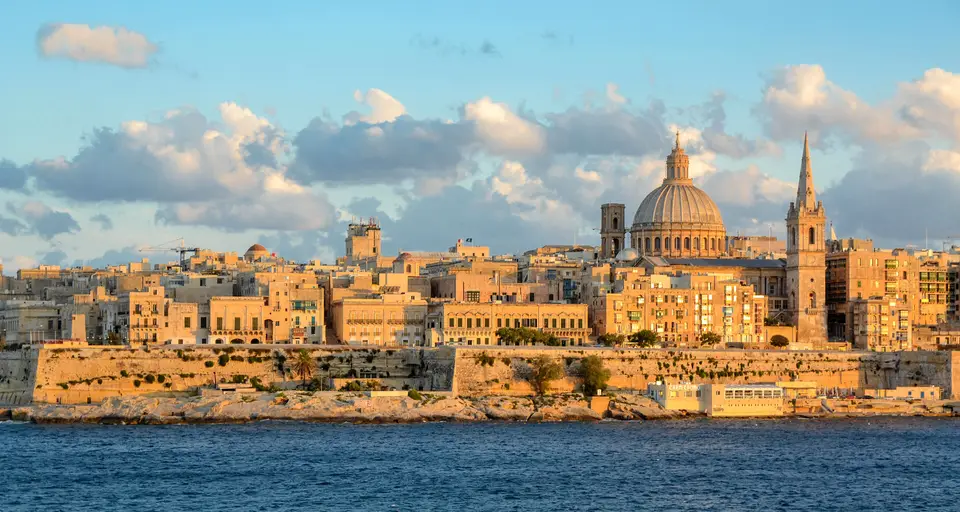
Quick Field Data
- UNESCO Inscription: 1980 · Criteria (i), (vi)
- Scale & Footprint: 55 hectares (0.55 km2 / 0.21 sq mi within a 0.61 km2 municipal peninsula) containing 320 historic monuments enclosed by bastions rising 47 to 100 metres above two natural harbours
- Access & Ticketing: Pedestrian-friendly historic grid entered free of charge through City Gate; individual tickets apply at St John's Co-Cathedral, the Grandmaster's Palace, Fort Saint Elmo, and Teatru Manoel
- Arrival Logistics: Located on the Sciberras Peninsula between Grand Harbour and Marsamxett Harbour, 8 km (5.0 miles) from Malta International Airport at Luqa and served by the central bus terminus outside City Gate
Hippodamian Grid Planning and 47-Metre Bastions on the Sciberras Peninsula
Rising to an elevation of 56 metres on the narrow rocky spine of the Sciberras Peninsula flanked on the east by the deep waters of the Grand Harbour and on the west by Marsamxett Harbour, the City of Valletta (known in Maltese as Il-Belt Valletta and historically styled Città Umilissima, the Humblest City) is the southernmost and smallest capital city in the European Union. Bastions and grid streets command both harbours here. Within an urban footprint of only 0.61 km2 (or 0.24 square miles) and a UNESCO heritage core of 55 hectares (0.55 km2 or 0.21 sq mi) inhabited by 5,157 residents in 2021 and 5,226 in July 2024, the peninsula concentrates 320 historic monuments, establishing the peninsula as one of the most densely built historic areas in the world.
Before the 16th century, this rocky promontory, known during the Arab period as Xagħret Mewwija or Ħal Newwija (sheltered place), at its tip as Xebb ir-Ras, and from Punic roots as Xeberras (the headland or middle peninsula), held only a small 1488 Aragonese coastal watchtower honouring Saint Elmo (Erasmus of Formia), which the Order of Saint John demolished in 1552 to build the star-shaped Fort Saint Elmo. During the Great Siege of Malta in 1565, Fort Saint Elmo withstood semanas of Ottoman bombardment before falling, buying critical time for Grand Master Jean Parisot de Valette and Sicilian reinforcements to repel the invasion. Determined to bind the Knights Hospitaller permanently to Malta inside an impregnable fortress capital, Grand Master de Valette appealed to European monarchs for aid. Pope Pius V dispatched his chief military engineer, Francesco Laparelli, while King Philip II of Spain contributed substantial financial backing, and on 28 March 1566 de Valette laid the city's foundation stone at the site of Our Lady of Victories Church, an occasion when, as chronicler Giacomo Bosio wrote between 1594 and 1602, Maltese elders prophesied that every handbreadth of land on Sciberras Hill would one day be worth its weight in gold.
Departing sharply from the winding medieval alleys of earlier Maltese towns, Francesco Laparelli conceived Valletta as a single, holistic creation of late Renaissance military urbanism. Inside a continuous perimeter of giant limestone bastions, demi-bastions, curtains, and raised gun cavaliers towering between 47 metres (154 ft) and 100 metres (330 ft) above the sea and harbour moats, Laparelli laid out a uniform rectangular Hippodamian street grid running straight from the landward City Gate down to Fort Saint Elmo at the seaward tip. Intentionally omitting any separate walled collacchio quarter for the knights, the plan integrated civil, religious, charitable, and military buildings across the entire peninsula under the strict building regulations of the Ufficio delle Case, banning front gardens, requiring corner sculptures, and mandating rainwater cisterns beneath every townhouse.
Following the death of 74-year-old Grand Master de Valette on 21 August 1568 and that of Laparelli in 1570, Laparelli's Maltese assistant Girolamo Cassar took charge of architectural construction, and on 18 March 1571 Grand Master Pierre de Monte formally transferred the Order's seat from Fort St Angelo in Birgu across the Grand Harbour to the new city. During the seventeenth century, Grand Master Antoine de Paule commissioned military engineer Pietro Paolo Floriani of Macerata to build the outer Floriana Lines across the landward approach, which under Grand Master António Manoel de Vilhena developed into the suburb and town of Floriana.
Auberges of the Knights, Caravaggio at St John's, and Baroque Transformation
Through the 1570s and 1580s, Girolamo Cassar designed the monumental palaces and churches that expressed the administrative and spiritual power of the Order of Saint John. Within Malta, the centre of main thoroughfare, historically called Strada Rjali and today Triq ir-Repubblika, stands the 1571-to-1574 Grandmaster's Palace, which later housed the Maltese Parliament until 2015 and today functions as the Office of the President of Malta. Nearby rose the Conventual Church of the Knights, now St John's Co-Cathedral, where Grand Master de Valette and his successors lie entombed beneath inlaid marble floor slabs and where the oratory displays the largest painting and only signed work by Michelangelo Merisi da Caravaggio.
To house the knights of the Order's regional linguistic divisions (Langues), Cassar built seven residential palaces known as Auberges by the 1580s, joined in the 18th century by an eighth, the Auberge de Bavière (giving its name to the surrounding il-Baviera neighbourhood near the English Curtain, alongside historic quarters such as l-Arċipierku, il-Biċċerija, il-Kamrata, Deux Balles, il-Fossa, and the rebuilt Manderaggio housing estate). Fulfilling the Hospitaller vow of medical charity, the Order erected the Sacra Infermeria in 1574 overlooking the Grand Harbour, one of Renaissance Europe's foremost hospitals and now the Mediterranean Conference Centre, alongside late-1570s residences such as Admiralty House.
In the 18th century, Grand Masters António Manoel de Vilhena and Manuel Pinto da Fonseca reshaped Valletta's austere Mannerist facades with exuberant Baroque architecture. In 1731, Vilhena commissioned the Manoel Theatre (Teatru Manoel), completed in just ten months and still operating as one of Europe's oldest working theatres. After suppressing a 1749 slave plot, Grand Master Pinto built the monumental Baroque seawall warehouses along the Valletta Waterfront and sumptuously remodelled the Auberge de Castille et Leon, which serves today as Malta's Office of the Prime Minister. Following the 1775 Rising of the Priests under Grand Master Ximenes, French forces expelled the Order in 1798 before capitulating to the British in September 1800.
Under British rule, when British colonial authorities dissolved the city's historic Università council in 1818, proposals by Henry Pigot and later 1870s officials to demolish the ramparts were fortunately abandoned, and a young Benjamin Disraeli praised Valletta in 1830 as an aristocratic city of palaces erected by gentlemen worthy of Palladio, Venice, and Cádiz, the city gained the 1883-to-1931 Malta Railway to Mdina and the 19th-century Royal Opera House. Despite devastating German and Italian air raids during the Second World War Siege of Malta after 1939 that destroyed the Royal Opera House, Valletta preserved its 16th-century grid and ramparts intact, earning UNESCO inscription in 1980, converting Saint James Cavalier into a Centre of Creativity in 2000, opening the new Parliament House in 2015, and serving as European Capital of Culture in 2018 across its four principal squares: Castille Square and St. John's Square together with St. George's Square and Tritons' Fountain.
Walking the Peninsula from City Gate to Fort Saint Elmo
Because traffic inside the bastions is restricted by a 2007 automated congestion-charging zone and a 2006 Floriana park-and-ride system, with principal thoroughfares fully pedestrianised and linked by electric taxis, Valletta is best explored on foot along its grid of stepped limestone streets and harbourside bastion gardens.
- City Gate, Saint James Cavalier, and St John's Co-Cathedral: Enter across the landward ditch past the Tritons' Fountain through City Gate, passing the 2015 Parliament House and the ruins of the Royal Opera House. Climb onto Castille Square to admire the Baroque facade of the Auberge de Castille and the adjacent Saint James Cavalier arts centre, then walk down Triq ir-Repubblika to St John's Co-Cathedral to view the gilded Baroque vault, the marble tombs of the Knights, and Caravaggio's signed masterpiece in the cathedral interior.
- Grandmaster's Palace, Teatru Manoel, and Fort Saint Elmo: Continue to St. George's Square to visit the state rooms and armoury of the 1571 Grandmaster's Palace and detour to the 1731 Teatru Manoel and the regenerated music venues of Strait Street (known as The Gut). Follow the central grid all the way to the seaward tip of the Sciberras Peninsula to explore the star fort of Fort Saint Elmo and the former 1574 Sacra Infermeria beside it.
- Upper and Lower Barrakka Gardens and Grand Harbour ferries: Time your walk around the eastern ramparts for midday at the Saluting Battery and the Upper and Lower Barrakka Gardens, which gaze directly across the Grand Harbour toward Fort St Angelo in Birgu, before riding down to the Pinto seawall at the Valletta Waterfront or taking a harbour ferry across Marsamxett Harbour. Visit in January for the Valletta International Baroque Festival or February for the Maltese Carnival, and consult our UNESCO World Heritage Atlas to pair Valletta with the Ħal Saflieni Hypogeum and Malta's Megalithic Temples.
