Quick Field Data
- UNESCO Inscription: Inscribed in 2000 (Ref. 990) as a Cultural site under Criteria (i), (ii), (iii), and (iv).
- Scale & Footprint: Covers 14,563.25 hectares across Assisi's historic centre and surrounding Monte Subasio Franciscan shrines, framed by a 4,087-hectare buffer zone.
- Access & Ticketing: Historic hillside streets, Piazza del Comune, and basilica naves welcome visitors free during daily liturgical schedules. Museum treasuries, Roman villa remains, and Rocca Maggiore fort require separate entry passes checked on official municipal channels.
- Arrival Logistics: Major international air hubs sit at Florence Airport, Peretola (FLR, 140 kilometres northwest), Rome Ciampino (CIA, 141 kilometres south), and Rome Fiumicino (FCO, 143 kilometres south). Closer Perugia San Francesco d'Assisi Airport (PEG, 8 kilometres west) runs limited regional routes. Road corridors link northward toward Siena (107 kilometres).
Roman Asisium Terraces and the Birth of the Franciscan Order
Perched on the western flank of Monte Subasio in central Umbria, assisi italy preserves an unbroken urban footprint shaped over more than two millennia. Earliest records cite the Umbri people, described by Pliny the Elder in AD 77 as Italy's oldest inhabitants. After defeating Italic coalitions at the Battle of Sentinum in 295 BC, Rome rebuilt the terraced hillside into the thriving municipium of Asisium, birthplace of the Augustan poet Propertius around 50 to 45 BC. Substantial Roman stones still anchor town life: defensive walls, the forum beneath Piazza del Comune, the porticoed Temple of Minerva now serving as Santa Maria sopra Minerva, a first-century AD elliptical amphitheatre, and a Roman villa unearthed in 1997 preserving rare frescoes and mosaics.
Bishop Rufinus brought Christianity to Assisi in AD 238 before dying at Costano, leaving his remains at San Rufino Cathedral. Ostrogothic forces under Totila destroyed most of the town in 545, after which Lombard and Frankish dukes of Spoleto governed the ridge. By the eleventh century, Assisi emerged as an independent Ghibelline commune locked in bitter rivalry with Guelph Perugia. During fighting at Collestrada, citizen Giovanni di Bernardone was captured and later renounced wealth as Saint Francis (1182 to 1226). Together with Saint Clare (Chiara d'Offreducci), he anchored two global religious movements from Assisi: the Order of Friars Minor founded in 1208 and the Order of Poor Clares.
As medieval Assisi expanded outside its Roman wall line in the thirteenth century under papal jurisdiction, Cardinal Gil de Albornoz rebuilt the summit fortress of Rocca Maggiore in 1366 to 1367 after townsfolk plundered an earlier imperial stronghold in 1189. Popes Pius II in 1458 and Paul III between 1535 and 1538 later added a polygonal tower and cylindrical entrance bastion, while seventeenth-century palazzi such as Bernabei and Giacobetti reflected quiet papal peace after the 1348 Black Death. During the Second World War, following German occupation in September 1943, church networks shielded Jewish refugees inside Assisi. German medical officer Colonel Valentin Müller helped designate the town a protected hospital city, sparing medieval stone shrines before the 12th Royal Lancers entered on 17 June 1944.
Two-Tier Basilica Architecture and Late Medieval Fresco Cycles
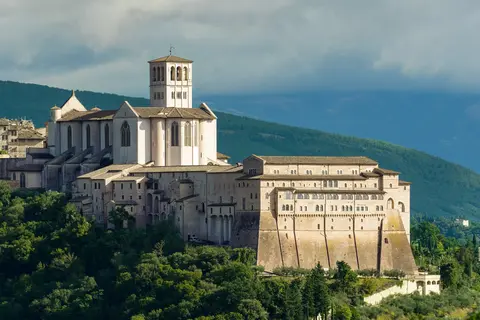
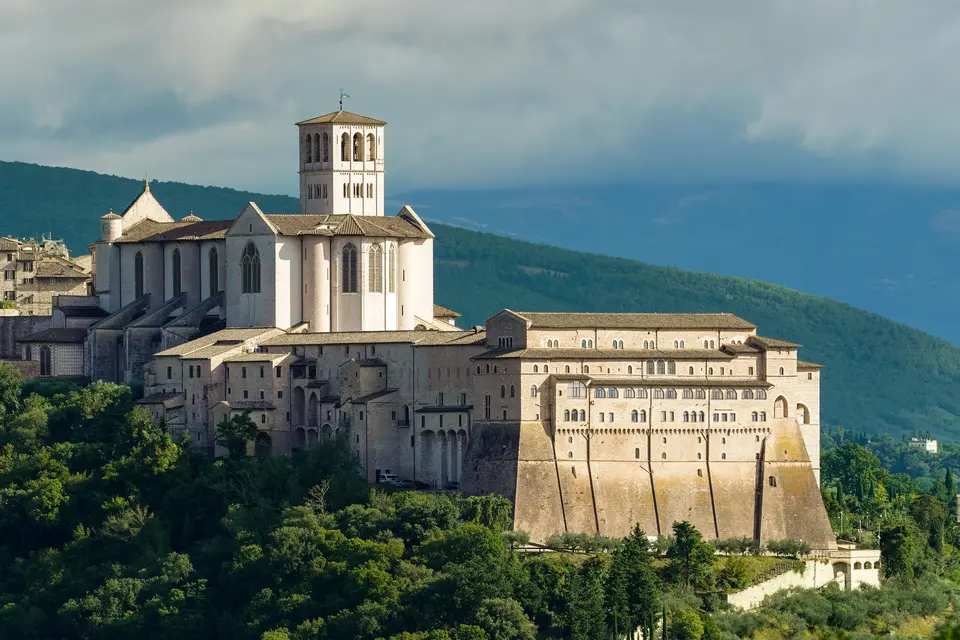
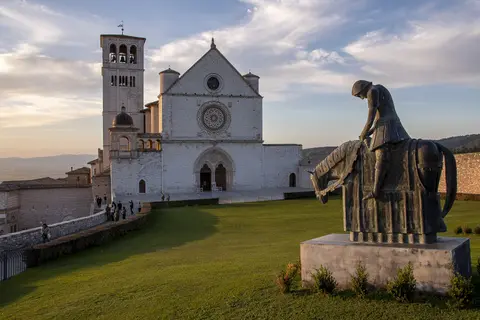
Anyone seeking assisi italy things to do centres their walk on the Basilica of San Francesco d'Assisi and attached Sacro Convento. Begun immediately after Pope Gregory IX canonised Francis on 16 July 1228, the sanctuary rose on a western spur donated by Simone di Pucciarello once called Colle d'Inferno and renamed Hill of Paradise. Architect Maestro Jacopo Tedesco designed a unified two-storey basilica and hillside friary overseen by Brother Elias of Cortona. Builders completed the Lower Church by 25 May 1230, when Francis's body was quietly transferred from San Giorgio, finished the Upper Church after 1239 for consecration by Pope Innocent IV in 1253, and gained Papal Church status under Nicholas IV in 1288.
Architecturally, the double church fuses Romanesque weight below with early Italian Gothic height above. The Lower Church functions structurally as an enormous vaulted crypt supporting the upper floor, fitted with low semicircular cross-vaults and barrel-vaulted transepts. Builders later added lateral chapels between 1350 and 1400 plus a Gothic doorway (1280 to 1300) enclosed by a 1487 Renaissance porch by Francesco di Bartolomeo da Pietrasanta. Below the floor, workers rediscovered Francis's hidden tomb in 1818, prompting Pope Pius VII to excavate a lower crypt. Inside, painted walls preserve Cimabue, Giotto, Simone Martini's vivid 1317 cycle, and Pietro Lorenzetti's emotional Passion frescoes paired with his 1330 Madonna dei Tramonti.
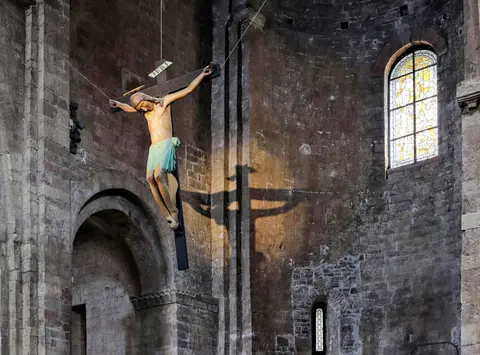
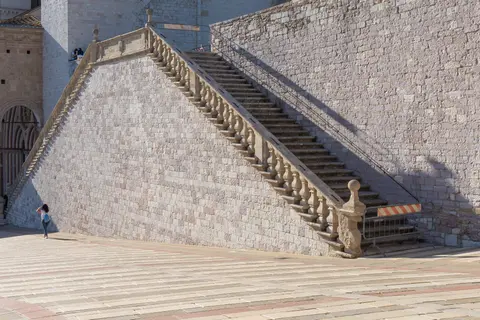
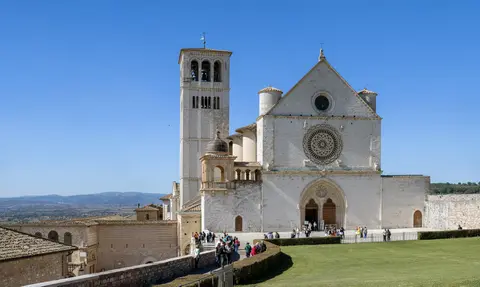
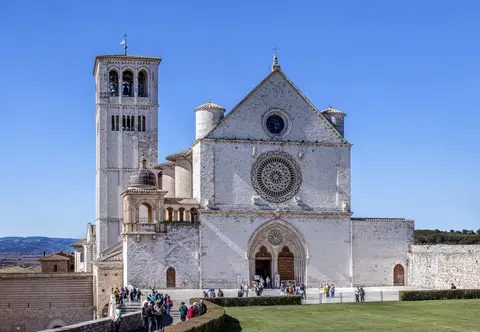
Climbing to the Upper Basilica reveals a bright single-nave hall of four square bays lit by tall Gothic tracery windows with stained glass by German, French (1270), and Maestro di San Francesco workshops. Its whitewashed brick facade pairs a cusped Gothic portal with a Romanesque rose window encircled by symbols of the Four Evangelists, joined at the left by the 1754 Baroque Benediction Loggia and below by 1474 pilgrim colonnades. Inside, 102 carved wooden choir stalls by Domenico Indovini (1501) surround a raised papal cathedra beneath Cimabue's darkened transept Crucifixion. Overhead, the Isaac Master vaults frame 32 biblical nave scenes and the celebrated Life of Saint Francis panels linked to Giotto and Roman masters around Pietro Cavallini. This synthesis of architecture and painting made every assisi italy church monument a benchmark for European art.
Earthquake Recovery and Rural Franciscan Sanctuaries Around Monte Subasio
Beyond the flagship basilica, assisi italy st francis traditions span a 14,563-hectare landscape unifying town churches, hillside caves, and valley sanctuaries. At the southeastern edge of the walled centre stands the Basilica of Santa Chiara, begun in 1257 with heavy lateral buttresses and a prominent rose window housing Saint Clare's tomb. Above Piazza del Comune rises Romanesque San Rufino Cathedral, displaying three rose windows, Roman cistern foundations, and the carved granite column baptismal font used for both Francis and Clare. Other urban monuments include Santa Maria Maggiore, Assisi's oldest church, plus Benedictine San Pietro and early Romanesque Santo Stefano. Nearby stand Chiesa Nuova over Francis's family home, the Piccolino Chapel, Rocca Minore's three towers, and Piazza del Comune with its 1305 Torre del Popolo and Palazzo dei Priori (1275 to 1493).
Outside the pink-and-white Umbrian limestone walls, ancient Roman roads and olive-clad ridges link three essential shrines tied directly to early Franciscan life. San Damiano sits south below the slope as one of the first modest chapels repaired by Francis and later the first home of Saint Clare's community. Higher up Monte Subasio, the Eremo delle Carceri occupies limestone canyon caves where Francis prayed in solitude amidst holm oaks and forests preserved around the sanctuary, close to tenth-century Abbey of St. Benedict ruins. Down across the fertile Umbrian plain stand the Santuario di Rivotorto, Palazzo del Capitano del Perdono, and the vast sixteenth-century Basilica of Santa Maria degli Angeli, begun in 1569 to shelter the Porziuncola and Transito chapels. In October 1986 and January 2002, Pope John Paul II even convened over 120 world religious leaders here for World Days of Prayer for Peace.
Protecting this monumental territory requires constant structural and visitor management. On 26 September 1997, twin earthquakes measuring 5.7 and 6.0 magnitude struck Umbria, causing an Upper Church vault collapse during an aftershock that killed two friars and two specialists while shattering sections of Cimabue and nave frescoes. International restoration reopened the Basilica within two years, reinforced by multi-tier safeguards under Italy's Ministry of Cultural Heritage, regional landscape protection laws since the 1950s, Assisi's 1972 Master Plan, and five-year World Heritage Management Plan reviews overseen by a dedicated municipal office.
Access Zones Across Assisi Italy and Its Franciscan Shrines
Because Assisi's 14,563.25-hectare listing stretches from walled hilltop streets down to plain sanctuaries and forest caves, visitors divide explorations into four manageable sectors. Footpaths connect central basilicas and Roman ruins easily, while outer shrines require local buses, taxis, or cars.
| Complex Zone | Key Highlights | Access & Ticket Rule |
|---|---|---|
| Basilica of San Francesco & Sacro Convento. | Upper Gothic fresco nave, Lower Romanesque chapels, Saint Francis's tomb crypt, 1474 Piazza Inferiore arcades, and hillside buttresses. | Active papal basilica welcoming walk-in visitors free outside major services. Audio guides, museum rooms, and dress codes apply. |
| Historic Centre & Piazza del Comune. | Roman Temple of Minerva, 1305 Torre del Popolo, Basilica of Santa Chiara, San Rufino Cathedral, Chiesa Nuova, and Rocca Maggiore castle. | Streets, squares, and parish naves open free on foot. Rocca Maggiore, Roman villa excavations, and cathedral museums charge entry. |
| Monte Subasio & Eremo delle Carceri. | Canyon hermitage caves, wooded Franciscan trails, and medieval ruins of the tenth-century Abbey of St. Benedict on Subasio slopes. | Hermitage grounds and marked mountain footpaths welcome visitors free. Check seasonal shuttle or uphill parking rules before driving. |
| Santa Maria degli Angeli & Plain Shrines. | Baroque basilica enclosing the Porziuncola and Transito chapels, Santuario di Rivotorto, and hillside Church of San Damiano. | Sanctuary interiors open free during daytime pilgrim periods. Verify quiet reflection rules and parish feast closures via official site. |
Three Structural and Pictorial Details Inside Assisi's Sanctuaries
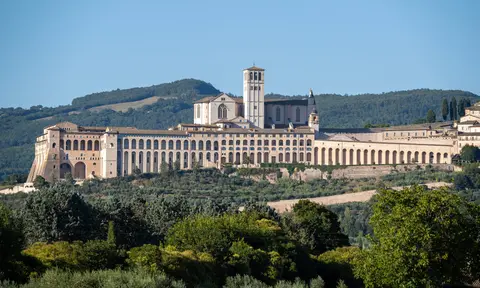
- Hillside Support Arcades Under Sacro Convento: Approach the western edge of Assisi from the plain below to look upward at the tall stone arches beneath the friary. Rather than standing on flat ground, Sacro Convento's lofty arcades act as colossal retaining buttresses anchoring both church storeys onto the steep limestone slope.
- Darkened Lead-Oxide Shadows in Cimabue's Upper Church Crucifixion: Step into the west transept of the Upper Basilica to study Cimabue's thirteenth-century frescoes. Because the workshop mixed lead oxide pigments onto drying plaster rather than fresh lime, chemical oxidation darkened pale highlights into dramatic negative silhouettes over the centuries.
- Porziuncola Enclosed Inside Santa Maria degli Angeli: Walk down the nave of the vast sixteenth-century Basilica of Santa Maria degli Angeli in the valley plain. Directly beneath its monumental dome sits the tiny rough-stone Porziuncola chapel preserved intact like a medieval stone reliquary inside a Renaissance shell.
Best Time to Visit Assisi Italy From Rome, Florence, or Siena
Determining the best time to visit assisi italy depends on balancing seasonal pilgrim gatherings against Umbria's mild hillside temperatures. Spring and autumn offer pleasant daytime conditions for walking steeply terraced limestone streets between Santa Chiara, Piazza del Comune, and San Francesco or hiking up to Eremo delle Carceri. Early May brings the lively Calendimaggio Festival, when upper blue and lower red town factions stage four days of medieval and Renaissance pageantry, while October's Saint Francis commemorations and summer pilgrimage peaks fill central squares. Wearing modest attire and quiet footwear inside active churches keeps access smooth across every sanctuary.
Travellers checking how to get to assisi italy commonly combine overland transport between central Italian cities, since routes run cleanly south for assisi italy to rome corridors or northwest for assisi italy to florence trips. Regional rail and road connections meet directly at Santa Maria degli Angeli in the valley below the hill town, making both how to get to assisi italy from rome and onward loops straightforward without driving narrow walled lanes. Major commercial air arrivals use Florence Airport (FLR, 140 kilometres) or Rome's Ciampino (CIA, 141 kilometres) and Fiumicino (FCO, 143 kilometres), while Perugia Airport (PEG, 8 kilometres) carries limited regional schedules. Extend your central Italian route westward to Siena (107 kilometres) or inspect nearby Tuscan and Umbrian landmarks across our UNESCO World Heritage Atlas.