


























Quick Field Data
- UNESCO Inscription: 1983 (Criterion iii; early medieval Alpine monastery preserving Switzerland's finest series of figurative murals painted circa 800 AD alongside 12th-century Romanesque frescoes and stuccoes).
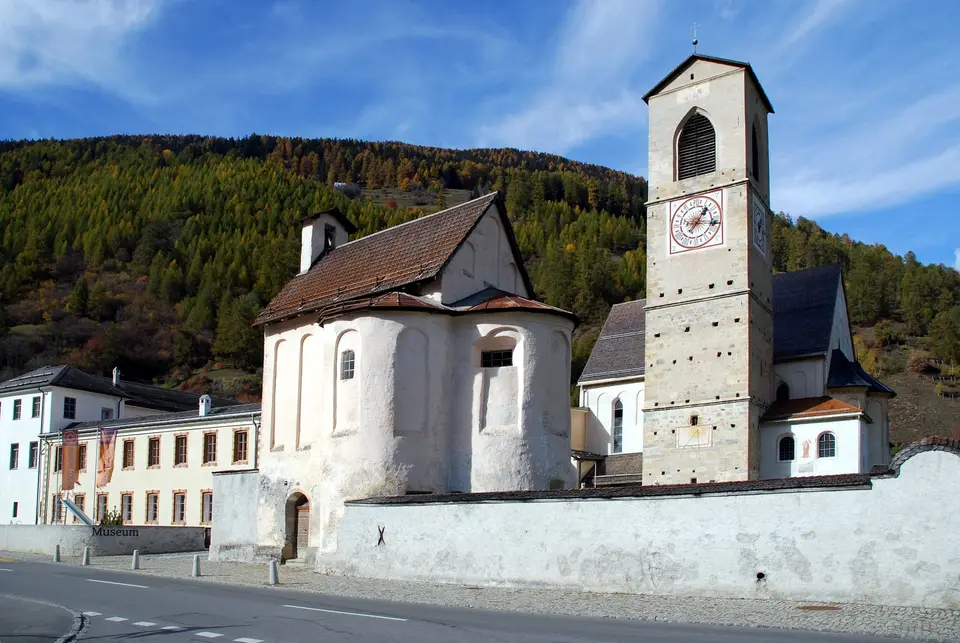
- Scale & Footprint: Comprises the Carolingian conventual church alongside the Saint Cross Church, the tower of Abbess von Planta, the old residence of the Bishop of Chur with the two-storey chapel of St Ulrich and St Nicholas, as well as two rectangular courtyards in Val Müstair, Canton of Graubünden, Switzerland.
- Access & Ticketing: An active Benedictine priory of nuns where religious life has continued for over 1,200 years; visitors access the conventual church and museum via ticketed entry, so check the official site.
- Arrival Logistics: Located in Santa Maria Val Müstair in the valley of the Grisons (Graubünden) in extreme south-eastern Switzerland south of the Alps, reachable via the Alpine pass routes north of Milano.
Charlemagne’s Alpine Pass Monastery and Twelve Centuries of Monastic Continuity
Standing in the Alpine valley of Val Müstair inside the Canton of Graubünden (the Grisons) in extreme south-eastern Switzerland, south of the Alps along the strategic mountain pass from Italy, the Benedictine Convent of St John (called Benediktinerinnenkloster St. Johann in German and Claustra benedictina da Son Jon in Romansh) was founded around 775 to 780 AD. Established by a Bishop of Chur, almost certainly on the orders of the Frankish monarch Charlemagne during the peacetime monastic renewal of the Carolingian Renaissance, the abbey formed part of a regional wave of early medieval monastery construction that included nearby Disentis alongside Pfäfers, Mistail, and Cazis. Fortified to control the Val Müstair Alpine pass, the monastery also functioned as a centre of Christian education and missionary training and manuscript illumination where Carolingian painters alongside jewellers and goldsmiths flourished. Peace fostered monumental art.
Noted at the beginning of the 9th century as a monastery of Benedictine monks, the abbey passed completely into the jurisdiction of the Bishop of Chur in 881. A church tower was added in the 10th century, followed during an 11th-century expansion by the enlargement of the bishop's residence alongside a tower home and a cloister as well as the two-storey chapel dedicated to St Ulrich and St Nicholas decorated with extensive stucco and fresco work. During the first half of the 12th century (first mentioned in documents in 1167, with the first abbess known by name, Adelheid, attested between 1211 and 1233), the occupants changed from monks to a women's abbey of Benedictine nuns. Throughout the Middle Ages, the Bishop of Chur alongside the Grey League (and League of God's House) and the House of Habsburg competed for influence over the abbess and the secular vogt, who governed the temporal affairs of the valley.
That rivalry ignited the Swabian War right at the convent gates on 20 January 1499, when Habsburg troops seeking control over the Grisons and Alpine passes occupied the valley and plundered the monastery before troops of the Three Leagues drove them back at the Battle of Calven, leading to the September 1499 Treaty of Basel that granted virtual independence to the Old Swiss Confederacy. Around 1500, the original single-nave Carolingian church was modified into a three-nave late Gothic church. Although the 1524 and 1526 Ilanzer Articles passed by the League of God's House weakened the temporal power of the bishop and reduced the abbey's income, and post-Council of Trent reforms between 1600 and 1614 regulated the sacraments alongside the breviary and common sleeping areas under the Benedictine Rule, religious activities have continued without interruption down to the present day after the abbey became a priory in 1810.
Carolingian Mural Registers, Romanesque Apse Frescoes, and the Convent Ensemble
Today the convent ensemble reflects more than 1,200 years of architectural history across two rectangular courtyards: the eastern zone anchored by the Carolingian conventual church alongside the Saint Cross Church, the tower of Abbess von Planta, and the residence of the Bishop of Chur, while the western courtyard is surrounded by cloisters together with two entrance towers and agricultural buildings. Conserved largely in its Carolingian architectural volume, the originally single-nave conventual church with five apses was designed from the outset as a unified painted space and houses the most important cycle of Carolingian frescoes conserved in situ anywhere in Europe, painted around 800 AD in the first half of the 9th century and rediscovered during 20th-century restoration works when later overpaintings were carefully examined.
Executed in a limited mineral palette of ochre alongside red and brown using rapid, bright brushwork that combines Roman figure portrayal with Christian gospel subject matter and Germanic geometric and animal motifs (closely linked to the early medieval murals at Castelseprio in the Lombard sanctuary of Santa Maria foris portas), the circa 800 AD murals are arranged in five horizontal rows stretching from the southern wall across the western wall to the northern wall. Because literacy was not required to read painted walls, these balanced, symmetrical compositions made Christian stories accessible to both clergy and lay parishioners. The uppermost row portrays episodes from King David's life in the Hebrew Bible; the middle three rows depict episodes from the youth and Passion of Christ; and the bottom row illustrates the crucifixion of St Andreas, while the western wall ties all five rows together in a monumental early medieval depiction of the Last Judgment assessing humanity's sins and confession.
During the 12th century (including works from the 1160s), the eastern wall and the three horseshoe apses were repainted with Romanesque frescoes alongside stucco sculptures. These Romanesque apse murals depict a rich variety of biblical themes: Christ in Majesty, the banquet of Herod Antipas (in which the dance performed by Herodias's daughter results in the beheading of the abbey's patron saint, John the Baptist), the parable of the wise and foolish virgins alongside the apostles and St Stephen. Together, the Carolingian nave registers and the 12th-century Romanesque apse compositions demonstrate how medieval painters adapted figure scale alongside mineral pigments and spatial framing across four centuries while maintaining the visual unity of the conventual church interior.
Visiting the Abbey Church, Residential Tower, and Val Müstair
Because the Convent of St John remains a living Benedictine priory where a community of nuns continues daily monastic observance, visitors explore the church and courtyard monuments along a clearly defined route across the monastic grounds that respects the quiet routine of the western cloisters.
- Inspecting the Five Carolingian Rows in the Abbey Church: Step inside the conventual church (modified around 1500 into a three-nave late Gothic hall) to trace the five horizontal registers of circa 800 AD Carolingian murals wrapping from the south wall across the western Last Judgment wall to the north wall, noting the top register of King David alongside the three central registers of the life and Passion of Christ and the lower register of St Andreas, and observing how the ochre alongside red and brown pigments organise each biblical scene.
- Studying the Romanesque Apses and Stuccoes: Walk toward the eastern choir to examine the 12th-century Romanesque frescoes painted across the three horseshoe apses and eastern wall, including Christ in Majesty and the banquet of Herod Antipas, the beheading of John the Baptist alongside the parable of the wise and foolish virgins, the apostles, and St Stephen, together with the medieval stucco work.
- Touring the Courtyards, Abbess Tower, and Saint Cross Church: Explore the two rectangular courtyards flanked by the western cloisters alongside the entrance towers and agricultural buildings, then visit the fortified residential tower of Abbess von Planta alongside the old residence of the Bishop of Chur housing the 11th-century two-storey chapel of St Ulrich and St Nicholas as well as the adjacent Saint Cross Church.
Twentieth-Century Rediscovery and Alpine Heritage Conservation
Rediscovered beneath later overpaintings during 20th-century restoration campaigns and inscribed on the UNESCO World Heritage List in 1983, the murals and stuccoes of Müstair provide an unmatched view of the evolution of Christian iconography from the reign of Charlemagne to the Romanesque era, while reflecting the political and socio-economic relations of the Grisons across twelve centuries. Ongoing conservation monitors the fragile plaster layers and mineral pigments inside the Alpine church. Travellers crossing the Alpine passes between Switzerland and northern Italy can link Val Müstair with Milano and explore companion early medieval monasteries in our UNESCO World Heritage Atlas.
