


























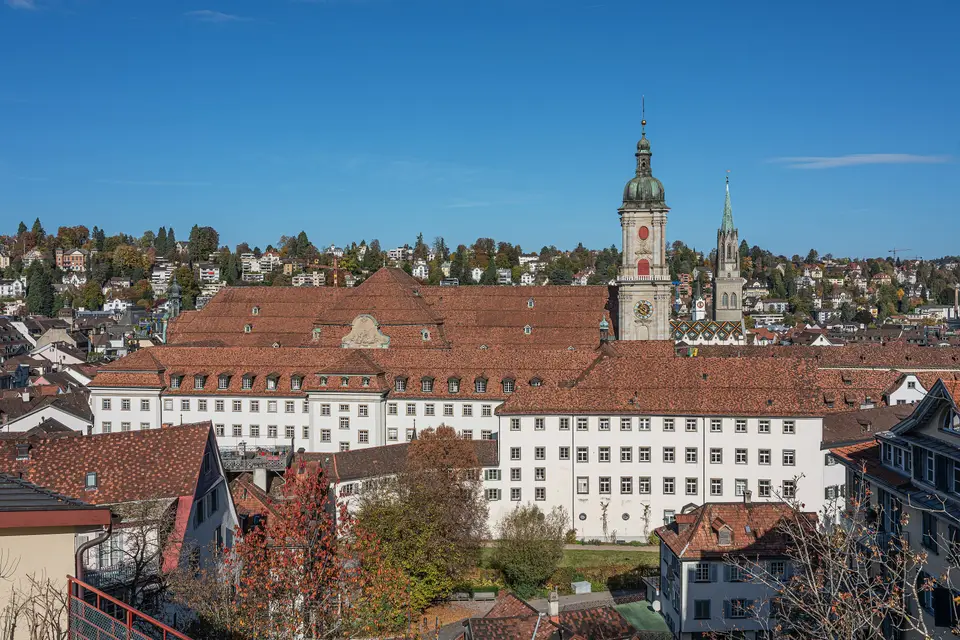
Quick Field Data
- UNESCO Inscription: 1983 (Cultural Criteria ii, iv)
- Scale & Footprint: Entire monastic ensemble in the town of St. Gallen uniting the Baroque Cathedral, Abbatial Library, Abbey Archives, plus conventual buildings
- Access & Ticketing: Active Catholic Cathedral and public museum library in St. Gallen; check the official site for Stiftsbibliothek and exhibition admission rules
- Arrival Logistics: Located in the city of St. Gallen in northeastern Switzerland near Lake Constance, east of Zurich
Twelve Centuries of Monastic Scholarship Between the Alps and Lake Constance
Located in the city of St. Gallen in the northeastern part of Switzerland near Lake Constance, the Abbey of St Gall (German: Abtei St. Gallen) preserves the architectural and intellectual heritage of one of Europe's chief Benedictine monasteries across 1,200 years of continuous activity, from the 8th century to its secularisation in 1805. Since 1983, the UNESCO World Heritage Atlas in 1983 under cultural criteria ii and iv, the conventual precinct forms the historic core of St. Gallen, situated east of Zurich. While its library and archives safeguard priceless early medieval manuscripts from the Carolingian era, the monumental above-ground ensemble largely owes its present unified appearance to the late Baroque rebuilding campaigns executed between 1755 and 1768 by the architect Peter Thumb. Twin Baroque towers dominate the town square.
According to tradition, the origins of the monastery date to around 612 CE when Gallus (Saint Gall), an Irish missionary who had travelled as a disciple alongside Saint Columbanus, established a hermitage cell on the spot that would later become the abbey. Gallus dwelt inside his woodland cell until passing away in 646 CE and was buried in Arbon in the Canton of Thurgau, after which his disciples remained living together at his cell following the rule of Saint Columban, combining prayer, manual work, reading, alongside teaching under his successors Saint Magnus, the deacon Stephen, and the priest Magulfe. Around 719 CE (with foundation dates also given as 720 and 747), a gentleman and judge of Thurgau named Waltraf (or Waltram) approached Charles Martel to place the hermitage under the local Alemannic pastor Otmar (Saint Othmar) as its founder and first abbot. Supported by Charles Martel and subsequently by his son Pepin (on the recommendation of his brother Carloman), Otmar substituted the Rule of Saint Benedict for that of Saint Columban in 747, founded the St. Gall School, and expanded the abbey rapidly, leaving 53 names in the register of monastic professions by the end of his rule while monks Magnus of Füssen and Theodor founded sister houses in Kempten and Füssen in the Allgäu.
Carolingian Golden Age and the 9th-Century Plan of St Gall
As noble families donated lands across Thurgau, Zürichgau, together with Alemannia as far as the Neckar (including properties sold in 744 by the nobleman Beata to finance a journey to Rome), Abbot Waldo of Reichenau (740 to 814) organised systematic manuscript copying with Anglo-Saxon and Irish monks, while Pope Adrian I, at Charlemagne's request, sent distinguished cantors from Rome to instruct the community in Gregorian chant. Conflict with the nearby Bishopric of Constance ended when Emperor Louis the Pious (ruled 814 to 840) confirmed the abbey's imperial immediacy (Reichsunmittelbarkeit) in 813, establishing its status as an Imperial Abbey, and King Louis the German confirmed its immunity and free election of abbots in 833 before releasing it from paying tithes to the Bishop of Constance in 854. Across the 9th and 10th centuries, the monastery flourished as home to celebrated scholars such as Notker the Stammerer, Notker of Liège, Tuotilo, Notker Labeo, plus Hartker (who developed the antiphonal liturgical books and early neume musical notation prior to five-line staff notation).
During this Carolingian Golden Age, a larger 9th-century church was built and the library expanded, acquiring and copying manuscripts of which over 400 survive in the library today:
- The 9th-Century Plan of St Gall: Drawn on parchment between 820 and 830 CE following one of the reform synods held at Aachen under Carolingian Emperor Louis the Pious (from 814 through 817) and dedicated to the abbot of Saint Gall, the Plan of St. Gall remains the oldest known architectural layout drawn on parchment and represents the sole surviving large-scale architectural drawing produced across the roughly 700-year span separating the collapse of the Western Roman Empire from the 13th century. Never actually built, it illustrates the ideal of a well-designed and well-supplied Carolingian monastery.
- Old Irish and Pauline Manuscripts: Among the medieval treasures preserved in the Stiftsbibliothek are a copy of Priscian's Institutiones grammaticae containing the Old Irish poem "Is acher in gaíth in-nocht" and a late 9th-century copy of the Pauline epistles featuring an ink illustration depicting Saint Paul preaching before an agitated crowd of gentiles alongside Jews.
- The Silver Age and Wiborada: Between 924 and 933, Magyar raids forced the monks to remove their books to Reichenau for safety, and on 26 April 937 a fire destroyed much of the abbey, though the library survived intact; in 926 the recluse Wiborada died during the raids and in 1047 became the first woman formally canonised by the Holy See (54 years after Saint Udalric, Bishop of Augsburg, in 993). Between 954 and 971/974, Abbot Notker enclosed the monastery within a defensive wall, in 1006 monks recorded the northernmost sighting of the 1006 supernova, and when Abbot Ulrich II passed away on 9 December 1076, the monastery's cultural silver age came to a close.
Prince-Abbots, the Appenzell Wars, and Peter Thumb's Baroque Reconstruction
In 1207, King Philip of Germany raised Abbot Ulrich von Sax to the rank of Prince (Reichsfürst) of the Holy Roman Empire, transforming the monastery into a Princely Abbey. Over the next three centuries, the surrounding town of St. Gallen, governed by cloth-weavers' guilds from 1353, progressively freed itself from the abbot, buying its liberty from King Sigismund in 1415 and becoming officially free of the abbey in 1457, while the farmers of the abbot's Appenzell estates launched the Appenzell Wars in 1401, won the battle at Stoss in 1405, and allied with the Swiss Confederation in 1411 (followed by the abbot allying with Zürich, Lucerne, Schwyz, alongside Glarus in 1451, and the town and Appenzell becoming full Confederate members in 1454). After Abbot Ulrich Rösch purchased the County of Toggenburg during 1468 and attempted in 1487 to build a new monastery at Rorschach on Lake Constance, Mayor Ulrich Varnbüler and Hermann Schwendiner led armed troops from St. Gallen and Appenzell on 28 July 1489 to destroy the Rorschach buildings, prompting the four sponsoring cantons to invade in early 1490 while Varnbüler and Schwendiner fled to King Maximilian.
When the municipality embraced the Protestant Reformation during 1524 while the monastery remained Catholic, Calvinist raids scattered several old books until Abbot Diethelm launched a restoration in 1530 and Abbot Pius Reher (1630 to 54) started a printing press. Even after Swiss forces pillaged the abbey during the Toggenburg War (Second War of Villmergen) in 1712 and carried manuscripts to Zürich and Bern, the Princely Abbey continued to govern Switzerland's largest ecclesiastical city-state, encompassing more than 77,000 residents. Between 1755 and 1768, the medieval monastery was demolished and rebuilt in late Baroque and Rococo style by architect Peter Thumb (1681 to 1766):
- The Baroque Cathedral of St Gall: Constructed between 1755 and 1768 as one of the last monumental Baroque abbatial churches in the West, the former abbey church became St. Gallen Cathedral when the abbey was made a separate See in 1846 and elevated in 1848 to function as the episcopal seat for the Saint Gallen Diocese.
- The Rococo Abbey Library (Stiftsbibliothek): Also designed by Peter Thumb in a luminous Rococo interior combining polished carved woodwork, decorative stucco, plus painted ceilings, the library houses over 160,000 books (as of 2005), of which 2,100 are handwritten codices (nearly half from the Middle Ages and 400 over 1,000 years old) with 355 documents digitised by December 2009 under the Codices Electronici Sangallenses project.
- The Northern Square and Abbey Archives: Bordering the northern part of the square are 19th-century buildings including the ancient arsenal, the Guardian Angels Chapel, plus the former Catholic school, while the Abbey Archives preserve the administrative records of the 73 ruling abbots (whose biographies were compiled by Henggeler in 1929 and whose heraldic coats of arms were printed in 1778 by Beat Jakob Anton Hiltensperger) down to the suppression of the last Prince-Abbot, Pankraz Vorster, in 1798 and final secularisation in 1805.
Visiting the Cathedral, Rococo Library, and Monastic Precinct
Today the entire monastic ensemble integrates with the surrounding historic town of St. Gallen and welcomes visitors year-round:
- Entry and Route: St. Gallen is easily reached by direct train from Zurich in northeastern Switzerland, followed by a short walk through the pedestrian town centre into the abbey courtyard.
- Tickets and Viewpoints: The Stiftsbibliothek is open to the public and hosts rotating manuscript exhibitions, concerts, alongside cultural events beside the Baroque Cathedral; check the official site for current library and exhibition admission conditions.
- Timing and Onward Connections: Plan at least half a day to inspect the late Baroque cathedral interior, view the medieval manuscripts and early neume musical codices in the Rococo library hall, and walk the surrounding streets of St. Gallen.
