


























Quick Field Data
- UNESCO Inscription: 1986 (Cultural Criteria ii, iii, iv)
- Scale & Footprint: 60.735-hectare fortified ridge complex (with a 475.542-hectare buffer zone) enclosed on three sides by a 6-kilometre wall pierced by nine gates
- Access & Ticketing: Administered by the Archaeological Survey of India (ASI); check the official site for palace enclave tickets and shuttle buses from the parking area
- Arrival Logistics: Located in Agra District of Uttar Pradesh, 35.7 kilometres (37 kilometres) west of Agra and east of Jaipur along National Highway 21
The City of Victory on the Vindhyan Sandstone Ridge
Perched atop a rocky sandstone ridge of the Vindhyan hill ranges rising 40 metres above the southeast bank of a former artificial lake in Agra District, Uttar Pradesh, Fatehpur Sikri preserves the complete urban, palatial, and religious core of the first planned capital city of the Mughal Empire. Built between 1571 and 1573 by the Mughal Emperor Akbar (who reigned from 1556 to 1605 CE) and inscribed in the UNESCO World Heritage Atlas in 1986 under cultural criteria ii, iii, and iv across a 60.735-hectare core zone (with a 475.542-hectare buffer zone), the site lies 35.7 kilometres (22.2 miles, or roughly 37 kilometres / 23 miles) west of Agra (marked along National Highway 21 by medieval mileposts such as Kos Minar 793 at kilometric point 19) and east of Jaipur. Although Fatehpur Sikri functioned as the imperial Mughal capital for only some 10 years, from 1571 until 1585, when Akbar relocated his court to Lahore for a campaign in Punjab, before the ridge was completely abandoned in 1610 due to failing water supplies, its exceptional state of preservation presents an intact architectural portrait of 16th-century Mughal court life. Red sandstone pavilions crown the ridge.
Long before Akbar laid out his rhombus-shaped palace city along a 3-kilometre-long (1.9-mile) by 1-kilometre-wide (0.62-mile) ridge enclosed on three sides by a 6-kilometre (3.7-mile, or 5-mile / 8.0-kilometre) bastioned wall and bordered on the fourth side by the lake, the village of Sikri had a deep pre-Mughal history. As documented by historians Syed Ali Nadeem Rezavi and Sugam Anand and confirmed by Archaeological Survey of India (ASI) excavations conducted in 1999 and 2000 at Birchhabili Tila (Chabeli Tila), occupation began in the Painted Grey Ware period, flourished under the Sungas, and developed a 6th- to 9th-century CE settlement yielding a Brahmi inscription and a statue of the Jain goddess Ambika. Between the 9th and 11th centuries, under the Sikarwar Rajputs (who ruled from the 7th to the 16th century) and the Gwalior Kachchhapaghata king Vajradaman (Vajrāma), red sandstone Jain temples stood at Saikrikya, yielding thousand-year-old statues of Bhagwan Adi Nath, Rishabh Nath, Mahavir, Jain Yakshinis, a 1010 CE (1067 VS) Sarasvati image, and a 1044 sculpture that survived Mahmud of Ghazni's 1018 to 19 raids on Mathura, Bulandshahr, and Bayana before Alauddin Khalji built a mosque here around 1300.
After the first Mughal emperor Babur defeated Rana Sangha at the Battle of Khanwa on the outskirts of Sikri in 1527, he renamed the lakeside spot Shukri ("Thanks", as noted in Annette Beveridge's translation of the Baburnama and Gulbadan Begum's Humayun-Nama), constructing a "Garden of Victory" with an octagonal pavilion, a lake platform, and a stepwell (baoli) about a kilometre from the Hiran Minar, where he and Humayun escaped the heat of Agra. As recorded by court chronicler Abul Fazl in the Akbarnama, Akbar remained without an heir until 1569, when the Sufi saint Sheikh Salim Chishti (1478 to 1572), whose khanqah stood on the Sikri ridge, predicted the birth of Akbar's son Salim (later Emperor Jahangir, born in Sikri in 1569 to Akbar's chief Rajput wife Mariam-uz-Zamani, popularly called Jodha Bai) as well as Prince Murad. Beginning a religious compound in 1569 and founding the walled city and palace after Jahangir's second birthday in 1571, Akbar named the capital Fatehpur Sikri ("City of Victory") following his victorious Gujarat campaign in 1573, creating a populous metropolis that English traveller Ralph Fitch described as larger than contemporary London and linked to Agra by a continuous 12-mile (Kos) market road.
Timurid and Gujarati Synthesis: Jama Masjid, Salim Chishti's Tomb, and the Palaces
Entered through nine fortified gates (the Delhi, Lal, Agra, Birbal's, Chandanpal, Gwalior, Tehra, Chor, and Ajmeri Gates, alongside the ceremonial Hathi Pol Gate or Elephant Gate) and studied by architectural scholar Attilio Petruccioli, Fatehpur Sikri combines Timurid spatial geometry with indigenous Hindu and Gujarati Sultanate stone carving across its religious and royal enclaves:
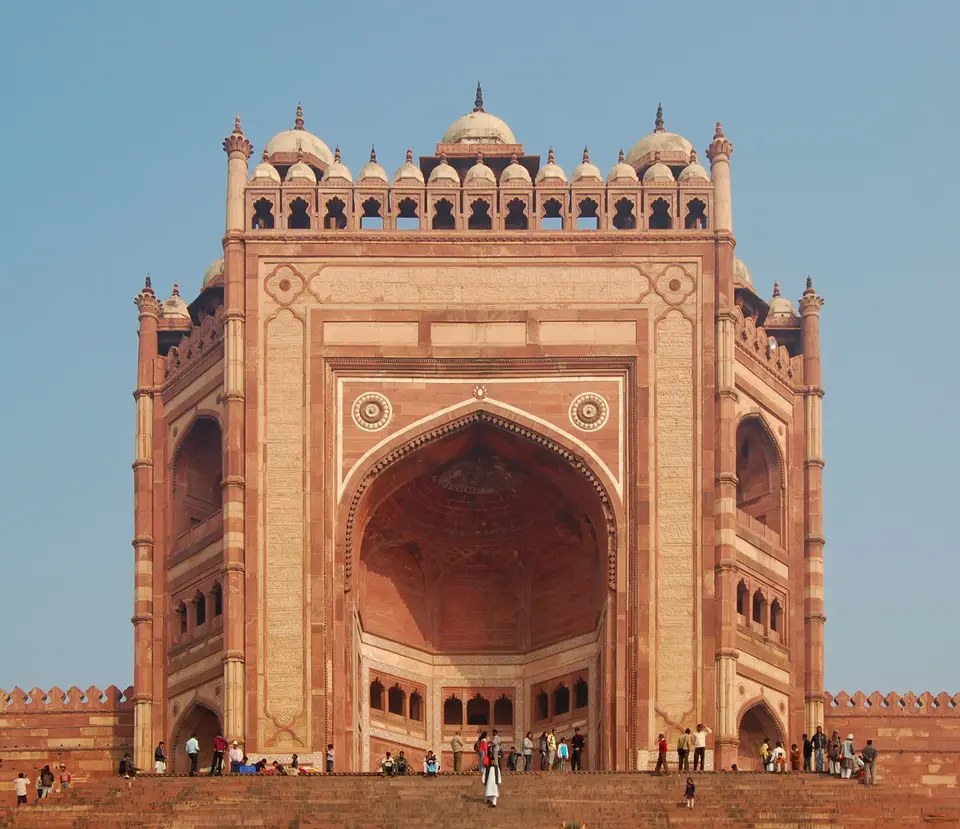
- Jama Masjid and the 54-metre Buland Darwaza: Completed in AH 979 (1571 to 1572 CE) as one of the largest congregational mosques in India, the Jama Masjid surrounds a vast courtyard (sahn) with pillared iwans, chhatri-topped roofs, and a domed sanctuary containing three mihrabs in each of its seven bays inlaid with geometric white marble. Set into its southern wall around 1576 to 1577 to commemorate the Gujarat victory towers the Buland Darwaza, rising 46 metres (150 feet) in structure and 54 metres (177 feet) from the ground below its giant steps (flanked on the left by a deep well); its central Horseshoe Gate archway bears a famous Persian inscription quoting Isa, Son of Mariam, likening the world to a bridge that travellers should pass over without building houses upon it.
- The white marble Tomb of Salim Chishti: Standing inside the Jama Masjid courtyard, the single-storey mausoleum of Sufi saint Salim Chishti is encased in white marble, featuring a square burial chamber under a timber baldachin inlaid with mother-of-pearl mosaic, a circumambulatory gallery enclosed by pierced geometric stone screens (jalis), and carved white marble serpentine brackets supporting sloping eaves inspired by early 15th-century Gujarat Sultanate tombs, flanked on the east by the red sandstone tomb of his grandson General Islam Khan I, who was the son of Shaikh Badruddin Chishti, crowned by a central dome surrounded by thirty-six small domed chattris.
- Diwan-i-Aam, Diwan-i-Khas, and the Ibadat Khana: Within the administrative and royal enclave stand the multi-bayed Diwan-i-Aam (Hall of Public Audience) and the square Diwan-i-Khas (Hall of Private Audience), famous for its single carved octagonal central pillar whose thirty-six serpentine brackets support a circular elevated platform linked by four stone walkways to the upper corners, where Akbar hosted interfaith debates alongside the 1575 Ibadat Khana (House of Worship) that laid the foundations of his syncretic Din-e-Ilahi creed.
- Anup Talao, Panch Mahal, Jodha Bai Mahal, and Birbal's House: Surrounding the four-bridged ornamental pool of Anup Talao (built by Raja Anup Singh Sikarwar) and the life-sized Pachisi Court board stand Akbar's Khwabgah ("House of Dreams"), the Astrologer's Seat, Ankh Michauli, and the five-storey open-pillared Panch Mahal supported by 176 carved columns diminishing upward to a single large-domed chhatri. Nearby rise the courtyard-centred Jodha Bai Mahal (integrating Rajput influence, a Hindu temple, and a tulsi math with summer and winter palaces), the chajja-shaded Birbal's House, the Naubat Khana (Naqqar Khana drum house), the circular tusk-studded Hiran Minar (Elephant Tower), the Turkic Sultana's House, Turkic Baths (Hammam), the imperial mint (Taksal), the records office (Daftar Khana), the royal workshop (Karkhana), and the treasury (Khazana).
Later History, Literary Echoes, and Practical Visitor Logistics
After 1585, Akbar visited Fatehpur Sikri only once in 1601 before William Finch found it "all ruinate" a few years after Akbar's death; Emperor Jahangir stayed here for three months during the 1616 to 1624 bubonic plague in 1619, Muhammad Shah undertook brief repairs, British General Gerard Lake parked his siege guns here during his October 1803 pursuit of Daulat Rao Sindhia's forces, the East India Company used it as an administrative centre from 1803 to 1850, and the Marquess of Hastings ordered monument repairs in 1815 (before the town, celebrated in Letitia Elizabeth Landon's 1833 poem on William Purser's painting, Vita Sackville-West's All Passion Spent, Salman Rushdie's The Enchantress of Florence, and the 1997 Hindi cinema production Pardes starring Mahima Chaudhry and Shah Rukh Khan, grew from 7,147 residents in 1901 to 32,905 residents across 4,936 households and 52 Gram panchayats in the 2011 Census):
- Entry and route: Fatehpur Sikri lies 35.7 kilometres (37 kilometres) west of Agra by road (served by regular UPSRTC buses and taxis) and 1 kilometre (0.62 miles) from Fatehpur Sikri railway station, while Agra Airport (Kheria Airport) is 40 kilometres (25 miles) away.
- Tickets and viewpoints: The Jama Masjid, Buland Darwaza, and Tomb of Salim Chishti are entered freely as active religious monuments, while the adjacent royal palace enclave (Diwan-i-Khas, Panch Mahal, Jodha Bai Mahal, and Anup Talao) requires an ASI admission ticket; check the official site before arrival for current e-ticketing rules.
- Timing and onward connections: Arrive early in the morning to inspect the carved central pillar of the Diwan-i-Khas and the 176 columns of the Panch Mahal in cool sunlight before driving onward to Agra or west along National Highway 21 toward Jaipur.
