


























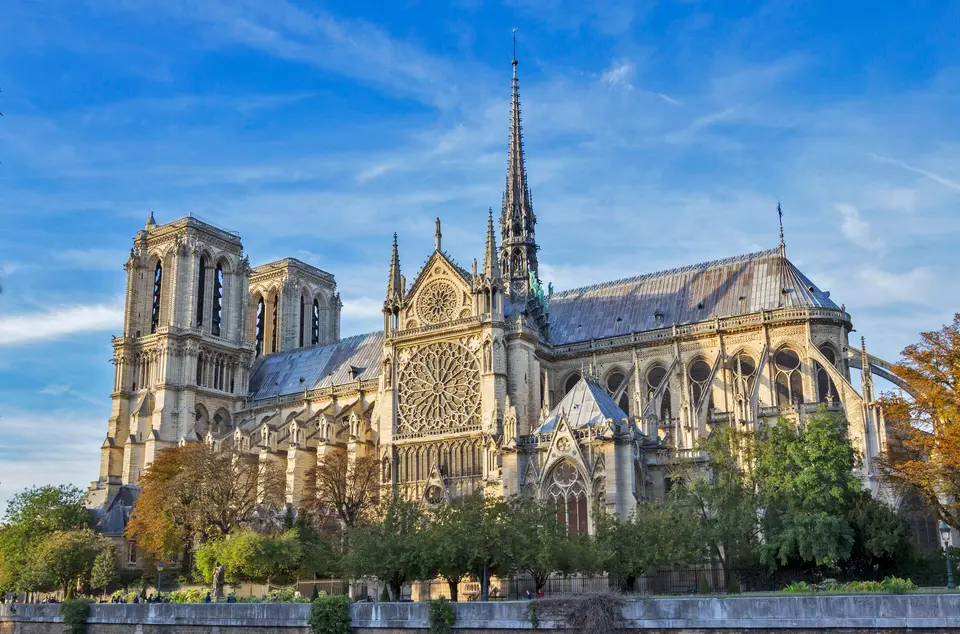
Quick Field Data
- UNESCO Inscription: 1991 (Cultural heritage serial property in Reims, Marne Department, Grand Est region, France)
- Scale & Footprint: Three monumental complexes, the 149.17-metre-long Cathedral of Notre-Dame with its 81-metre towers, the adjoining archiepiscopal Palace of Tau, and the Former Abbey of Saint-Rémi with its 9th-century nave
- Access & Ticketing: Owned by the French state since 1905 and managed with the Ministry of Culture; check the official site for cathedral tower climbs, Palace of Tau treasury exhibitions, and Saint-Rémi Basilica hours
- Arrival Logistics: Located at Place du Cardinal Luçon in central Reims (51100), linked by high-speed rail and motorway corridors to the national capital
Baptism of Clovis, the Holy Ampulla, and the Coronation City of France
Rising above the chalk plains of Champagne in the Marne Department of the Grand Est region, the serial property of the sacred trio of Reims Cathedral, the archiepiscopal Palace of Tau, and the ancient Abbey of Saint-Rémi embodies the sacred and political bond between the Catholic Church and the French monarchy across fifteen centuries. After 1991, the UNESCO World Heritage Atlas in 1991, the three monuments trace their shared destiny to the ancient Gallic capital of the Remes, recorded by Julius Caesar during the Gallic Wars as Durocortorum and later elevated to the metropolis of the Roman province of Second Belgium. After Saint Sixtus founded the city's first Christian church between 250 and 300 AD and Bishop Bétause erected a Cathedral of the Holy Apostles in 314, Bishop Nicasius transferred the episcopal see in the early 5th century (around 420) onto the foundations of Gallo-Roman baths built under Emperor Constantine, dedicating a 20-by-55-metre Merovingian basilica to the Virgin Mary just before the Council of Ephesus in 431.
It was in the baptistery of this Merovingian cathedral, excavated directly beneath the present nave in the 1990s, that Bishop Saint Remigius (Saint Rémi, 440 to 533) baptised Clovis I, King of the Franks, around 496 AD, anointing him with sacred oil from the miraculous Holy Ampulla (Sainte Ampoule). When Pope Stephen IV crowned Charlemagne's son Louis the Pious at Reims in 816, Archbishop Ebbo and royal architect Rumaud began a larger 86-metre Carolingian cathedral in 818 using stone from the city ramparts, which Archbishop Hincmar completed and dedicated in the presence of Emperor Charles the Bald on 18 October 862, before Archbishop Heriveus restored the crypt of Saint Remigius in the early 10th century and Archbishop Adalbero, described by his pupil Richerus, expanded the western arcades in 976. Combined with the prestige of the Archbishop of Reims and the custody of the Holy Ampulla at the Abbey of Saint-Rémi, where the saint's relics rested inside a monumental 9th-century nave, Clovis's baptism established Reims from the crowning of Henry I, in 1027 through to Charles X in 1825 as the traditional coronation sanctuary of France, hosting 25, or across all historical eras 31, royal coronations, including Joan of Arc's triumphal escort of Charles VII on 17 July 1429 during the Hundred Years' War during the Hundred Years' War.
After Archbishop Samson of Mauvoisin (1140 to 1160) lengthened the church to 110 metres with a twin-towered Early Gothic facade modelled on the Royal Abbey of Saint Denis outside Paris, a catastrophic fire on 6 May 1210 destroyed the timber-roofed basilica. Exactly one year later, on 6 May 1211, Archbishop Aubry de Humbert (Aubrey) laid the first stone of the present High Gothic cathedral. Using standardised pre-cut ashlar blocks that accelerated construction despite a violent 1233 to 1236 burgher revolt and interdict, four successive master architects, Jean d'Orbais, followed by Jean-le-Loup, Gaucher of Reims, and finally Bernard de Soissons completed the eastern chapels by 1221, the choir stalls by 1241, the structural frame and Rayonnant rose windows by 1275 to 1280, and the lead-covered nave roof by 1299, while the 81-metre western towers and the Gallery of Kings were completed in the 1460s and the roof was restored after the fire of 1481.
The Smiling Angel, Two Thousand Sculptures, and Twentieth-Century Resurrection
Stretching 149.17 metres in length with a unified three-storey interior elevation derived from the 1190 Soissons Cathedral and the monumental scale of Chartres, supported by clustered colonnette piers with lush floral capitals, four-part rib vaults, and double-arched exterior flying buttresses topped by statue tabernacles and rainwater gargoyles, Notre-Dame de Reims achieves a marriage of High Gothic structure and sculptural grace that directly inspired German Gothic masterworks across Germany. Thousands of carved figures animate the building inside and out, blending the monumental classicism of Île-de-France with the delicate precision of Champagne goldsmiths.
On the harmonic west facade, three deeply recessed portals rise beneath the central Rayonnant rose window and the Gallery of Kings, where 56 statues standing 4.5 metres tall portray the kings of France centred on Clovis I, between Queen Clotilde and Saint Remigius. Above the central portal shines the Coronation of the Virgin (copied in 1955 by Georges Saupique and Louis Leygue), while the jamb pillars below contrast the grave, antique drapery of Mary and Elizabeth in the Visitation with the courtly elegance of the Annunciation and the world-famous Smiling Angel (Saint Gabriel) on the north portal, which depicts the Crucifixion alongside the south portal's Last Judgement and Apocalypse. Uniquely among French Gothic cathedrals, the interior face of the western wall is carved with a grid of narrative niches where scenes such as the Communion of the Knight, showing Abraham in 13th-century chainmail receiving bread and wine from Melchizedek, link biblical history to the royal liturgy. Overhead, surviving 13th-century stained glass in the west Dormition rose, the north Creation rose with its 12 bar-tracery mullions, and four upper nave bays shares space with 20th-century masterpieces: Jacques Simon's 1950s Champagne viticulture windows honoring Dom Perignon in the south transept, Brigitte Simon's 1961 abstract grisaille bays, Marc Chagall and Charles Marq's three modern axial chapel windows depicting the Tree of Jesse, the biblical scriptures, and the Grandes Heures de Reims, and German artist Imi Knoebel's six abstract windows covering 128 square metres installed on both sides of the Chagall chapel for the cathedral's 800th anniversary in June 2011.
Few monuments in Europe have survived greater modern destruction. After losing its medieval choir furniture in 1741 to 1749 and suffering revolutionary vandalism in 1793 when the Sainte Ampoule was smashed, before 19th-century restorations under Jean-Jacques Arveuf, Eugène Viollet-le-Duc, Eugene Millet, Victor Ruprich-Robert, Denis Darcy, and Paul Gout, the cathedral was struck by more than 300 German artillery shells during the First World War. On 19 September 1914, shells fired from Les Mesneux ignited wooden scaffolding and the oak roof "forest" while German wounded lay on 15,000 straw bales inside under the care of Abbe Maurice Landrieux, melting the bells and pouring molten lead through the gargoyles onto the adjacent bishop's palace. Between 1919 and 1938, chief architect Henri Deneux, backed by the Rockefeller Foundation, reconstructed the roof frame using light, fireproof prefabricated reinforced-concrete trusses, setting the stage for the historic Franco-German reconciliation Mass attended by President Charles de Gaulle and Chancellor Konrad Adenauer in July 1962 and Pope John Paul II's 1500th-anniversary commemoration of Clovis's baptism on 26 September 1996.
Walking the Cathedral Nave, the Palace of Tau, and Saint-Rémi Basilica
Travellers arriving in Reims from Paris can visit the gothic sanctuary and the adjoining Palace of Tau right on Place du Cardinal Luçon before walking or riding two kilometres south to the Former Abbey of Saint-Rémi. Light streams through the stained glass. Together, the three monuments allow visitors to trace every step of the French coronation ritual.
- West facade portals, interior reverse wall, and the Chagall and Knoebel apse: Begin on the forecourt to compare the classical drapery of the Visitation jamb figures with the Gothic smile of the Angel Gabriel on the left portal. Step inside to study the carved stone niches of the interior west wall beneath the rose window, walk down the nave past the clustered floral capitals to the transept, noting the 14th-century astronomical clock with its moving Magi figures, the 1487/1647/1938 grand organ, Pierre Jacques's 1541 Renaissance retable, and Prosper d'Épinay's 1901 statue of Joan of Arc, and conclude in the axial chapel where Marc Chagall's blue stained glass stands flanked by Imi Knoebel's 2011 primary-coloured panels.
- Palace of Tau, the Palatine Chapel, and the Coronation Treasury: Step next door into the archiepiscopal Palace of Tau, named for its cross-shaped medieval ground plan and remodeled between 1686 and 1693 by Robert de Cotte, where kings lodged before their anointing and hosted post-coronation feasts in the 15th-century Banquet Hall with its immense gothic fireplace. Browse the treasury and sculpture galleries housing original 13th-century facade statues moved indoors since 1967 (including the original Coronation of the Virgin), 1530 and 1573 Flemish tapestries gifted by Archbishop Robert de Lenoncourt and Cardinal Charles of Lorraine (donor of the 10,000-kilogram "Charlotte" bell in the south tower), the 12th-century Chalice of Saint Remigius, the sapphire-set Talisman of Charlemagne, and the reliquary of the Sainte Ampoule.
- Former Abbey of Saint-Rémi and the tomb of the Apostle of the Franks: Travel south along the historic processional route to the Basilica and Former Abbey of Saint-Rémi, where the sacred Holy Ampulla was kept before being carried to the cathedral for each coronation. Walk down the expansive 9th- and 12th-century Romanesque nave into the luminous Early Gothic choir and ambulatory to view the monumental tomb of Archbishop Saint Rémi (440 to 533) encircled by 12th-century stained glass, and explore the adjacent monastic cloister and buildings housing the Saint-Rémi Museum of Gallo-Roman and medieval history.
