


























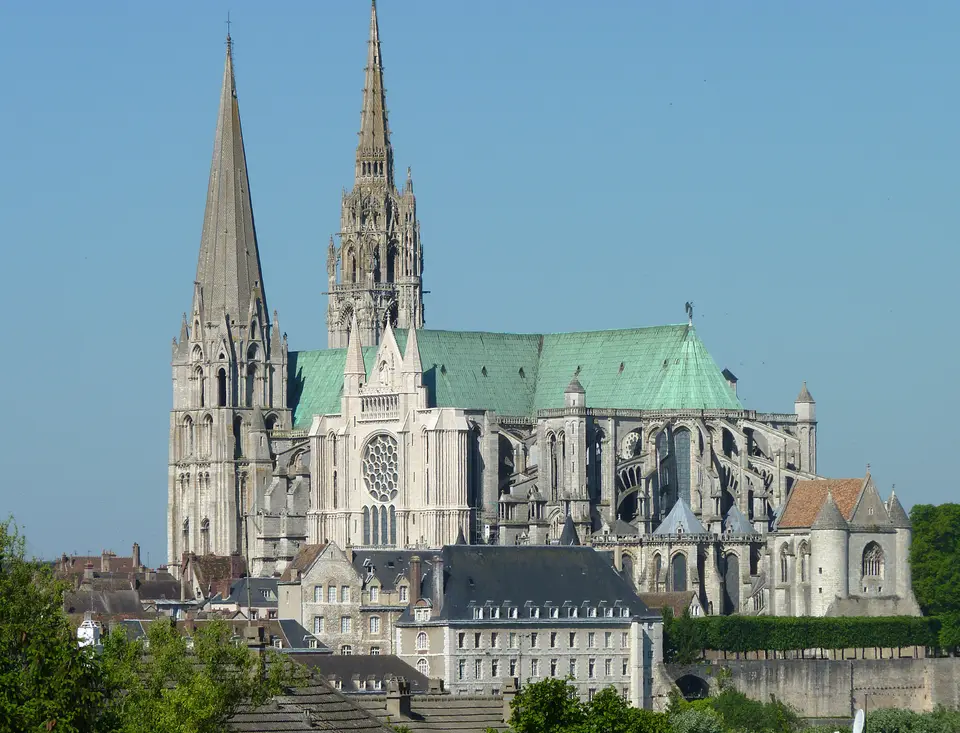
Quick Field Data
- UNESCO Inscription: 1979 · Criteria (i), (ii), (iv).
- Scale & Footprint: 10,875 square metres cathedral measuring 130 metres long and 32 to 46 metres wide, with a 37-metre-high nave and spires of 105 and 113 metres.
- Access & Ticketing: Free entry to the main nave alongside the ambulatory, stained glass, and floor labyrinth; separate admission for the North Tower climb, the Crypt of Saint Fulbert, and the treasury.
- Arrival Logistics: Located at 16 Cloître Notre Dame in Chartres inside the Centre-Val-de-Loire region, roughly 80 kilometres southwest of Paris.
From Fulbert's Crypt and the 1194 Fire to Flying Buttress Engineering
Rising above the grain plains of the Centre-Val-de-Loire region about 80 kilometres southwest of Paris, the Cathedral of Our Lady of Chartres (Cathédrale Notre-Dame de Chartres) occupies a site where at least five earlier cathedrals have stood since the Diocese of Chartres became an episcopal see in the fourth century. An early basilica at the base of the Gallo-Roman wall was burned in 743 when the Duke of Aquitaine ordered its destruction, and its successor was torched by Danish pirates in 858 before Bishop Gislebert rebuilt the sanctuary, leaving the subterranean ninth-century Saint Lubin Chapel, named after the sixth-century Bishop Lubinus, beneath the present apse. In 876, King Charles the Bald donated the cathedral's defining relic, the Sancta Camisa, venerated as the silk tunic worn by the Virgin Mary when Christ was born, transforming Chartres into the premier Marian pilgrimage centre of medieval Western Christianity and the seat of four great annual trade fairs on the feasts of the Presentation alongside the Annunciation, Assumption, and Nativity.
After another fire on 7 September 1020 destroyed the tenth-century church, Bishop Fulbert (bishop from 1006 to 1028), founder of the famous School of Chartres where scholars Thierry of Chartres alongside William of Conches and John of Salisbury later pioneered Scholastic philosophy, appealed to European monarchs including Cnut the Great and completed the vast U-shaped Romanesque Saint Fulbert Crypt in 1025, stretching 230 metres long around the earlier vault and housing the 33-metre-deep Celtic Well of the Saints-Forts (Puits des Saints-Forts). Following a town fire in 1134 that sparked the 1145 Cult of Carts, masons built the western narthex, the Royal Portal (1145 to 1155), and the 105-metre octagonal stone south spire (completed around 1160 to 1170 without an internal timber frame). On the night of 10 June 1194, lightning ignited a fire that destroyed everything except the crypt and the western towers along with the Royal Portal; when priests emerged three days later from iron trapdoors carrying the unharmed Sancta Camisa, a papal legate declared that the Virgin Mary demanded a grander church.
Constructed largely between 1194 and 1220, when the canons entered their choir stalls in 1221 before formal consecration in October 1260 attended by King Louis IX, the High Gothic rebuilding reused Fulbert's 10,875-square-metre cruciform footprint (130 metres long and 32 to 46 metres wide, with a 16.4-metre-wide nave rising 37 metres high) while revolutionising structural engineering. For the first time in a major cathedral design from the outset, the anonymous master architect employed external flying buttresses connected by double stone arches spoked like wheels to counterbalance the outward thrust of lighter four-compartment rib vaults. Supported below by alternating round and octagonal bundled piers (pilier cantonné), this external skeleton allowed the builders to eliminate the traditional Romanesque tribune gallery, compress the triforium into a narrow horizontal band, and open the upper clerestory walls into soaring expanses of stained glass that became the structural model for Reims alongside Amiens and Beauvais.
Three Sculpted Façades, 176 Windows, and Nine Centuries of Preservation
Across its western, northern, and southern entrances, Chartres presents an encyclopaedic programme of twelfth- and thirteenth-century stone sculpture carved from fine Parisian limestone (calcaire), contrasting with the harder, brittle local Berchères stone used for the interior piers and capitals. On the west façade, the twelfth-century Royal Portal (proportioned in a 10:7 ratio) unites three doorways above slender column-statues of biblical kings and queens: the right portal depicts Christ's Incarnation and the Virgin enthroned as Sedes sapientiae framed by archivolts of the Seven Liberal Arts; the left portal shows the Ascension surrounded by the zodiac and labours of the months; and the central tympanum portrays Christ in a mandorla flanked by the Tetramorph symbols together with the Twelve Apostles and the 24 Elders of the Apocalypse. Added between 1205 and 1230, the deep triple porches of the north transept celebrate the Virgin Mary and St Anne alongside scriptural prophets and the vita activa (preparation of flax) as well as local martyrs St Modesta and St Potentian, while the south transept porch portrays the Last Judgment, Christian martyrs, confessors, eighteen kings beginning with King David, and an angel holding a sundial.
Inside the dark, cavernous nave, whose floor tilts slightly so medieval stewards could sluice out the straw where pilgrims slept and preserves the early-1200s stone pavement labyrinth, 152 of the 176 original stained-glass windows survive intact, the largest medieval glass ensemble in the world. Above the Royal Portal glow three twelfth-century lancets (before 1145) depicting the Jesse Window alongside the Life of Christ and the Passion, while the south choir ambulatory holds the famous 1180 composite panel of Notre-Dame de la Belle-Verrière (the Blue Virgin). The remaining 8.1-by-2.2-metre aisle lancets, clerestory doublets, and three monumental 10.5-to-12-metre rose windows, comprising the western rose of the Last Judgment (c. 1215), the northern rose of the Glorification of the Virgin donated with the arms of Blanche of Castile (c. 1230), and the southern rose of the Glorification of Christ donated by the Mauclerc Counts of Dreux-Bretagne (where four evangelists sit on the shoulders of four prophets), were glazed between 1205 and 1250, featuring trade scenes of labourers alongside wine sellers and money-changers in their lower registers.
Subsequent centuries added layered landmarks without breaking this thirteenth-century unity: the two-storey Chapel of Saint Piatus of Tournai at the eastern apse in 1326 (whose treasury reopened in 2024), the Flamboyant Chapel of the Annunciation founded by Louis de Bourbon in the south aisle in 1417, the 113-metre Flamboyant north spire and 1520 twenty-four-hour astronomical clock tower built by Jehan de Beuce (Jean Texier) after lightning struck in 1506, the 100-metre-long sculpted choir wall with 200 statues in 41 scenes built between the sixteenth century and 1714, and the grand organ perched 16 metres above the nave floor (4,000 pipes and 70 stops). Crowned here on 27 February 1594 because the Catholic League held Reims, King Henri IV, mounted the rood screen before the nave crowd; during the French Revolution, an architect saved the cathedral from demolition by arguing its rubble would choke the streets for years; after an 1836 workmen's fire burned the lead-covered wooden roof and melted the bells (except the 1520 Pierre Savyet clock bell, later joined by 1840 Cavillier bourdons), engineers installed an iron-framed copper roof; and on 16 August 1944, American Colonel Welborn Barton Griffith Jr. rang the cathedral bells to halt an American artillery order before dying in combat at nearby Lèves, while the stained glass returned safely from wartime country storage and underwent exterior protective glazing and the 1997 to 2018 interior stone-cleaning campaign defended by Isabelle Paillot despite criticism from Martin Filler.
Reading the Portals, Walking the Labyrinth, and Climbing the North Spire
Approaching Chartres across the plain today, the asymmetrical pair of the 105-metre Romanesque south pyramid and the 113-metre Flamboyant north spire rises above the rooftops of the medieval town long before you reach the parvis at 16 Cloître Notre Dame. Inside, the controversial 2009 restoration has returned the Berchères limestone vaults and piers to their bright thirteenth-century cream-and-ochre faux-marble paintwork, throwing the deep cobalt blues and ruby reds of the stained glass into sharp contrast. Bring binoculars for the glass. Walking the exterior porches and interior aisles in sequence reveals how medieval architecture, sculpture, and light functioned as a single theological book.
- Entry and Route From the Royal Portal to the Labyrinth: Start on the western parvis to examine the twelfth-century column statues and Liberal Arts archivolts of the Royal Portal alongside the 1520 polychrome clock of Jean Texier at the base of the north tower, then step into the 37-metre-high nave beneath the three 1145 lancets. Walk slowly down the central axis to the thirteenth-century circular stone labyrinth set into the nave pavement (cleared of chairs on Fridays between Lent and All Saints' Day except Good Friday), noting the slight drainage tilt of the medieval floor and the sixteenth-century wooden case of the grand organ overhead.
- Tickets, Interiors, and Viewpoints in the Crypt and North Tower: While the nave alongside the 100-metre sculpted choir wall, the Blue Virgin window (Notre-Dame de la Belle-Verrière), the Sancta Camisa reliquary, and the newly reopened 1326 Chapel of Saint Piatus treasury are accessible from the main floor, purchase a ticket at the north porch to climb the 113-metre Flamboyant spire of Jehan de Beuce for close-up views of the wheeled flying buttresses and the 1836 iron roof truss. Join a scheduled tour descending into the 230-metre-long Romanesque Crypt of Saint Fulbert to see the ninth-century Saint Lubin vault, the 33-metre Well of the Saints-Forts, and the 1200 fresco in the Our Lady of the Crypt Chapel.
- Timing and Onward Connections: Visit on a sunny day to experience the full chromatic intensity of the 152 medieval windows, inspecting the north rose in the morning, the south rose at midday, and the western Last Judgment rose in the late afternoon, and stay after dusk during the seasonal Chartres Light Celebration when projections illuminate the three sculpted porches, or attend evening Vespers sung by the Chemin Neuf Community. Located an easy 80-kilometre rail or road trip southwest of Paris, Chartres pairs with other French cathedrals in our UNESCO World Heritage Atlas.
