


























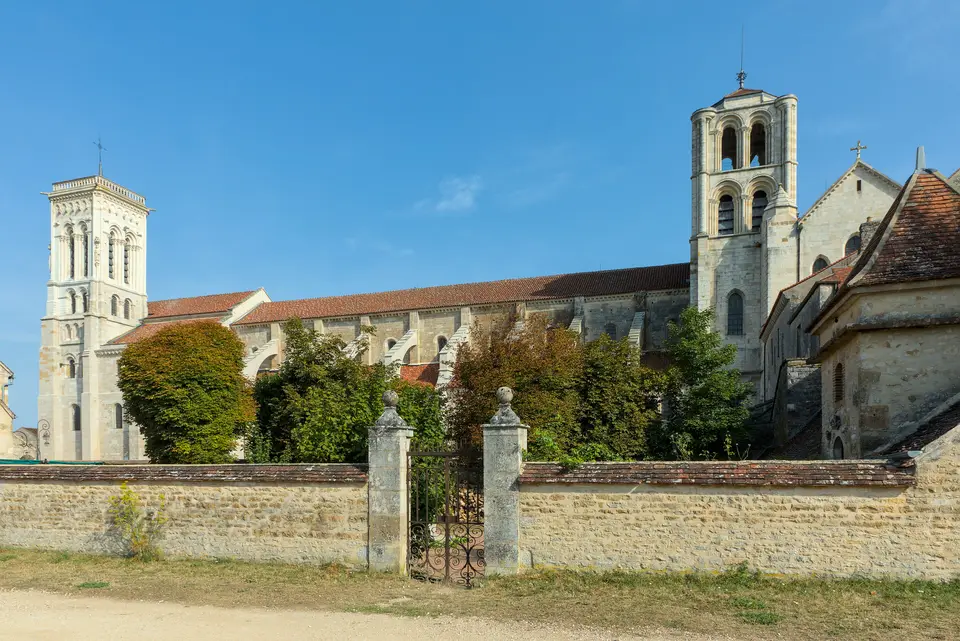
Quick Field Data
- UNESCO Inscription: 1979 · Criteria (i), (vi).
- Scale & Footprint: 183 hectares hilltop monastic town and basilica surrounded by an 18,373 hectares rural buffer zone in Burgundy-Franche-Comté.
- Access & Ticketing: Free pedestrian climb up the fortified village street and free entry to the narthex, nave, and crypt of the Basilica of Sainte-Marie-Madeleine.
- Arrival Logistics: Perched atop a high limestone ridge in the department of Yonne in Burgundy-Franche-Comté, southeast of Paris.
From Carolingian Foundations to the Eternal Hill of Mary Magdalene
Commanding a steep ridge in the department of Yonne within the Burgundy-Franche-Comté region, long known in French cultural memory as the eternal hill, Vézelay Abbey (the Basilica of Sainte-Marie-Madeleine) grew from a ninth-century Carolingian monastic foundation into one of the supreme spiritual assembly points of medieval Western Christianity. Built on land once occupied by the late Roman villa of Vercellus, the estate passed to the Carolingian count Girart of Roussillon, whose two early convents in the valley were looted by eighth-century Moorish raiding parties before a first hilltop convent was burned by Norman raiders. In the ninth century, the monk Badilo refounded the Benedictine monastery on the defensible crest of the hill and affiliated the house with the reformed Benedictine order of Cluny.
The architectural and economic fortune of the hilltop town changed dramatically in the mid-eleventh century, around 1050, when the monks of Vézelay proclaimed that they held the corporeal relics of Saint Mary Magdalene, brought from the Holy Land or translated from a crypt sarcophagus at St-Maximin in Provence showing the Unction at Bethany. Because Mary Magdalene stood as the supreme Christian prototype of the forgiven penitent, knights, nobles, and freed captives flocked to the Burgundy hill to lay their iron fetters before her shrine; in 1037, the newly elected Abbot Geoffroy melted down these votive chains and reforged them into wrought-iron railings around the Magdalene's altar. Positioned at the starting point of one of the four major French pilgrimage roads leading southwest to Santiago de Compostela in Galicia, the hilltop town expanded in the twelfth century to a population between 8,000 and 10,000 inhabitants, while its abbots fiercely defended their privileges against the bishops of Autun, the counts of Nevers, the mother abbey of Cluny, and the local townsmen.
To accommodate these surging crowds, a new Romanesque abbey church was dedicated on 21 April 1104 (after heavy building taxes provoked a peasant revolt that killed the abbot), and following a catastrophic fire in the nave in 1120, masons constructed the present central nave between 1120 and 1140 and added a monumental two-storey western narthex (pilgrims' vestibule) inaugurated by Pope Innocent II, in 1132. After another fire damaged the upper nave in 1165, late-twelfth-century builders replaced the eastern monastic choir and transept in bright early Gothic style, creating a spatial progression down the longitudinal axis of the church from the shadowed Romanesque narthex through the polychrome Romanesque nave into the light-filled Gothic sanctuary above the Carolingian crypt.
The Pentecost Tympanum, Crusader Summons, and Viollet-le-Duc's Rescue
Because Vézelay functioned as the ideological staging ground for the medieval Crusades, where Pope Urban II, initially planned to preach the First Crusade in 1095 before moving to the Council of Clermont, where Saint Bernard of Clairvaux preached the Second Crusade at Easter 1146 before King Louis VII, and Queen Eleanor, where exiled archbishop Thomas Becket delivered his 1166 Whitsunday excommunication sermon against supporters of Henry II, of England, where King Richard the Lion-Hearted and King Philip II, Augustus met for three months in 1190 before departing on the Third Crusade, and where Francis of Assisi founded the first Franciscan establishment on French soil in 1217, its sculptural programme departs radically from standard Romanesque portals. Unlike the Last Judgment tympanums of St. Lazare d'Autun (where Master Gislebertus moved around 1120 after working at Cluny and Vézelay) or St. Pierre de Moissac, the central portal inside the Vézelay narthex, completed in 1130 and interpreted by scholars George Zarnecki, Adolf Katzenellenbogen (1944), and Peter Low, portrays the Pentecostal Mission of the Apostles.
In France, the centre of semicircular tympanum sits an elongated, contraposto Christ within a mandorla with arms spread wide, projecting rays of divine grace from his fingers onto the flanking Apostles while holding no judgment scroll, welcoming and commissioning Crusaders whose sins were remitted. Surrounding the central scene, eight radial compartments divide humanity by stage of evangelisation: the four lower compartments depict nations that had already received the Gospels (among them the Byzantines, Armenians, and Ethiopians) rendered in normal human proportions, while the four upper compartments show the Apostles healing the sick and casting out demons, including two lepers comparing their miraculously healed limbs. Below the tympanum, the horizontal lintel portrays the unconverted peoples at the edges of the earth in medieval ethnographic caricature: pygmies mounting a horse with a ladder, figures with pig snouts, a man covered in feathers, and men with elephantine ears waiting to receive the Word, framed by outer archivolts of the zodiac and monthly agricultural labours.
Passing through this portal into the Romanesque central nave (1120 to 1140) reveals a bold structural rhythm: groined vaults without ribs span the central vessel between transverse horseshoe arches built of alternating dual-coloured brown and pale cream stone voussoirs, while nearly a hundred carved stone capitals atop the nave and narthex piers depict vivid biblical narratives, hagiographic miracles, and profane moral allegories. As Franciscan father Hugues Delautre discovered in 1976, the southern clerestory windows were astronomically aligned so that at local noon on the summer solstice in June, shortly before the liturgical feast of Saint John the Baptist, sunlight casts a row of illuminated spots precisely down the longitudinal centre of the nave floor toward the high altar. After the rival 1279 discovery of Mary Magdalene's body at Saint-Maximin-la-Sainte-Baume under Charles II, the Angevin king of Sicily, eclipsed the pilgrimage, the abbey was sacked and its relics torched by Huguenots in 1569 and vandalised during the French Revolution. By 1834, when French inspector of historical monuments Prosper Mérimée visited the hill, the outward thrust of the groined vaults had pushed the nave walls to the brink of collapse; between 1840 and 1861, the young architect Eugène Viollet-le-Duc saved the basilica by reconstructing external flying buttresses, restoring the nave vaults, and replacing weathered exterior portal carvings while preserving the original twelfth-century narthex tympanum indoors.
Climbing the Hilltop Street and Exploring the Basilica and Ramparts
Approaching Vézelay today across the wooded valleys and vineyards of the 18,373 hectares buffer zone, the long limestone profile of the Basilica of Sainte-Marie-Madeleine crowns the top of the 183 hectares hilltop village precisely as it did for twelfth-century walkers bound for Santiago de Compostela. A single steep main street climbs from the lower town square between medieval stone houses and cellar doorways up to the open parvis before the western façade. Silence fills the high stone nave. Today the Jerusalem monastic community maintains daily liturgical chanting inside the church, continuing a millennium of monastic prayer on the ridge.
- Entry and Route Up the Eternal Hill to the Narthex: Leave your vehicle at the base of the hill near the town ramparts and walk up the steep paved spine of the medieval village, passing the hillside where Francis of Assisi established the first French Franciscan priory in 1217, until the western façade of the basilica opens before you. Step first into the enclosed twelfth-century narthex to stand directly beneath the 1130 Pentecost tympanum, where the enclosing vestibule walls shielded the carved rays of Christ's hands, the lintel of distant nations, and the zodiac archivolts from eight centuries of Burgundian rain.
- Tickets, Interiors, and Viewpoints From the Cloister Terrace: Entry into the narthex, the dual-coloured horseshoe arches of the Romanesque nave, the white-stone Gothic choir, and the Carolingian crypt holding the nineteenth-century reliquary of Saint Mary Magdalene is free, while the neighbouring Maison du visiteur offers guided explanations of the astronomical alignment and the sculpted capitals. After walking the nave aisles to inspect the biblical and hagiographic capitals, exit through the southern chapter house and single surviving gallery of the Romanesque cloister onto the tree-lined terrace behind the apse for a sweeping panorama across the valley and the northern hillside where Saint Bernard preached the Second Crusade in 1146.
- Timing and Onward Connections: Plan to stand inside the nave at local noon in mid-to-late June to watch the summer solstice light spots align down the longitudinal centre of the floor, or time your visit around the midday or evening offices chanted by the monastic community. Located in the Yonne department of Burgundy-Franche-Comté southeast of Paris, Vézelay links naturally with other Burgundian and French medieval monuments featured in our UNESCO World Heritage Atlas.
