Quick Field Data
- UNESCO Inscription: Reference 797, inscribed in 2000 as a Cultural site under Criteria (ii) and (iv) in Veneto, Italy.
- Scale & Footprint: Encompasses 444.4 hectares cradled inside a sweeping bend of the River Adige at the foot of the Lessini Mountains, preserving Verona's Roman street grid and consecutive defensive perimeters.
- Access & Ticketing: Historic squares including Piazza Bra, Piazza delle Erbe, Piazza dei Signori, Roman gates, and Ponte Pietra remain open for free walking, while entering the Verona Arena, Casa di Giulietta courtyard museum, Castelvecchio, and major churches operates ticketed entry.
- Arrival Logistics: Verona Villafranca Valerio Catullo Airport (VRN) sits 10 kilometres south-west of the city centre, backed by regional rail connections from neighbouring Veneto and Emilia gateways including Treviso and Bologna, delivering travellers directly into central Verona.
Roman Grid Foundations Inside the Bend of the River Adige
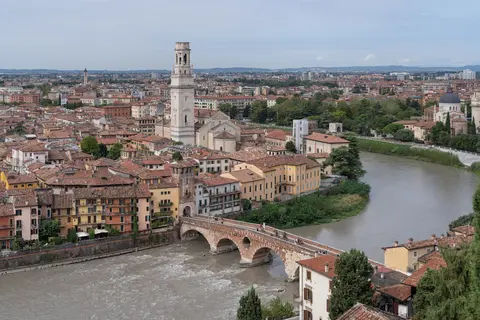
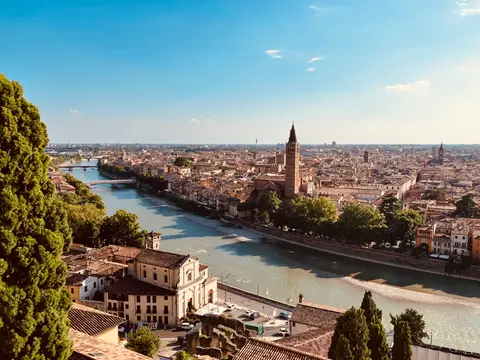
Settled between the fourth and third centuries BCE near the foot of the Lessini Mountains, Verona is historically linked with the Euganei and Cenomani around 550 BC. The settlement rose rapidly once Rome brought the Po valley under control around 300 BC, gaining Roman colonia status in 89 BC and municipium rank in 49 BC under the Poblilia tribe. Positioned at the crossroads of strategic imperial highways crossing the River Adige, the city organised itself along orthogonal cardines and decumani streets intersecting at right angles inside a protective river loop. Even today, aerial views trace that classical checkerboard clearly across the centre, while original basalt-paved Roman roadways survive roughly 6 metres beneath modern basements and cellars.
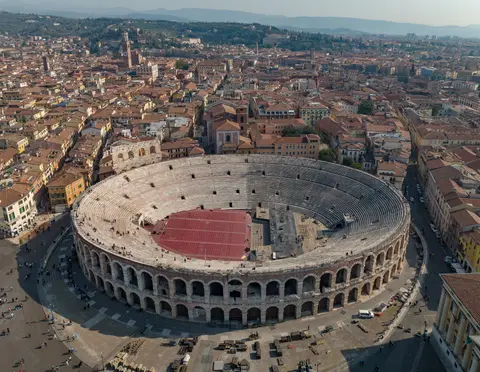
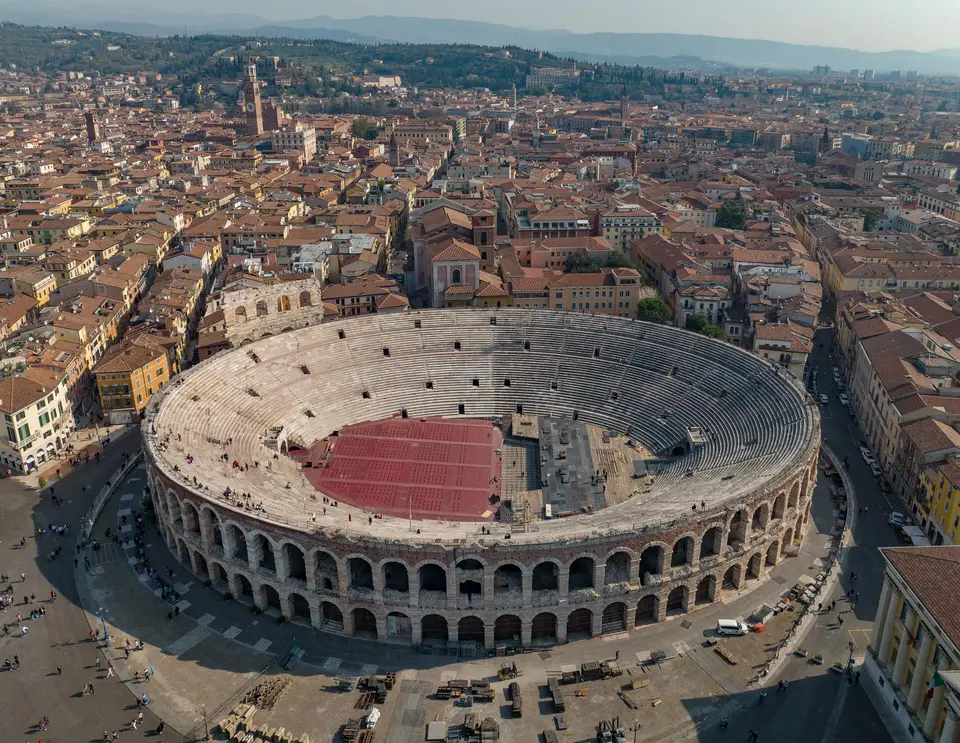
Verona retains one of northern Italy's richest ensembles of standing Roman engineering. On expansive Piazza Bra rises the Verona Arena, completed around 30 AD as the third-largest Roman amphitheatre in Italy behind Rome's Colosseum and Capua. Measuring 139 metres long by 110 metres wide, its 44 marble seating tiers once held around 25,000 spectators watching gladiator games. Though most of its outer three-storey perimeter ring fell over centuries, one soaring section in white and pink Valpolicella limestone still stands, and the virtually intact interior still stages open-air summer opera.
Across the old centre, Roman infrastructure punctuates everyday streets. The first-century BC Roman theatre survived thanks to eighteenth-century Veronese citizen Andrea Monga, who bought and cleared away houses stacked atop its stone slopes. Nearby crosses the Ponte Pietra, while the engraved Arco dei Gavi stands beside Castelvecchio, preserving the name of its builder, architect Lucius Vitruvius Cordone. The arch straddled Corso Cavour until dismantled by French troops in 1805 and carefully reassembled beside Castelvecchio in 1932. Along the Roman Via Sacra (today Corso Porta Borsari, lined with Renaissance palazzi and the ancient Church of Santi Apostoli) rises the third-century Porta Borsari facade. Inscribed in 245 AD with the title Colonia Verona Augusta, this gate pairs with the excavated guard courtyard of first-century BC Porta Leoni. Nearby, early Christian bishop burials lie inside the two-storey ambulatory and cruciform crypt of Santo Stefano.
Scaliger Fortifications, Venetian Rule, and Austrian Bastions
Late antiquity and the early Middle Ages transformed Verona into a contested northern stronghold. Roman general Stilicho defeated Alaric's Visigoths here in 402, before Ostrogoth ruler Theodoric the Great captured the city in 489 and built a palace during Gothic dominance. Byzantine officer Artabazes briefly breached the walls for a single day in 541 and Valerian besieged Verona in 552. Lombard King Alboin then made it a royal seat in 569 before his assassination in 572, and Charlemagne crushed final Lombard resistance in 774. On 3 January 1117, a devastating earthquake wrecked early medieval edifices (recounted earlier in the Carolingian poem Versus de Verona) and spurred sweeping Romanesque rebuilding. Verona formed a free commune in 1135 and joined the 1164 Veronese League and 1167 Lombard League against Frederick Barbarossa, winning autonomy through the 1176 Battle of Legnano and 1183 Peace of Constance.
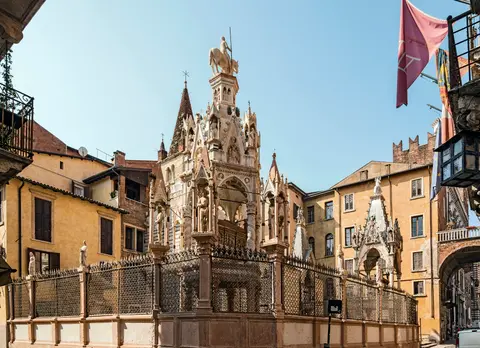
After Ezzelino III da Romano's brutal lordship ended following the 1257 slaughter of 11,000 Paduans, the della Scala (Scaliger) family seized power in 1262 under Mastino the First and defined Verona's medieval golden age. Cangrande the First della Scala (1291 to 1329) expanded rule over Treviso (1308), Vicenza (1311), and Padua (1328) while protecting exiled luminaries Dante, Petrarch, and Giotto, turning Verona into a 40,000-strong cultural capital. Successor Mastino II conquered Brescia and bought Parma and Lucca before a coalition war trimmed domains back, followed by bloody family succession. Cansignorio assassinated Cangrande II and embellished Verona with palaces, bridges, aqueducts, and Piazza delle Erbe, before Antonio fled Milanese war under Gian Galeazzo Visconti in 1387, the year of the Battle of Castagnaro. Their Gothic monuments endure in the Arche Scaligere tombs beside Santa Maria Antica and the fortified Castelvecchio compound.
Submitting to the Republic of Venice in 1405 kept Verona encased inside massive medieval and Renaissance bastions for centuries. During this Venetian period, Emperor Maximilian the First held the city from 1508 to 1517, and the devastating 1630 to 1631 plague killed roughly 33,000 residents (over 60% of the population). After 1776 saw the development of Veronese bellringing art, Verona rose on Easter Monday 1797 against Napoleon's garrison before the Treaty of Campo Formio transferred the city to Austria in 1797 and 1798. It returned briefly under Napoleon's Kingdom of Italy via the 1805 Treaty of Pressburg, before Austrian Lombardy-Venetia hosted the 1822 Congress of Verona until unification with Italy in 1866. Crucially, those fortified outer rings barred heavy nineteenth-century railways and factories from tearing through the 444.4-hectare historic core. Today, Verona remains the largest city in Veneto with 255,139 residents (2026) inside a 1,426-square-kilometre metropolitan area of 714,310, governed by a directly elected 33-councillor municipal council seated in Palazzo Barbieri.
Piero Gazzola's Post-War Restoration and Continuous Civic Life
Verona's twentieth-century history brought dark fascist chapters followed by landmark conservation discipline. Italy's 1938 racial laws and Nazi German occupation from 1943 turned Verona into a major hub of the Italian Social Republic. An Austrian fort (today the Santuario della Madonna di Lourdes) held Allied prisoners, Jews, and anti-fascists. The January 1944 Verona trial at Castelvecchio condemned Galeazzo Ciano prior to Allied and partisan liberation on 26 April 1945. Heavy wartime bombing inflicted severe damage across historic bridges and urban quarters, before Cold War NATO alliance ties anchored SETAF headquarters near the city.
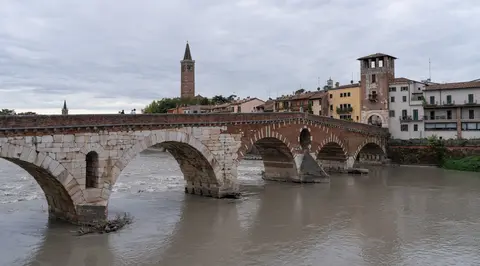
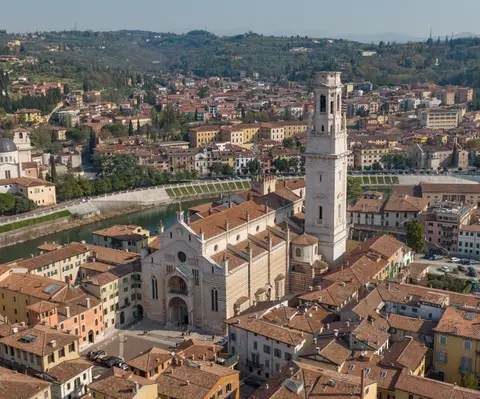
Instead of clearing bombed streets for concrete expressways, Verona launched a rigorous 1946 reconstruction plan guided by Professor Piero Gazzola, later the first President of ICOMOS. Applying Italian restoration principles grounded in material authenticity, Gazzola documented destroyed buildings block by block and supervised the painstaking rebuilding of the Roman Ponte Pietra using salvaged original river stones recovered from the Adige riverbed. Late nineteenth-century flood defences also tamed seasonal river surges, protecting the low-lying Roman core without altering its waterfront character.
Today, municipal conservation officers, Palazzo Barbieri's city administration, the provincial council in Palazzo del Governo, and the national Superintendence under Italy's Cultural Heritage and Landscape Code oversee preservation. Working with the Diocese of Verona and a dedicated city UNESCO office, they coordinate tourism, traffic rules, and building conservation across the entire 444.4-hectare zone. Literary tourism drawn by three William Shakespeare plays set here culminates at Casa di Giulietta, the medieval Cappello family house adapted as a civic museum in the 1930s with an added stone balcony. This site coexists beside everyday fruit markets on Piazza delle Erbe and Renaissance government halls around Piazza dei Signori.
Access Zones Across Piazza Bra, Piazza delle Erbe, and San Zeno
Walking across Verona's 444.4-hectare bend in the River Adige pairs expansive free urban squares with focused ticketed visits to ancient amphitheatre tiers, Scaliger fortresses, and basilica cloisters.
| Complex Zone | Key Highlights | Access & Ticket Rule |
|---|---|---|
| Piazza Bra & Roman Arena | Verona Arena amphitheatre (30 AD), Palazzo Barbieri, Bra promenade | Piazza Bra open freely; daytime Arena monument visits and evening summer opera performances require separate tickets |
| Piazza delle Erbe & Signori Core | Former Roman Forum market square, Palazzo del Comune, Loggia del Consiglio, Domus Nova, Arche Scaligere | Public squares and street-level views of the Scaliger Tombs remain free; tower climbs and Casa di Giulietta museum charge entry |
| Roman Gateways & River Crossings | Porta Borsari, Porta Leoni excavation court, Arco dei Gavi, Castelvecchio, Ponte Pietra | All Roman street gates, bridges, and exterior fortress walls open freely; Castelvecchio civic museum interiors require tickets |
| San Zeno & Left-Bank Hills | Basilica of San Zeno Maggiore, Roman theatre hillside, Santo Stefano early Christian church | Ponte Pietra and riverside walks free; Roman theatre museum and basilica monument circuits operate ticketed entry |
Three Stonework and Engineering Details Across Verona's Monuments
Stepping closely to examine masonry seams and carved stone across Verona uncovers how architects and engineers bridged two thousand years of construction on one river bend.
- White and Pink Valpolicella Limestone Wing of the Arena: Stand on the outer curve of Piazza Bra to compare the two-storey internal arcaded drum against the single surviving four-bay fragment of the Arena's original three-storey outer facade. Cut from white and rose Valpolicella limestone, that towering stone wing shows both the scale of Verona's first-century AD masonry and how medieval builders later quarried outer blocks across town.
- Engraved Architect Signature and Reassembled Blocks on Arco dei Gavi: Inspect the triumphal Roman arch standing beside Castelvecchio. Built in the first century AD across the approach road that became Corso Cavour, the arch bears the engraved name of its architect, Lucius Vitruvius Cordone, an uncommon signature in Roman antiquity. Numbered masonry joints recall its 1932 reassembly after Napoleon's troops dismantled it in 1805, turning a single archway into both a first-century AD epigraphic monument and a demonstration of modern Italian anastylosis.
- Wheel of Fortune Rose Window and Bronze Doors at San Zeno Maggiore: Inspect the third successive church built between 1123 and 1135 over the fourth-century shrine to patron Saint Zeno. Across its facade, trace the carved Wheel of Fortune spokes on the golden stone rose window above doorway lintels depicting the months of the year. Flanking the entrance are 18 biblical bas-relief panels on each side, paired with 48 inner bronze door panels illustrating Scripture and Saint Zeno's life.
Opera Season Pacing, Foggy Winters, and Pairing with Verona Guides
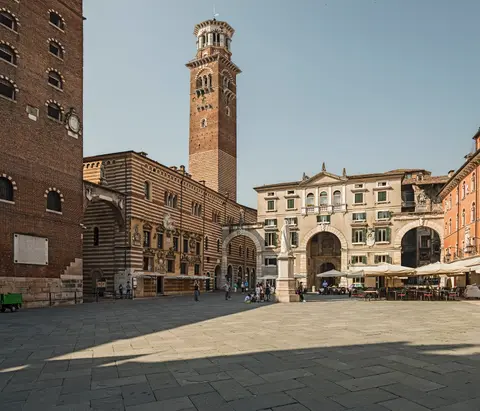
Verona's humid subtropical inland climate swings sharply across the calendar, bringing warm summers tailored for open-air evening opera inside the 25,000-seat Roman Arena. In cool, humid winters, proximity to Lake Garda sends drifting fog across Ponte Pietra and Piazza dei Signori from dusk into late morning. Visiting the Roman gates, Piazza delle Erbe, and San Zeno early in the day helps avoid pedestrian congestion funnelled between Piazza Bra and Casa di Giulietta. Early visits let you explore before midday crowds pack the narrow Roman street grid. Piazza delle Erbe itself sits directly atop the Roman Forum and preserves Scaliger-era restorations by Cangrande the First and Cansignorio using marble statues and stone fragments salvaged from ancient Roman spas and villas. From there, passages link straight through to Palazzo del Comune, Palazzo del Governo, Loggia del Consiglio, and Domus Nova on adjacent Piazza dei Signori.
With Verona Villafranca Valerio Catullo Airport only 10 kilometres away and main-line northern Italian trains stopping minutes from Piazza Bra, travellers can explore the core smoothly on foot or via local ATV buses. For neighbourhood osterias, river viewpoint walks above the Roman theatre, and detailed multi-day routes across Veneto, pair this architectural survey with our dedicated Verona city guide. Readers mapping fortified medieval towns and classical Roman ruins across Italy and Europe can explore further entries in our UNESCO World Heritage Atlas.