





















Quick Field Data
- UNESCO Inscription: 1996 · Criteria (i), (ii), (iv); on the List of World Heritage in Danger from 2004 to 2006
- Scale & Footprint: 144.58 metres long and 86.25 metres wide outside, with a built area of 7,914 square metres; the north tower reaches 157.38 metres and the south tower 157.31 metres
- Access & Ticketing: The nave is a working cathedral open to visitors outside services; the climb up the south tower and the Cathedral Treasury have their own tickets
- Arrival Logistics: Köln Hauptbahnhof stands right next to the cathedral, with high-speed trains to Frankfurt, an ICE line to Brussels and Eurostar trains to Paris via Brussels
Seven Centuries on One Medieval Plan
The foundation stone of the Gothic cathedral was laid on 15 August 1248. The cathedral keeps the relics of the Three Magi, which were brought to Cologne from Milan in 1164.
Master Gerhard directed the first phase, the eastern arm with its choir and ring of chapels. That part was consecrated in 1322. Work then moved west, but it slowed and stopped in 1473. The south tower stood finished only up to the belfry level, and work on the nave ended in the sixteenth century.
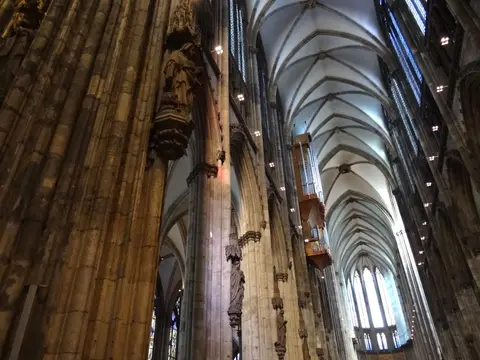
Construction resumed in 1842. The architect Ernst Friedrich Zwirner led the work until his death in 1861. The builders followed the surviving medieval plans closely, so the nineteenth-century towers and nave match the thirteenth-century choir. The cathedral was completed and celebrated on 15 October 1880. UNESCO describes it as a High Gothic, five-aisled basilica and stresses this rare faithfulness to one original design.
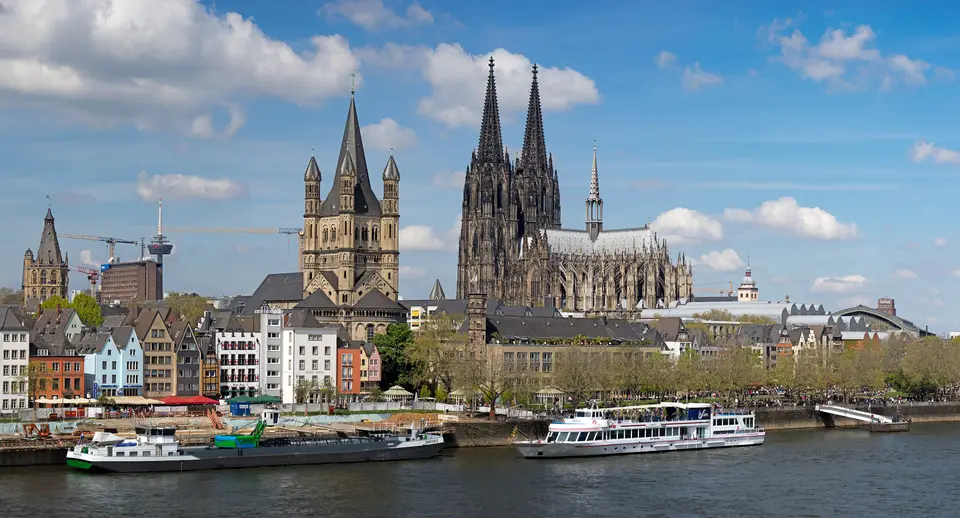
The plan is easy to read on the ground. The two west towers face the Domplatte square and the station. The long nave leads east to the crossing and the transepts. Behind them, the choir ends in a curve of radiating chapels. The building is about 145 metres long outside, so it helps to walk the full outside before going in.
The Shrine of the Three Kings and Other Treasures
The most important object is the Shrine of the Three Kings behind the high altar. Archbishop Philip von Heinsberg commissioned it, and the goldsmith Nicholas of Verdun began it in 1190. It is made of gilded bronze and silver with enamel and gemstones, and it has the shape of a small basilica. When it was opened in 1864, it was found to contain bones and garments.
The Gero Crucifix is carved from oak and is believed to have been commissioned around 960 for Archbishop Gero. It is considered the oldest large crucifix north of the Alps. St Mary's Chapel holds the Altar of the City Patrons, painted by Stefan Lochner for the patron saints of Cologne.
The medieval choir stalls and a cycle of medieval stained glass also survive, which UNESCO names as part of the site's value. A modern addition sits in the south transept. Gerhard Richter's window was installed on 25 August 2007. It covers 113 square metres and uses 11,500 squares of glass, all of the same size.
The cathedral was hit by aerial bombs fourteen times in the Second World War. In 1946 a cathedral building commission was set up to oversee the Cathedral Workshop, the team of masons and glaziers led by the cathedral architect. That workshop still maintains the building today. UNESCO notes that it works in the medieval tradition.
The site was placed on the List of World Heritage in Danger from 2004 to 2006 because of plans for high-rise buildings near the cathedral. It was the only Western European site on that list at the time.
Visiting the Nave, the Tower and the Domplatte Today
Around six million people visit the cathedral each year, so the Domplatte in front of the west facade is busy from morning to evening. The nave stays a place of worship, so visits pause during services. Allow at least an hour for the interior and another hour for the tower.
- Walk the Nave and Choir in Order: Enter through the main west portal and walk up the nave to the crossing, where the full height of the vaults is clearest. Then follow the ambulatory around the choir. Look for the Shrine of the Three Kings behind the high altar, the Gero Crucifix and the Lochner altarpiece in St Mary's Chapel. Finish in the south transept, where the Richter window throws coloured light on the floor on sunny days.
- Climb the South Tower: The climb starts at a separate entrance on the side of the cathedral, where the tickets are sold. It has 533 steps and no lift, and the viewing platform is 97 metres above the ground. About halfway up, at 53 metres, you pass the belfry with St Peter's Bell, which weighs 24 tonnes. The stairs are narrow, so you go up on the right and come down on the left. On a clear day the view takes in the Rhine and the Siebengebirge hills.
- Plan Your Timing and Next Stop: Come early on a weekday or late in the afternoon to avoid the largest groups. Check the cathedral's own website for service times, because parts of the church close during Mass. The Hohenzollern Bridge next to the station crosses the Rhine on foot and gives a long view back to the cathedral. Find more Gothic churches and palaces in our UNESCO World Heritage Atlas, or take the direct train to Brussels, our closest city guide.
