


























Quick Field Data
- UNESCO Inscription: 1991 (Cultural heritage property in the town of Lorsch, Bergstraße district, Hesse, Germany)
- Scale & Footprint: 3.11 hectares of World Heritage core area buffered by 14.825 hectares across the main Benedictine abbey precinct on an Ice Age sand dune and the nearby Altenmünster site
- Access & Ticketing: Administered by the heritage authorities in Hesse; check the official site for combined admission to the Königshalle exterior, museum centre, herb garden, and Lauresham Open-Air Laboratory
- Arrival Logistics: Situated in Lorsch along the Bergstraße corridor in southern Hesse, approximately 10 kilometres east of Worms and accessible by regional rail and motorway routes
Count Cancor, Saint Nazarius, and the Imperial Burial Ground of the Eastern Franks
Rising on a low Ice Age sand dune above the Weschnitz river plain in southern Hesse, roughly 10 kilometres east of Worms along the foot of the Bergstraße hills, the Abbey and Altenmünster of Lorsch preserve one of the rarest architectural witnesses to the Carolingian Empire in Europe. Within Germany, the UNESCO World Heritage Atlas in 1991 across 3.11 hectares with a 14.825-hectare buffer zone, the Imperial Abbey of Lorsch, known in German as Reichsabtei Lorsch and in Latin charters as Laureshamense Monasterium or Laurissa, was originally established in 764 when Frankish Count Cancor together with his widowed mother Williswinda endowed a proprietary church and monastery (Eigenkirche) dedicated to Saint Peter and Saint Paul on a small island in the Weschnitz today called the Altenmünster.
Cancor and Williswinda entrusted the new foundation to their relative Chrodegang, Archbishop of Metz, who settled the community with Benedictine monks from Gorze Abbey and secured from Pope Paul I, the bodily relics of the Roman martyr Saint Nazarius, executed under Emperor Diocletian. After the relics arrived on 11 July 765, pilgrims flocked to Laurissa in such numbers that when Chrodegang handed the abbacy to his brother Gundeland in 766 with fourteen monks, the community relocated a few hundred metres onto the higher Ice Age dune. Following a property dispute with Cancor's son in 772, Abbot Gundeland placed the monastery directly under the protection of Charlemagne, transforming Lorsch into a Royal Abbey whose new basilica dedicated to Saints Peter, Paul, and Nazarius received consecration in September 774 by the Archbishop of Mainz in the personal presence of Charlemagne and his court.
Over the next century Lorsch rose to become a premier spiritual, political, and intellectual powerhouse of the Carolingian domain, governed across 468 years by 46, or in full count 47, Benedictine abbots and favoured by popes and emperors with vast estates stretching from the Alps to the North Sea. When Ludwig der Deutsche, King Louis II the German, died in 876, he was buried at Lorsch in a royal funerary chapel (ecclesia varia), making the abbey the dynastic necropolis for the Carolingian kings of the Eastern Frankish domain, among them his successor Louis the Younger (Ludwig der Jüngere, who died in 882), his grandson Hugo (died 879), and later Queen Kunigunde (died after 915), consort of King Konrad, the earliest non-Carolingian ruler. Although royal control briefly curtailed free abbatial elections between 895 and 956 until Emperor Otto I, restored the privilege, the sovereign Reichsabtei grew powerful enough for Abbot Udalrich to march to Trebur with 1,200 armed horsemen to confront the king over the nearby castle of Starkenburg, while Pope Leo IX personally consecrated an altar in the Carolingian burial chapel in 1052.
The Königshalle Gatehouse, the Codex Aureus, and Monastic Decline
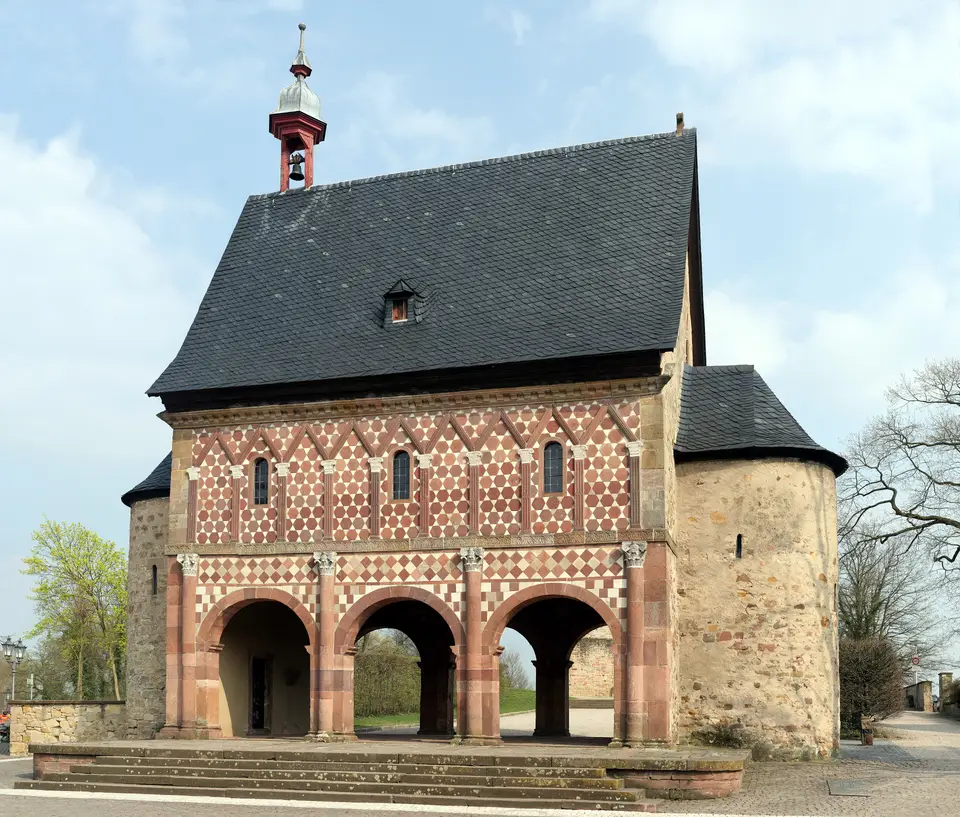
In Germany, the centre of abbey lawn stands the celebrated 9th-century Torhalle, or Königshalle or aula regia, erected during the 9th century under King Louis II the German or his immediate successors as the sole largely intact above-ground building of the Carolingian era in Germany. Blending the monumental vocabulary of a Roman triumphal arch with native Teutonic decorative craftsmanship, the two-storey freestanding structure features three open round-arched passageways on the ground floor framed by four engaged Corinthian half-columns supporting a carved horizontal architrave. Above this classical lower tier, the upper facade is divided by ten fluted Ionic pilasters crowned by steep triangular pediments rather than round arches, while the wall surface between the columns and pilasters is inlaid with a geometric mosaic of red and white sandstone plaques cut into squares, hexagons, and diamonds. Flanking the main rectangular hall rise two circular staircase towers giving access to an upper ceremonial chamber illuminated by Carolingian wall paintings and topped by medieval Gothic stepped gables.
Equally influential was the 9th-century monastic scriptorium and library of Lorsch, whose four surviving 9th-century catalogues record one of the richest collections of Classical and Christian manuscripts in medieval Europe. Around the year 800 monks here compiled the Lorsch Pharmacopoeia, a foundational treatise of early medieval medicine, while court and monastic illuminators produced the famed Codex Aureus of Lorsch, whose gilded gospel leaves and carved ivory consular diptychs of the Byzantine consul Anastasius (517) are today divided between the Vatican Library in Rome as well as the Batthyaneum Library in Alba Iulia in Romania, and in the 1170s chroniclers compiled the Lorscher Codex (Codex Laureshamensis, now preserved in Würzburg and edited by Karl Glöckner between 1929 and 1936), recording more than thousands of property charters across central Europe.
A devastating fire in 1090 forced a major Romanesque reconstruction of the basilica in the 12th century, of which only a three-bay western nave fragment survives today. In 1226 Pope Gregory IX deposed the last Benedictine abbot, Conrad, and in 1232 Emperor Friedrich II (Frederick II) transferred Lorsch to Siegfried III, Archbishop of Mainz, who replaced the monks first with Cistercians from 1232 to 1248 and then, under Pope Celestine IV in 1248, with Premonstratensian canons from Allerheiligen Abbey. Mortgaged to the Electoral Palatinate in 1461, the monastery was dissolved in 1556 to 1563 when Elector Palatine Otto Heinrich introduced the Protestant Reformation and transferred its manuscripts to Heidelberg's Bibliotheca Palatina, later presented in 196 cases by Elector Maximilian of Bavaria to Pope Gregory XV in 1623 under Leo Allatius, before Spanish troops pillaged the abbey in 1621 during the Thirty Years' War and French forces under Louis XIV torched the remaining buildings in the late 17th century, leaving Lorsch to pass back to Mainz in 1623 and finally into Hesse in 1803.
Exploring the Torhalle, Church Fragment, and Lauresham Open-Air Laboratory
Travellers journeying south from Dortmund across Hesse toward the Bergstraße region can explore the tranquil grass-covered hill of Kloster Lorsch, where archaeological layouts in the lawn trace the footprint of the vanished basilica and cloister. Stone walls mark the ancient foundations. Since 2014 the University of Heidelberg's digital Bibliotheca Laureshamensis project, envisioned in 2005 and launched in 2010, has also virtually reunited 309 surviving Lorsch manuscripts held across dozens of institutions in 12 countries. Across the centuries between the 8th and 12th centuries, medieval Latin and Old High German charters recorded the monastery under a rich sequence of evolving toponyms, from 8th-century Laurisham and 9th-century Lorishaim, Loresham, and Laurishaim to 10th-century Laresham, Lareshaeim, and Lauresheim, 11th-century Lauresham, Larsem, Loraszam, Lorozam, and Lorisham, and 12th-century Laurisca, Laureshan, Loressam, Lorisheym, Lorscheim, and Lors. By combining the standing 9th-century architecture of the Torhalle with the digital reunification of the Bibliotheca Laureshamensis and the full-scale reconstructions of the Lauresham Open-Air Laboratory, Lorsch offers a complete window into the intellectual, agricultural, and artistic world of the Carolingian Renaissance.
- The 9th-century Königshalle (Torhalle) and Romanesque church fragment: Walk up the gentle slope of the Ice Age sand dune to examine the polychrome red-and-white sandstone masonry, composite Corinthian capitals, and fluted pilasters of the Carolingian Königshalle from all four sides. East of the gatehouse, step inside the surviving three-bay fragment of the 12th-century Romanesque abbey church, which served as a tobacco warehouse before the First World War, and follow the low stone foundation walls across the lawn that mark the full length of the 774 basilica and the eastern Carolingian royal burial chapel.
- Altenmünster foundations and the monastic herb garden: Follow the walking path a few hundred metres across the Weschnitz meadow to the Altenmünster, where low stone outlines mark the original 764 proprietary monastery founded by Count Cancor and Williswinda before Abbot Gundeland moved the abbey to the dune in 766. Returning to the main abbey hill, stroll through the reconstructed medieval medicinal garden inspired by the 9th-century Lorsch Pharmacopoeia, written here around the year 800.
- Lauresham Open-Air Laboratory and museum exhibition centre: Complete your visit at the Lauresham Open-Air Laboratory, an experimental archaeology village reconstructing an 8th- and 9th-century Carolingian lordly manor complete with timber houses, workshops, storage barns, and heritage livestock breeds based on excavations and descriptions in the Lorscher Codex. Inside the nearby museum centre, inspect excavated Carolingian stone sculptures, sarcophagi from the royal burial ground, and facsimiles of the Codex Aureus.
