


























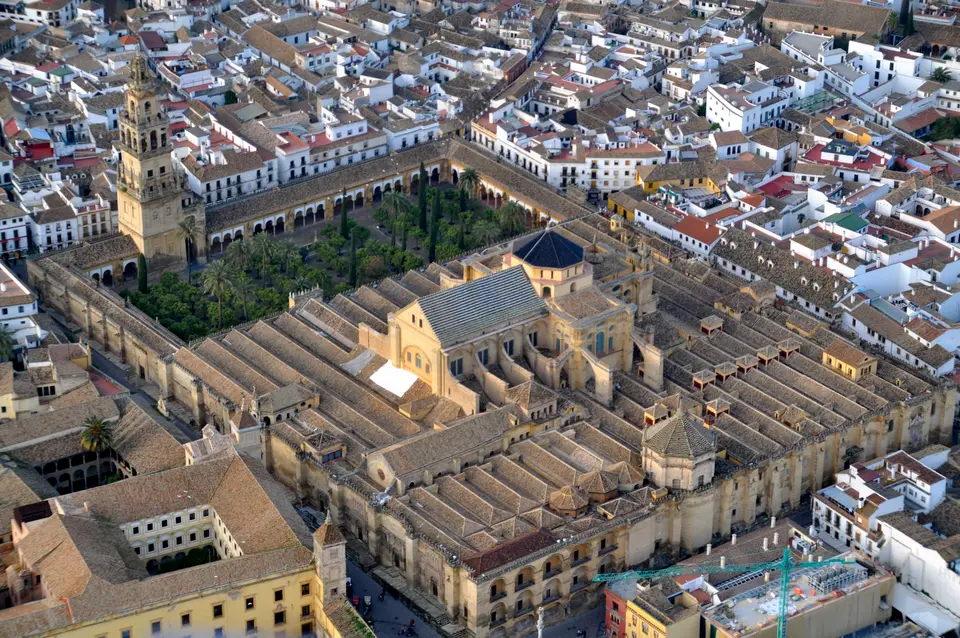
Quick Field Data
- UNESCO Inscription: 1984 (initially registered for the Mosque-Cathedral and expanded in 1994 to include the old town), recognised for preserving Roman and Visigoth alongside Islamic and Jewish as well as Christian monuments.
- Scale & Footprint: Comprises the narrow winding streets and blocks of houses around the Mosque-Cathedral, extending south across the River Guadalquivir (to include the 16-span Roman Bridge and Calahorra Tower), east to Calle San Fernando, north to the commercial centre, and west to the Alcázar de los Reyes Cristianos and San Basilio quarter.
- Access & Ticketing: The historic streets and Roman Bridge and the La Judería lanes are open to pedestrians, while the Mosque-Cathedral and Alcázar alongside the Caliphal Baths and Synagogue operate ticketed entry; check the official site for schedules.
- Arrival Logistics: Situated on the banks of the Guadalquivir River in Andalusia, Spain, connected by rail and highway to Seville.
Spread along the northern bank of the River Guadalquivir in Andalusia, the Historic Centre of Cordoba (Córdoba) is one of the largest and richest historic urban ensembles in Europe. First registered on the UNESCO World Heritage Atlas in 1984 for the Great Mosque-Cathedral of Córdoba and expanded a decade later in 1994 to incorporate much of the surrounding old town, the district reflects thousands of years of occupation by successive cultural groups, Roman and Visigoth and Islamic and Jewish as well as Christian, each leaving a permanent architectural mark. Commanded by its riverside port and serving as an obligatory passage between southern Andalusia and the central Spanish meseta for exporting agricultural products and copper from the nearby Sierra Morena mines, Córdoba reached its greatest glory between the eighth and tenth centuries as the premier urban and cultural focus of the western world. Travellers arriving along the Guadalquivir valley from Seville step into a preserved network of narrow winding streets and monumental fortifications alongside courtyard residences. Whitewashed walls shade the cobbled lanes.
From Roman Corduba to the Caliphate of 929 and Ferdinand III
Founded by the Romans in the second century BC (after the Carthaginian township was taken by Roman forces in 206 BC) near the pre-existing Tartesic settlement of Corduba, the city first served as capital of Hispania Citerior and later acquired major prominence during the period of Emperor Augustus as capital of the Roman province of Baetica. With the crumbling of the Roman Empire in the sixth century AD, the city passed under Visigoth control until the early eighth century, when Moorish armies conquered the city.
In 716, Córdoba became a provincial capital dependent on Damascus, and in 766 it was established as the seat of the Muslim emirate governing al-Andalus. In 929, Abderraman III proclaimed the city the headquarters of an independent Caliphate. Throughout the tenth century, the Caliphate of Córdoba stood among the most advanced cities in the world, celebrated for its learning and its huge library alongside religious tolerance while enclosing more than 300 mosques and innumerable palaces and administrative buildings constructed to rival the splendours of Constantinople and Damascus as well as Baghdad. During this medieval era, Córdoba also flourished for centuries as a seat of Jewish life in Andalusia and the home of the influential medieval rabbi and philosopher Maimonides (the Rambam).
In 1236, during the thirteenth-century Christian conquest, King Ferdinand III (the Saint) took the city, erected new defensive structures, and turned Córdoba's Great Mosque into a Christian cathedral. Around the converted mosque-cathedral grew the Christian city of palaces and churches alongside hospitals and fortresses: the Moorish castle was adapted in the fourteenth century as a residence for the Christian kings, the Almohad bridgehead tower underwent major structural rebuilding under King Henry II in 1369, and King Philip II added the Royal Stables in 1570.
The Mosque-Cathedral, the 16-Span Roman Bridge, and La Judería
The urban and landscape heart of the inscribed zone is the Great Mosque-Cathedral of Córdoba, surrounded by historic blocks of houses and narrow winding streets that create its monumental setting. Directly to the south, the protected boundary extends across the River Guadalquivir to encompass the 16-span Roman Bridge and the defensive Torre Fortaleza de la Calahorra (Calahorra Tower) on the opposite bank, linked to the northern bank by the sixteenth-century Puerta del Puente gate. Further evidence of the Roman era survives in the tall columns of the Roman temple alongside the Roman walls of Córdoba and the mosaics preserved inside the Alcázar.
West of the Mosque-Cathedral stands the Alcázar de los Reyes Cristianos, whose terraced gardens and adjacent Caliphal Baths reflect the enduring Moorish design of the city's hydraulic and palatine spaces, alongside the Episcopal Palace of Córdoba (erected over the foundations of the earlier Visigoth palace and now housing the Diocesan Fine Arts Museum) and the walled San Basilio district. In the western perimeter stands the Moorish gate of the Puerta de Almodóvar, which leads into the historic Jewish Quarter (La Judería). Here stands the medieval Córdoba Synagogue, built in 1314 and used by the Jewish community until 1492, alongside the little Chapel of San Bartolomé, finished in 1410 in the Gothic-Mudéjar style.
Across the surrounding quarters extending toward Calle San Fernando in the east and the commercial centre in the north stand major religious and civic monuments from the fourteenth to eighteenth centuries. Minarets from the Islamic period survive inside the Christian churches of Santiago and San Lorenzo as well as San Juan and the Santa Clara Hermitage, complemented by the churches of San Nicolás and San Francisco. Sixteenth-century landmarks include the former San Sebastián Hospital (finished in 1516 blending Gothic and Mudéjar and Renaissance styles and now serving as the Congress Centre), the San Pelagio Seminary, alongside the noble residence of the Marqués de la Fuensanta del Valle, planned by architect Hernán Ruiz, while the eighteenth-century Hospital del Cardenal Salazar is noted for its Baroque facade.
Courtyard Houses and Walking from the Guadalquivir to San Basilio
Alongside its great religious and defensive monuments, the Historic Centre of Cordoba is defined by its residential patio architecture, where modest and noble houses alike turn plain walls toward the narrow streets and open inward onto cool, plant-filled courtyards in the San Basilio quarter and around the cathedral.
What makes the Historic Centre of Cordoba so visually and historically compelling is the seamless coexistence of Roman infrastructure, Umayyad caliphal grandeur, medieval Jewish heritage, and Christian Gothic and Mudéjar as well as Renaissance and Baroque monuments within a living residential fabric. From the 16 arches of the Roman Bridge spanning the River Guadalquivir and the fortified Calahorra Tower to the hypostyle arches of the Great Mosque-Cathedral and the terraced water gardens of the royal Alcázar de los Reyes Cristianos alongside the 1314 synagogue in La Judería, each era built directly upon the foundations of its predecessors while preserving the intimate courtyard scale of the surrounding whitewashed quarters.
As visitors move from the monumental riverbank perimeter into the winding streets stretching toward Calle San Fernando and the San Basilio neighbourhood, the interplay between public stone monuments and private flower-filled patios becomes clear at every corner. Former Islamic minarets rising as Christian bell towers over parish squares, Roman mosaics displayed inside royal halls, and sixteenth-century hospitals and palaces designed by Hernán Ruiz together illustrate why Córdoba stood for centuries as a cultural crossroads between the Guadalquivir valley and the Spanish meseta.
Walking a continuous loop from the southern riverbank through La Judería and into the western quarters connects all five historical cultures of Córdoba.
- Start at the Calahorra Tower and cross the 16-span Roman Bridge: Begin on the southern bank of the River Guadalquivir to view the Mosque-Cathedral and Episcopal Palace rising above the water before walking across the 16 arches of the Roman Bridge and through the sixteenth-century Puerta del Puente.
- Visit the 1314 Synagogue and 1410 Chapel of San Bartolomé in La Judería: Enter through the Puerta de Almodóvar into the winding lanes of the historic Jewish Quarter to see the medieval Córdoba Synagogue (used until 1492) and the nearby Gothic-Mudéjar Chapel of San Bartolomé beside the Baroque Hospital del Cardenal Salazar.
- Tour the Alcázar gardens and Caliphal Baths alongside the San Basilio quarter: Dedicate the afternoon to the western sector of the UNESCO site, inspecting the Roman mosaics and Moorish water gardens of the royal Alcázar de los Reyes Cristianos and the 1570 Royal Stables alongside the Caliphal Baths and courtyard houses of San Basilio.
