


























Quick Field Data
- UNESCO Inscription: 1986, with buffer zone extension in 2016 (Criteria iii, iv; fortified medieval urban ensemble blending Roman foundations alongside Islamic, Northern Gothic, and Italian Renaissance architecture).
- Scale & Footprint: Encompasses a 9-hectare walled core zone surrounded by an Almohad perimeter wall with 30 towers from the Muslim period and a 60.63-hectare buffer zone in Cáceres, Extremadura, Spain.
- Access & Ticketing: The walled streets and squares of the Ciudad Monumental are open public thoroughfares; individual museums, church interiors, and palace courtyards set their own entry rules, so check the official site before visiting.
- Arrival Logistics: Situated within the Autonomous Community of Extremadura across the southwestern Iberian Peninsula, reachable by regional rail and highway routes north from Seville.
From Norba Caesarina and Almohad Towers to the Fortified Houses of the Nobility
Set within the Autonomous Community of Extremadura across the southwestern Iberian Peninsula, the Old Town of Cáceres (known in Spanish as the Ciudad Monumental de Cáceres or Parte Antigua) occupies a strategic rise that has drawn human settlement since prehistoric times. Late Paleolithic paintings preserved in the nearby caves of Maltravieso (Cuevas de Maltravieso) and El Conejar attest to the earliest inhabitants of the district before the Romans founded the colony of Norba Caesarina in 25 BC. Across the centuries, Roman settlers were followed by Arab alongside Jewish and Christian communities, turning the hilltop into a long-standing trade route city and political centre where battles between Moors and Christians left a layered architectural record. Every stone wall reflects that frontier history.
During the Islamic period, Muslim builders fortified the 9-hectare urban perimeter with an Almohad perimeter wall defended by some 30 towers, many erected over reused Roman ashlars. Following the Christian Reconquest of the city between 1170 and 1229, noble families settled inside the intramural enclosure and competed for civic dominance between the 14th and 16th centuries. That rivalry between powerful noble factions shaped the spatial configuration of the walled town, filling the narrow medieval streets with austere fortified houses alongside urban palaces and defensive family towers built in Northern Gothic, Mudéjar, and Italian Renaissance styles.
When Queen Isabel (Isabella I) of Castile and King Fernando II of Aragon (Ferdinand II), the Catholic Monarchs, consolidated royal authority after the succession conflict against Juana la Beltraneja, the crown ordered every noble family that had backed her rival to truncate its defensive towers. Only the loyal nobleman Diego Fernández de Cáceres y Ovando received royal permission in 1480 to raise his full crenellated tower at the Palacio de los Cáceres Ovando. Before the main gate of the walled town, the Catholic Monarchs also swore to uphold the municipal privileges originally granted by Alfonso IX, with Isabel taking the oath on 30 June 1477 and Fernando on 27 February 1478, while sixteenth-century conquistadors returning from Peru with Francisco Pizarro, such as Francisco de Godoy Aldana (who returned in 1545 to marry Leonor de Ulloa Ovando and ordered his palace in 1548), financed new Renaissance mansions across the city.
Almohad Cisterns, Truncated Noble Towers, and the Four Historic Parishes
Since the Middle Ages, the urban layout of Cáceres has been divided by its medieval defensive wall into two distinct zones: the intramuros enclosure (the Monumental City) containing the two parishes of Santa María and San Mateo, and the extramuros zone outside the walls organised around the Plaza Mayor and the two parishes of Santiago and San Juan. Protecting the northwest flank overlooking the Plaza Mayor rises the 12th-century Torre de Bujaco (Bujaco Tower), the emblem of Cáceres and the most famous of its 30 Islamic towers, built with a square floor plan on reused Roman ashlars and named after the Almohad caliph Abu Ya'qub (Abu Jacob), accompanied by the Tower of the Pulpits as well as the Tower of the Yerba. Nearby, the 15th-century Torre Mochada forms part of the conserved defensive circuit frequently compared to the Torre de Espantaperros in Badajoz and the Torre del Oro in Seville, while on the eastern side the 1st-century Roman ashlar gate of the Arco del Cristo (also called the Puerta del Río or Puerta del Concejo) survives from the Roman colony of Norba Caesarina near the Round Tower, the River Tower, and the advanced wall section of the Baluarte de los Pozos (formed by the Tower of the Wells and the Tower Coraja to guard access to the Ribera water).
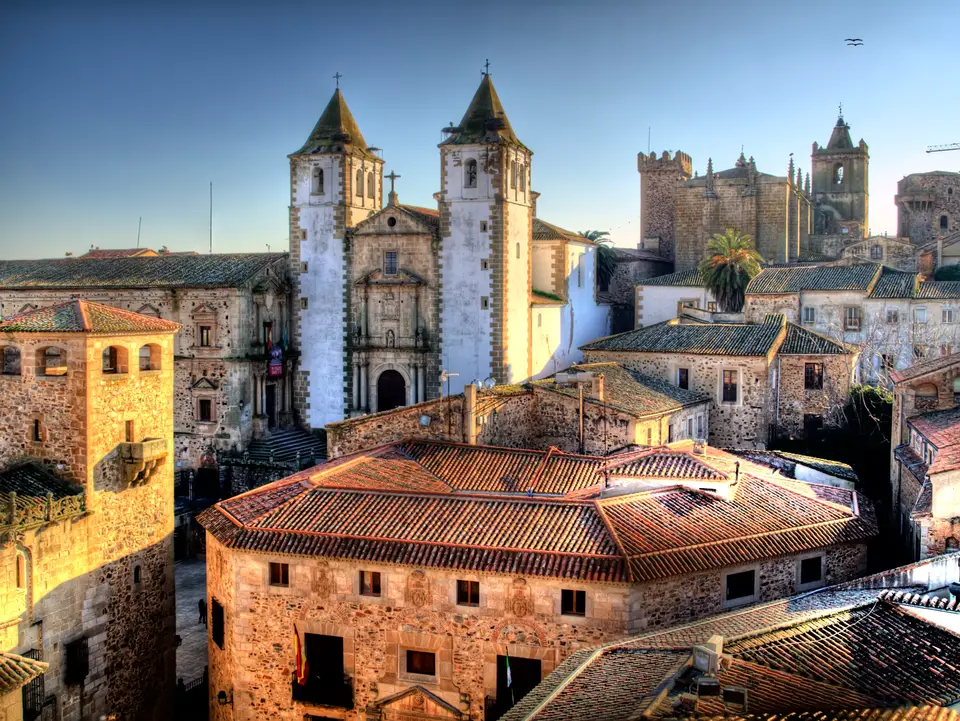
In the lower intramural parish of Santa María, the squares of Plaza de Santa María and Plaza de los Golfines are presided over by the 13th-century Gothic Concatedral of Santa María la Mayor and the Episcopal Palace (whose 1587 Renaissance facade hosted King Philip II in 1583). Around the square rise the 15th-century Carvajal Palace (with its round Reconquest tower, now housing the Diputación de Cáceres Tourist Board), the Palacio de Hernando de Ovando, the Mayoralgo Palace, the House of Moraga, the House of Golfin-Toledo, and the Lower Golfines Palace (Palace of the Golfines de Abajo), which combines a 15th-century fortress-house with 16th-century humanist ornament and displays the shields of the Catholic Monarchs and the Carvajal lineage (linked to the brothers sentenced in 1312 by King Ferdinand IV). Adjacent in the Plaza del Conde de Canilleros stands the Toledo-Moctezuma Palace (now the Provincial Historical Archive), uniting the shields of the Toledo, Carvajal, and Moctezuma families after Mariana de Carvajal y Toledo wed Juan de Toledo Moctezuma, whose lineage through Isabel de Moctezuma and her spouse Juan Cano de Saavedra traced back to Aztec ruler Moctezuma II Xocoyotzin.
In Spain, the centre of walled enclosure, the sloping Plaza de San Jorge is dominated by the Baroque 18th-century Jesuit Church of San Francisco Javier (Church of the Precious Blood, constructed between 1698 and 1755 with the fortune of the Figueroa family above an 18th-century cistern) alongside the College of the Company of Jesus, the Gothic House of the Becerra (now the Mercedes Calles and Carlos Ballestero Foundation), and the Garden of Cristina de Ulloa. Higher up in the San Mateo quarter, the 15th-century Gothic Church of San Mateo (built over the former mosque) and the Franciscan Convent of San Pablo face the 14th-century Palacio de los Golfines de Arriba (the Upper Golfines Palace, founded by García de Golfín with Isabel de la Cerda, where General Francisco Franco kept his headquarters for 38 days from 26 August 1936), the 15th-century Casa del Sol (with its 16-rayed sun shield of the Solís family), the House of the Eagle, the Tower of Sande, and the untruncated 1480 tower of the Palacio de las Ciguenas (Palace of the Storks). Beside them on the Plaza de las Veletas stands the 15th-century Veletas Palace (Palacio de las Veletas) and the 16th-century Casa de los Caballos, housing the Museum of Cáceres over the ancient Almohad fortress cistern: an underground rainwater reservoir roughly 15 metres long by 10 metres wide, divided into five vaulted naves by 16 horseshoe arches resting on 12 columns, some of Roman origin.
Walking the Extramuros Plaza Mayor, Intramuros Squares, and Jewish Quarters
Because the 9-hectare Monumental City preserves its medieval street layout without outward signs of modern traffic (a setting used in Season 7, episodes 3 and 5 of Game of Thrones), visitors can explore the entire ensemble on foot along its cobbled slopes and wall-side lanes.
- Entering from the Plaza Mayor through the Arco de la Estrella: Begin outside the walls in the arcaded 16th-century Plaza Mayor, near the 19th-century Town Hall and the 1750 Hermitage de la Paz; inspect the 12th-century Torre de Bujaco on the eastern flank, then walk up through the 18th-century Arco de la Estrella into the Plaza de Santa María to view the Concatedral alongside the Carvajal Palace, the Lower Golfines Palace, and the Toledo-Moctezuma Palace.
- Climbing through Plaza de San Jorge to San Mateo and Las Veletas: Ascend the central steps to the baroque Church of San Francisco Javier and the House of the Becerra in the Plaza de San Jorge, then continue into the upper squares of San Mateo and San Pablo to examine the untruncated tower of the Palace of the Storks, the House of the Sun, the Upper Golfines Palace, and the 14th-century Palace of the Marquis of Torreorgaz (Commander of Alcuéscar, serving since 1989 with the 15th-century Casa de los Ovando Perero as the Parador de Turismo de Cáceres) before descending into the Veletas Palace to see the 16-arch Almohad cistern.
- Tracing the Adarves and the Old Jewish Quarter to the Arco del Cristo: Follow the cobbled wall-side lanes known as the Adarves (named for Father Rosalío, Santa Ana, Estrella, Christ, and Bishop Álvarez de Castro) past the Arco de Santa Ana, the 15th-century Palacio de la Generala and Palace of Ribera (seat of the University of Extremadura rectorate), the 14th-century Gothic and Mudéjar Casa de Aldana, and the 15th-century Casa del Mono (housing the 30,000-volume Alonso Zamora Vicente Library); then wind through the Old Judería (San Antonio de la Quebrada) past the Ermita de San Antonio (erected over the former synagogue) and the House of the Rich Jew down Cuesta del Marqués to the 1st-century Roman Arco del Cristo.
Multidisciplinary Conservation and the Extremadura Heritage Landscape
Declared a Spanish Historic Ensemble on 21 January 1949 (RI-53-0000016) and inscribed on the UNESCO World Heritage List in 1986 with a 60.63-hectare buffer zone extension in 2016, the Old Town of Cáceres also encompasses notable monuments in the extramuros parishes of Santiago and San Juan, including the 13th- to 15th-century Gothic Church of San Juan Bautista, the 16th-century Convent of Santo Domingo, the 1548 Francisco de Godoy Palace (undergoing hotel renovation from 2023 to 2024), and the Church of Santiago de los Caballeros restored in the 16th century by master Rodrigo Gil de Hontañón. Travellers journeying north from Seville can compare Cáceres with other Iberian fortified cities in our UNESCO World Heritage Atlas.
