


























Quick Field Data
- UNESCO Inscription: 1981 · Criteria (vii), (x)
- Scale & Footprint: 16,000 hectares (160 square kilometres) of deltaic wetlands alongside lakes, ponds, and sandbanks along the southeastern shore of the Senegal River in northern Senegal
- Access & Ticketing: Managed under national park legislation where commercial resource exploitation is prohibited; visitor entry operates through park gates and licensed pirogue boat excursions along the main channels and pelican nesting colonies
- Arrival Logistics: Located in northern Biffeche northeast of the coastal city of St-Louis in northwestern Senegal, accessible by road from St-Louis with onward regional connections to Dakar
The Post-Sahara Freshwater Oasis in the Senegal River Delta
Protected in Senegal as a national park on 14 April 1971 alongside its designation as a Ramsar wetland of international importance (Site No. 138) on 11 July 1977 and World Heritage inscription in 1981 during the 5th session, the Djoudj National Bird Sanctuary (Parc national des oiseaux du Djoudj) covers 16,000 hectares (160 square kilometres) in the Senegal River delta. Situated in northern Biffeche along the southeastern shore of the Senegal River northeast of St-Louis, the park forms a fragile freshwater oasis surrounded by the arid Sahelian desert margin. Within its 16,000-hectare footprint, a large central shallow lake is encircled by a braided network of streams alongside ponds plus backwaters, shallow fords, and exposed sandbanks that flood and recede with the seasonal pulse of the river. Water sustains every arrival here.
What gives Djoudj its global ornithological importance is its exact geographic position at the southern edge of the Sahara desert. For millions of Palaearctic and Afrotropical waterbirds flying south from Europe and western Asia each autumn, the Senegal River delta represents the very first permanent freshwater wetland and feeding ground encountered after crossing the hyper-arid expanse of the Sahara. Exhausted migratory flocks descend onto the park's shallow lagoons and mudflats to replenish fat reserves and overwinter across the dry season, turning this chain of lakes alongside backwaters, fords, and sandbanks into a dense biological refuge in the desert.
Across the reserve, ornithological surveys have recorded between 365 and 395 (almost 400) species of birds, including more than 120 species of Palaearctic migrants. Depending on seasonal water levels, between 1.5 million and nearly three million individual birds congregate inside the 16,000-hectare sanctuary, ranking the Djoudj National Bird Park as the world's 3rd largest ornithological reserve. Beyond the massive flocks of waterbirds, the deltaic channels and reedbeds shelter large populations of aquatic reptiles and mammals, including crocodiles and West African manatees that depend on the park's quiet backwaters and seasonal flood channels throughout the dry months.
White Pelican Colonies alongside Aquatic Warblers and the Diama Dam Crisis
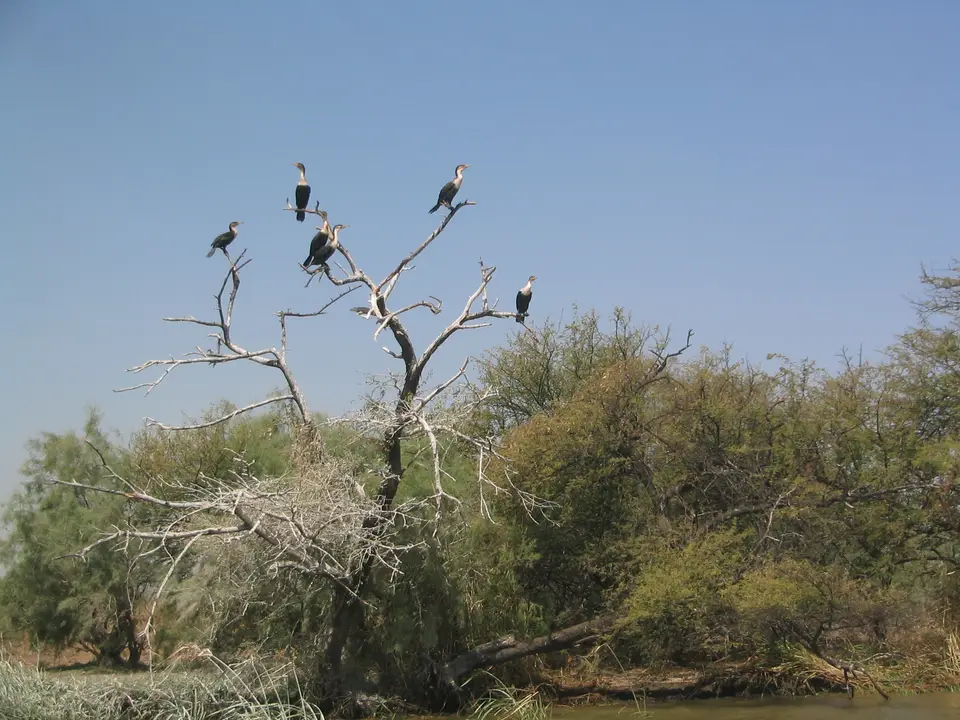
Among the nearly 400 recorded bird species in the sanctuary, six resident and migratory waterbirds anchor the park's breeding colonies: the white pelican (Pelecanus onocrotalus) and the purple heron (Ardea purpurea) alongside great egrets (Casmerodius albus) plus African spoonbills (Platalea alba), night herons (Nycticorax nycticorax), and cormorants (Phalacrocorax carbo), joined by large seasonal flocks of flamingos. To counter bank erosion and upgrade conditions for migration reception across the central lagoons, park engineers built nest boxes and artificial sandbank improvements that are renovated annually. With this annual renovation of nesting infrastructure and active control of the hydraulic system, both migratory numbers and breeding colonies of white pelicans and wading birds have expanded across the protected islands and sandbanks.
While the thousands of nesting white pelicans and wading flamingos are the most visually striking residents on the open water, the vegetated marsh margins harbour one of the rarest songbirds migrating from Europe: the globally threatened aquatic warbler. As confirmed by a February 2007 BirdLife International expedition, the wet sedge and grass habitats of Djoudj constitute the primary global wintering refuge yet discovered for the European aquatic warbler population, which crosses the Sahara each autumn to spend the northern winter hidden in the delta's low emergent vegetation. Protecting these wet sedge margins alongside the open pelican lagoons requires continuous water-level regulation across the entire 160-square-kilometre wetland sanctuary so that neither drought nor reed encroachment eliminates the shallow foraging zones required by wintering songbirds and wading waterbirds across northern Senegal and the Senegal River delta.
Despite its protected status under national laws where commercial resource extraction is prohibited outside scientific research, the sanctuary's hydrological balance has twice pushed Djoudj onto the List of World Heritage in Danger, first during the period from 1984 to 1988 and again from 2000 to 2006. These ecological crises demonstrate how sensitive deltaic wetlands in northern Senegal are to river engineering along the lower Senegal River basin. When the Diama Dam was constructed downstream on the Senegal River and began operating in 1988 to control river flow, it severely disrupted the natural water balance alongside the flood amplitude plus the salinity cycle and sediment flushing of the Djoudj basin. Orbital images captured by NASA during 1979 prior to the building of the Diama Dam and again in 1999 (after a decade of dam operation) provided stark visual evidence of the ecological impact across the delta: a marked lowering of water levels alongside reduced amplitude of seasonal floods plus channel silting and desalinisation of the wetland lagoons.
Deprived of the natural seasonal flush of brackish water and dry-season drawdowns that previously kept freshwater weeds in check, the park's channels experienced an explosive proliferation of invasive aquatic plants. Floating mats of giant salvinia (Lavinia molesta) and water lettuce (Pistia stratoites) threatened to choke out native vegetation and blanket open water surfaces, while dense stands of reedmace (Typha australis) and common reeds (Phragmites) encroached across the shallow mudflats and sandbanks, leading to the decrease or disappearance of several bird colonies. Through sustained hydraulic management alongside annual clearing of invasive Typha and Phragmites reeds, biological control of giant salvinia, a development and management plan, and a dedicated avian flu monitoring programme put into effect in 2006 (even though no cases of avian flu were reported in Senegal), park authorities restored open-water habitats and secured the sanctuary's removal from the World Heritage in Danger list in 2006.
Navigating the Pirogue Channels and Pelican Islands Today
Because Djoudj functions primarily as a winter refuge for trans-Saharan migrants and a seasonal breeding ground tied to the hydraulic cycle of the Senegal River delta, the physical landscape changes dramatically between the wet summer rains and the dry winter months. Visiting the 16,000-hectare sanctuary centres on quiet boat excursions along the main waterways and elevated observation towers overlooking the shallow lagoons alongside fords and sandbank rookeries where white pelicans and cormorants nest in dense concentrations across the delta.
Plan your ornithological field visit around the Palaearctic migration window and delta navigation routes.
- Approach from St-Louis and board a shallow-draft pirogue: Travel northeast from the historic coastal city of St-Louis into northern Biffeche to enter the sanctuary gate near the southeastern shore of the Senegal River. Once inside the 160-square-kilometre reserve, the primary way to inspect the white pelican (Pelecanus onocrotalus) nesting islands alongside the cormorant (Phalacrocorax carbo) roosts and crocodile sandbanks is aboard a shallow-draft wooden boat guided by park rangers along the main creek channels and backwaters where manatees also swim.
- Scan the reedbeds and mudflats from the observation towers: Combine boat excursions with stops at the wooden watchtowers positioned along the perimeter tracks overlooking the central lake alongside ponds and shallow fords. Bring high-magnification binoculars or a spotting scope to distinguish purple herons (Ardea purpurea) alongside African spoonbills (Platalea alba), great egrets (Casmerodius albus), and night herons (Nycticorax nycticorax) wading in the shallows, while scanning the low sedge margins where European aquatic warblers winter between the Typha australis and Phragmites reeds.
- Visit during the dry winter migration window and connect to Dakar: Schedule your trip during the northern winter dry season when more than 1.5 million Palaearctic and Afrotropical migrants of 365 to 395 species have arrived across the Sahara and pelican breeding activity is at its height across the artificial nest boxes and sandbanks. From St-Louis and the Senegal River delta, travellers can connect southward to our closest city guide in Dakar or compare neighbouring Diawling National Park and other West African wetlands in our UNESCO World Heritage Atlas.
