Quick Field Data
- UNESCO Inscription: Reference 784, inscribed in 1996 as a Cultural World Heritage Site under criteria (ii) and (iv).
- Scale & Footprint: Covers 236 hectares on both banks of the River Salzach, framed by the Mönchsberg, Nonnberg, and Kapuzinerberg hills beneath the 1,972-metre Untersberg peak 16 km away.
- Access & Ticketing: Old town streets, Getreidegasse, Domplatz, Mirabell Gardens, and Nonnberg Abbey grounds are open public spaces; Hohensalzburg Fortress, the funicular railway, and palace museums operate via admission tickets. Check official monument websites before visiting.
- Arrival Logistics: Salzburg Airport (SZG) sits just 3 km west of the historic centre, with Munich Airport (MUC, 112 km northwest) serving as the major intercontinental alternative. Pair local walks with our Salzburg destination guide (1 km).
Roman Iuvavum, Salt Tolls, and the Prince-Archbishops' Domain
Long before Baroque domes crowned its skyline, Salzburg functioned as an Alpine river stronghold built on salt wealth. Continuous settlement dates back to the Neolithic Age and the Celtic La Tène period, when the area formed an administrative centre for the Taurisci inside the Kingdom of Noricum. After Roman troops occupied the basin in 15 BC, they abandoned surrounding hilltops to build Municipium Claudium Iuvavum on the valley floor, receiving municipal rank in 45 AD. Following Noricum's collapse in 488 AD at the start of the migration period, part of the Romano-Celtic population stayed under Baiuvarii rule. Around 696 AD, Duke Theodo II of Bavaria granted Bishop Rupert the remains of Iuvavum, an upper castle (castrum superius) on the Nonnberg terrace, and the manor of Piding. Bishop Rupert founded St Peter's church and monastery on the valley floor as well as a Benedictine nunnery at Nonnberg for his relative Erentrude.
Salzburg became a diocesan bishopric in 739 AD, when Willibald's report on Bavarian dioceses recorded the German name Salzburg after salt-carrying barges taxed along the River Salzach. The name combined Salz with an older Germanic word for settlement rather than fortress, and the see rose to an archbishopric in 798 AD under Archbishop Virgil's first cathedral. In 996 Holy Roman Emperor Otto III granted Archbishop Hartwig market and minting rights, while salt extraction, trade, and gold mining financed independence from Bavaria. In 1077 Archbishop Gebhard founded Hohensalzburg Fortress on an adjacent Roman fort site (distinct from the Nonnberg fort). Later rulers endured a three-month siege there during the 1525 German Peasants' War before suppressing the revolt.
Governing as a sovereign prince-bishopric of the Holy Roman Empire (and joining the Bavarian Circle after the Imperial reform of 1500), Salzburg's archbishops shaped both politics and religion until Napoleonic secularisation in 1803. Confessional intolerance marked 31 October 1731 (the 214th anniversary of the 95 Theses) when Archbishop Leopold Anton von Firmian issued the Emigrationspatent, expelling 21,475 Protestant citizens. Most were welcomed into East Prussia by King Friedrich Wilhelm the First, while others reached Protestant European states and British North American colonies. Decades later under reformist Archbishop Hieronymus Graf von Colloredo (1772 to 1803), Salzburg became a centre of late Illuminism. Friction ended court composer Wolfgang Amadeus Mozart's employment in 1781, when he left for Vienna while his father Leopold stayed behind. By contrast, after municipal absorptions in 1935 and post-war refugee housing, the city grew past 100,000 inhabitants around 1950 and crossed 150,000 in 2016.
Vincenzo Scamozzi, Santino Solari, and Baroque Urban Renewal
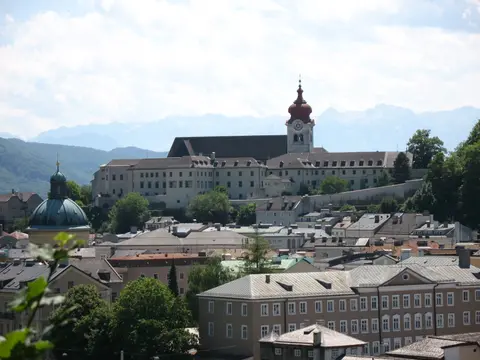
Most ecclesiastical principalities of the Holy Roman Empire disappeared as independent states after secularisation in 1803. Napoleon transferred Salzburg first to Grand Duke Ferdinando III of Tuscany, then briefly to Austria with Berchtesgaden in 1805, and to Bavaria in 1809 after Wagram. It returned definitively to Austria under the 1816 Treaty of Munich (without Rupertigau and Berchtesgaden), becoming capital of the Duchy of Salzburg in 1850 and later part of Austria-Hungary in 1866. Through those shifts, the Renaissance and Baroque townscape remained unusually intact. Transformation had begun under Prince-Archbishop Wolf Dietrich von Raitenau, who commissioned Italian architect Vincenzo Scamozzi to replace cramped medieval alleys with broad axial squares. When Scamozzi's vast cathedral plan failed upon Raitenau's fall, Markus Sittikus hired Italian master Santino Solari. Solari's second cathedral rose as Salzburg's flagship early Baroque monument and shaped churches across Austria and southern Germany.
Markus Sittikus and Paris von Lodron extended rebuilding with Hellbrunn Palace, the Residence, university halls, and bastion fortifications. Later commissions brought Giovanni Antonio Daria's Residenz fountain, Giovanni Gaspare Zuccalli's Erhard and Kajetan churches, and major designs by Austrian master Johann Bernhard Fischer von Erlach under Johann Ernst von Thun. Expansion then paused (explaining why Salzburg lacks Rococo churches), save for works such as the Sigmundstor tunnel and the Domplatz Marian statue under Sigismund von Schrattenbach. Later Gründerzeit builders Jakob Ceconi and Carl Freiherr von Schwarz expanded residential streets, while Romantic-era tourism inspired the 1892 Hohensalzburg funicular.
Twentieth-century turmoil tested the historic centre severely. Following the 1918 to 1919 transition into the First Austrian Republic, Nazi Germany annexed Salzburg on 12 March 1938, destroying the synagogue and operating a Romani forced-labour camp in Maxglan plus five Dachau subcamps. Fifteen Allied air strikes destroyed 7,600 houses (46 per cent of city buildings, heavily around the railway station) and killed 550 inhabitants. The raids also collapsed the cathedral dome and bridges before US forces entered on 5 May 1945. After Austria signed its 1955 independence and neutrality treaty, reconstruction protected the Baroque townscape. Modern works include Clemens Holzmeister's 1960 Großes Festspielhaus, the 1964 Lepi public baths, Linzergasse 22, the 2001 Makartsteg footbridge, and the 2001 Congress House. Later works include Robert Rechenauer's Mozarteum, the 2010 award-winning Lechner house, the 2011 Unipark Nonntal, and Hangar-7 near Salzburg Airport. All contemporary additions remain regulated under federal, provincial, and municipal laws and the 2008 to 2009 Management Plan.
Ecclesiastical Courts Versus Narrow Burgher Market Streets
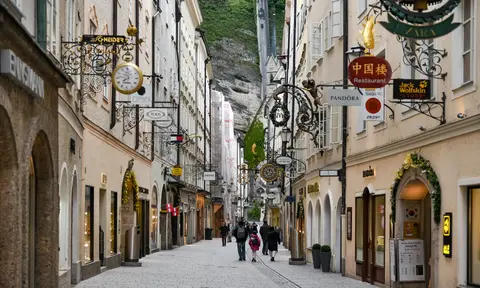
Walking across the 236-hectare Altstadt reveals the constitutional split of a prince-archbishopric right on the ground. On the left bank between the River Salzach and Mönchsberg cliff lies the monumental spiritual enclave already extensive in medieval centuries. Its centrepiece is the Cathedral, where Conrad of Wittelsbach had raised the largest Romanesque basilica north of the Alps before Baroque rebuilding. Nearby sit the Prince-Archbishops' Residence and St Peter's Abbey with its late-Gothic Margaret Chapel. The enclave also includes the Franciscan Church (rooted in the early ninth century with a Gothic choir begun by Hans von Burghausen and finished by Stephan Krumenauer) and the 1139 Marienkirche. Completing the precinct are the former Frauengarten women's convent area dissolved in 1583 and wide ceremonial plazas led by Domplatz.
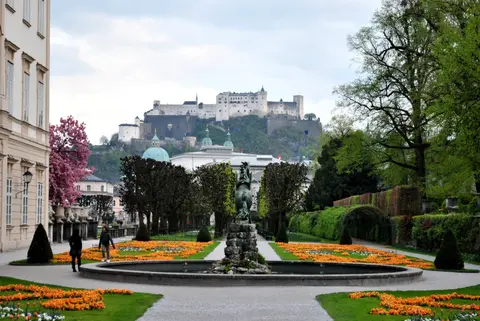
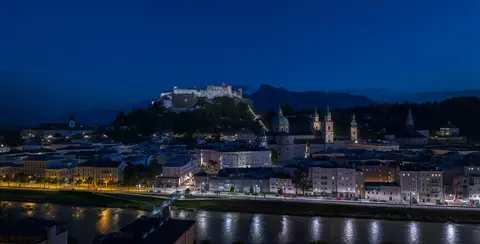
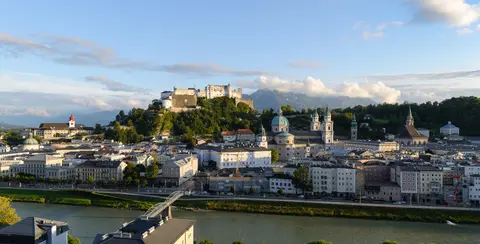
Immediately north of this church precinct stretches the secular burgher town, governed by a city judge by 1120. It spread from the twelfth century along Getreidegasse, Sigmund-Haffner-Gasse (former Abtsgasse), and the river quay before city fortifications arose around 1280 and the oldest municipal law code was written in 1287. Here merchants crowded onto small plots facing narrow alleys, leaving open space only at three compact markets. Above both quarters stand Nonnberg Abbey on its eastern terrace and Hohensalzburg Fortress, whose late-Gothic Hoher Stock state rooms and St George's Chapel crown the hilltop. Maintaining visual coherence across both riverbanks and surrounding green hills (Mönchsberg and Kapuzinerberg) remains delicate because inappropriate contemporary additions in the buffer zone can disrupt the Baroque skyline. Local authorities combine consensual management with property owners and cultural societies, funding through the Federal State and the Historic Centre Maintenance Fund, and strict visual-impact screening under the 2008 to 2009 heritage plan.
Today's city also balances its monumental past with three universities, a large student population, and diverse German, Bosnian, Serbian, and Romanian resident communities, ensuring the medieval alleys remain lived-in neighbourhoods rather than empty stage sets.
Old Town Landmarks and Hilltop Access Zones
Compact distances across the left and right banks allow visitors to link open squares and monastic lanes with ticketed palaces and hilltop monuments on foot, supported by municipal and Historic Centre Maintenance Fund preservation.
| Complex Zone | Key Highlights | Access & Ticket Rule |
|---|---|---|
| Hohensalzburg Fortress & Mönchsberg | 1077 archiepiscopal citadel, late-Gothic Hoher Stock halls, St George's Chapel, 1892 funicular | Exterior cliff paths are open public trails; fortress courtyards, museums, and funicular travel require admission tickets. |
| Cathedral Quarter (Domplatz & St Peter's) | Santino Solari's Baroque Cathedral, Residenz palace, Franciscan Church, and St Peter's Abbey | Domplatz, abbey courtyards, and church naves welcome visitors; state rooms and museum wings operate on ticketed entry. |
| Nonnberg Terrace & Southern Monastic Edge | Nonnberg Benedictine Abbey (founded around 696 AD), late-Gothic stonework, and views over Nonntal | Abbey forecourt and hillside approach paths are open on foot; respect monastic enclosure rules and liturgical schedules. |
| Burgher Altstadt (Getreidegasse & Markets) | Twelfth-century merchant lanes, wrought-iron guild signs, Mozart birthplace house, three historic market squares | Public streets and market plazas are permanently open-access; indoor house museums sell timed or standard tickets. |
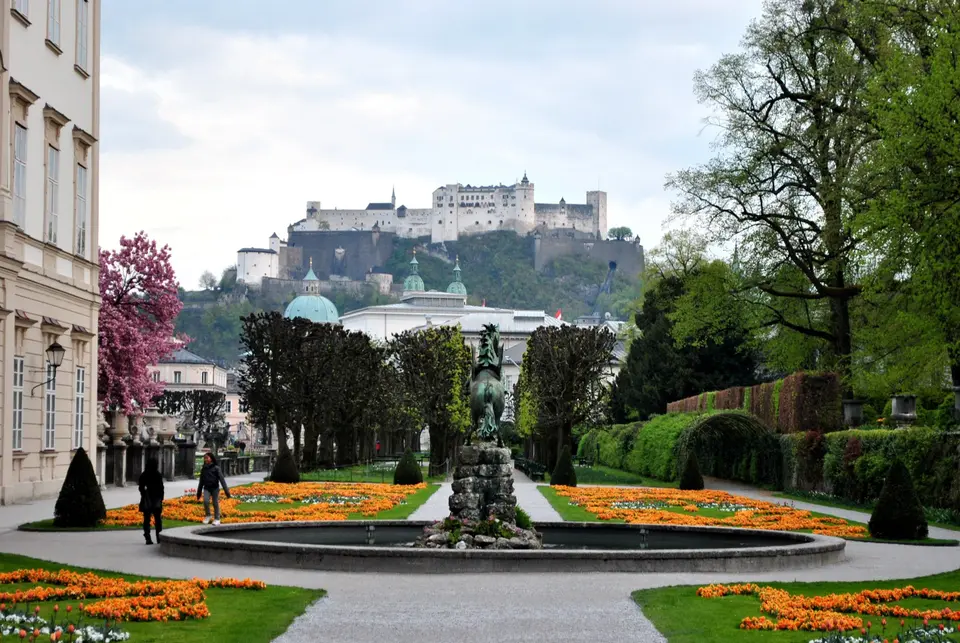
| Right Bank & Mirabell Enclave | Linzergasse, Mirabell Gardens, Mozarteum, Makartsteg footbridge, and Kapuzinerberg slopes | Gardens, footbridges, and hillside viewpoints are free to enter; check official festival listings for concert hall bookings. |
Inspecting Salzburg's Towers, Stonework, and Funicular Engineering
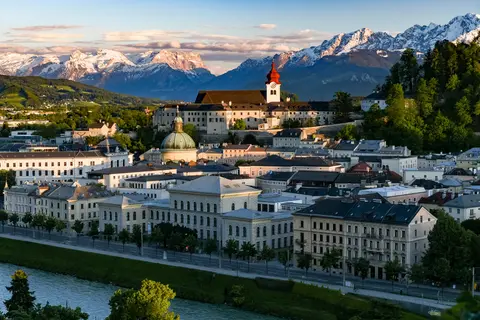
Looking closely at street level clarifies how medieval guilds, Baroque planners, and nineteenth-century engineers layered this compact river basin between Mönchsberg and Kapuzinerberg.
- Prince-Bishopric Plot Boundaries: Walk directly from the wide limestone expanse of Domplatz into the tight vertical corridor of Getreidegasse to observe the abrupt shift from archiepiscopal ceremonial courts to narrow medieval merchant house fronts and wrought-iron shop signs.
- Late-Gothic Vaulting Before Baroque Renewal: Inside the Franciscan Church choir behind the Baroque nave, examine Hans von Burghausen and Stephan Krumenauer's soaring Gothic ribs next to the Hoher Stock halls inside Hohensalzburg Fortress, witnessing what stood before Santino Solari arrived.
- Historic and Modern Mountain Transit: Compare the 1892 funicular incline hauling visitors up Hohensalzburg's steep cliff with the eighteenth-century Sigmundstor tunnel cut cleanly through the Mönchsberg rock face.
Planning Salzburg Around Rainfall, Festivals, and City Walks
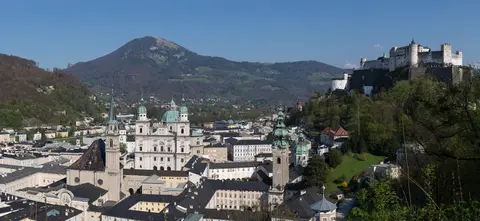
Salzburg sits at the northern rim of the Alps roughly 150 km east of Munich, 281 km northwest of Ljubljana, and 300 km west of Vienna. Public transport links stretch across the nearby German border toward Freilassing, Ainring, and Piding. Today's city of 157,994 residents (2026) experiences cool winters averaging 0.0 °C in January and warm summers averaging 19.6 °C in July. Conditions bring steady summer drizzle locally called Schnürlregen and brisk southerly foehn winds that rapidly thaw winter snow, while climate warming has gradually reduced snow frequency toward oceanic averages. Early morning walks across the Makartsteg footbridge and up to Nonnberg Abbey catch clear views before crowds enter Getreidegasse. Living musical heritage spans summer performances around the Großes Festspielhaus and film-location heritage from the 1960s musical The Sound of Music. Special commemorative events, such as 27 January 2006 when all 35 Salzburg churches rang their bells for Mozart's 250th birth anniversary, are monitored by city experts and the Federal Office for Protection of Monuments. Because the inscribed historic core covers a compact footprint between riverbanks and twin hills, linking cathedral courts, market alleys, and cliff paths requires no car. Walking leaves time to climb Mönchsberg or Kapuzinerberg for views across the entire Baroque skyline and Untersberg backdrop.
Link your walk from Salzburg Airport (3 km) or Munich (112 km) with neighbourhood routes and dining notes in our Salzburg city guide, and explore sibling Baroque and medieval towns across the UNESCO World Heritage Atlas. Balancing early morning steps along Domplatz and Getreidegasse with afternoon walks across the Salzach toward Mirabell Gardens keeps the contrast between ecclesiastical power and merchant streets sharp.