Quick Field Data
- UNESCO Inscription: 2021 (Ref. 1613), uniting eleven component towns across Austria, Belgium, Czechia, France, Germany, Italy and the United Kingdom; Criteria (ii) and (iii)
- Scale & Footprint: 7,018 hectares combined across eleven urban spa quarters, thermal catchment valleys and landscaped woodland hills
- Access & Ticketing: Outdoor promenades, manicured spa parks and many mineral-drinking colonnades open freely; Roman archaeological complexes, grand bathhouses, historic pump rooms and theatres operate local entry ticketing or timed bathing bookings
- Arrival Logistics: Near the southwestern German axis around Baden-Baden, Stuttgart Airport (STR) sits 46 kilometres from the regional reference centre and Frankfurt Airport (FRA) lies 112 kilometres north. Karlovy Vary Airport lies 4.5 kilometres southeast of the Bohemian resort, while Bath sits 18 kilometres southeast of Bristol and 156 kilometres west of London.
Eleven Mineral Resorts Built Around a Single Urban Blueprint
The Great Spa Towns of Europe was inscribed on 24 July 2021 following an international nomination launched in 2012 and submitted in 2019. It links eleven towns across seven states that defined European thermal culture from roughly 1700 to the 1930s. The transnational series builds on the earlier 1987 recognition of the City of Bath in the United Kingdom. It gathers Baden bei Wien in Austria, Spa in Belgium, Františkovy Lázně, Karlovy Vary and Mariánské Lázně in Czechia, Vichy in France, Bad Ems, Baden-Baden and Bad Kissingen in Germany, and Montecatini Terme in Italy.
Each resort sprang directly from natural mineral water sources whose chemistry shaped an entire municipal plan. Doctors prescribed rigid daily regimens called taking the cure, pairing external immersion in bathhouses with internal drinking and inhalation inside covered colonnades, pump rooms and Trinkhalle drinking halls. Because wealthy patients stayed for weeks, architects and landscape gardeners ringed the springs with kurhaus and kursaal therapy halls, grand hotels, private villas, assembly rooms, theatres and casinos where visitors met to see and be seen. Water piping, saltworks, railways, steep funiculars and graded forest trails stitched built streets smoothly into wooded hills, turning brisk outdoor walks between glasses of spring water into formal medical therapy.
Bath: From Aquae Sulis to Georgian Limestone Crescents
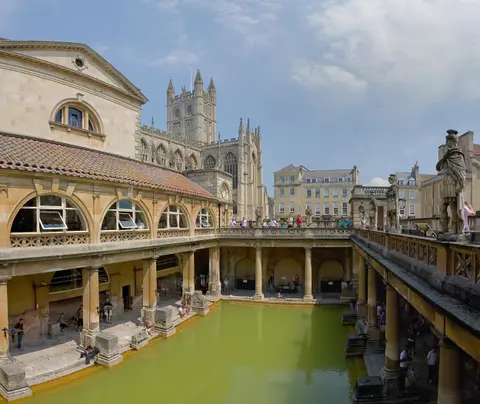
At the western edge of the serial network, Bath in Somerset illustrates the deepest chronological roots of European thermal urbanism across hills such as Bathampton Down. Mesolithic traces, Bronze Age round barrows and the Iron Age hill fort of Solsbury Hill frame the River Avon valley. Long before Roman troops arrived, Iron Age Britons revered the hot springs as a sacred sanctuary dedicated to the Celtic water deity Sulis, later equated with Roman Minerva. Devotees cast Latin curse tablets scratched onto metal sheets into the steaming pool. Around 60 to 70 AD, Roman engineers transformed the site into Aquae Sulis, driving oak piles into valley mud to anchor an irregular lead-lined stone spring reservoir. Over three centuries of expansion, builders enclosed the hot spring inside a wooden barrel-vaulted hall housing a hot caldarium, warm tepidarium and cold frigidarium, surrounded by third-century defensive walls. In March 2012 archaeologists uncovered a hoard of 30,000 Roman silver coins just 150 metres from the baths.
After Roman rule ended and silting buried the vaults, Anglo-Saxon chroniclers recalled the hot pools as Hat Bathu and Acemannesceastre. The baths appear vividly in the Old English poem The Ruin and descriptions by ninth-century historian Nennius and Bede. King Offa of Mercia rebuilt St Peter's church in 781, and King Alfred laid out defensive walls of 1,375 yards (1,257 metres) manned by 1,000 defenders in the Burghal Hidage. King Edgar's 973 coronation in Bath Abbey established the ritual template for future English coronations. Following the sacking of 1088, royal physician John of Tours became bishop, enlarged the abbey church and built new baths around the three springs. Around 1180, Bishop Reginald Fitz Jocelin founded St John's Hospital beside the Cross Bath for the poor infirm. Bishop Oliver King rebuilt the abbey on a smaller scale in 1500 shortly before Henry VIII dissolved Bath Priory in 1539. Bath's resort trade revived through Queen Elizabeth's 1590 charter, Bishop James Montagu's post-1608 restoration campaign (conscious that the town lived wholly by its waters), and royal visits by Queen Anne in 1613 and 1615. Even during the English Civil War from 1642 onward, including royalist control from the July 1643 Battle of Lansdowne until 1645, piped hill water spared Bath from the bubonic plague that struck Bristol and Gloucester. That resilience left the city ready for Thomas Guidott's 1676 medical treatise on its springs.
Eighteenth-century Bath turned spa life into monumental neoclassical theatre. Master of ceremonies Beau Nash governed social etiquette from 1705 until 1761 across the Assembly Rooms and Grand Pump Room. Architects John Wood the Elder and John Wood the Younger orchestrated palatial streets and curved terraces such as the Royal Crescent and the Circus. Much of their warm golden limestone came from Ralph Allen's Combe Down and Bathampton Down quarries, advertised visually by Allen's own Prior Park estate above the valley. Modern Bath retains a dense cultural landscape spanning the Theatre Royal, Victoria Art Gallery, Museum of Bath Architecture, Herschel Museum of Astronomy, Fashion Museum, and Holburne Museum. Green open spaces and civic institutions include Royal Victoria Park, Parade Gardens, Sydney Gardens and two universities. Rebuilding steadily through the nineteenth century and after the Second World War Bath Blitz, the living city recorded 94,080 inhabitants in the 2021 census and welcomed over six million visitors annually as of 2019.
Karlovy Vary and the West Bohemian Thermal Valley
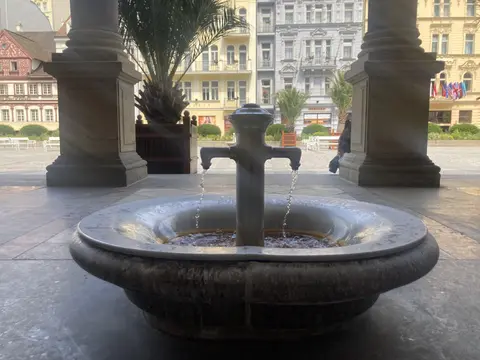
Where Bath embodies Roman continuity and eighteenth-century crescent planning, Karlovy Vary in western Bohemia captures the grand nineteenth-century Central European kurhaus era. The town lies 106 kilometres west of Prague where the Ohře, Teplá and Rolava rivers meet below the 642-metre hill Vítkův vrch between the flat Sokolov Basin and the wooded Slavkov Forest. Here it taps the deep tectonic fault of the Eger Graben across an infiltration basin covering several hundred square kilometres. More than 80 thermal springs rise across the valley, 16 channelled into public drinking fountains, delivering roughly 2,000 litres of mineralised water per minute with identical chemical composition despite wide surface temperature differences. Coolest outflows fall below 40 degrees Celsius, whereas the main geyser Vřídlo climbs up to 73.4 degrees Celsius (164.1 degrees Fahrenheit), making it the hottest thermal spring in Czechia. Its continental valley climate averages 7.4 degrees Celsius annually, shifting from minus 1.8 degrees in January to 17.2 degrees in July. Yearly precipitation totals 568.4 millimetres, peaking in June at 71.1 millimetres while February stays driest at 27.8 millimetres.
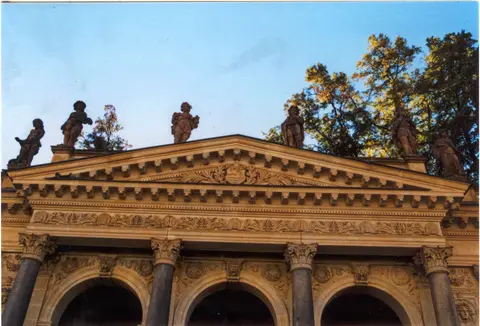
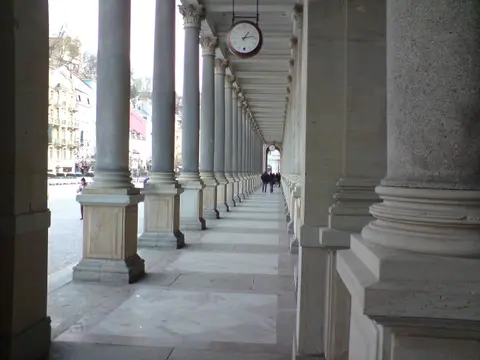
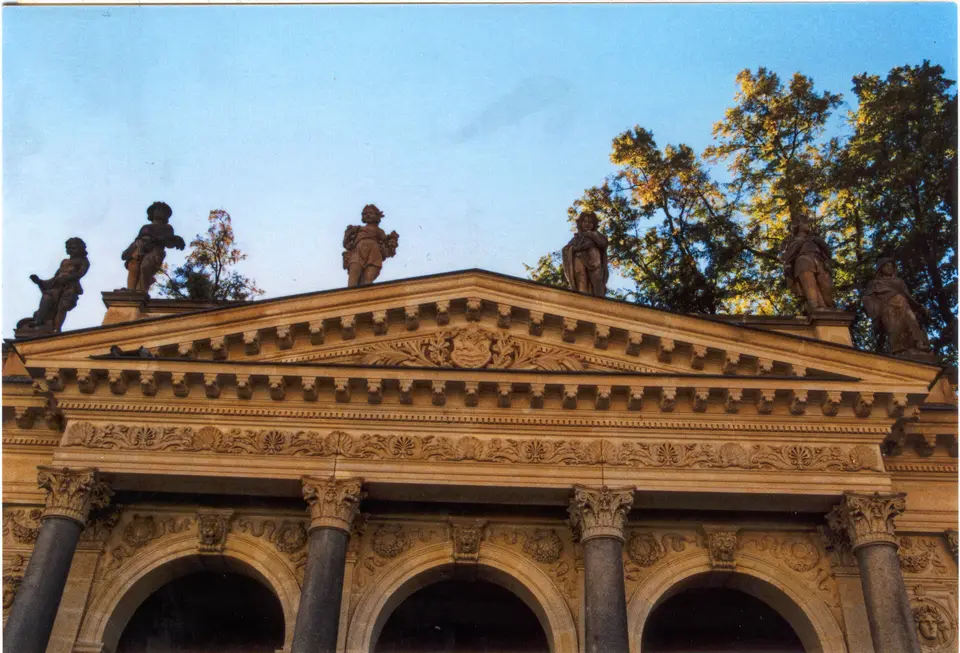
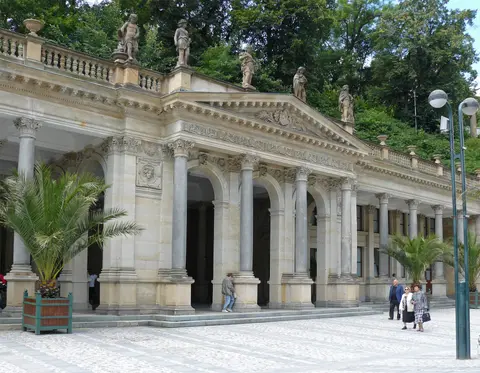
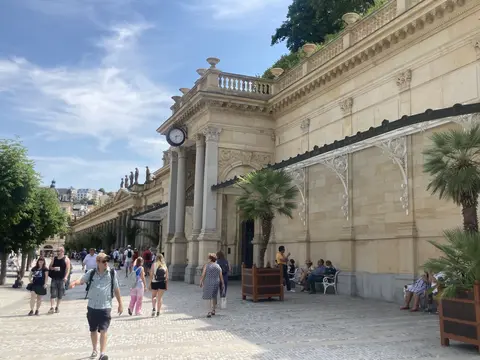
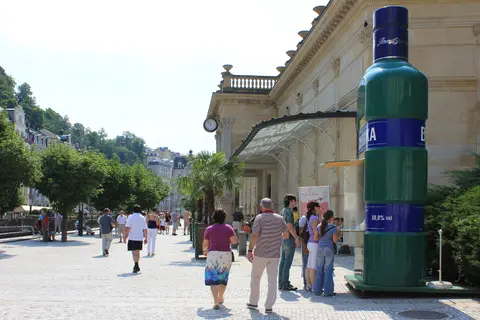
Holy Roman Emperor Charles IV established the settlement around 1349 near the older 1325 village of Obora and earlier Slavic and late Bronze Age settlements in Tašovice, Sedlec and Drahovice. He granted town privileges on 14 August 1370 after legend credited a hot spring with healing his injured leg, naming the resort Karlsbad (Charles' Baths). Metternich convened German Confederation ministers here in 1819 to enact the Carlsbad Decrees imposing anti-liberal censorship. Meanwhile, physicians David Becher and Josef von Löschner codified drinking cures that raised annual attendance from 134 families in 1756 to 26,000 guests by the late nineteenth century. Once the Prague to Cheb railway opened in 1870, attendance peaked at 70,956 cure guests in 1911 before the First World War halted aristocratic travel. Interwar tensions following the 1919 Treaty of Saint-Germain-en-Laye and the 1930 census of 23,901 residents gave way to 1938 Munich Agreement annexation and post-war population expulsions. After the 1989 Velvet Revolution restored international spa life across its 15 municipal parts, the city grew to 48,788 residents in 2026 within a 138,000-person agglomeration, with 13.0 percent foreign-born residents in the 2021 census. Protected since 2018 as an urban monument reservation, Karlovy Vary connects today via the D6 motorway, České dráhy and Deutsche Bahn rail corridors, local buses and the Imperial and Diana ridge funiculars. Architectural highlights include the French Neo-Renaissance Císařské lázně (Imperial Baths), the neoclassical Mill Colonnade, Grandhotel Pupp (featured in Last Holiday and Casino Royale), and Palace Bristol (which inspired The Grand Budapest Hotel). Living spa traditions pair Mattoni 1873 mineral water bottling and the Karlovy Vary International Film Festival with Becherovka herbal liqueur since 1807, Moser glass since 1857 and Karlovarské oplatky wafers since 1867.
Access Zones Across the European Spa Circuit
| Complex Zone | Key Highlights | Access & Ticket Rule |
|---|---|---|
| Drinking Colonnades & Pump Rooms | Covered stone and cast-iron galleries such as Karlovy Vary's Mill Colonnade and Bath's Grand Pump Room | Most outdoor continental colonnades open freely; museum pump rooms require entry tickets or restaurant seating |
| Historic Bathhouses & Roman Ruins | Roman spring chamber in Bath, Císařské lázně in Karlovy Vary, Friedrichsbad in Baden-Baden and municipal bath halls | Ticketed archaeological museums or pre-booked bathing slots governed by local hygiene regulations |
| Assembly Rooms, Theatres & Casinos | Social palaces framing spa promenades across Baden-Baden, Vichy, Spa, Bad Ems, Bad Kissingen and Bath | Guided architectural visits, concert tickets or casino entry rules apply depending on the house |
| Woodland Trails & Funicular Slopes | Engineered terrain-cure exercise paths, Teplá valley overlooks and Karlovy Vary's Imperial and Diana funiculars | Parks and hillside paths remain open without fees; funiculars and cable cars sell point-to-point fares |
Each of the eleven municipalities retains its own conservation rules, site manager and local management plan under an overarching Property Management Plan. Coordination passes through the Great Spas Management Board of eleven mayors, an Inter-Governmental Committee, a Site Managers Group and a jointly funded international Secretariat. Extensive historical archives of building plans, photographs and patient records guide authentic restorations across every component town. Managers must balance modern hygiene and spa-technology upgrades against historic building fabric, protect mineral spring catchment zones, manage visitor crowding and keep scenic views open between valley colonnades and surrounding wooded ridges.
Three Spa Architecture Features to Observe in Person
- Lead-Lined Roman Spring Tank Beneath Bath: Look past the Georgian colonnades around the Great Bath to spot the irregular Roman stone reservoir supported on oak piles driven into valley mud and sheeted in original Roman lead.
- Open-Air Vapour Galleries Along the Teplá River: Walk beneath the Corinthian columns of Karlovy Vary's Mill Colonnade to see how nineteenth-century architects designed high sheltered walkways allowing visitors to sip 40 to 73.4 degree Celsius mineral waters through rain and snow.
- Hillside Funicular Connections From Springs to Woodland: Steep rail cables such as Karlovy Vary's Imperial tunnel funicular and the Diana ridge funicular bridge the narrow Teplá river valley floor directly up to panoramic woodland exercise routes. These hillside climbs were prescribed as part of the daily cure, tying urban colonnades directly to forested slopes just as Prior Park crowns Bath's Georgian quarries.
Combining Multiple Spa Towns and Pairing Stuttgart
The eleven World Heritage resorts span seven countries from Somerset to Tuscany, reflecting successive phases from early eighteenth-century English elegance through nineteenth-century model spa planning to early twentieth-century international resorts. Focus an individual trip on one regional cluster rather than racing across Europe. Travellers visiting southwestern Germany can anchor in Stuttgart, situated 36 kilometres from the regional reference point, to explore Baden-Baden, Bad Ems and Bad Kissingen, where historic kurhaus halls, drinking galleries and tree-lined parks remain fully active. Czech itineraries link the West Bohemian spa triangle of Karlovy Vary, Mariánské Lázně and Františkovy Lázně by regional train. Bath connects easily onward from Bristol and London before travellers compare other transnational cultural networks inside the UNESCO World Heritage Atlas.