Quick Field Data
- UNESCO Inscription: 1997 (Ref. 810); Criteria (ii) and (iv)
- Scale & Footprint: 6.4 hectares encompassing the entire historic oval islet set inside the Čiovo strait between the Dalmatian mainland and Čiovo Island
- Access & Ticketing: Pedestrian stone lanes, the main square, the Town Loggia and the southern seafront promenade open freely; entering St Lawrence Cathedral, its 47-metre bell tower, Kamerlengo Fortress, the Town Museum and Sacred Art collection requires local admission
- Arrival Logistics: Split Saint Jerome Airport (SPU) lies 4 kilometres east by straight-line distance (6 kilometres by road) with regular buses connecting Trogir to the airport and to Split, which stands 15 kilometres east across Kaštela Bay (27 kilometres by coastal road)
From Hellenistic Tragurion to Venetian Traù
Few Adriatic settlements pack 2,300 years of unbroken urban life onto a tighter island footprint than Trogir. Ancient Greek colonists sailing from Vis founded the trading colony in the third century BC as Tragurion, taking its name from tragos for male goat and oros for hill. Neighbouring Čiovo derived its classical name Bua from voua, meaning cattle herd. Colonists enclosed the eastern end inside megalithic stone walls laid out on a rectangular street grid. Its two principal Roman-era arteries, the cardo maximus and decumanus, remain the structural spine of the town today. Though nearby Salona initially overshadowed Roman Tragurium, citizens fleeing Salona's collapse later revitalised the protected islet.
From the ninth century onward, Trogir balanced shifting maritime powers by paying tribute to Croatian rulers and Byzantium. After briefly submitting to Venice in 1000, the city acknowledged Hungarian supremacy and won autonomous municipal charters from King Coloman in 1105, 1107 and 1108. Nearly levelled by a Saracen sack in 1123, the town rebuilt rapidly through twelfth- and thirteenth-century maritime commerce. Its island channel walls saved King Béla IV of Hungary from pursuing Mongol forces in 1242. Fourteenth-century Šubić dukes shaped local politics, exemplified by Mladen III (1348), remembered on his cathedral slab as the shield of the Croats. Following a 14 March 1381 anti-Venice alliance with Chioggia and Zadar, and even after Venice secured the Adriatic salt customs at conquered Šibenik in July 1412, Trogir entered Venetian rule in 1420. Continuous rule as Traù lasted nearly four centuries until 1797, marked by Renaissance architecture and the discovery around 1650 of a rare manuscript of Petronius's Satyricon containing Cena Trimalchionis.
After the fall of Venice in 1797, Habsburg rule lasted until 1918 aside from Napoleonic French administration between 1806 and 1814, when Traù lay inside the Napoleonic Kingdom of Italy and Illyrian Provinces. Twentieth-century shifts brought Trogir into the Kingdom of Yugoslavia (during which Dalmatian Italians departed for Italy) and the Banovina of Croatia in 1939. Wartime Italian governance followed inside the province of Spalato from 1941 to 1943, then German military supervision until Partisan liberation by the 26 Division on 27 October 1944, and independent Croatia in 1991. Modern Trogir recorded 10,107 urban residents and 12,393 municipal inhabitants across eight settlements in the 2021 census, supplied with fresh water piped from the Jadro River source that once fed Diocletian's Palace.
Concentric Medieval Quarters, Palaces and Venetian Defences
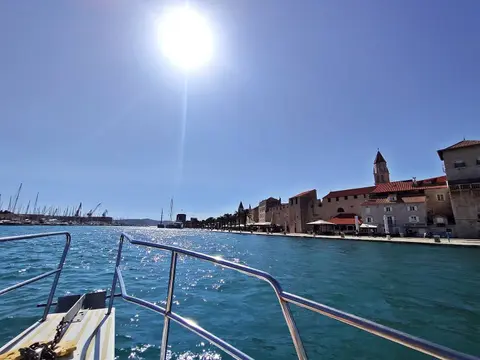
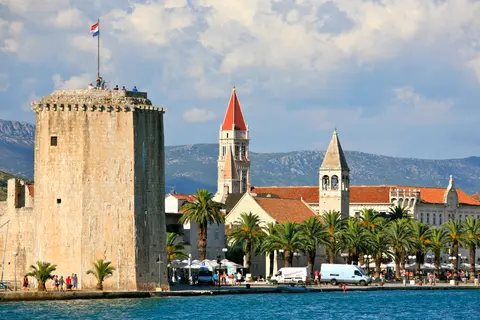
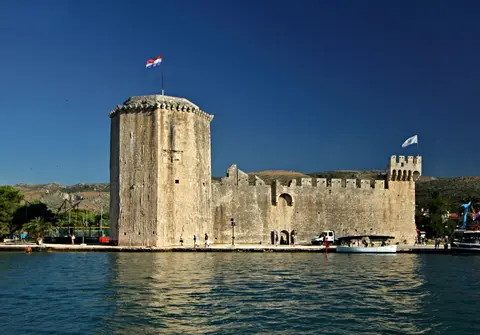
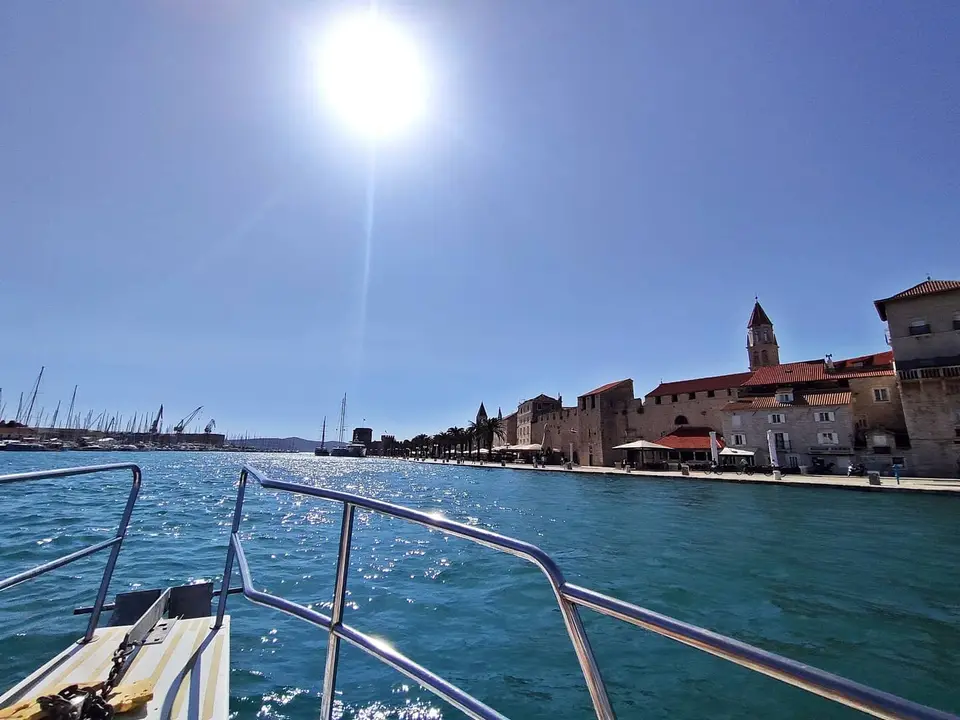
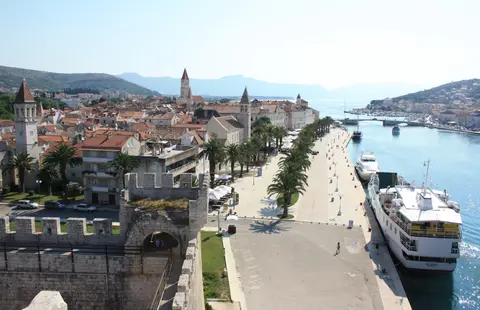
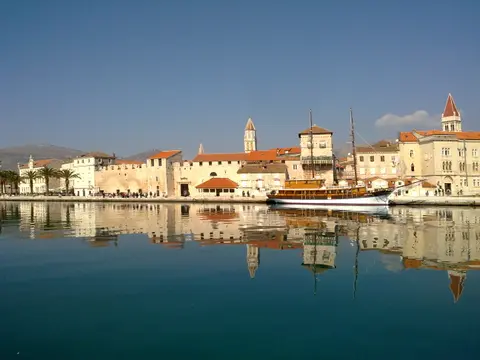
Walking across the 6.4-hectare islet shows how successive generations built directly atop Hellenistic foundations without wiping them clean. While prehistoric terrain fixed the oval perimeter and Greek planners staked out the rectangular eastern grid, medieval expansion formed two concentric rings of dwellings inside old ramparts before adding the western craft quarter of Pasike on a distinct diagonal alignment. On the southern flank facing Čiovo Island (where two yacht marinas operate today), the harbour quay met fifteenth-century defensive walls, a seventeenth-century city gate and massive Venetian bastions incorporating the Genoese-built Kamerlengo Fortress.
Around the main square, civic and patrician architecture forms an uninterrupted stone gallery mellowed by local limestone's golden patina. Flanking the cathedral stand the thirteenth-century Duke's Palace and the fourteenth- and fifteenth-century Town Hall, restored in the nineteenth century while retaining Renaissance details. Directly opposite the cathedral's west front, the fifteenth-century Big and Small Cipico Palaces occupy a full city block. Near the ramparts, mansions of the Cega, Vitturi, Lucie, Paitoni, Statileo and Andreis families rise over Late Classical and Romanesque masonry. Unified under plans by Ignacije Macanović from earlier Romanesque and Gothic blocks, the eighteenth-century Garagnin-Fanfogna Palace houses a two-storey southern economy wing with an outer stone stair and the Cata Dujšin-Ribar Gallery upstairs. Inside, visitors find a Late Baroque eastern street vestibule, an eighteenth-century stuccoed drawing room, and wall paintings of philosophers in the library of numismatist Ivan L. Garagnin (1722 to 1783). Seventeenth- and eighteenth-century graphics collections sit above a ground-floor lapidarium displaying original Hellenistic Tragurion city walls.
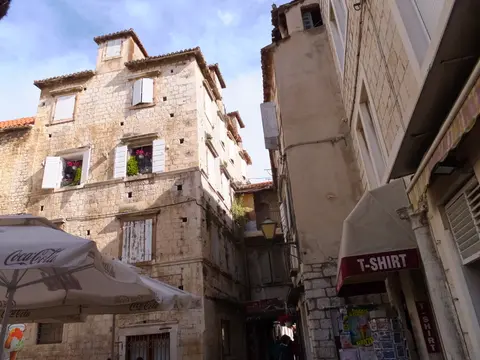
Sacred and communal landmarks pack tight alleys around the square. First recorded in thirteenth-century documents and restored in 1892, the Town Loggia hosted public contracts, proclamations and court hearings. On its eastern wall, Niccolò di Giovanni Fiorentino's 1471 relief of Justice still frames patron saints Lawrence and John of Trogir, though its central Venetian winged lion was removed in 1932. The south wall balances that panel with Ivan Meštrović's relief of Croatian viceroy Petar Berislavić (1513 to 1520). Next door, citizens raised St Sebastian's Church in 1476 in thanks for deliverance from the plague. Fiorentino's Renaissance facade holds sculptures of St Sebastian and Christ the Saviour, coats of arms of Bishop Giacomo Torlon and duke Malipiero, a two-storey town clock tower and a Croatian War for Independence memorial plaque. Right beside it lie wall remains of the demolished ninth-century six-apsed Carolingian chapel Santa Maria de Platea, documented in Ch. L. Clerisseau's eighteenth-century drawing. Nearby stands the Benedictine St Peter's Church, traditionally linked to King Béla IV's wife and restored in the late seventeenth century with Baroque wooden oval ceiling panels. Inside are Fiorentino's bust of St Peter, statues of Saints Peter and Paul, and Andreis and Cipico floor tombs. Close by lie the Romanesque Church of St John the Baptist and the Late Baroque Museum of Sacred Art. Its collection displays works by Blaž Jurjev Trogiranin, Gentile Bellini, Paolo Veneziano, Quirizio da Murano and the thirteenth-century cathedral high-altar polyptych.
St Lawrence Cathedral and Master Radovan's West Portal
Rising over an Early Christian cathedral ruined in the 1123 Saracen attack, the triple-naved Cathedral of St Lawrence anchors Trogir's skyline. It is also affectionately called St John's Cathedral after twelfth-century Bishop John, who died in 1111, while Trogir's ancient diocese operated from the eleventh century until 1828. Construction started around 1200 to 1213 and finished its main stone shell by 1251. That campaign yielded a predominantly Romanesque interior with heavy elongated piers separating aisles and Apulian-influenced cross vaults and aisle terraces. Over the next three centuries builders added Gothic ribbed aisle and nave vaults in the fifteenth century, a large western vestibule with a Gothic rose window, and a Gothic sacristy with pilastered outer masonry. In 1467 Albanian-born master Andrija Aleši (1430 to 1504), a pupil of Juraj Dalmatinac, carved the Romanesque-Gothic baptistery.
Rising 47 metres (154 feet) above the southern flank, the solitary bell tower traces Dalmatia's stylistic evolution storey by storey between the late fourteenth and early seventeenth centuries. Only the south campanile of two planned towers was built. Masters Stjepan and Matej raised its first Gothic level, repaired after Venetian bombardment in 1420 by Matija Gojković. Venetian-inspired masons added a second low-Gothic storey echoing Palazzo Ca' d'Oro. Between 1575 and 1609, Trifun Bokanić completed the top Renaissance belfry beneath four Mannerist statues by Venetian sculptor Alessandro Vittoria (1525 to 1608). King Louis of the Angevin dynasty's carved coat of arms sits within a small round opening in the facade.
At the main west entrance, local sculptor Master Radovan signed and completed his monumental Romanesque-Gothic portal in 1240 (following the simpler south portal of 1213), earning a lunette inscription praising him as the finest master in his craft. Below a Nativity lunette watched by adoring angels and Gospel archivolts, inner jambs carve seasonal agricultural labours, saints, apostles, centaurs, mermaids and exotic beasts resting upon hunched stone bearers, flanked outside by Adam and Eve standing upright on carved lions. Assisted by pupils whose distinct hands appear on secondary panels and fifteenth-century masters including Matija Gojković, Ivan Budislavić, Grgur Vidov and Petar Pozdanić, Radovan's doorway shaped Dalmatian sculpture across neighbouring coastal towns from Split to Šibenik. Inside the nave, heavy elongated piers divide Gothic-ribbed side aisles beneath Apulian-influenced cross vaults, while the thick exterior wall displays stone pilasters pierced by arched openings.
Access Zones Across the Historic Island of Trogir
| Complex Zone | Key Highlights | Access & Ticket Rule |
|---|---|---|
| Main Square, Town Loggia & Lanes | Hellenistic cardo and decumanus grid, Cipico Palaces, Town Hall, Town Loggia and St Sebastian Clock Tower | Open pedestrianised core free to walk day and night; heavy vehicle transit relocated outside the island since 2018 |
| Cathedral of St Lawrence & Bell Tower | Master Radovan's 1240 west portal, Andrija Aleši's 1467 baptistery, Gothic nave vaults and 47-metre south campanile | Paid visitor entry outside liturgical services; narrow steep stairs regulate climbs up the south bell tower |
| Kamerlengo Fortress & Seafront Quay | Fifteenth-century Venetian curtain walls, corner tower over Genoese foundations and southern yacht harbour | Seafront promenade opens freely; entering the fortress interior and parapet ramparts requires a gate ticket |
| Palace Museums & Sacred Art | Garagnin-Fanfogna Palace lapidarium with Greek walls, Pinacotheca paintings and St Peter's Church | Individual municipal and ecclesiastical museum tickets follow seasonal schedules |
Protection operates strictly under Croatian Act No. Z-3249, supervised by the National Service for the Protection of Cultural Heritage under the Ministry of Culture and Media. Local oversight follows the Comprehensive Land Use Plan updated in 2020. Under these rules, Trogir rejects abrasive limestone cleaning in favour of preserving its historic patina and using traditional masonry materials and craft techniques during restoration. Relocating regional highway traffic away from the historic core in 2018 cut heavy-vehicle vibration. Conservation planners still manage peak seasonal tourism pressure, long-term Adriatic sea-level rise and gradual depopulation of the historic island core.
Three Architectural Details to Spot Around Trogir's Core
- Radovan's Seasonal Labours and Lion-Mounted Figures: Stand inside the Cathedral vestibule to trace monthly harvest and pruning scenes carved up the inner doorway posts beside stooped bearers, centaurs and Adam and Eve atop lions.
- Removed Venetian Lion Inside the Town Loggia: Inspect Niccolò di Giovanni Fiorentino's 1471 Justice relief on the eastern wall, where the central winged lion plaque was chiselled away in 1932 between intact reliefs of Saints Lawrence and John.
- Hellenistic City-Wall Blocks Inside Garagnin-Fanfogna Palace: Step into the Town Museum's ground-floor lapidarium to see massive dressed stone courses surviving from third-century BC Tragurion beneath Baroque palazzo plasterwork. Outside, trace the transition from the straight eastern Hellenistic street grid to the angled medieval craft lanes of Pasike.
Navigating the Islet and Pairing With Split
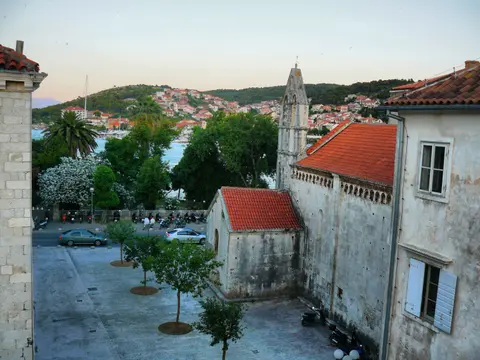
Early mornings reveal quiet limestone lanes, Venetian coats of arms and unobstructed views of Master Radovan's 1240 west portal and the four Alessandro Vittoria rooftop statues crowning St Lawrence's 47-metre bell tower. Visiting early avoids midday tour groups arriving across the mainland bridge, particularly in peak summer when temperatures reach 31 degrees Celsius compared with mild 4 to 12 degree winters. Walk the pedestrian quay past two yacht marinas toward Kamerlengo Fortress, then cross the bridges onto Čiovo Island for classic views back toward the walled oval core. Trogir sits directly along the Kaštela Bay bus and coastal corridor just 27 kilometres by road west of Split and 15 kilometres across the bay. Both medieval Dalmatian ports combine naturally inside one itinerary before exploring further Adriatic listings in the UNESCO World Heritage Atlas.