


























Quick Field Data
- UNESCO Inscription: Inscribed in 1979 as a Cultural heritage site under criteria (i) and (iii) near the village of Madara, 16 kilometres east of Shumen in northeastern Bulgaria.
- Scale & Footprint: Nearly life-size rock relief carved 23 metres above the ground in an almost vertical 100-metre cliff face on the Madara Plateau.
- Access & Ticketing: Open-air archaeological reserve with a stone staircase climbing to the cliff viewing terrace; check the official site for seasonal visitor schedules.
- Arrival Logistics: Located 16 kilometres east of Shumen in northeastern Bulgaria, accessible by regional road or the railway stop at Madara village.
Monumental Rock Carving on the Madara Plateau
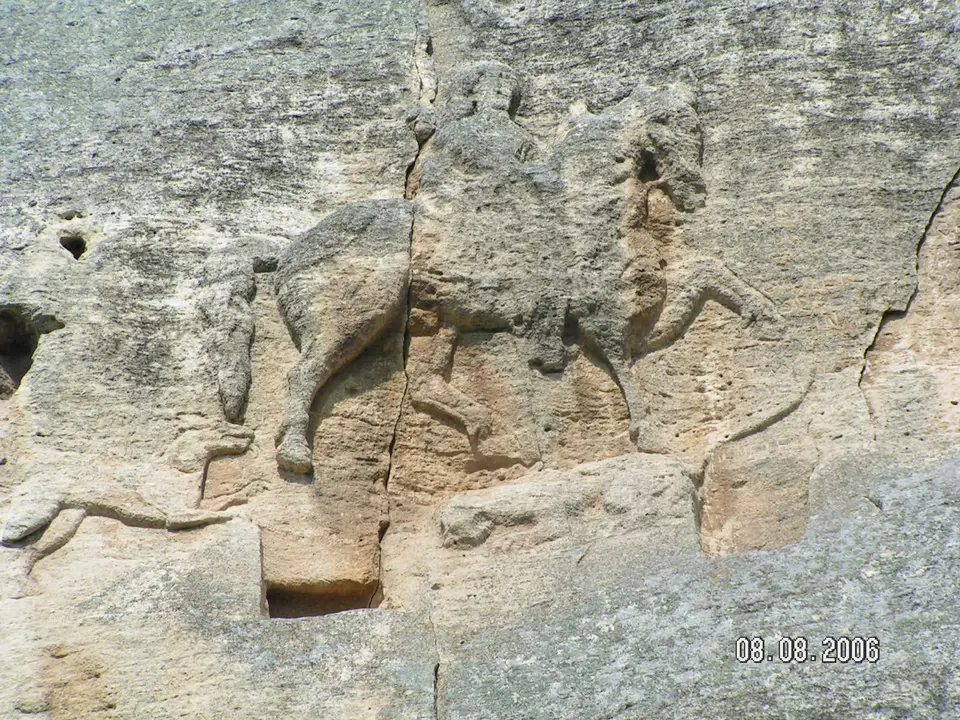
The cliff is sheer. Steep sandstone walls tower overhead. Carved directly into an almost vertical 100-metre (328-foot) sandstone cliff rising above the wooded slopes of the Madara Plateau, 16 kilometres east of Shumen in northeastern Bulgaria, the Madara Rider, also known as the Madara Horseman (in Bulgarian, Madarski konnik), is an extraordinary survival of early medieval European sculpture. Positioned approximately 23 metres (75 feet) above ground level and facing right across the plain, the nearly life-size relief stands in immediate proximity to Pliska, the first capital of the Bulgarian state founded at the end of the seventh century following the arrival of the Bulgars in the Lower Danube region during 680 and 681 AD. Unlike smaller portable metalwork and stone monuments left by early medieval peoples across the continent, the Madara relief has no parallel in Europe as the only monumental rock-cut relief of the early Middle Ages, surviving in its authentic state without alteration in the past or the present and earning inscription on the UNESCO World Heritage List in 1979 as monument number 43 with a core area of 1.2 hectares and a 501.7-hectare buffer zone.
Within the carved composition, a knight or horseman sits astride a high-necked steed walking calmly toward the right with his right hand holding the bridle reins and his left hand grasping a spear that has just been thrust into a fallen lion lying at the horse's feet. On the left side behind the mount, a hunting dog bounds forward in pursuit of the rider. Due to centuries of wind erosion, surface water runoff from heavy rain and melting snow, and biological coatings on the uncertain supporting rock, the sculpted details of the rider's halo and knee-length garments, together with a bird positioned before the rider's face and a skull-cup, are barely recognisable today, although the relief resembles carbon images discovered at Saltovo and Soulek alongside Pliska and Veliki Preslav. Dressed with his right foot resting inside a stirrup, the rider turns his upper body slightly toward the viewer in a triumphant posture that celebrates sovereign strength over nature and enemies alike.
Archaeologists and historians have long debated the cultural source, masonry tradition, and exact date of this striking visual formula. The sculpture likely combines features from native Thracian cults alongside the ritual traditions of the newly arrived Bulgars: the monumental size, stirrup, halo, skull-cup, and bird belong to Bulgar tradition, whereas the rightward direction and the lion are typical of Thracian tradition. Early researchers such as Konstantin Josef Jireček and Karel Škorpil initially interpreted the relief as a representation of the Thracian horseman deity of Paleo-Balkanic mythology, typically shown as a caped rider astride a steed with a spear poised to slay a beast, before gradually rejecting that assumption because of differences in the specific iconographic features and how the animals relate to the rider. Other historians link the sculpture to the cultural formation of the Bulgars as a semi-nomadic equestrian warrior people from the Eurasian Steppe, or point to parallels in the Sasanian Persian rock-carving tradition and the hero-horseman of Turkic and Iranian-Alanic mythology, relating the figure to the Bulgar deity Tangra or, as Vladimir Toporov suggested, the Iranian deity Mithra. Still others identify the relief with the early Bulgar ruler Khan Tervel around 705 AD (during his rule from 701 to 718 AD), rather than the once-considered Khan Krum (802 to 814 AD).
Medieval Greek Chronicles Engraved Around the Horseman
What gives the Madara cliff face unmatched historical weight is the group of four fragmentary inscriptions carved into the soft sandstone around the horseman in Medieval Greek language and script, studied in detail by Vesselin Beschevliev in his classic monographs of 1955, 1963, and 1979 alongside later analyses by Slavi Donchev in 1981, Kiril Petkov and Uwe Fiedler in 2008, and Panos Sophoulis in 2011. Serving as a monumental stone chronicle of the First Bulgarian Empire between 705 and 801 AD and the early ninth century, these three partially preserved texts and a fourth fragment record diplomatic treaties and gold tributes alongside military campaigns involving three famous Khans: Tervel, Krumesis or Kormisos (or Krum, 802 to 814 AD), and Omurtag (who reigned from 814 to 831 AD).
The oldest text, Inscription I, carved directly beneath the horse, dates to the reign of Tervel (701 to 718 AD) and records that Justinian the emperor with the cut-off nose made a treaty and came to Tervel after his uncles at Thessaloniki did not trust him and went back to the Kisiniie, adding that the ruler Tervel gave the emperor five thousand men and scored a fine victory. Inscription II, placed around the relief, recounts eighteen gold tributes, soldiers, and how the Greeks (Byzantines) sent gold every year and asked the ruler Krumesis, who divided the gold before they tore the treaties and war resumed. Inscription III and the fragmentary Inscription IV, carved during the reign of Khan Sybigi Omurtag between 814 and 831 AD, describe how Omurtag, the ruler set by God, sent military help and made sacrifice to the god Tangra alongside his high official the itchurgu boila.
The cliff relief did not stand in isolation on the plateau. Before Bulgaria converted to Christianity in the ninth century, the Madara sanctuary functioned as the chief sacred site of the First Bulgarian Empire inside an archaeological reserve containing monuments up to 2,000 years old. Between 1924 and 1935, excavations some 250 metres north beneath the relief uncovered the remnants of a complex dated by 1970s pottery studies between the eighth and tenth centuries: a pagan shrine (three-aisled church built over an early Byzantine basilica), a rectangular private dwelling where the ruler performed sacral rituals related to Tangra (accompanied by a damaged inscription by Khan Omurtag mentioning Tangra), and a Christian burial to the west with a golden decorated belt dated around 900 AD, while 3.2 kilometres (two miles) northeast stood a fifth-to-sixth-century basilica with an inner rectangular structure. In modern Bulgaria, the Madara Horseman has become a national emblem: stamped on the front of low-value Bulgarian coins from 1 up to 50 stotinki minted in 1999 and 2000, it won the 29 June 2008 official national survey with 25.44 percent of the votes to appear on Bulgaria's euro coins emitted in early 2026 upon accession to the Eurozone, and also lent its name to Antarctica's Madara Peak on Livingston Island within the South Shetland archipelago.
Climbing the Cliffside Staircase at Madara Today
Sunlight sharpens the stone. Because the relief sits 23 metres above the rock base on a porous sandstone face, visitors observe the carving from a railed viewing platform rather than touching the fragile surface.
- Entry and Route Up the Cliff: Enter the archaeological reserve from the visitor car park above Madara village, follow the shaded forest path to the base of the 100-metre cliff, and climb the stone steps to the viewing terrace directly opposite the horseman.
- Tickets, Interiors and Viewpoints: Bring binoculars or a telephoto lens to make out the pierced lion beneath the horse's hooves, the running dog, and the Greek letters of the Tervel, Krumesis, and Omurtag inscriptions; after viewing the relief, continue along the cliff trail to the Large Cave and climb the steep rock-cut staircase to the Madara Fortress on the plateau summit, checking the official site for visitor schedules.
- Timing and Onward Connections: Visit in the afternoon when the westward-facing cliff catches direct sunlight that throws the shallow relief into sharp contrast, and explore other early medieval sites across Europe in our UNESCO World Heritage Atlas.
