


























Quick Field Data
- UNESCO Inscription: 1979 · Criteria (ii), (iii)
- Scale & Footprint: 171.9 hectares along the limestone canyon cliffs of the Rusenski Lom Nature Park in Ruse Province, northeastern Bulgaria
- Access & Ticketing: Located inside Rusenski Lom Nature Park; valley viewpoints and canyon trails are accessible along the river floor, while ascending the cliffside stairs into the main Church of the Holy Virgin requires an entry ticket and compliance with rock-massif conservation rules
- Arrival Logistics: Situated near the village of Ivanovo, 20 kilometres (12 miles) south of the Danube port city of Rousse along the rocky banks of the Rusenski Lom River
Monolithic Cliff Architecture in the Rusenski Lom Canyon
Carved directly into the vertical limestone cliffs of the Rusenski Lom River canyon 20 kilometres (12 miles) south of Rousse in northeastern Bulgaria, the Rock-Hewn Churches of Ivanovo (Ivanovski skalni tsarkvi) form a 171.9-hectare monastic landscape completely distinct from the freestanding masonry monasteries found elsewhere in the Balkans. Inscribed on the World Heritage List in 1979 under criteria (ii) and (iii) and protected within the surrounding Rusenski Lom Nature Park, the complex occupies high rock terraces perched up to 32 metres (105 feet) above the meandering river below. Rather than building walls of brick and mortar on the valley floor, medieval Bulgarian hermits and monks hollowed out natural karst cavities in the cliff face to chisel churches alongside chapels, monastic cells, and baptisteries out of solid living rock. Vertical cliffs sheltered their solitude.
Monastic settlement in the canyon began in the twelfth century and expanded systematically from the 1220s onward, when the future Patriarch of Bulgaria, Joachim I, retreated to the cliffs of Ivanovo and founded the rock-cut monastery of St Archangel Michael. Throughout the thirteenth and fourteenth centuries during the height of the Second Bulgarian Empire (1187 to 1396), rulers from the royal capital of Tarnovo, led by Tsar Ivan Asen II and Tsar Ivan Alexander alongside boyar nobles from Tarnovo and the nearby medieval fortress town of Cherven, lavished royal donations and patronage upon the cliff complex. Tsar George I, ruler of Bulgaria, was also entombed within the monastery premises, confirming the royal prestige enjoyed by this cliffside monastic complex across the medieval Bulgarian state and its close spiritual ties to the royal court in Tarnovo, while the rock-cut chapels continued to attract pilgrims from across the Danube plain.
At the zenith of its medieval expansion in the fourteenth century, when Ivanovo functioned as a major spiritual centre of hesychasm (the contemplative Byzantine monastic practice of inner quietude and unceasing prayer) across the Bulgarian lands, the canyon network encompassed roughly 40 rock-cut churches and chapels linked by narrow cliffside ledges alongside timber galleries and stone stairs to around 300 monastic cells and auxiliary chambers. Monks lived in isolated rock cells during the week and gathered along the cliff paths for communal liturgy inside the larger cave churches. Although the monastery continued to function during the early centuries of Ottoman rule in Bulgaria before gradually falling into decay by the seventeenth century, structural rockfalls over the centuries collapsed many of the outer galleries, leaving five primary historical monuments with preserved thirteenth- and fourteenth-century frescoes alongside rock-cut inscriptions.
The Tarnovo School of Painting and Palaeologan Fresco Masterpieces
Today, five principal rock-cut sanctuaries preserve the medieval artistic and architectural achievements of the Ivanovo complex: the St Archangel Michael Chapel (referred to as the Buried Church) alongside the Baptistery plus the Gospodev Dol rock chapel, the sanctuary of St Theodore (referred to as the Demolished Church), and the main fourteenth-century sanctuary, the Church of the Holy Virgin (known simply as the Church). Alongside these painted sanctuaries, the cliff walls retain important medieval epigraphic records chiselled into the limestone, including the famous indented rock inscription carved by the monk Ivo Gramatik in 1308 and 1309, which provides primary historical testimony on the monastic community and its royal benefactors across the Rusenski Lom valley.
What elevates the Rock-Hewn Churches of Ivanovo, and specifically the fourteenth-century murals inside the Church of the Holy Virgin funded by Tsar Ivan Alexander, to the forefront of South-Eastern European medieval art is their mastery of the Palaeologan Renaissance style practiced by the royal Tarnovo School of painting. Executed after the famous mosaics and frescoes of the Khora Monastery (Karia Djami, dated 1303 to 10), the Ivanovo murals depart strikingly from the rigid, flat frontal canons of earlier Byzantine church iconography. Working on plaster applied directly to the uneven rock-cut ceilings and walls 32 metres above the Rusenski Lom River, the master painters of Tarnovo revived classical Hellenistic spatial depth and emotional expressiveness across every register of the rock-cut interior.
Across the rock-cut nave and narthex of the Church of the Holy Virgin, biblical scenes and lives of the saints unfold against complex, three-dimensional architectural backdrops and rugged landscapes. Figures are rendered with dynamic movement alongside anatomical proportion, dramatic gesture, and a surprising return to classical motifs including muscular nude figures and Hellenistic caryatids, paired with royal donor portraits of Tsar Ivan Alexander and the imperial family. Together, the thirteenth- and fourteenth-century fresco layers across the five surviving churches document the artistic evolution of the Second Bulgarian State between 1187 and 1396, bridging metropolitan Byzantine court art and the monastic traditions of the Tarnovo literary and artistic school across northeastern Bulgaria.
Because the monolithic churches were excavated directly inside a porous, fissured limestone cliff face exposed to freeze-thaw cycles alongside river humidity and tectonic weathering, the physical survival of the frescoes depends on the structural stability of the rock massif itself. Deep vertical cracks and water seepage through the overlying cliff threatened the Church of the Holy Virgin for decades, prompting Bulgarian conservation engineers and geologists to execute a long-term scientific programme focused on the structural investigation alongside the stabilization and waterproofing of the limestone rock massif around the Church of the Holy Virgin, anchoring the fractured cliff layers and sealing overhead rock fissures against rainwater infiltration while preserving the original rock-cut setting inside Rusenski Lom Nature Park.
Visiting the Cliffside Church of the Holy Virgin and Rusenski Lom Canyon
Set within the wooded limestone gorge of Rusenski Lom Nature Park just 20 kilometres south of Rousse, the Ivanovo complex offers a quiet canyon setting far removed from urban traffic. Because most of the 300 medieval cells and 40 churches sit high in fragile, unguided cliff faces where rockfalls have eroded the ancient ledges, public visiting focuses on the stabilized cliff terrace of the Church of the Holy Virgin and the valley trails linking the nearby medieval sites of the Rusenski Lom basin.
Plan your canyon visit around the cliffside staircase alongside the Palaeologan frescoes inside the main church and neighbouring medieval landmarks.
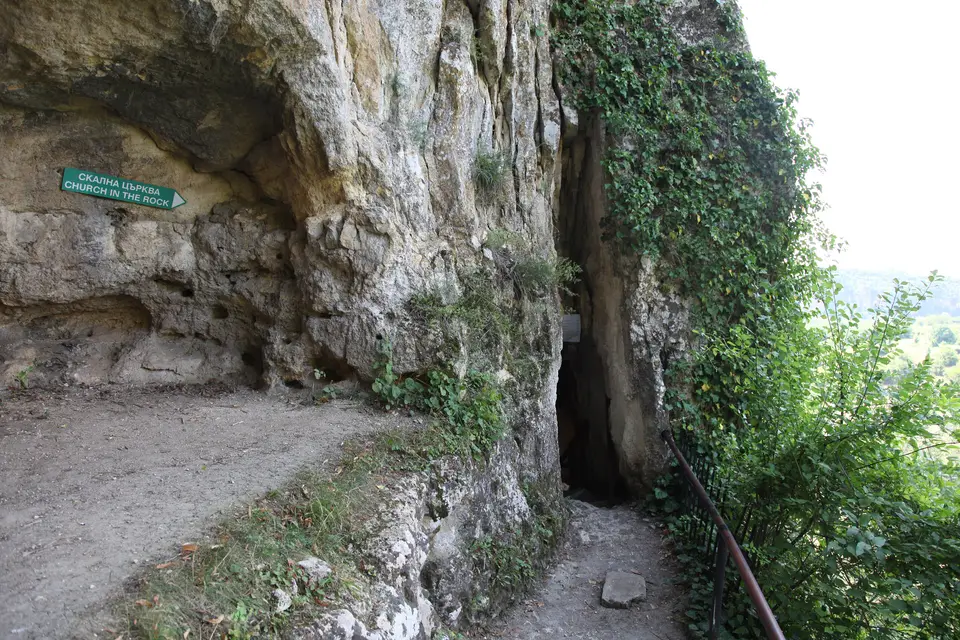
- Climb the cliff path from the Rusenski Lom valley floor: Drive 20 kilometres south from Rousse past the village of Ivanovo into the Rusenski Lom River gorge to reach the roadside parking area at the foot of the limestone massif. From the valley floor, ascend the stone staircase cut into the cliffside to reach the rock terrace standing 32 metres above the river, which provides sweeping views across the wooded canyon bends of Rusenski Lom Nature Park where hermits first settled in the twelfth century.
- Inspect the Palaeologan frescoes inside the Church of the Holy Virgin: Step inside the rock-cut chambers of the Church of the Holy Virgin to examine the fourteenth-century Tarnovo School murals at close quarters. Look closely at the donor portrait of Tsar Ivan Alexander alongside the expressive Hellenistic architectural backgrounds, the classical caryatid motifs, and the emotional drama of the biblical scenes that parallel the 1303 to 10 Khora Monastery cycle, as well as the chisel marks showing how hesychast monks hollowed the sanctuary directly out of solid limestone.
- Pair Ivanovo with the medieval fortress of Cherven and Rousse: Visit during the morning or early afternoon when natural canyon light illuminates the cliff face and the small interior of the rock church is uncrowded between tour groups. After descending from the 32-metre cliff terrace, follow the Rusenski Lom Nature Park road network to visit the nearby medieval cliffside town and fortress of Cherven, whose boyar nobles patronised the Ivanovo monasteries in the thirteenth and fourteenth centuries, or explore other rock-hewn sanctuaries across our UNESCO World Heritage Atlas.
