


























Quick Field Data
- UNESCO Inscription: 1983 (Cultural Criteria iii, iv)
- Scale & Footprint: 27.1-hectare rocky Black Sea peninsula connected to the mainland by a narrow isthmus, protected by a 1,245.6-hectare marine and coastal buffer zone
- Access & Ticketing: Open pedestrian historic town managed by Nesebar Municipality; check the official site for combined museum and church passes
- Arrival Logistics: Located on the Bulgarian Black Sea Coast in Burgas Province, immediately south of Sunny Beach and north of Istanbul
Three Millennia of Maritime Urbanism on a Black Sea Peninsula
Occupying a compact, 27.1-hectare rocky peninsula that juts into the western Black Sea at an elevation of up to 30 metres and links to the Bulgarian mainland only via a narrow human-made isthmus, the Ancient City of Nessebar (often transcribed as Nesebar or Nesebur, postal code 8230) preserves more than 3,000 years of continuous coastal settlement. Included in the UNESCO World Heritage Atlas in 1983 under cultural criteria iii and iv, the peninsula functions as the administrative centre of Nesebar Municipality (covering a total municipal area of 31.852 square kilometres) in Burgas Province, situated immediately south of the resort of Sunny Beach and north of Istanbul along the western Black Sea coast. Frequently called the "Pearl of the Black Sea", the city exists in two distinct parts separated by the narrow causeway: the modern mainland section housing hotels and recent development, and the ancient peninsular settlement (previously an island) where successive maritime civilisations left lasting architectural traces inside a single homogeneous urban fabric surrounded by a 1,245.6-hectare buffer zone. Sea breezes sweep across the rocky headland.
Systematic underwater archaeological expeditions conducted between 1961 and 1972 by Bulgarian archaeologist Lyuba Ognenova-Marinova (leading six underwater expeditions for the Bulgarian Academy of Sciences along the Bulgarian Black Sea Coast) documented five distinct eras of coastal urban development around the Nesebar peninsula extending back to the close of the second millennium BCE: a Thracian protopolis, the classical Greek colony of Mesambria, a Roman settlement continuing into the Early Christian period, a Medieval town, plus a Renaissance era coastal port. Originally a Thracian settlement known as Menebria or Melsambria (derived according to Hellenistic legend from a founder named Melsas), the town developed into a Greek colony after Dorian settlers from Megara arrived at the beginning of the 6th century BCE. Known in Greek as Mesembria (and in Bulgarian before 1934 as Mesemvriya, before adopting the name Nesebar from the local Erkech dialect), Mesembria stood as the sole Dorian settlement founded along the Black Sea shoreline, whereas rival ports such as Apollonia (modern Sozopol) were Ionian colonies. During 425 alongside 424 BCE, the port entered the Delian League led from Athens. Surviving Hellenistic monuments on the headland encompass the acropolis, a stone wall belonging to the Thracian fortifications along the northern shore, an agora, plus a Temple of Apollo. Local workshops struck silver alongside bronze coinage in Mesembria starting in the 5th century BCE and gold coins from the 3rd century BCE; after Roman legions brought the settlement under imperial control in 71 BCE, the port retained civic privileges including the right to mint its own coinage.
Imperial Frontier Stronghold Between Byzantium and Bulgaria
From the 5th century CE onwards, the peninsula served as a key military and commercial stronghold of the Byzantine Empire along the western Black Sea littoral. Because it repeatedly stood on the frontier of contested empires, Byzantines and Bulgars fought over the town across the Middle Ages:
- First Bulgarian Empire Era (812 CE): After a two-week siege in 812, Khan Krum captured the fortress and incorporated the port into the lands of the First Bulgarian Empire; although Knyaz Boris I, ruler of Bulgaria, ceded the town back to Byzantium in 864, his son Tsar Simeon the Great reconquered it.
- Prosperity Under Tsar Ivan Alexander (1331 to 1371): During the Second Bulgarian Empire, the city, attested in Bulgarian as Nesebar or Mesebar since the 11th century, shifted repeatedly between Bulgarian and Byzantine control while enjoying notable architectural and cultural patronage under Bulgarian Tsar Ivan Alexander, who ruled from 1331 to 1371, until a Crusader fleet commanded by Amadeus VI, the Count of Savoy, seized the harbour in 1366.
- Ottoman Rule and 19th-Century Architecture: Captured by Ottoman forces during the Bulgarian-Ottoman wars, restored to Byzantine sovereignty under the 1403 Treaty of Gallipoli, and permanently incorporated into the Ottoman Empire in 1453, the town (administered before 1878 as Misivri, a kaza centre within the İslimye sanjak of Edirne Province) preserved its architectural heritage and enriched its streetscape in the 19th century with wooden houses typical of the Bulgarian Black Sea Coast. During the early decades of the 19th century, numerous townspeople entered the Greek patriotic society Filiki Eteria, and when the Greek War of Independence began in 1821, young volunteers from the peninsula fought under Alexandros Ypsilantis. Following the 1878 liberation of Bulgaria from Ottoman rule, the peninsula was incorporated into Eastern Rumelia, an autonomous Ottoman province administered through Burgaz department, before joining the Principality of Bulgaria during unification in 1885. Around 1900 it was a small coastal town of Greek fishermen and vinegrowers with a population of approximately 1,900 (of whom 89 percent were Greeks), before a new mainland town quarter was built after 1925 and the Old Town was restored, growing to a municipal population of 13,347 (and 28,957 in the wider area) by December 2010 and 13,600 inhabitants by December 2019.
Forty Churches: Early Christian Basilicas to Medieval Cross-Domed Sanctuaries
Having functioned for a thousand years as a spiritual hearth of Christian culture, Nessebar is often said to have the highest number of churches per capita of any town, with a total of forty churches surviving wholly or partly in its vicinity. Whether erected under Byzantine, Bulgarian, or Ottoman rule, these sanctuaries embody the sacred building traditions of the Eastern Orthodox world while illustrating how Early Christian basilicas evolved step by step into medieval cross-domed churches:
- The Church of St Sophia (Stara Mitropoliya / Old Bishopric): Dating from the 5th and 6th centuries, this basilica without a transept stands at the heart of the Old Town, complemented on the northern shore by the 6th-century Basilica dedicated to the Holy Mother of God Eleusa (the Virgin church).
- The Church of John the Baptist and St Stephen (Nova Mitropoliya): Built in the 11th century, the Church of John the Baptist illustrates medieval stone vaulting, while the 11th-century Church of St Stephen (the New Bishopric, reconstructed and embellished from the 16th to the 18th century) preserves painted murals and wooden liturgical fittings.
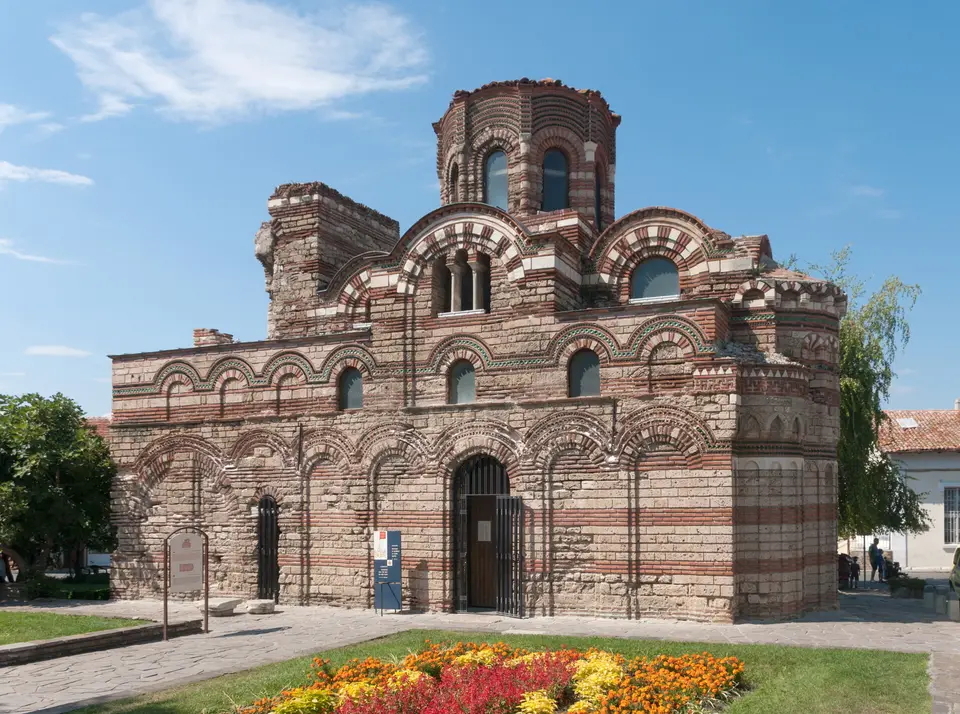
- 13th- and 14th-Century Medieval Churches: Erected across the 13th and 14th centuries, the 13th-century Church of St Theodore, the 13th- to 14th-century Church of St Paraskeva (or St Paraskevi), the 13th- to 14th-century Church of Christ Pantocrator, the 13th- to 14th-century sanctuary dedicated to the Holy Archangels Michael and Gabriel, plus the 14th-century Church of St John Aliturgetos display medieval religious architecture modified by traditional Byzantine forms and ornamental ceramics art, alongside the 17th-century Church of St Spas, the 17th-century Church of St Clement, and the 19th-century Church of the Assumption of the Holy Virgin.
Black Sea Timber Vernacular, Coastal Engineering, and Walk Logistics
Alongside its medieval churches, the residential vernacular architecture of Nessebar reflects the stages of architectural development across the Balkans and the East Mediterranean, dominated by 19th-century wooden houses rising over stone ground floors. In the 1980s, engineering works were carried out around the peninsula coastline both to preserve the historic relief and to consolidate the port. Beyond the peninsula, whose name is even commemorated in Antarctica by the mountain pass called Nesebar Gap on Livingston Island inside the South Shetland archipelago and which is twinned with Norilsk, the modern mainland town also hosts the 6,000-spectator football stadium (with a 100 by 50 metre field) of PFC Nesebar and seasonal tennis clubs including TC Egalite and Tennis academy Nesebar.
- Entry and Route: Cross the narrow isthmus on foot past the historic wooden windmill standing between the northern harbour and southern bay, with regular bus connections from Burgas and Sunny Beach.
- Tickets and Viewpoints: Walking the peninsula lanes and viewing open ruins such as the Church of St Sophia and Church of St John Aliturgetos is open year-round, while museum churches require entry tickets; check the official site before visiting.
- Timing and Onward Connections: Explore the Old Town in the early morning or evening to enjoy the coastal relief, town walls, and wooden houses before midday resort crowds arrive from Sunny Beach.
