Quick Field Data
- UNESCO Inscription: 1997 (Ref. 835); Criteria (ii) and (iv)
- Scale & Footprint: 48 hectares covering the Old Town, New Town and Teutonic Castle ruins along the high bank of the Vistula River, encircled by a 300-hectare buffer zone
- Access & Ticketing: Medieval market squares, Kulm-law streets and Vistula curtain walls remain open public spaces; entering the Teutonic Castle archaeological zone, Old Town Hall tower, Nicolaus Copernicus House museum and cathedral interiors requires local admission
- Arrival Logistics: Poznań-Ławica Airport (POZ) operates as the primary international gateway 137 kilometres southwest, while closer Ignacy Jan Paderewski Bydgoszcz Airport (BZG) at 43 kilometres runs smaller regional schedules with fewer international flights
Kulm Law, Hanseatic Grain and the 1454 Revolt
Toruń occupies an ancient strategic crossing on the Vistula River in north-central Poland, where archaeological layers reach back to Lusatian settlements around 1100 BC and two Roman-period settlements with a cemetery. A seventh- to thirteenth-century Slavonic ford fortified under the Polish Piast dynasty later fell to Prussian raids near the turn of the twelfth and thirteenth centuries. Mentioned in 1226 as Thorun, a name linguists link to the Old Slavic word tor for a beaten road, the settlement later appeared as Turon, Turun and from the fifteenth century in German as Thorn. Chełmno Land, a territory within the Duchy of Masovia, changed course when Duke Konrad I struggled against Prussian raids and settled the Teutonic Knights at Vogelsang and Nieszawa between 1227 and 1228. Teutonic commanders Hermann von Salza and Hermann Balk crossed the Vistula near Nieszawa in spring 1231 with Mazovian knights to build an initial post near Stary Toruń. On 28 December 1233, they granted municipal charters for Toruń and Chełmno under Kulm law modelled on Silesian towns, though the original parchment perished in 1244.
Frequent river flooding forced the knights to move the Old Town upstream to its permanent elevated bank in 1236, welcoming Franciscan friars in 1239 and Dominicans in 1263. As commerce boomed, the Order founded an adjacent New Town in 1264 specifically for incoming artisans and craftsmen from German-speaking lands, and by 1280 both towns joined the mercantile Hanseatic League (remaining a leading Hanseatic member until 1411). Even though fourteenth-century papal verdicts ordered the knights to return the territory to Poland, Teutonic control held until Poland briefly recaptured the city in 1410 with the active cooperation of Toruń's council, before the First Peace of Thorn in February 1411 restored Order rule. In the 1420s Polish King Władysław II Jagiełło built Dybów Castle across the left bank of the Vistula, though knights occupied Dybów from 1431 to 1435.
Refusing to bankroll Teutonic wars against Poland, Toruń gentry co-founded the rebellious Prussian Confederation in 1440 and negotiated with Polish King Casimir IV Jagiellon at Dybów Castle from 1452 onward. A Confederation delegation subsequently travelled to Kraków requesting royal restoration as rightful ruler. When open revolt erupted in 1454, enraged townspeople stormed and conquered the hated Teutonic castle and dismantled its fortifications brick by brick, sparing only the projecting Gdanisko tower used until the eighteenth century for gunpowder storage. The local mayor pledged allegiance under the act of incorporation signed in Kraków on 6 March 1454. Old Town and New Town amalgamated that March, followed in May by solemn regional homage ceremonies in Toruń attended by nobility, knights, landowners, mayors and officials from across Chełmno Land. King Casimir IV authorised Toruń to mint Polish coins and stayed frequently at Dybów Castle while the city financed the Polish army. At Dybów Castle he issued the foundational Statutes of Nieszawa, laying the ground for Polish noble democracy until 1795. After the Thirteen Years' War, the 1466 Second Peace of Thorn sealed Polish sovereignty, renunciation of Teutonic claims and Gdańsk-scale urban privileges.
Dual Market Grids, Brick Granaries and Copernicus's Birthplace
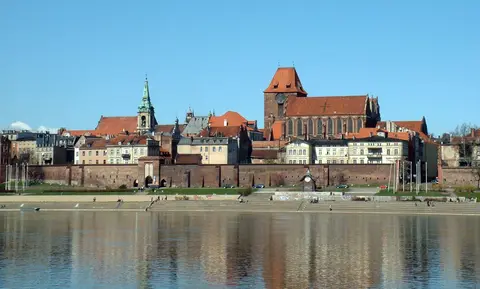
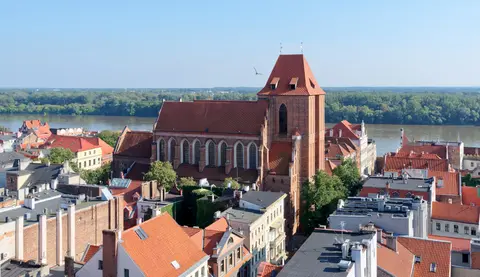
What distinguishes Toruń across northern Europe is the rare survival of three medieval settlement nuclei locked inside a single brick defensive circuit. Between the commercial Old Town on the west and the artisanal New Town on the east lay the mid-thirteenth-century Teutonic Castle, now preserved as excavated ruins. Built on an unusual horseshoe plan ringed by curtain walls and moats above the high right bank of the Vistula escarpment, it served as an early base for the conquest and evangelisation of Prussia. Even though the fortress survives primarily in excavated ruins and conservation documentation after 1454, its layout, room functions and defensive perimeter remain legible between both historic towns. Both the Old Town and New Town retain their crisp thirteenth-century rectangular quarters, market squares, city gates, defensive towers and Gothic parish churches. Surviving brick boundary walls divide narrow medieval burgher plots, keeping historic panoramas unaltered under towering spires and the monumental Town Hall.
Prosperity from Baltic grain and overland trade clothed those medieval plots in richly detailed Brick Gothic architecture enriched later by Mannerist and Baroque flourishes, reflecting close artistic exchange across Hanseatic ports. Multi-purpose burgher townhouses combined front living quarters, vaulted cellars, stuccoed ceilings and wall paintings with rear storage wings and tall brick granaries rising up to five storeys high, preserving traditional templates, architectural details and exterior colour schemes. In 1473, astronomer Nicolaus Copernicus was reputedly born inside one such Old Town merchant townhouse, functioning today as a museum preserving his life and scientific legacy within an authentic medieval interior.
Monumental parish churches, city gates and fortified towers punctuate the skyline above the ceramic-tiled roofs. St John's Cathedral houses the great 1500 Tuba Dei bell, then the largest church bell in Poland, alongside the buried heart of Polish king John I. He died in Toruń in 1501, one year after builders spanned the Vistula with Poland's longest wooden bridge. Elevated to a Polish royal city in 1506 and granted a royal mint in 1528, Toruń ranked among Poland's four largest cities with voting rights in royal elections. It hosted Polish-Lithuanian Commonwealth Sejms in 1576 and 1626 and became famed for a gingerbread-baking tradition approaching a millennium old. Founded in 1568, its influential academic gymnasium rose after 1594 among northern Poland's premier schools and opened Toruń's earliest museum (Musaeum) that same year.
Reformation Tolerance, Partitions and Wartime Survival in Toruń
Rapid wealth brought fierce religious and political crosscurrents. Adopting Protestantism in 1557, Toruń consolidated municipal administration under Mayor Heinrich Stroband from 1586 to 1609. It weathered Counter-Reformation tensions after Jesuits took St John's Church in 1595 while Protestants retained St Mary's. Yet in 1645, even as the Thirty Years' War devastated German lands to the west, King Władysław IV Vasa convened the three-month Colloquium Charitativum in Toruń to promote dialogue among European Catholics, Lutherans and Calvinists. Early eighteenth-century Swedish sieges during the Great Northern War and Tsar Peter the Great's 1709 Treaty of Thorn restoring Augustus II the Strong followed. The 1724 Tumult of Thorn then hardened divides in a town split evenly between German-speaking Protestants and Polish-speaking Roman Catholics.
Prussia annexed the city in the 1793 Second Partition before Toruń briefly joined the Duchy of Warsaw. After defending itself against Austrian troops, it served as Poland's temporary capital in April and May 1809 while welcoming a growing Jewish community, then returned to Prussia in 1815. Resisting Germanisation, Polish residents opened a first synagogue in 1847 and the Toruń Scientific Society in 1875. Poland recovered the city after the First World War as capital of Pomeranian Voivodeship (1921 to 1945). It later led Toruń Voivodeship (1975 to 1998) before sharing Kuyavian-Pomeranian governance with Bydgoszcz from 1999 onward. Brutal German occupation from 7 September 1939 to 1 February 1945 brought Einsatzkommando crimes and the murder of railwaymen and police in Gąbin on 19 to 21 September 1939. Intelligenzaktion executions and mass imprisonment followed inside Fort VII of the outer Toruń Fortress, including 1,200 arrests in three October 1939 days alone and November sweeps of teachers. Crucially for heritage survival, however, the Old Town and New Town escaped heavy bombing and firestorms. They endure into modern times as a 196,935-resident university city and Camerimage International Film Festival host whose medieval fabric stays exceptionally unaltered.
Access Zones Across Toruń's Old Town, New Town and Castle
| Complex Zone | Key Highlights | Access & Ticket Rule |
|---|---|---|
| Old Town Market & Copernicus Quarter | Gothic Town Hall tower, St John's Cathedral, St Mary's Church, Copernicus House museum and brick granaries | Public market square and medieval lanes open free; museum houses, tower ascent and church interiors ticketed |
| Teutonic Castle Ruins & Gdanisko Tower | Excavated horseshoe fortress foundations, outer defensive moats and surviving 13th-century sanitary tower | Ticketed archaeological enclosure tucked along the Vistula slope between Old Town and New Town |
| New Town Square & Artisan Streets | 1264 craft district grid, St James's quarter and surviving medieval workshop plots | Open public streets and square; religious buildings keep seasonal parish schedules |
| Vistula Curtain Walls & Kępa Bazarowa | Riverside brick city gates, defensive towers and panoramic terrace on Kępa Bazarowa island | Free public riverfront promenades and island overlook linked across the Vistula bridge |
The site is safeguarded on Poland's National Heritage Register as a Monument of History. The city mayor and council administer it through the Municipal Monuments Protection Office, Office of Toruń City Centre and Municipal Programme for the Guardianship of Monuments. The 48-hectare core balances tourism, catering and municipal commerce with statutory spatial planning across its 300-hectare buffer zone. Ongoing priorities focus on updating local spatial development plans and implementing a comprehensive management plan to shield medieval masonry from environmental stress and modern urban investment.
Three Brick Gothic Details to Inspect in Toruń
- The Projecting Gdanisko Tower of the Teutonic Castle: Walk the southern castle path between the Old Town and New Town to inspect the sole major tower spared during the 1454 uprising. A high brick arcade on piers connects it across the moat to overlook excavated horseshoe curtain walls. It functioned first as the knights' fortified sanitary wing and later until the eighteenth century as a gunpowder store.
- Five-Storey Brick Granaries and Original Plot Walls: Look behind main commercial facades near the Vistula riverfront and Copernicus Street to spot towering gabled brick granaries and surviving medieval brick partition and boundary walls. These walls preserve thirteenth-century property widths and show how Hanseatic burghers paired ground-floor commerce and storage with upstairs living quarters across both Old Town and New Town grids.
- Vaulted Townhouse Ceilings and the 1500 Tuba Dei Bell: Step inside St John's Cathedral to view Poland's massive 1500 bronze bell. It shares the church with the royal heart burial monument of Polish king John I, who died here in 1501. Nearby restored Gothic merchant townhouse interiors retain vaulted brick cellars, interior painted wall decoration and ornate stucco ceilings.
Timing Your Vistula Visit and Pairing With Poznań
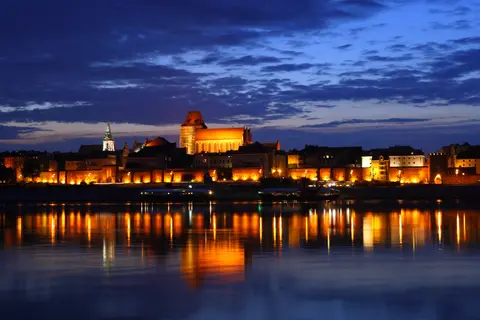
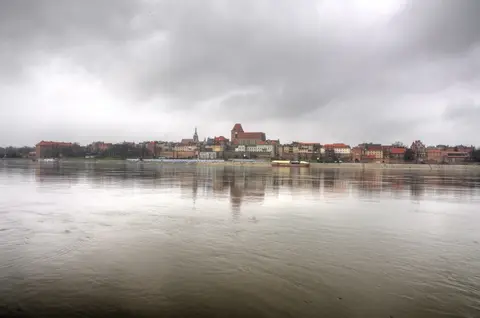
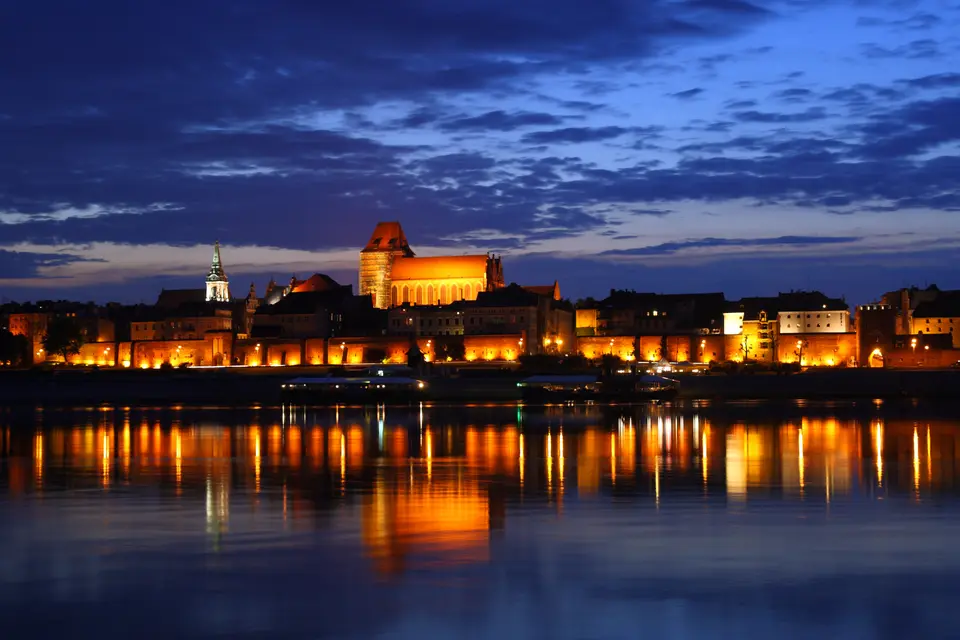
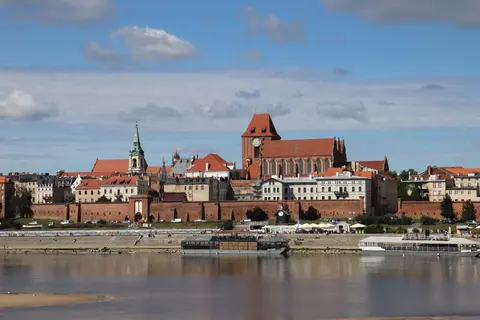
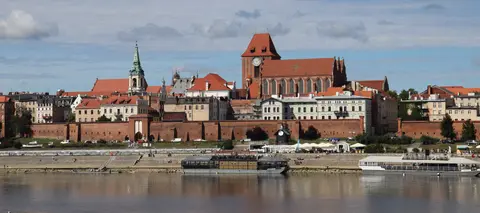
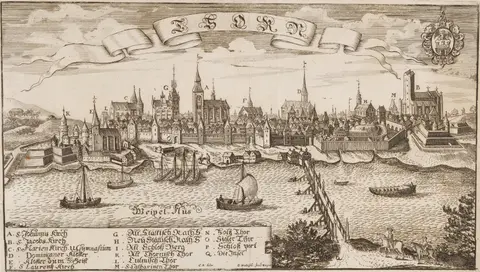
Cross the Vistula bridge early or at dusk onto Kępa Bazarowa island to take in the uninterrupted medieval skyline without foreground traffic. Gothic brick church towers, Town Hall spires, ceramic-tiled roofs and fortified city gates rise behind the curtain walls, just as Christoph Hartknoch engraved Toruń in seventeenth-century panoramas. Spend unhurried mornings wandering Old Town gingerbread bakeries and walking between the Old Town Market and the 1264 New Town craft square before afternoon tour coaches arrive. You can also explore cross-river left-bank Dybów Castle, where the 1454 Statutes of Nieszawa were proclaimed. Toruń pairs smoothly along northern Polish rail corridors with Poznań, 131 kilometres southwest. From there, continue exploring Teutonic castles and Hanseatic Brick Gothic towns inside the UNESCO World Heritage Atlas.